
When a man gives a woman a Chinese hairpin, the gesture can express affection, admiration, remembrance, or a wish for a lasting bond. In modern romantic settings, it may feel more intimate than an ordinary accessory because a hairpin is worn close to the body and carries strong associations with traditional dress. However, it is not accurate to treat hairpin-giving as a universal ancient Chinese proposal custom. Its meaning depends on the relationship, the occasion, the design, and the words that accompany the gift.
簪 / 发簪
Zān / fàzān
Secures and decorates hair
Affection, respect, remembrance
Table of Contents

What Does It Mean When a Man Gives a Woman a Hairpin?
The most reasonable interpretation is personal rather than automatic. A thoughtfully chosen hairpin can say, “I notice your style,”“I value our relationship,”or “I hope you will remember me.”Because traditional hair ornaments are visually associated with intimacy, grooming, and carefully arranged dress, the gift can feel romantic when exchanged between partners.
Meaning becomes clearer through context. A private gift accompanied by affectionate words is different from a souvenir presented to a colleague, a costume accessory exchanged among friends, or a family heirloom passed to a younger relative. The giver's intention and the recipient's understanding matter more than a supposedly fixed code.
Is Giving a Hairpin the Same as Proposing Marriage?
No. There is no reliable basis for saying that every man who gave a woman a hairpin in historical China was formally proposing. Traditional marriage was shaped by family negotiations, betrothal arrangements, ritual exchanges, local customs, and social status. These practices also changed across time and place.
Hairpins could certainly participate in courtship, betrothal, dowry, wedding dress, or the exchange of keepsakes. Literary stories and modern period dramas often use a hairpin as a compact visual symbol of love or fidelity. That narrative convention is emotionally meaningful, but it should not be mistaken for a universal legal or ritual formula.
A Brief History of Chinese Hairpins
Hairpins in China have a very long material history. The Metropolitan Museum of Art holds a carved bone hairpin dated to the Shang dynasty, around the thirteenth to eleventh century BCE. Such early objects show that pins were already practical and decorative items long before later romantic interpretations developed.
Over the centuries, artisans worked in bamboo, bone, bronze, gold, silver, jade, pearls, gemstones, enamel, filigree, and other materials. Forms ranged from restrained single pins to elaborate ornaments with flowers, birds, phoenixes, insects, pendants, and trembling components. Court, elite, urban, rural, and regional styles were not identical.
Hairpins were also not exclusively female objects throughout Chinese history. Men in some periods used pins in connection with bound hair, headgear, or formal dress. The modern assumption that every historical hairpin was a woman's romantic ornament oversimplifies a much broader material tradition.

Hairpins, Adulthood, and the Ji Li Ceremony
The hairpin is closely associated with the traditional female coming-of-age ritual known as ji li (笄礼). Classical ritual texts connect the insertion of a ji with recognition of a girl's new social status. The often-cited passage “a girl, at fifteen, is hairpinned”comes from the Book of Rites, although historical practice was more varied than a single sentence suggests.
This ritual association helps explain why hairpins can carry ideas of maturity, dignity, responsibility, and transition. It does not mean that a hairpin from a boyfriend repeats the historical adulthood ceremony. The same object type can acquire different meanings in ritual, fashion, family life, literature, and romance.
Hairpins in Love, Betrothal, and Marriage
In romantic interpretation, a hairpin can work as a keepsake: a durable object worn close to the head, seen in the mirror, and remembered whenever the hair is arranged. A man may choose one to express admiration or exclusivity, and a couple may treat it as a private symbol of commitment.
Marriage-related meaning is often strengthened by the ornament itself. Ming and later hairpin designs include motifs that researchers connect with marital harmony, fertility wishes, prosperity, and longevity. Wedding use, however, depends on the complete design and documented context—not merely on the object being a hairpin.
Modern media has amplified this symbolism. Historical dramas frequently show a man buying, fastening, repairing, or returning a hairpin as an act of affection. These scenes draw on the intimate nature of the object and on broader traditions of exchanging personal tokens. They are useful for understanding contemporary imagination, but they are not documentary proof of one standardized ancient custom.

How Motifs and Materials Change the Message
A hairpin's design can add a second layer of meaning. These associations are common in later decorative culture, but they should still be read as conventions rather than guaranteed promises.
| Element | Common association | Gift nuance |
|---|---|---|
| Lotus | Purity, harmony, integrity | Gentle admiration or a wish for harmony |
| Plum blossom | Resilience and renewal | Respect for strength and perseverance |
| Butterfly | Beauty, transformation; in some contexts longevity | Romantic charm or a celebratory wish |
| Dragon and phoenix | Auspicious pairing and harmony | Strongly wedding-oriented in many modern settings |
| Jade | Refinement, moral virtue, preciousness | Respectful and enduring affection |
| Pearl | Luster, elegance, completeness | Formal elegance and care |
What the Gift Means in Different Situations
Usually romantic, especially with a personal note or meaningful motif.
May express continuing affection, celebration, or shared interest in traditional style.
Could be friendship or a cultural souvenir; do not assume romance without context.
Often conveys blessing, heritage, adulthood, or continuity between generations.
Price alone does not determine seriousness. A simple wooden pin selected for the recipient's taste may be more personal than an expensive ornament chosen without understanding her style. Likewise, a highly ceremonial dragon-and-phoenix design can send a stronger marriage-related message than a neutral floral pin.

How to Give a Chinese Hairpin Today
Choose according to the recipient's hair length, styling habits, metal sensitivities, and aesthetic preferences. If she does not normally wear traditional clothing, a restrained floral, wood, jade-toned, or pearl design may integrate more easily into modern outfits.
Be direct about the meaning. A short card prevents ambiguity and makes the gift personal:
- Romantic: “I chose this because its quiet elegance reminds me of you.”
- Commitment: “May this be a small reminder that I treasure what we are building together.”
- Birthday: “Wishing you beauty, confidence, and joy in the year ahead.”
- Friendship: “I thought this design suited your style and your love of Chinese art.”
Avoid claiming that the gift creates an obligation or constitutes an engagement unless both people have explicitly discussed that meaning. Cultural symbolism should enrich communication, not replace it.
Hairpin Elements in Contemporary Design
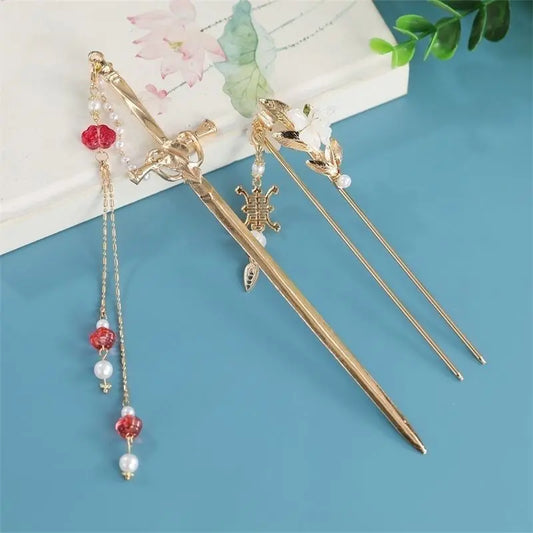
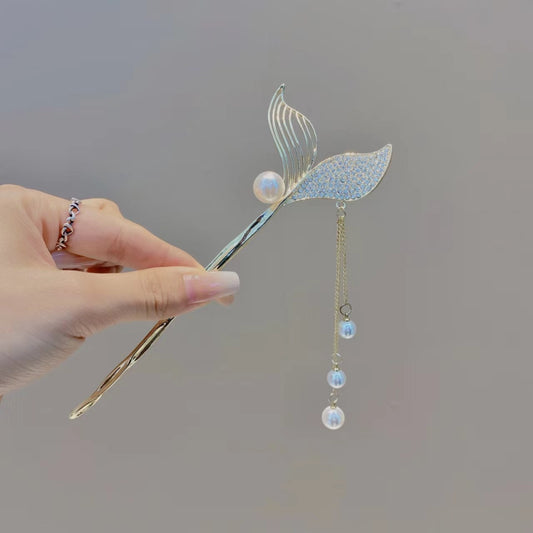
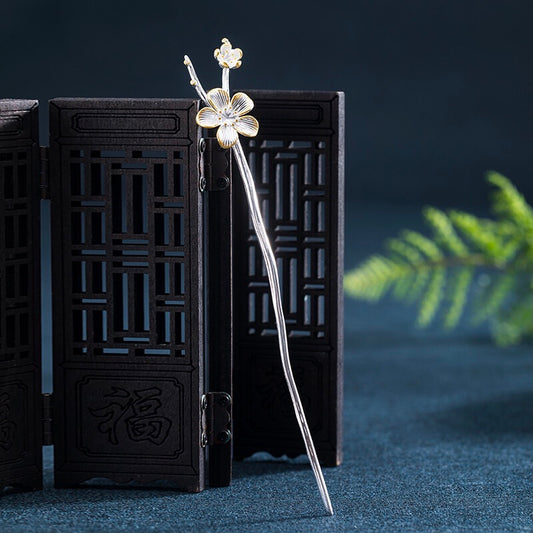
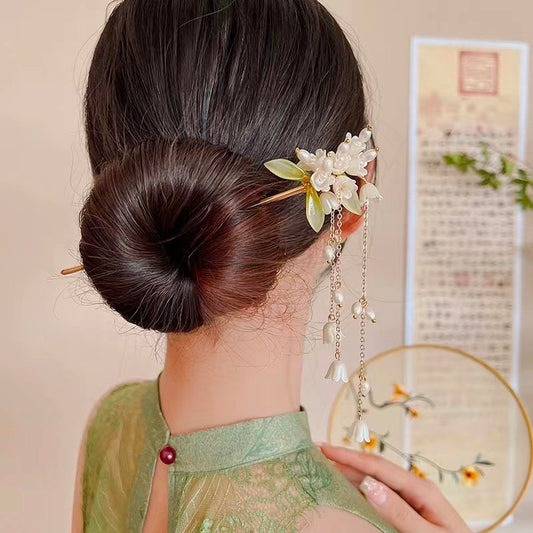
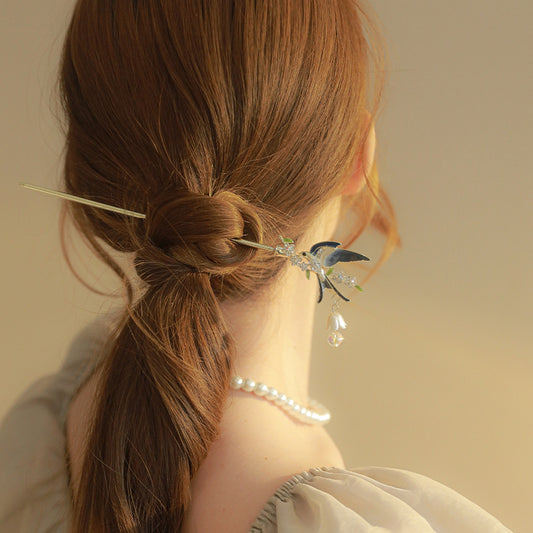
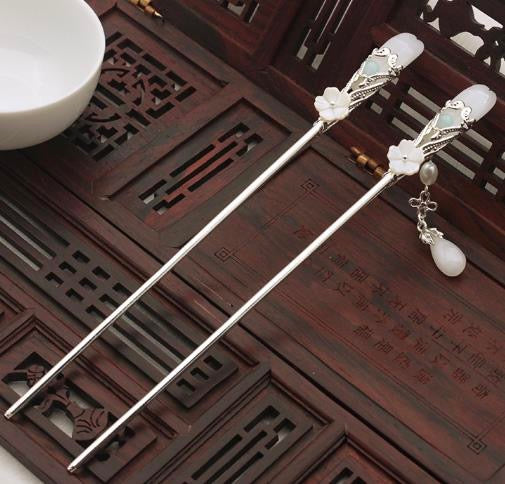
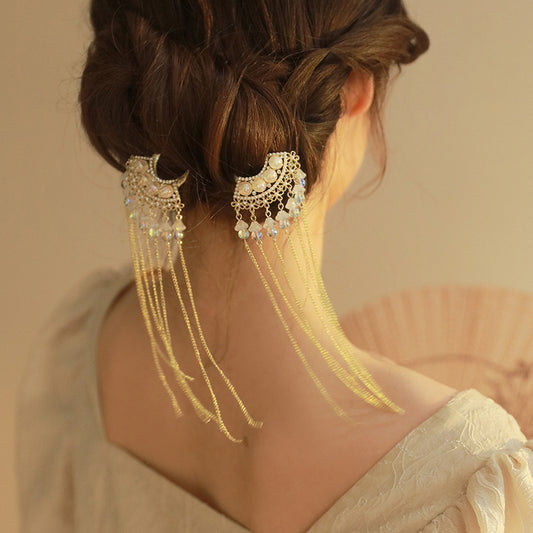
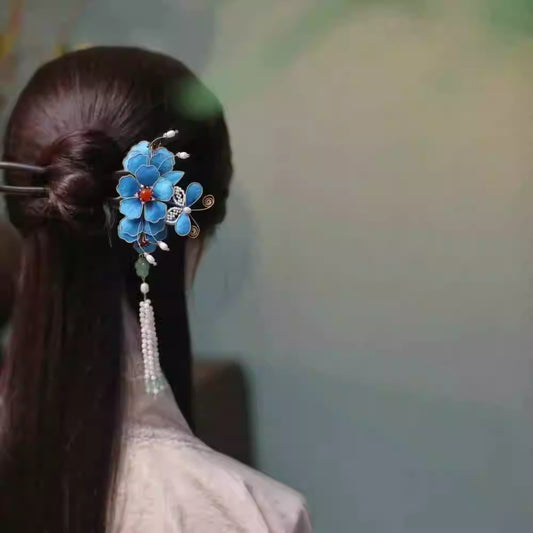
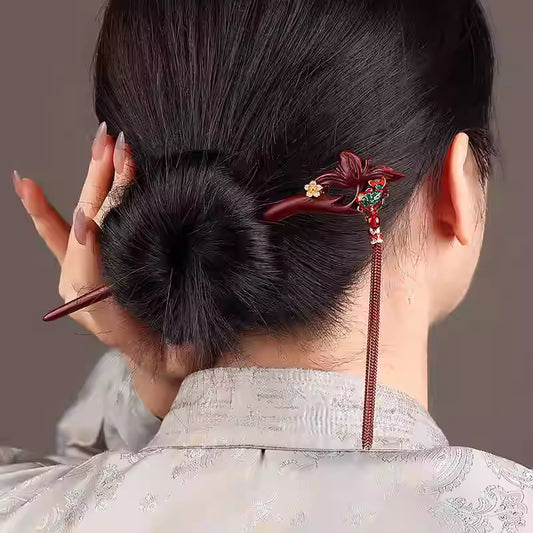
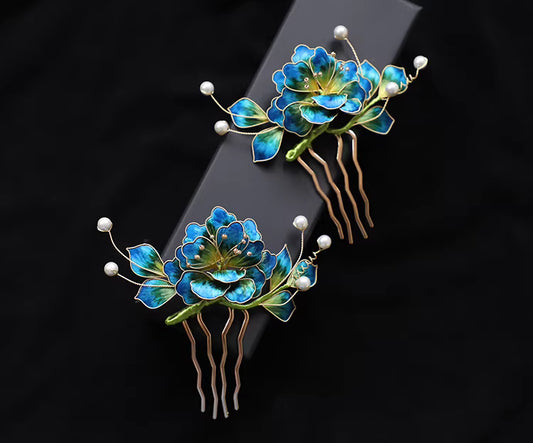
Contemporary hairpins adapt historical visual vocabulary through floral silhouettes, jade accents, pearls, tassels, and phoenix imagery. The examples below show different ways these elements can communicate refinement, resilience, or auspicious pairing; they are modern designs rather than reproductions of specific museum objects.

Phoenix, Gourd Leaves, and Jade
Phoenix imagery creates an auspicious focal point, while jade and leaves soften the composition.
$76.99 USD
Explore the Design
Plum Blossom, Butterfly, and Jade
Plum blossom suggests resilience, while the butterfly adds movement and lightness.
$76.99 USD
Explore the Design
Pearl and Dian Cui Style Details
Freshwater pearls and peacock-feather-inspired detailing create a more refined ceremonial composition.
$106.99 USD
Explore the DesignFrequently Asked Questions
What does a hairpin symbolize in Chinese culture?
Depending on context, it can symbolize grooming, maturity, status, refinement, affection, remembrance, or an auspicious wish.
Does a man giving a woman a hairpin mean he loves her?
It can be romantic, particularly between partners, but the gift alone is not proof. The occasion and accompanying words provide the clearest meaning.
Is a Chinese hairpin an engagement gift?
Sometimes couples may treat it as one, but it is not a universal or automatic engagement symbol across Chinese history.
What is the difference between ji, zan, chai, and buyao?
Ji and zan refer broadly to pin-like hair fasteners; chai commonly has two prongs; buyao has suspended elements that move as the wearer walks. Usage varies by period.
Did men wear hairpins in ancient China?
Yes. In some historical settings men used pins with bound hair, crowns, caps, or formal headwear, although styles and practices changed over time.
What motif is best for a romantic hairpin gift?
Lotus, paired birds, butterflies, or dragon-and-phoenix imagery can feel romantic. Choose a motif the recipient genuinely likes rather than relying only on symbolism.
Can I give a Chinese hairpin to someone who is not Chinese?
Yes. Present it respectfully, explain that it is a contemporary design, and avoid claiming one fixed ancient meaning.
Can short hair be styled with a Chinese hairpin?
It depends on length and texture. Shorter hair may need a smaller pin, a half-up style, or additional clips for support.
References
- The Metropolitan Museum of Art. “Hairpin, China, Shang Dynasty, 13th–11th Century BCE.”Accessed July 31, 2026.
- Palace Museum. “Silver-Gilt Butterfly Hairpin Inlaid with Jewels.”Accessed July 31, 2026.
- British Museum. “Silver-Gilt Hair-Pin with Birds and Flowers, Qing Dynasty.”Accessed July 31, 2026.
- Book of Rites (Liji), “Nei Ze.”Traditional ritual text.
- Deng Lili and Liu Xiaodan. “Application of Hairpin Pattern in Ming Dynasty in Modern Wedding Jewelry Design.”Journal of Gems & Gemmology, 2021, no. 2.
- Yang Jingqiang. Research on Zan and Chai Culture in the Wei, Jin, Southern and Northern Dynasties. Beijing Institute of Fashion Technology, 2025.

















1 comment
Wonderful Information