The tiger has a distinctive presence among the animal forms of ancient Chinese jade. Its appeal comes not only from the power of the living creature, but also from the way that power is transformed. A substantial body becomes a thin piece of jade; movement is expressed through a shifting outline; markings become carefully organized lines.
The book illustration identifies the accompanying object as a tiger-shaped jade pendant of the Spring and Autumn period. Its curved body, coiled tail, and densely patterned surface form a coherent design. At first glance, it appears still. Closer looking reveals an impression of energy held within the shape. It represents an animal, but also an understanding of materials, ornament, and visual balance.
The Jade Tiger Pendant at a Glance
| Period | Spring and Autumn |
|---|---|
| Object type | Tiger-shaped jade pendant |
| Overall form | A flat animal silhouette with an arched body, tucked limbs, and a coiled tail |
| Surface decoration | Dense incised patterns, including curling lines and geometric arrangements |
| Design focus | The balance between a forceful outline and intricate surface detail |
| Wider ornament tradition | Comparable tiger-shaped jades include paired pieces and components of composite ornaments |
1. From a Living Tiger to an Image in Jade
Tigers did not enter jade art for the first time during the Spring and Autumn period. The late Shang burial of Fu Hao had already yielded both fully sculpted and flat jade tigers. Craftspeople were exploring different ways of representing the animal long before this illustrated pendant was made.
The National Museum of China's discussion of its Shang jade tiger emphasizes selection and exaggeration in the treatment of the subject. Rather than describing every anatomical detail, a maker could concentrate on the features that conveyed a formidable animal.
During the Spring and Autumn period, tiger pendants developed varied outlines and decorative arrangements. Observation of the animal interacted with geometric design, the shape of the available jade, and the requirements of suspension.
It is therefore more rewarding to ask how a pendant establishes its character than whether it reproduces the exact proportions of a living tiger. Which features were retained? Which were transformed? How do a few distinctive shapes allow the animal to remain recognizable?
2. An Arched Back and Coiled Tail: Strength within the Outline
One of the most striking features of the illustrated pendant is the long curve running through its body. The back rises while the underside draws inward, and the limbs remain close to the torso. This makes the composition compact without making it lifeless.

The design does not need widely extended legs to suggest movement. Instead, its curves create an impression of readiness. The animal's strength seems compressed into the outline, as though a larger body had been gathered into a smaller space.
The tail introduces another change of rhythm. The broad movement of the torso passes into a tighter coil, leading the eye from an expansive curve toward a concentrated ending. Head, body, and tail become connected stages of one design rather than separate features.
This effect need not be assigned to a fixed narrative. The pose may suggest advancing, crouching, or remaining alert, but those are ways of describing a visual response. The pendant's achievement is to preserve a sense of life without requiring a complete scene around the animal.
3. Dense Decoration: More than an Animal's Markings
Once the eye has followed the outline, the surface patterns begin to attract attention. The illustration shows curling, turning, and repeated lines that distinguish parts of the body while creating changes of direction and density across the jade.
Some lines appear to follow the movement of the animal. Others establish smaller areas of repetition, giving the broad torso an internal rhythm. The surface is not simply filled: its details help organize the way the object is seen.
These patterns should not all be understood as literal copies of a tiger's coat. Natural features have been transformed into a decorative language. The Palace Museum's collection entry for a different Spring and Autumn jade reclining tiger describes distinct incised patterns on the body and limbs. It provides a useful comparison for the relationship between structure and decoration, rather than an identification of the pendant illustrated here.
Successful density does not obscure the whole. From a distance, the silhouette remains clear; at close range, the patterned surface offers further detail. Both ways of looking contribute to the object's appeal.
4. Fine Decisions within a Thin Piece of Jade
A flat jade pendant may look light and compact, but its manufacture involves decisions about both appearance and material. The body must remain continuous, the turn of the tail must be clearly defined, and the areas around any perforations must suit the object's construction.
These challenges cannot be solved by adding decoration alone. A maker has to coordinate the outline, thickness, openings, edges, and surface treatment. What looks effortless in the finished shape depends on the relationships between those elements.
An important feature of traditional jade working is the use of abrasives with tools to shape the stone, rather than simply cutting it as one might carve soft wood. A University of Chinese Academy of Sciences report on ancient jade-working research discusses shaping, drilling, decorating, and polishing, together with the importance of studying surviving tool marks.
The precise manufacturing sequence of an individual pendant requires examination of the object itself. Even without reconstructing every step, however, we can appreciate the care involved in connecting its curves and arranging its details. Refinement is present not only in conspicuous patterns, but also in the small decisions that hold the entire design together.
5. From One Pendant to an Arrangement of Ornaments
Today, the word pendant often suggests a single ornament hanging from a cord or chain. Ancient personal adornment could involve more complex arrangements, in which the role of an individual piece depended on its connections to others.
Henan Museum's study of Spring and Autumn tiger-shaped pendants discusses examples from several burials, including paired pieces and components of composite jade ornaments. Animal-shaped pendants could be combined with differently shaped jade elements and beads rather than always being worn alone.
This gives perforations particular significance. A hole may help determine the direction in which a piece hangs, its point of connection, or its balance within a larger arrangement. Such practical details can be essential to understanding the design.
Within a composite ornament, the tiger's outline would participate in a broader composition. Curving bodies, coiled ends, and descending strands could establish relationships across different directions. Thinking about these possibilities takes us beyond admiring an isolated carving and toward considering how ornaments helped organize a person's dressed appearance.
6. Authority and Identity: Why Give a Pendant the Form of a Tiger?
A tiger readily suggests strength, courage, and alertness. Jade introduces a different visual and tactile character: a surface that can appear calm, refined, and smooth. Bringing the two together creates a compelling contrast. The image is forceful, yet the object need not seem rough or aggressive.
Against the background of Zhou-period dress and ritual, personal jade ornaments cannot be understood only as expressions of individual taste. Access to materials, skilled work, and elaborate arrangements could also relate to the social circumstances in which they were used.
Nevertheless, a tiger pendant alone does not establish that its wearer was a military figure or held a particular rank. Animal imagery, an object's function, and its owner's identity do not form a simple equation.
The same care is needed when considering symbolism. Later associations between tigers, protection, and the warding off of harmful influences belong to the wider history of the image. They should not become the sole explanation for every early jade tiger. Understanding a particular object requires attention to its period, use, and archaeological setting.
7. How to Appreciate a Jade Tiger Pendant
Begin by setting aside the fine surface patterns and looking at the complete outline. Follow the distance between back and underside, the transition from head to body, and the way the tail responds to the larger curve of the torso.
Then examine the gaps and changes of direction around the limbs. Solid jade and open space work together: an opening may separate two features while helping them remain part of a unified animal shape.
Only after this should the smaller lines take center stage. Notice which patterns emphasize direction, which establish repetition, and which help a head or joint emerge from the surrounding decoration. Their effectiveness depends on placement as much as complexity.
Color also needs careful interpretation. The material itself, changes during burial, lighting, and printing can all affect a book illustration. Rather than identifying jade solely from its apparent shade, a sound starting point is the object's form, lines, and composition.
Tiger-Themed Jewelry to Explore at Chinese Showcase
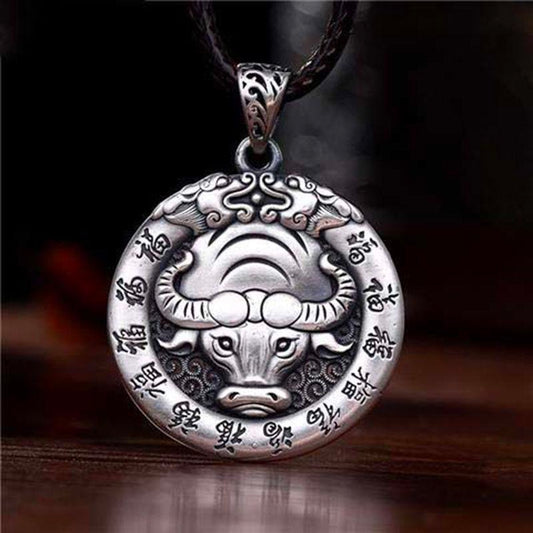
These contemporary pieces offer different interpretations of the tiger motif in pendants and rings. They are modern metal jewelry, not ancient jade artifacts or replicas of the illustrated pendant.

Green-Eye Silver Tiger Pendant
A 925 silver pendant with green eye accents and a richly detailed tiger face, offering a bold modern interpretation of the animal motif.
View product details
Hollow Brass Tiger-Head Ring
A gold-tone brass ring with hollow tiger-head details and an adjustable open design, translating the animal's features into a graphic form.
View product details
Sculptural Tiger-Head Ring
An expressive tiger-head ring with textured facial details and an adjustable opening, selected for its sculptural approach to a familiar subject.
View product detailsFrequently Asked Questions
What is a jade tiger pendant?
It is a jade ornament shaped as a tiger and made for suspension. Individual examples vary in outline, decoration, perforations, and how they were combined with other ornaments.
What is distinctive about the illustrated pendant?
Its arched body, closely held limbs, coiled tail, and dense incised patterns create an impression of energy within a compact, flat form.
Were tiger-shaped jades always worn as individual necklaces?
No. Comparable finds include paired pieces and elements of composite ornaments. Excavation records, perforation positions, and wear help clarify how a particular example was used.
Does a tiger pendant prove that its wearer was a military figure?
No. An animal motif alone cannot establish a person's occupation or exact rank. Interpretation needs the object's archaeological setting and associated evidence.
Can the jade's source be identified from the book illustration?
No. Printed color and visible form are not enough to establish geological origin. Lighting, printing, and changes to the material can all influence the image.
Are the recommended products jade or archaeological reproductions?
No. They are contemporary tiger-themed metal jewelry, selected for their shared animal subject. Their materials and designs differ from those of ancient jade pendants.
Conclusion
A Spring and Autumn jade tiger pendant transforms the strength of a formidable animal into an ornament that can accompany the human body. Curves, turns, and patterned surfaces create presence without relying on size, while a compact shape retains an impression of life.
Its enduring appeal lies in the balance between force and refinement, compression and movement, function and decoration. Across the centuries, the pendant preserves more than an animal image: it reveals a capacity to observe nature, work a demanding material, and give strength an ordered, lasting form.
References
- National Museum of China. Jade Tiger. Chinese-language collection entry; title translated. Background on Shang jade tigers and the artistic use of selection and exaggeration.
- The Palace Museum. Jade Reclining Tiger with Incised Decoration. Chinese-language collection entry; title translated. A comparative Spring and Autumn example, distinct from the pendant in the accompanying illustration.
- Henan Museum. Green Jade Tiger-Shaped Pendants. Chinese-language collection study; title translated. Comparative discussion of tiger forms, paired pendants, and composite jade ornaments.
- University of Chinese Academy of Sciences, School of Humanities. Ancient Jade-Working Techniques and Research Examples, lecture report, 2021. Chinese-language report; title translated. Background on manufacturing processes, abrasives, and the study of tool marks.