Among the animal forms found in ancient Chinese jade, the deer has a particularly quiet presence. It does not depend on the force of a tiger or the fantastic body of a dragon. A lifted head, branching antlers, an attentive ear, and a few carefully placed curves are enough to suggest a living creature.
Western Zhou deer-shaped jade pendants reveal how observation could become ornament. Their makers translated the proportions and movements of an animal into a small, flat object, combining a recognizable silhouette with the restrained beauty of worked jade. Looking closely at these pieces means looking at both an ancient animal image and a design intended to accompany the human body.
Western Zhou Jade Deer Pendants at a Glance
| Period | Western Zhou |
|---|---|
| Object type | Deer-shaped jade pendants |
| Subject | Deer shown in profile, with prominent antlers and bent legs |
| Design approach | A clear, silhouette-like outline with selective incised detail |
| Details to notice | The branching antlers, neck, back, abdomen, leg shapes, and spaces between them |
| Historical perspective | Early animal imagery should be distinguished from later auspicious interpretations of the deer |
1. From a Living Animal to an Image in Jade
The deer was not a new subject in the Western Zhou. Earlier jade traditions had already explored animal forms, and Zhou craftspeople inherited a visual vocabulary that they could adapt. What makes many jade deer compelling is not the invention of a subject, but the precise selection of its most recognizable features.
Standing, resting, and turning poses could produce quite different impressions. The line of a neck might suggest alertness; folded legs could make a compact, settled body; antlers could extend a small ornament well beyond the outline of its torso. These are not interchangeable details. Together, they determine how the animal appears to occupy space.
The National Museum of China's comparative discussion of jade deer mentions Western Zhou examples from Rujiazhuang at Baoji. Flat forms, spare body decoration, and curved lines that articulate the animal's structure are important features of that tradition. Such comparisons help us understand a broader approach to animal design without identifying every similar-looking pendant as the same excavated object.
2. The Power of the Silhouette: Saying More with Less
The two deer in the accompanying illustration rely above all on their outlines. Their bodies are broad enough to feel substantial, yet the thin projections of their antlers and the bends of their legs keep them from becoming simple blocks. The eye reads the animal before it begins to examine the surface.

A curved back, a tucked abdomen, and the transition from chest to neck carry much of the design. Small changes in those lines affect the apparent weight and balance of the whole creature. The open spaces beneath an antler or between a leg and the body matter as much as the solid areas around them.
Incised lines can then clarify a feature without competing with the outline. Instead of covering the body in dense decoration, a maker could allow a few marks to indicate an eye, a limb, or a turn in the form. This is selective description: enough information to make the animal convincing, but not so much that the design loses its unity.
That restraint should not be mistaken for a lack of skill. Reducing a living creature to a handful of coherent shapes requires judgment. The challenge is to preserve recognition and character while leaving out almost everything else.
3. Antlers and Posture: Life within a Still Form
The antlers create an immediate contrast with the compact body. Their branches reach into the surrounding space, turning the area above the head into an active part of the composition. In the larger brown deer, the wide spread of the antlers is especially striking beside the rounded mass of the torso.
Posture adds another kind of movement. A turning neck can interrupt the body's direction and lead the viewer's eye back across the object. Baoji Bronze Museum's Western Zhou jade deer looking back offers a useful comparative example: a distinctive head position and branching antlers give a spare animal form a strong sense of presence.
It is tempting to describe a deer as listening, pausing, or watching something beyond the image. These are useful ways of expressing our visual response, not fixed stories established by the artifact. The achievement of the design lies partly in that openness. A stationary pendant can suggest attention and movement without depicting an entire scene.
4. Fine Craftsmanship on a Small Scale
A small pendant presents practical problems as well as artistic ones. Slender antlers must remain legible without becoming unnecessarily fragile. Edges must support the overall shape, and any perforation must work with the way the object is suspended. Surface finishing and fine lines need to belong to the same design rather than look like separate stages.
Traditional jade working depended extensively on abrasion. The Palace Museum's explanation of jieyu sha, or jade-working abrasive, describes hard mineral particles used with tools to grind jade. This helps explain why shaping, opening spaces, and finishing a compact animal form involved controlled and patient work.
General knowledge of jade working does not, however, establish the exact tool sequence for each pendant. That requires close study of surviving marks and surfaces. From an illustration, we can appreciate the demands of the design, while microscopic evidence is needed to reconstruct an individual maker's methods.
The refinement is therefore not confined to visible decoration. It is also present in the relationships between projections and body, solid jade and open space, delicate appearance and structural stability.
5. A Pendant in Relation to the Human Body
The word pendant reminds us that these objects were not conceived only as images for a display case. Threading and suspension brought them into a relationship with clothing, movement, and the wearer. An animal shape that looks balanced on a page might sit or move differently when hung from a cord.
Perforation positions, wear around holes, and archaeological placement help researchers investigate such uses. A deer-shaped jade might have functioned as an individual ornament or within a larger arrangement, depending on the example. We should not assume that every piece was worn as a modern necklace, or that an object found in a tomb existed only for burial.
Material and skilled labor also gave jade ornaments value. Yet a single animal pendant cannot establish its owner's precise rank, gender, or personal beliefs. Those questions depend on associated finds, burial evidence, and wider comparisons. The object is most revealing when its beauty and its context are considered together.
6. From Deer Calls to Good Fortune: Meanings Change over Time
Deer acquired rich associations in Chinese art and literature. The poem Luming, often translated as The Deer Call, in the Book of Songs places the image of calling deer alongside hospitality and the reception of guests. It demonstrates the expressive possibilities of the animal in early literature, but does not prove that a particular jade pendant illustrates the poem.
Later auspicious imagery developed further connections. The word for deer, lu, sounds like a word associated with official emoluments and prosperity. Deer also appear in later imagery connected with longevity. These familiar meanings can enrich our understanding of later Chinese design, but they should not automatically be projected back onto a Western Zhou ornament.
Liangzhu Museum's discussion of deer imagery is helpful in keeping these layers distinct. An animal motif can have a long history while its meanings and settings continue to change. For an early jade deer, observation, ornament, social use, and beliefs may have interacted in ways that cannot be reduced to one modern phrase such as “wealth” or “long life.”
Recognizing that difference does not diminish the pendant. It allows us to encounter an early image on its own terms, before surrounding it with every later interpretation of the same animal.
7. How to Appreciate a Jade Deer Pendant
Begin with the complete silhouette. Follow the head into the neck, across the back, and down toward the legs. Then compare the broad body with the branching antlers. Notice where a smooth curve becomes an angle, and where a gap separates two parts without breaking the unity of the animal.
Next, look at the smaller decisions: a line around the haunch, a small eye, a sharply defined ear, or the narrow space beneath an antler. Their effectiveness comes from their placement, not their quantity. A few details can direct attention more clearly than an evenly decorated surface.
Finally, distinguish what the image shows from what it cannot establish. Gray and brown tones in a printed illustration may reflect the material, changes during burial, photography, lighting, or printing. They do not by themselves identify the original color of the jade, its geological source, or a precise deer species.
This way of looking combines pleasure with care. We can respond to the animal's apparent liveliness while remembering that archaeological interpretation asks different questions from visual appreciation.
Deer and Jade Pendants to Explore at Chinese Showcase
These contemporary pieces offer either a deer-theme or jade-material connection to the article. They are modern jewelry, not Western Zhou artifacts or replicas of the illustrated pendants.

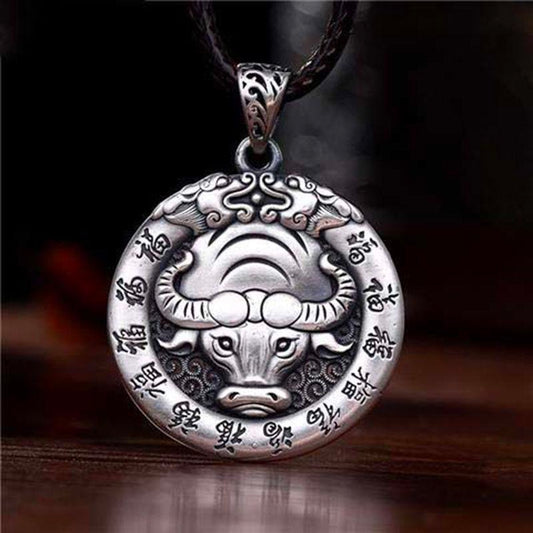
Silver Deer and Ruyi-Lock Pendant
A deer-themed 999 fine silver pendant combining a ruyi-lock outline, cloisonné enamel, and gold-tone accents. This selection connects through its animal motif rather than jade material.
View product details
Swan and Jade Teardrop Pendant
A swan motif, jade, sterling silver, and enamel accents come together in a teardrop design: a modern interpretation of an animal-themed suspended ornament.
View product details
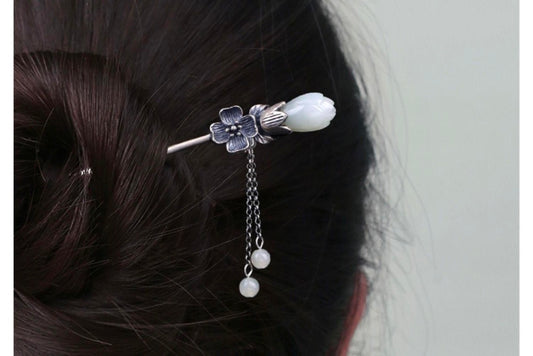
Lotus Pendant Necklace with Jade Bead
A lotus motif in 925 sterling silver paired with a jade bead, offering another way to explore the relationship between a shaped element and a suspended stone.
View product detailsFrequently Asked Questions
What is a jade deer pendant?
It is a jade ornament shaped as a deer and made for suspension. Individual examples differ in posture, antler design, surface detail, and the arrangement of their perforations.
What is distinctive about the illustrated Western Zhou deer?
Their compact profile bodies, branching antlers, bent legs, and selective incised lines make the silhouette the main vehicle of expression.
Did the Western Zhou deer already mean prosperity?
The familiar deer and prosperity wordplay belongs to a longer, changing history of auspicious imagery. It should not be assumed to explain a Western Zhou pendant without supporting evidence.
Were all jade deer worn as individual necklaces?
Not necessarily. Threading, wear, and excavation evidence are needed to determine how a particular piece was suspended or combined with other ornaments.
Can the jade's source be identified from the illustration?
No. Printed color and visible form cannot establish a stone's geological source. Material identification requires examination and suitable analysis.
Are all the recommended pendants made of jade?
No. The deer and ruyi-lock pendant is silver with enamel and gold-tone accents; it was selected for its deer motif. The swan pendant and lotus-bead necklace provide the jade connection. All three are contemporary jewelry.
Conclusion
A Western Zhou jade deer can seem simple at first glance. Closer looking reveals how much depends on a curve, a gap, or the angle of an antler. The small object becomes convincing not through exhaustive detail, but through the careful organization of its parts.
Its enduring appeal lies in that balance between restraint and life. An ancient maker observed an animal, selected what mattered, and gave those observations a lasting form in jade. Across the distance of time, the result still invites us to pause and look.
References
- National Museum of China. Jade Reclining Deer. Chinese-language collection entry; title translated. Includes comparative background on Western Zhou jade deer from Rujiazhuang, Baoji; the entry is not an identification of the two illustrated pendants.
- Baoji Bronze Museum. Western Zhou Jade Deer Looking Back, March 22, 2021. Chinese-language collection entry; title translated. A comparative example of a flat deer form with branching antlers and a turned head.
- The Palace Museum. Jieyu Sha: Jade-Working Abrasive. Chinese-language terminology entry; title translated. Background on abrasive materials used in traditional jade working.
- Liangzhu Museum. Countdown to the Exhibition, Two Days to Go: Deer Calls, December 4, 2022. Chinese-language museum article; title translated. Comparative discussion of deer imagery, early poetry, and later auspicious meanings.