The Six-Syllable Mantra, widely written as Om Mani Padme Hum, is one of the best-known mantras associated with Avalokiteshvara, the bodhisattva of compassion. In Chinese it is commonly represented by the transliterated characters 唵嘛呢叭咪吽, although other written forms also appear.
Its importance is deeper than a literal translation. Within Buddhist traditions, the mantra is used to support compassion, wisdom, ethical awareness, and attentive practice. Across China and the Himalayan world, it also became a visible cultural symbol on manuscripts, prayer wheels, mani stones, architecture, paintings, beads, pendants, rings, and bracelets.
What Is the Six-Syllable Mantra?

A mantra is a sacred formula made from words, syllables, or sounds used within a religious or contemplative tradition. The Six-Syllable Mantra is known in Sanskrit transliteration as Om Mani Padme Hum. It is also called the Mani mantra, the Six-Character Mantra, or the Six-Character Great Bright Mantra in English-language discussions of Chinese and Tibetan Buddhism.
The Palace Museum describes the Six-Syllable Mantra as a highly revered mantra in Tibetan Buddhism and gives the familiar Chinese transliteration 唵、嘛、呢、叭、咪、吽. The National Palace Museum identifies it as the six-syllable mantra of Avalokiteshvara and notes its importance in regions shaped by Tibetan Buddhist culture.
The phrase is short, but its interpretations are layered. Commentarial traditions may connect its six syllables with the six perfections, six classes of beings, forms of mental affliction, purification of body, speech, and mind, or the union of compassionate action and wisdom. These systems are related, but they are not interchangeable word-for-word translations.
How Is Om Mani Padme Hum Written and Pronounced?
English usually writes the mantra as Om Mani Padme Hum. Chinese sources use several phonetic transcriptions, including 唵嘛呢叭咪吽 and 嗡嘛呢叭咪吽. Other historical transliterations can look quite different because translators were trying to represent Indic or Tibetan sounds with Chinese characters available in their own period.
That variation does not automatically mean one object carries a different mantra. Sanskrit, Tibetan, Chinese, and English have different sound systems, and no single English or Mandarin spelling reproduces every original sound perfectly. People following a particular lineage should use the pronunciation taught in that community. Readers approaching the subject through art history can simply recognize the main forms without treating spelling differences as mistakes.
What Does Om Mani Padme Hum Mean?
A common popular rendering is “the jewel in the lotus,” but that phrase should be treated as a doorway into the symbolism rather than a complete translation. Mani means jewel, while padme is related to lotus. Om and hum function as sacred syllables and carry meanings that depend on ritual and commentarial context.
One widely used Buddhist explanation associates the jewel with method, compassionate intention, and the wish to benefit others. The lotus represents wisdom and purity, including the ability to see experience without the distortions created by self-centered attachment. Hum can then signify that method and wisdom are not separate. Study Buddhism presents this interpretation while also emphasizing that the mantra, like many mantras, has several levels of meaning.
| Component | Basic language note | Common traditional association | Practical reflection |
|---|---|---|---|
| Om | A sacred opening syllable | Body, speech, and mind; the starting point of transformation | Notice how intention, words, and actions affect others |
| Mani | “Jewel” | Compassionate method, generosity, and the wish to help | Turn goodwill into considerate action |
| Padme | “Lotus” or “in the lotus,” depending on analysis | Wisdom, purity, and insight | Respond clearly rather than from anger or attachment |
| Hum | A concluding sacred syllable | The inseparability or establishment of method and wisdom | Balance a kind heart with sound judgment |
This explanation helps modern readers understand the mantra without reducing it to a promise of supernatural results. In a traditional religious context, recitation may be accompanied by visualization, vows, ritual instructions, or guidance from a teacher. In an everyday reflective context, it can serve as a reminder to speak and act with compassion.
How Is the Mantra Connected with Avalokiteshvara?
Avalokiteshvara is the bodhisattva most closely associated with compassion. In Chinese Buddhism this figure is known as Guanyin, while Tibetan traditions commonly use the name Chenrezig. The Six-Syllable Mantra is therefore frequently described as the mantra of Avalokiteshvara or the mantra of the Compassion Buddha.
The connection explains why compassion is central to its interpretation. Reciting the mantra is not merely the repetition of an exotic sound. Ideally, it is connected with the wish that living beings be free from suffering and with a willingness to change one's own conduct. The Rubin Museum of Himalayan Art identifies Om Mani Padme Hum as one of the world's most recognizable mantras in its discussion of an Avalokiteshvara image.
In visual culture, the mantra may appear beside images of four-armed Avalokiteshvara, Guanyin, lotus flowers, prayer wheels, or other Buddhist symbols. The surrounding imagery can help identify the intended religious context, especially when the script itself is unfamiliar to the viewer.
How Did the Six-Syllable Mantra Become Part of Chinese Culture?
Buddhist ideas, texts, and images entered China through centuries of translation and exchange. Tibetan Buddhism later developed especially visible connections with the imperial court and with communities in Tibet, Qinghai, Sichuan, Gansu, Inner Mongolia, and other regions. The Six-Syllable Mantra circulated through these overlapping religious, artistic, and multilingual networks.
Chinese cultural history therefore preserves the mantra in more than one script. It may appear in Tibetan script, Chinese phonetic characters, Sanskrit-oriented scripts, Mongolian, Manchu, or multilingual arrangements. During the Ming and Qing periods, court patronage, scripture production, temple building, diplomatic relationships, and the movement of monks and artisans all contributed to the circulation of Tibetan Buddhist objects and texts.
The National Palace Museum's exhibition Om Mani Padme Hum: A Special Exhibition of Tibetan Buddhist Art used scriptures, paintings, ritual objects, and sculptures to show this broader history of translation and cultural exchange. This context matters because the mantra is not simply a decorative phrase imported into modern jewelry. It belongs to a long history of Buddhist devotion and cross-cultural art.
Where Does the Six-Syllable Mantra Appear?
The mantra appears in both sacred spaces and portable objects. Materials and functions vary, but the inscription is usually intended to keep the teaching of compassion visibly or physically present.
| Object or setting | Traditional role | Respectful modern understanding |
|---|---|---|
| Mani stones and rock inscriptions | Public expressions of devotion and accumulated prayer | Observe respectfully; do not step on or remove them |
| Prayer wheels | Hold or display repeated mantras within a devotional practice | Not merely a mechanical device for collecting luck |
| Manuscripts and calligraphy | Preserve, transmit, and contemplate sacred language | Appreciate both textual meaning and script tradition |
| Temple architecture and paintings | Integrate the mantra into a sacred visual environment | Follow local rules when photographing or entering |
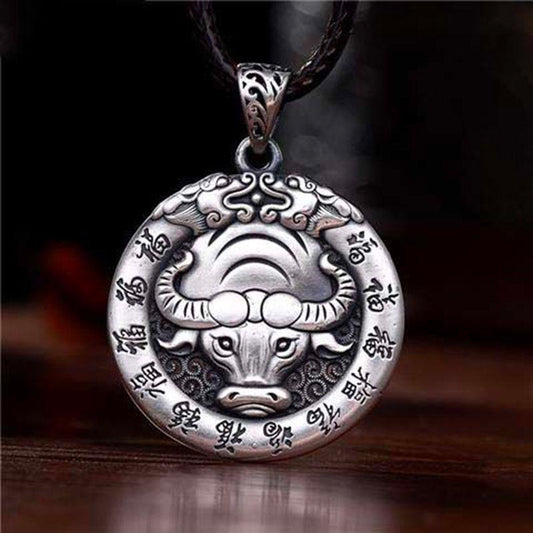
| Beads, pendants, rings, and bracelets | Keep a reminder of compassion and practice close to the body | Wear as a cultural or spiritual reminder, not a guarantee |
Why Is the Mantra Carved on Stones?
In Tibetan and Himalayan regions, the mantra is often carved onto stones known as mani stones. Stone is durable and public: an inscription can remain beside a road, village, mountain pass, or monastery for generations. The stone becomes part of a shared devotional landscape rather than a disposable souvenir.
Visitors should not climb on a mani pile, step on inscribed stones, or remove them for personal decoration. Respecting the location is more important than possessing a physical fragment of it.
Why Is It Used on Prayer Wheels?
Prayer wheels often display the mantra on the outer cylinder and may contain repeated written mantras inside. The practice belongs to a religious framework that combines movement, intention, recitation, and awareness. A wheel should therefore not be described as a device that automatically grants wishes. Its significance comes from the practice and attitude surrounding it.
Why Do People Recite Om Mani Padme Hum?
For Buddhist practitioners, the mantra may support devotion to Avalokiteshvara, cultivation of compassion, purification, concentration, and other lineage-specific practices. The Foundation for the Preservation of the Mahayana Tradition presents it as the mantra of the Compassion Buddha and discusses its benefits from within a Tibetan Buddhist faith perspective.
A cultural or secular article should distinguish religious testimony from scientific claims. People may experience rhythmic recitation as calming or focusing, but the traditional promises attached to mantra practice are matters of faith. It is more responsible to say that the mantra can support a compassionate intention than to claim that repeating it will certainly cure illness, create wealth, or prevent every misfortune.
The most grounded interpretation is behavioral: if a person uses the mantra to pause before speaking harshly, to remember someone else's suffering, or to pair kindness with better judgment, its symbolism has entered daily life in a meaningful way.
Can You Wear the Six-Syllable Mantra?
Yes. The mantra has long appeared on portable objects, and contemporary jewelry offers another way to carry it. A wearer may understand the inscription as a devotional aid, a reminder of compassion, an expression of cultural identity, or an appreciation of Buddhist art.
Respect depends less on rigid superstition and more on intention and conduct. Keep the object reasonably clean, avoid mocking or deliberately degrading the inscription, and do not use it to make exaggerated promises to other people. If a piece has been received as a formal religious object, follow the guidance of the relevant teacher or community rather than a generic internet rule.
It is also wise to remember that not everyone sees sacred writing as fashion. When wearing the mantra in a temple or giving it to a devout person, humility is better than certainty. A short explanation such as “I understand this as a reminder of compassion and wisdom” is usually more appropriate than claiming special spiritual authority.
Is It Appropriate as a Gift?
A Six-Syllable Mantra piece can be a thoughtful gift for someone interested in Guanyin, Tibetan Buddhist art, meditation, Chinese cultural symbols, or meaningful jewelry. It may communicate wishes for peace, clarity, compassion, and steadiness.
Before giving it, consider the recipient's beliefs. A clearly religious object may not suit someone who follows another faith or prefers not to wear sacred text. When in doubt, explain the symbolism first. Avoid saying that the recipient must wear it or that refusing it will bring bad luck.
Common Misunderstandings About the Six-Syllable Mantra
- It is not primarily a wealth spell. Commercial descriptions sometimes emphasize prosperity, but the mantra's central religious association is compassion.
- One English spelling is not the only possible form. Om, Oṃ, Hum, and Hūṃ reflect different transliteration choices.
- The six Chinese characters are phonetic. Reading their ordinary dictionary meanings does not translate the mantra.
- “Jewel in the lotus” is not the entire interpretation. It summarizes imagery but does not replace traditional commentary.
- Jewelry is not proof of spiritual attainment. A symbolic object can prompt reflection, but conduct gives the symbol practical meaning.
- Religious belief and historical description are different. Museums can document how the mantra was used without asking every visitor to share the same faith claims.
Six-Syllable Mantra Jewelry as Cultural Symbol Examples
The following pieces show how Om Mani Padme Hum is adapted to contemporary jewelry. They are best understood as examples of cultural and spiritual design. Jewelry should not be treated as a promise of luck or as a way to control the future.

Guanyin and Six-Syllable Mantra Pendant
This silver pendant makes the relationship between Avalokiteshvara and Om Mani Padme Hum visually explicit. It can represent compassion and mindful conduct.
View Symbol Piece
Cloisonne Six-Character Mantra Ring
The colored enamel gives sacred lettering a decorative frame while keeping the inscription close at hand as a quiet reminder of compassion and wisdom.
View Symbol Piece
Obsidian Six-Character Mantra Bracelet
This design combines the mantra with Pixiu, bringing Buddhist lettering and a Chinese auspicious creature into one contemporary cultural object.
View Symbol PieceA gentle way to read these designs: The mantra can represent compassion, the lotus can suggest wisdom and purity, Guanyin embodies compassionate response, and Pixiu belongs to a separate Chinese auspicious tradition. Combining symbols creates a modern design language; it does not guarantee a specific result.
Frequently Asked Questions
What is the Six-Syllable Mantra?
The Six-Syllable Mantra is Om Mani Padme Hum, a Buddhist mantra closely associated with Avalokiteshvara, the bodhisattva of compassion. In Chinese it is commonly transliterated as 唵嘛呢叭咪吽.
What does Om Mani Padme Hum mean in English?
Mani means jewel and padme relates to the lotus. “Jewel in the lotus” is a common short rendering, but traditional explanations go further by linking the jewel with compassionate method, the lotus with wisdom, and hum with their inseparability.
Is Om Mani Padme Hum Chinese or Tibetan?
The mantra is Sanskrit in origin and became especially important in Tibetan Buddhism. It is also known in Chinese Buddhist culture through several phonetic transcriptions and through centuries of cultural exchange.
Why are there different spellings of Om Mani Padme Hum?
Sanskrit, Tibetan, Chinese, and English use different writing and sound systems. Om or Oṃ, Hum or Hūṃ, and several Chinese character sequences can refer to the same mantra.
Is the Six-Character Mantra the same as the Six-Syllable Mantra?
Usually, yes. “Six-Syllable” refers to the sounds of the mantra, while “Six-Character” often refers to its six Chinese transliteration characters.
What does the mantra have to do with Guanyin?
Guanyin is the Chinese name for Avalokiteshvara. Because Om Mani Padme Hum is associated with Avalokiteshvara, it is often called the Guanyin mantra or the mantra of compassion.
Can anyone chant Om Mani Padme Hum?
It is widely recited, but methods and interpretations can differ by lineage. A person seeking formal practice should follow a qualified teacher, while a general reader can approach it respectfully as a reminder of compassion.
Can I wear Om Mani Padme Hum jewelry?
Yes. Many people wear it as a devotional object, cultural symbol, or reminder of compassion and wisdom. Treating the inscription respectfully is more important than following invented superstitions.
Is Six-Syllable Mantra jewelry a protection amulet?
Some wearers understand it within a protective religious tradition, but it should not be marketed as a guaranteed shield against harm. Its most grounded meaning is a reminder to cultivate compassion, awareness, and ethical conduct.
Is a Six-Syllable Mantra gift appropriate?
It can be thoughtful for someone interested in Guanyin, Tibetan Buddhist art, meditation, or meaningful jewelry. First consider the recipient's beliefs and avoid pressuring them to wear a sacred symbol.
Should I remove mantra jewelry in certain situations?
There is no single universal rule for every wearer. Keep it reasonably clean, avoid deliberate disrespect, and follow the guidance of your own religious community if the piece is used for formal practice.
Does Om Mani Padme Hum bring money or good luck?
Its central Buddhist meaning concerns compassion and wisdom, not guaranteed wealth. Auspicious commercial language should be understood as cultural interpretation rather than a factual promise.
Final Thoughts
Om Mani Padme Hum is short enough to fit on a ring, yet large enough in meaning to connect language, devotion, ethics, art, and cultural exchange. Its jewel and lotus imagery invites reflection on compassionate action and clear understanding. Its association with Avalokiteshvara places concern for suffering at the center.
In China, the mantra became part of a multilingual Buddhist landscape rather than a single isolated tradition. It can be encountered in museums, temples, manuscripts, stones, prayer wheels, and contemporary jewelry. Understanding that background allows us to appreciate the design without turning it into a simplistic promise of luck.
Whether the mantra is recited, studied, displayed, or worn, its most responsible modern message is straightforward: let compassion guide intention, let wisdom guide action, and let respect guide the way a sacred symbol is used.
References
- The Palace Museum: Six-Syllable Mantra
- National Palace Museum: Om Mani Padme Hum, A Special Exhibition of Tibetan Buddhist Art
- Rubin Museum of Himalayan Art: Red Avalokiteshvara
- Study Buddhism: What Is a Mantra?
- FPMT: The Benefits of Chanting Om Mani Padme Hum
Recommended Categories