Some plants are admired for their beauty; others also give shape to the qualities people hope to cultivate in themselves. In Chinese art, plum blossom, orchid, bamboo, and chrysanthemum form a particularly expressive group. A flowering branch can suggest courage, an orchid quiet refinement, bamboo integrity, and a chrysanthemum a composed independence.
Known as the Four Gentlemen, these plants bring different forms and temperaments into a shared artistic language. Their appeal lies both in the way they look and in the possibilities they offer for thinking about character. The four photographs here return that language to living plants: a vivid plum blossom, pale orchids among arching leaves, bamboo carrying snow, and a yellow chrysanthemum beneath a white covering.
Together, they invite a generous understanding of a good life. Strength can coexist with gentleness, clear principles with flexibility, and an appreciation of beauty with a steady sense of purpose.
The Four Gentlemen at a Glance
| Plum blossom | Small blossoms and strong branches; commonly associated with resilience and courage. |
|---|---|
| Orchid | Modest flowers and arching leaves; commonly associated with refinement and restraint. |
| Bamboo | Segmented stems and pointed leaves; commonly associated with integrity and flexibility. |
| Chrysanthemum | Layered petals and a rounded flower head; commonly associated with autumn and composure. |
| Shared theme | Different natural forms used to reflect on cultivated character and a considered life. |
1. Why Are They Called the Four Gentlemen?
The word gentlemen refers here to an ideal of cultivated character. The plants became a way to express personal aspirations through natural forms. Artists and viewers could recognize qualities in a branch, a leaf, or a flower that also mattered in human conduct.
The grouping developed through a history of painting and appreciation. The Palace Museum's glossary discusses Huang Fengchi's compilation of painting manuals devoted to plum, bamboo, orchid, and chrysanthemum during the Ming dynasty. The association gives four distinct subjects a common setting without erasing their individual identities.
This is not a demand that everyone express strength in the same way. Plum's resilience, orchid's restraint, bamboo's integrity, and chrysanthemum's composure can complement one another. The group offers several ways to imagine a considered and honorable life.
Nor does an ornamental arrangement need to follow a literal flowering calendar. Artists can bring branches and leaves together, reduce a flower, lengthen a leaf, or adjust their proportions to fit a particular surface. A stable theme therefore leaves room for considerable invention.
2. Plum Blossom: Courage with a Gentle Form

Plum blossom is often admired for opening while the season is still cold. Small flowers appear against firm, angular branches, creating a contrast between delicacy and strength. That relationship makes the plant a fitting image for perseverance when circumstances offer little comfort.
In the photograph, a pink-red blossom stands out against a softly blurred background. Its petals gather around a fine cluster of stamens, while the dark stem establishes a strong direction through the image. The flower feels vivid and tender rather than severe.
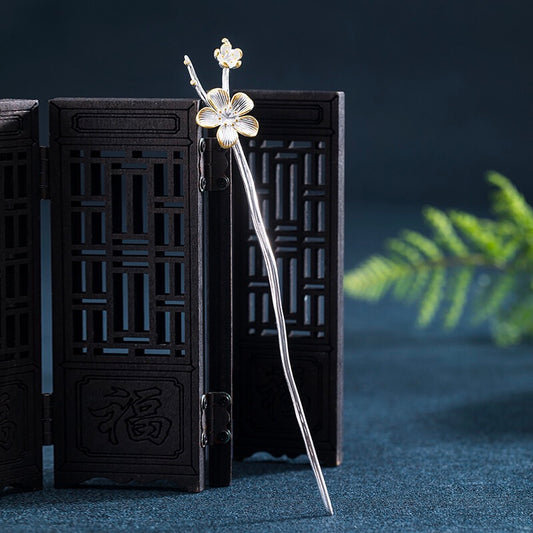
In decorative art, the blossom can be simplified into a compact five-petaled shape. A branch's changes of direction and the spacing between flowers create rhythm. Even a small motif can retain the recognizable relationship between a firm structure and a delicate bloom.
The human association need not turn courage into a refusal of softness. A person can remain determined while also being patient and considerate. The plum's visual contrast gives that possibility an especially clear form.
3. Orchid: Refinement without Display

The orchid's appeal often rests in details that reward attention. A modest flower, a gently turning petal, and a few long leaves can establish a memorable presence without filling the entire composition. In traditional appreciation, that restrained elegance is often connected with refinement and an inwardly sustained character.
The pale flowers in the photograph are framed by slender green leaves. Their light surfaces stand out against the darker background, while the leaves continue beyond the flower heads. The result feels open and spacious even in a close view.
When an orchid enters a pattern, the movement of its leaves can matter as much as the flower itself. A few arching lines lead the eye between different parts of the design. Their sweep can soften an otherwise rigid outline or give a dense arrangement a more relaxed rhythm.
Such quietness does not have to imply distance from others. It can suggest a manner of expression that is attentive and measured: occupying enough space to be present, while allowing neighboring forms to remain themselves.
4. Bamboo: Integrity and Flexibility

Bamboo has a particularly legible structure. Its stems are divided by nodes, and its pointed leaves gather into distinct groups. Upright lines and clear intervals give the plant a feeling of order, making it a familiar artistic association for integrity, self-discipline, and steadiness.
The supplied photograph places green bamboo against snow. Tall stems establish a firm vertical rhythm on the right, while branches and leaves bend across the upper part of the scene. The curved canopy and the upright stalks contribute different kinds of movement to the same view.
This relationship helps explain why bamboo can suggest both principle and adaptability. Holding a clear position does not require refusing every change. Flexibility can be part of endurance rather than evidence of its absence.
In ornament, segmented stems and pointed leaves remain effective even after considerable simplification. They can form a border, organize an open area, or balance a group of rounder flowers. Their value is visual as well as symbolic.
5. Chrysanthemum: Composure in a Changing Season

Chrysanthemums offer a different kind of richness. Many petals gather into a rounded flower head, producing a fullness that contrasts with an orchid's long leaves or bamboo's sharper outlines. Their familiar association with autumn invites thoughts of maturity, independence, and a life guided by chosen values.
In the photograph, snow rests over a yellow flower. The bright petals remain visible beneath their white covering, while dark leaves give the bloom a supporting base. The image brings abundance and restraint into close contact.
A decorative chrysanthemum can build its character through repeated petals, changes in scale, and the relationship between an open flower and nearby buds. The form rewards close looking: what first appears as a single rounded bloom gradually reveals many smaller turns and layers.
The composure associated with the chrysanthemum can be understood as an active choice. It suggests knowing what deserves one's attention and continuing to care for it, even when the surrounding world favors a different pace.
6. From Living Plants to Decorative Patterns
Bringing the Four Gentlemen into a single design is an exercise in composition. A small blossom, a broad flower head, an arching leaf, and a segmented stem each contribute a different shape. Their differences give an artist the means to create balance without making every part identical.
In a circular arrangement, the plants can follow the border, gather around a center, or overlap in several layers. An open composition allows each branch and flower to remain distinct. A denser one makes the complete outline more prominent, revealing its finer details only at close range.
Black-and-white versions make the importance of open space particularly clear. Dark areas give a design weight; narrow light lines separate neighboring forms and describe petals or leaves. A pause between branches can be as important to the result as another piece of decoration.
The photographs on this page offer useful points of comparison with such stylization. Notice the plum branch's turns, the orchid leaves' long curves, bamboo's repeated nodes, and the chrysanthemum's clustered petals. An ornamental design can select those relationships while leaving much of the botanical detail behind.
7. Bringing Their Meaning into Everyday Life
The Four Gentlemen remain approachable because their associations connect with ordinary hopes. People want courage in difficult periods, clarity amid distraction, a sense of proportion in relationships, and some calm as circumstances change.
When these plants appear on a textile, an object for the home, or a piece of jewelry, the material changes how the lines can be expressed. Metal has to account for thickness and connections; a small accessory needs a motif that remains legible at the scale of the body. Adaptation is part of the tradition's continuing life.
A related gift can also carry a particular intention. Plum may express encouragement, orchid an appreciation of refinement, bamboo respect for integrity, and chrysanthemum a wish for a more settled life. The gesture becomes personal through the recipient's character and circumstances.
These are cultural associations and expressions of care. A meaningful choice can rest on the design, the stated materials, and the sentiment shared between people, without depending on a promised supernatural effect.
Four Plant-Inspired Pieces to Explore at Chinese Showcase
Each selection below connects with one of the four plants through its stated design. These are contemporary accessories, with materials and construction that differ from one another. Explore the product pages for current details, dimensions, prices, and availability.

Blue Plum Blossom Stud Earrings
Blue enamel plum blossoms on 925 sterling silver studs offer a compact floral interpretation of the theme. Their small, clearly defined flowers connect with the plum motif discussed above.
View product details
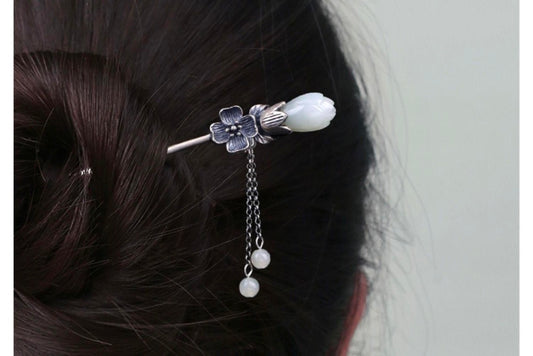
Openwork Orchid Tassel Hairpin
An orchid-inspired openwork ornament with hanging tassels brings the flower into a hair accessory. Its silver-tone finish and open spaces give the floral form a light, airy appearance.
View product details
Bamboo Node and Leaf Silver Bracelet
This bracelet is listed in 999 fine silver and combines bamboo-like segments with leaf details. The repeated nodes and small green leaves connect directly with the plant's characteristic visual structure.
View product details
Blue Chrysanthemum Hairpin
A blue chrysanthemum hair ornament in plated alloy translates a layered flower head into an accessory for an updo. The rounded petals provide a contemporary comparison with the flower's fuller form.
View product detailsFrequently Asked Questions
Which plants are the Four Gentlemen?
The group consists of plum blossom, orchid, bamboo, and chrysanthemum. In Chinese art, they provide a shared language for reflecting on cultivated character.
Why are plants described as gentlemen?
The name connects qualities admired in the plants with ideals of human conduct. Their forms offer ways to express resilience, refinement, integrity, and composure.
Do the four plants have to flower at the same time?
No. Their combination is an artistic and cultural grouping. A decorative composition can bring different plants together without describing one literal garden or a single moment in the year.
Do the photographs show historical artworks?
They show living plants. They help illustrate the natural forms from which artists can select branches, petals, leaves, and repeated structures for ornament.
How can I choose a related gift?
Look for a design that clearly connects with a plant the recipient appreciates. Check the stated materials, size, construction, and care needs, and consider the sentiment you want the gift to express.
Do these motifs guarantee good fortune?
Their meaning lies in cultural associations and personal goodwill. They can communicate a wish or a shared value without promising a particular outcome.
A Shared Language of Character
Plum, orchid, bamboo, and chrysanthemum do not need to resemble one another to belong together. Their branches, leaves, and flowers contribute different kinds of strength and beauty. In a coordinated design, each can remain distinctive while helping the whole feel complete.
That relationship is part of the Four Gentlemen's lasting appeal. They offer an image of a life with principles and room to grow: resilient without losing tenderness, refined without becoming remote, adaptable without losing direction, and composed without ceasing to care.
References
- The Palace Museum, Beijing. Five Pure Ones, glossary entry. Background on the grouping of plum, bamboo, orchid, and chrysanthemum and the related painting manuals compiled by Huang Fengchi.
- Fukuoka City Museum. The Four Gentlemen: Plants of Noble Character, exhibition introduction, No. 572. Background on the relationship between plant characteristics and cultivated character.
- Photographs supplied for this article. Visual discussion is based on the four plant photographs shown above.