The Chinese orchid pattern, often called lanhua wen, turns flowers, slender stems and arching leaves into a decorative language of integrity, refinement and quiet beauty. Its character comes not only from the blossom, but also from the rhythm of the leaves and the space around them. From ink painting to porcelain and personal accessories, the orchid offers a graceful way to connect natural form with cultivated character.

Orchid Pattern at a Glance
| Name | Lanhua wen; Chinese orchid pattern or orchid motif |
|---|---|
| Main elements | Orchid-like flowers, buds, slender stems and long, arching leaves |
| Frequent associations | Integrity, virtue, refinement, steadfastness and cultivated character |
| Common arrangements | Single plants, clumps, orchid-and-rock compositions, mixed flowers, borders and repeats |
| Decorative settings | Painting, ceramics, textiles, embroidery, fans, carving and accessories |
| Important distinction | Ancient references to lan, traditional Chinese Cymbidium orchids and modern ornamental orchids are not always interchangeable |
What Is the Chinese Orchid Pattern?
The term describes a family of plant-based designs rather than one fixed emblem. A composition may show a small flowering plant beside a rock, several clumps of leaves, or a stylized floral unit adapted to a roundel or border.
In many traditional examples, the leaves carry much of the movement. They rise, bend, cross and taper, creating contrasts between long curves and small blossoms. A flower provides a point of attention; the surrounding lines give the design its rhythm.
This makes the orchid especially responsive to its setting. On a fan, the leaves can follow the spread of the surface. On a vase, they can curve around the body. In an embroidered panel, thread direction can emphasize the relationship between the flowers and the foliage.
Does the Ancient Word Lan Always Mean an Orchid?
No. Early Chinese references to lan can refer to fragrant herbs other than the plants now classified as orchids. The Wuhan Botanical Garden of the Chinese Academy of Sciences explains that the word's botanical meaning changed over time. It is therefore misleading to treat every ancient literary reference as evidence for the same modern plant.
Traditional Chinese orchids, often called guolan, are closely associated with terrestrial Cymbidium species. Familiar cultivated groups include spring orchid, Cymbidium faberi, C. ensifolium, C. sinense and C. kanran. These should not simply be equated with every large-flowered ornamental orchid sold today.
The distinction matters when interpreting design. A modern moth-orchid ornament can be a genuine orchid-inspired design without reproducing the plant forms favored in a traditional ink painting.
History and Development: From Fragrant Plant to Decorative Motif
The orchid's cultural history connects several traditions: admiration for fragrant plants, literary reflections on personal character, the cultivation of orchids, and the painting of flowers and foliage. These strands overlap, but they should not be reduced to one uninterrupted botanical identity.
In literati painting, orchid leaves became a subject for expressive brushwork. The Palace Museum's Ming-dynasty Orchids fan leaf by Wen Zhengming offers a documented example. The museum describes the contrast between freely handled orchid leaves and the slower, firmer strokes used for surrounding thorny branches.
Such works show how a plant could become an exploration of line, movement and artistic character. Craftspeople working in other materials could draw on a related visual vocabulary while adapting it to different surfaces.
A painted orchid and an embroidered orchid need not look identical. A brush can produce a tapering leaf in one continuous gesture; stitching builds a line from thread; carving establishes the same curve through depth and edge. The motif's history is therefore also a history of translation between materials.
What Does the Orchid Pattern Mean?
Integrity and Virtue
The orchid's best-known Chinese associations include moral refinement and virtuous character. In the ideal of the junzi, or cultivated gentleman, beauty is connected with conduct rather than display alone.
An orchid motif can therefore suggest esteem for someone's character: a thoughtful presence, an upright spirit or qualities appreciated beyond outward appearance. These are cultural associations, not promises attached to an object.
Steadfastness without Ostentation
The image of a fragrant orchid growing away from public attention lends itself to the idea of maintaining one's principles without seeking applause. The Hong Kong Palace Museum also identifies virtue and steadfastness among the orchid's symbolic associations.
This is a poetic reading, not a rule that every orchid species grows in isolation or thrives in harsh conditions. Cultural symbolism should not be mistaken for a botanical description.
Elegance and Cultivation
The orchid can also express a cultivated taste for subtle relationships: a slight turn in a leaf, a small blossom against a broad area of empty space, or the balance between a plant and a stone.
That elegance need not mean an entirely pale or minimal design. A richly embroidered orchid or a brightly colored accessory can interpret the same subject in a different visual language.
Friendship and Personal Appreciation
In a gift context, an orchid-inspired object can convey admiration, respect or an appreciation of someone's refined qualities. The precise message comes from the relationship and occasion as well as the motif.
No single meaning applies automatically to every orchid image. Inscriptions, accompanying subjects, recorded titles and the object's use can all change the interpretation.
Common Forms of the Orchid Pattern
The following are practical viewing categories, not an exhaustive historical classification.
| Form | Arrangement | Design effect |
|---|---|---|
| Single plant | A compact group of leaves with one or more blossoms | A concentrated subject with room for open space |
| Orchid clump | Several overlapping plants or sprays | Layered lines and varied directions |
| Orchid and rock | Flowering foliage beside or around a stone | Contrast between flexible leaves and a solid mass |
| Orchid and bamboo | Arching orchid leaves with jointed bamboo stems | Different types of line within one composition |
| Mixed floral composition | Orchids among other flowers and foliage | Variety in scale, shape and seasonal associations |
| Roundel, border or repeat | Plant elements reorganized into a decorative unit | A pattern suited to a defined surface or edge |

Orchids with Other Traditional Motifs
Orchids and Bamboo
These plants offer a useful visual contrast. Orchid leaves tend to sweep out from a clump, while bamboo introduces jointed stems and branching foliage. Their different structures allow a maker to vary the direction and density of a design.
Orchids and Rocks
A rock gives slender leaves a substantial companion. Angular contours can interrupt the flow of the plant, and open areas between them can make the composition feel spacious.
Such a pairing does not have one universal blessing name. A more specific reading should be supported by the work's inscription or reliable collection record.
The Four Gentlemen
The orchid belongs to the familiar grouping of plum blossom, orchid, bamboo and chrysanthemum known as the Four Gentlemen. The subjects can be presented in separate paintings or panels, or brought together in decorative work.
A collection record in Taiwan's National Cultural Memory Bank describes an orchid embroidery as one panel of a Four Gentlemen set. It also records a rock and paired butterflies, showing how a named group can coexist with additional imagery.
Seasonal associations are part of the grouping's appeal, but they do not mean that all orchid species bloom only in spring.
Orchids and Butterflies
Butterflies can add movement and an auspicious layer to an orchid composition. Museum interpretations associate particular examples with good fortune, relationships or longevity.
The meaning depends on context. The embroidered panel recorded in Taiwan is interpreted partly through a longevity association, whereas other presentations emphasize different wishes. A butterfly beside an orchid is not automatically a marriage emblem.
The Orchid Pattern in Traditional Crafts
Ceramics: Drawing with Blue and White
Porcelain offers a clear setting for the interaction of painted leaves and unpainted glaze. A long blue stroke can travel across a vessel's rounded surface, while smaller flowers provide changes of scale.

The shape of a vessel influences the arrangement. A tall vase encourages upward movement; a wide cup allows leaves to spread across a lower field. Borders can separate the main plant design from the rim or base.
Orchids are not confined to sparse blue-and-white decoration. The National Museum of China's record for a famille-rose gourd-shaped vase with a profusion of flowers includes orchids among several floral subjects. A dense, multicolored design can therefore offer a useful contrast to an open composition.

Textiles and Embroidery
Thread can distinguish the plant's components through color, direction and density. Fine stitches emphasize narrow leaves; denser areas can build up a flower or rock.
The recorded Four Gentlemen embroidery demonstrates how an orchid composition can occupy a long panel, with plants, stone and butterflies distributed vertically. It is one documented arrangement rather than a template for every orchid textile.
Fans, Carving and Personal Ornaments
A fan's changing width creates opportunities for leaves to spread and turn. Carving translates similar curves into raised or recessed lines, making the relationship between plant and background tangible.
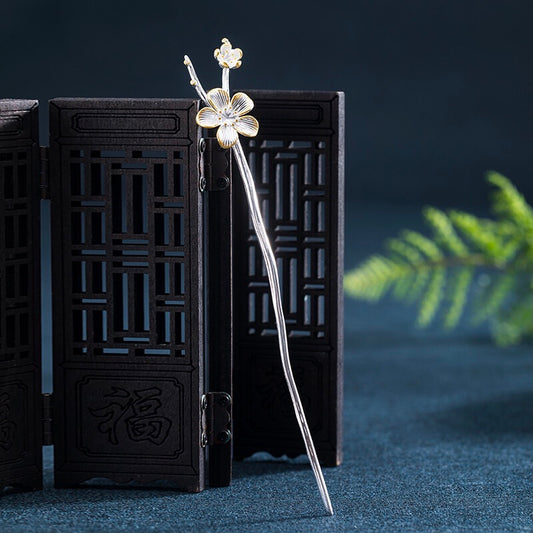
Accessories can reduce the motif to a flower, a leaf spray or a small sculptural cluster. The result may be highly stylized; the material and manufacturing details should be checked against the individual product rather than inferred from its symbolism.
How to Recognize an Orchid Motif
Look at the flowers, leaves, stems and overall growth pattern together. Long, narrow leaves are a useful clue in many traditional designs, but they are not sufficient on their own.
- Orchid versus bamboo: jointed stems and branching leaf clusters point toward bamboo; orchid foliage often emerges in an arching clump.
- Orchid versus magnolia: magnolia is a different plant. The presence of lan in the Chinese name yulan does not make it a Cymbidium orchid.
- Traditional orchids versus moth orchids: both can inform orchid designs, but they have different floral forms and should not be treated as interchangeable historical references.
- Flower shape versus identification: petal count or a single stylized blossom is rarely enough. Supporting foliage and reliable records are valuable.
Where the evidence is limited, “orchid-inspired floral design” is more accurate than a confident species identification. Likewise, a recognizable orchid motif does not establish an object's age, maker or provenance.
Orchids in Contemporary Design
A modern designer can work with several aspects of the motif: the curve of a leaf, a small cluster of flowers, a roundel, or the contrast between a delicate plant and a heavier surrounding form.
Color changes the mood without requiring a new subject. Blue and white emphasize painted line and contrast; warm metallic tones make the plant sculptural; colored fibers can create a soft, textured blossom.
Contemporary designs also interpret orchids freely. A product's orchid-inspired name is not a botanical identification or evidence that it reproduces a particular historical object.
Three Orchid-Inspired Picks from Chinese Showcase
Explore contemporary floral interpretations as wearable accents. These selections use the orchid theme in different ways; see each product page for its current specifications, price and availability.

Orchid Velvet Flower Brooch
White floral forms and long green leaves create a soft, sculptural accent for clothing.
View product details
Orchid-Inspired Open Ring
A sculptural flower and curling details translate the floral theme into an open-ring design.
View product details
Orchid Hair Stick for Buns
A pale floral ornament adds a contemporary botanical accent to a bun or twisted updo.
View product detailsFrequently Asked Questions
Does every orchid pattern have the same meaning?
No. Integrity, refinement and virtuous character are familiar associations, but the complete composition and its context determine a more specific reading.
Is a magnolia motif the same as an orchid motif?
No. Magnolia and Cymbidium orchids are different plants. Names and simplified floral shapes can cause confusion, so inspect the foliage and supporting records.
Must a traditional orchid design be pale or monochrome?
No. Orchid imagery can appear in ink, blue-and-white painting, multicolored ceramics, embroidery and richly colored ornament.
Do all orchids represent spring?
No. The orchid has a spring association within common Four Gentlemen interpretations, but flowering seasons vary between species and cultivated varieties.
Can an orchid pattern tell me how old a vase is?
Not by itself. Dating requires consideration of the vessel's form, materials, technique, marks, condition and documented history.
A Small Flower, a Rich Language of Line
The orchid pattern invites close attention. Its meaning may begin with refined character, but its visual pleasure lies in the way leaves rise and fall, blossoms interrupt a curve, and empty space gives each element room to breathe.
Whether painted on porcelain, stitched into a panel or reimagined as an accessory, the motif remains expressive through these relationships. Looking beyond the flower alone reveals how much a few carefully arranged lines can convey.
References
- Wuhan Botanical Garden, Chinese Academy of Sciences: educational articles on plants commonly mistaken for orchids and traditional Chinese Cymbidium orchids, 2014 and 2015.
- The Palace Museum: collection record for Wen Zhengming's Ming-dynasty Orchids fan leaf.
- Hong Kong Palace Museum: The Ways in Patterns, including its interpretation of orchid-and-butterfly textile decoration.
- National Cultural Memory Bank, Taiwan: embroidered Four Gentlemen panel, Orchid, collection record 17120005355.
- National Museum of China: collection record for a famille-rose gourd-shaped vase decorated with a profusion of flowers.