The Chinese plum blossom pattern, often called meihua wen, turns flowers, buds and branching stems into a decorative language of resilience, refinement and renewal. It can be a simple five-petal emblem, a freely extending flowering branch, or part of an auspicious composition with birds, pine and bamboo. Its beauty lies in the contrast between delicate blossoms and the strength of a weathered branch.

Plum Blossom Pattern at a Glance
| Name | Meihua wen; Chinese plum blossom pattern |
|---|---|
| Main elements | Blossoms, stamens, buds and branching stems |
| Common forms | Single flowers, flowering sprigs, scattered repeats, borders and roundels |
| Frequent associations | Resilience, integrity, the arrival of spring and good wishes |
| Decorative settings | Ceramics, textiles, embroidery, jewelry, carving and architectural ornament |
| Identification caution | A five-petal flower alone does not prove that a design represents plum blossom |
What Is the Chinese Plum Blossom Pattern?
The name describes a family of designs rather than one fixed emblem. Some versions follow the flower's natural appearance, showing blossoms at different angles alongside unopened buds. Others simplify petals and stamens into balanced, almost geometric shapes.
Three features are especially useful when looking at a design: the flower's structure, the movement of its branches and its accompanying imagery. Branches may stretch diagonally, curve around an object or form a repeated border. Buds and open flowers introduce variation without breaking the composition.

Five petals are a familiar convention, but double blossoms and artistic transformations also occur. Conversely, other flowers can be reduced to five-petal forms. A label, inscription or reliable object record may therefore be more decisive than petal count.
From Natural Flower to Decorative Motif
The decorative life of plum blossom is closely connected with the traditions of admiring, painting and writing about the flower. In poetry and painting, the blossom can be both a seasonal subject and an expression of personal character. Its contrast with bare or rugged branches gives artists a way to suggest gentleness without weakness.
Painting offers many compositional possibilities: a branch entering from the edge, a diagonal spray crossing an open field, or a cluster of flowers balanced by empty space. Craftspeople can translate these relationships into objects, adjusting the design to the material and the surface available.
The history of the motif is therefore better understood as repeated adaptation than as a single moment of invention. A painted ceramic surface, a stitched textile and a carved wooden panel each require different solutions. Similar subject matter does not mean identical techniques or meanings.

What Does the Plum Blossom Pattern Symbolize?
Resilience and Determination
Plum blossom is closely associated with the cold season and the approach of spring, although flowering time varies by location and variety. Its cultural image suggests the ability to endure difficult circumstances. In ornament, slender flowers against strong, angular branches can make that association visible.
Integrity and Quiet Refinement
Plum imagery can express a restrained beauty and a commitment to one's principles. A few blossoms, a bent branch and generous empty space may communicate this mood more effectively than a densely filled surface. The emphasis is on character rather than display.
Spring, Renewal and Hope
Buds and opening flowers can also suggest a fresh beginning. In seasonal decoration or a thoughtful gift, plum blossom can convey encouragement, renewal and good wishes for the future. These are cultural associations, not promises that an object will change its owner's fortune.
Five Petals and the Five Blessings
Popular explanations sometimes connect the flower's five petals with the Five Blessings. The lists and interpretations vary. A modern symbolic explanation should not be treated as the universal meaning of every historical five-petal design. For a particular object, read the surrounding motifs, inscriptions and documented context.
Common Types of Plum Blossom Pattern
| Type | Structure | Design effect |
|---|---|---|
| Single blossom | One flower with emphasized petals and stamens | A clear focal point for small objects |
| Flowering sprig | A section of branch carrying buds and flowers | Movement and a painterly quality |
| Scattered repeat | Separate flowers or short sprigs across a field | Lightness and measured spacing |
| Continuous border | Linked or repeated branches and blossoms | Rhythm along an edge |
| Roundel | Flowers arranged within a compact circular field | A self-contained decorative unit |
| Combined motif | Plum with birds or other plants | A richer narrative or auspicious theme |

These forms can overlap. A textile might use roundels as its main pattern while smaller blossoms fill the ground. The name of the flower identifies the subject; terms such as border, repeat and roundel describe its arrangement.
Plum Blossom in Auspicious Combinations
Magpies and Plum: Joy Reaching the Brow
Magpies on plum branches are a familiar auspicious combination. The bird supplies an association with joy, while the Chinese words for plum and eyebrow share the sound mei. Together they suggest happiness visibly expressed on the face. However, a stylized bird should not automatically be identified as a magpie without supporting details.
Pine, Bamboo and Plum: Three Friends of Winter
Pine, bamboo and plum form the Three Friends of Winter. Their cold-season imagery expresses steadfastness and companionship. The combination is also visually effective: pine needles, slender bamboo leaves and open plum branches offer contrasting textures.
Plum, Orchid, Bamboo and Chrysanthemum: Four Gentlemen
Plum is also one of the Four Gentlemen of Chinese painting. A set of panels or objects can give each plant its own space while maintaining a shared artistic language. One plum branch alone, however, is not a complete representation of either this group or the Three Friends of Winter.
Plum Blossom Across Materials and Crafts
Ceramics
Painting, carving and molding can all translate floral imagery onto ceramics. A branch may follow the curve of a bowl or extend around a vessel, revealing its composition as the viewer moves. Color contrast can make blossoms stand out or allow them to merge softly into the ground.

Textiles and Embroidery
On cloth, plum blossom can act as either a main motif or a quieter background. Embroidery builds petals through stitch direction and color, while weaving places greater emphasis on the structure of a repeat. The same flower can therefore have very different textures in different techniques.
Jewelry and Hair Accessories
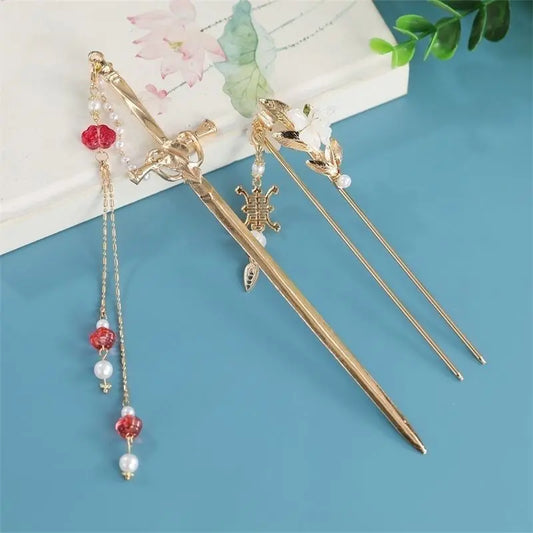
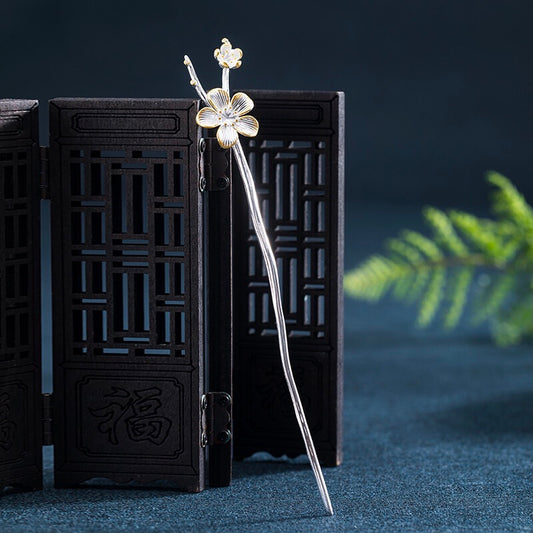
A single blossom makes a compact earring or pendant, while a branching structure adds movement to a brooch or hairpin. Beads may suggest buds, and openwork can keep a larger design visually light. The motif itself does not establish the material: metal, stone, enamel and fabric can all carry floral decoration.
Carving and Architectural Ornament
Carving translates branches into raised or pierced forms. Light and shadow become part of the design, especially when flowers and birds occupy several depths. It is useful to distinguish a plum pattern on a surface from a plum-shaped object: shape and decoration are related, but not identical.

How to Distinguish Plum from Similar Floral Motifs
Plum, peach and apricot blossoms can resemble one another after stylization. Look at the entire branch, the placement of buds, the treatment of stamens and any accompanying inscription. When evidence is limited, describing a design as a five-petal flower may be more accurate than assigning a species.
Plum and wintersweet are also different plants, even though both are associated with cold-season flowering. Their names should not be used interchangeably. Botanical identification becomes especially uncertain when a craftsperson has deliberately simplified or combined natural forms.
Using Plum Blossom in Contemporary Design
A modern design does not need to reproduce a complex historical composition. One flower can anchor a small accessory; a loose branch can organize packaging; a repeated spray can give a textile border its rhythm. Scale and spacing should suit the object.
Color is equally flexible. White, pink, ink black, deep blue and the natural color of a material can each create a different mood. The essential relationship is often between the softness of the flower and the strength of the branch, rather than a prescribed palette.
Plum Blossom Jewelry from Chinese Showcase
Explore contemporary accessories that carry the plum blossom theme into daily wear. These are shop products, not historical artifacts. Check the linked product pages for current materials, specifications and availability.
Three Picks from Chinese Showcase
Three contemporary shop selections inspired by this article’s materials, motifs, or wider decorative themes. These products are not historical artifacts. Check each product page for current specifications, price, and availability.

Hetian jade black and white cat plum blossom red agate tassel pendant
View product details
Vintage Chinese Crane & Plum Blossom Brooch – Elegant Oriental Lapel Pin for Women
View product details
2 Hotan Jade Plum Blossom 4 Pearl Hairpin - Sterling Silver
View product detailsFrequently Asked Questions
Does a plum blossom pattern always have five petals?
No. Five is a common convention, but double blossoms and decorative transformations can produce other forms.
Is plum blossom decoration only suitable for winter?
No. The seasonal background helps explain its symbolism, but the motif can be used throughout the year.
Does plum blossom symbolize love?
It can express affection in a particular context, but love is not its only meaning. Resilience, refinement and renewal are common associations.
Is every bird on a plum branch a magpie?
No. The bird's details and the design's documented context matter. A decorative bird-and-flower image should not automatically receive one fixed interpretation.
Is plum blossom jewelry a meaningful gift?
Yes. It can convey encouragement, respect or hopes for a new beginning. A personal explanation usually makes the gift more meaningful than a generic promise of luck.
Conclusion
The plum blossom pattern combines delicacy with strength. Its flowers and branches can express springtime joy, quiet integrity or determination through difficulty. Understanding it means looking beyond a list of symbolic meanings to see how shape, material, spacing and context work together.
References and Image Notes
Background references include the Palace Museum's auspicious-pattern glossary and flower-and-bird basin design record, and the National Palace Museum's collection descriptions of the Three Friends of Winter. Images were supplied for this article; selected images were digitally cleaned to remove lettering and watermarks. They illustrate visual forms and are not presented as independently authenticated historical objects.