Liangzhu jade culture was a sophisticated ritual, political, and craft system that flourished in the lower Yangtze region about 5,300–4,300 years ago (roughly 3300–2300 BCE). Its jade cong, bi, yue, rings, tubes, and ornaments were more than decoration: their controlled production and unequal placement in elite burials reveal rank, shared belief, specialist labor, and the authority of a complex early society.
| Chinese name | 良渚玉文化 |
|---|---|
| Pinyin | Liángzhǔ Yù Wénhuà |
| Recommended English | Liangzhu jade culture |
| Major sites | Liangzhu City, Fanshan, Yaoshan, Huiguanshan, Fuquanshan, and related sites |
| Key forms | Cong tubes, bi discs, yue axes, crown-shaped ornaments, trident-shaped ornaments, awl-shaped pendants, huang, rings, tubes, and beads |
| Core significance | Ritual authority, social rank, specialist production, and community identity |
What Is Liangzhu Jade Culture?
Liangzhu jade culture is the archaeological system of making, using, and depositing jade associated with the Liangzhu culture. “Jade culture” does not mean that every person wore jade or that jade had one fixed meaning. It describes a material language in which particular forms, motifs, and combinations appeared repeatedly in high-status contexts.
The scale of Liangzhu society matters. Archaeology at the Liangzhu city, its water-management system, platforms, cemeteries, and surrounding settlements shows coordinated labor and marked social inequality. Jade belonged to this wider structure. The finest pieces required scarce material, patient grinding, and exceptional control of design, while major tombs received far more jades than ordinary burials.
Discovery and Historical Setting
Shi Xingeng began excavating sites near Liangzhu in 1936. In 1959, archaeologist Xia Nai formally used “Liangzhu culture” for this archaeological tradition. Later discoveries at Fanshan and Yaoshan transformed understanding of its jades: exceptionally rich tombs revealed complete ritual sets, repeated emblems, and objects made with astonishingly fine incision.
In 2019, the Archaeological Ruins of Liangzhu City were inscribed on the UNESCO World Heritage List. The inscription concerns the whole urban and landscape system—not jade alone—but the jades are among the clearest records of its hierarchy and ceremonial life.
Major Forms: Cong, Bi, Yue, and Personal Ornaments
Cong: square outside, circular within
A jade cong is typically a tube with a circular bore and a square or squared exterior divided into registers. Some are short and broad; others rise in multiple sections. Corners can carry simplified faces or repeated versions of the deity-and-animal composition. The famous large cong from Fanshan Tomb M12 is often called the “King of Cong.”

Short, wearable cong-form rings also occur. Their square-rounded outline and central opening recall the larger ritual form, but identification must depend on size, wear, and archaeological context; not every short cong was necessarily worn as a bracelet.
Bi discs and ring-shaped jades
A bi is a flat disc with a central perforation, although proportions and finishing vary. Liangzhu burials also contain rings, bracelets, and other perforated forms. Archaeologists distinguish them through profile, hole-to-body ratio, dimensions, wear, and find context rather than by shape alone.

Yue axes and elite insignia
Jade yue axes echo working tools but are often too ceremonial for ordinary labor. Their appearance in elite graves, sometimes with elaborate fittings, links them to public authority. They may have evoked command or sanctioned force, although their exact actions in ceremony cannot be reconstructed with certainty.
Dress and body ornaments
Crown-shaped pieces, trident-shaped ornaments, awl-shaped pendants, huang, tubes, beads, and plaques were attached to the head, body, or textiles. Their placement shows that Liangzhu jade was seen in motion and in relation to the dressed body, not only as isolated museum objects.
The Deity-and-Animal-Mask Emblem
The best-known Liangzhu image combines an upper figure—often described as a deity or human-like being—with a lower animal face. The complete version can include a feathered headdress, arms, large circular eyes, fangs, and claws. On small objects, the composition is compressed into paired eyes, a bridge-like nose, and curling lines.
“Deity-and-animal-mask emblem” is a modern descriptive label. The figure’s name, story, and precise theological meaning are unknown. It may have expressed sacred authority and a shared elite identity, but calling it a particular god, shaman, or totem as settled fact goes beyond the evidence. It also should not be equated automatically with the later bronze taotie; similarities invite comparison, not identity.
How Were Liangzhu Jades Made?
Liangzhu artisans worked without steel tools or motorized machinery. They shaped very hard stone through long sequences of sawing or grooving, drilling, abrasion, grinding, polishing, and incision. Sand-sized abrasives did much of the cutting work; tools guided the abrasive and controlled pressure.
Tubular drilling helped create circular openings, often leaving diagnostic traces. Relief was established first, then sharpened with grinding and fine lines. Some incisions are so narrow and regular that magnification is needed to appreciate them. Experimental archaeology can suggest workable tool-and-abrasive combinations, but the exact material of every ancient tool remains debated.
What Stone Did Liangzhu Artisans Use?
Many Liangzhu objects are made from tremolite-actinolite nephrite, the tough, interlocking mineral material commonly called nephrite jade. Scientific studies also identify serpentinite and other visually jade-like stones in some assemblages. “Jade” in archaeology is therefore partly a cultural category; it should not be reduced to a single modern gemological label.
The locations of all quarries are not yet securely established. Variation in color and chemistry indicates multiple sources or geological zones. Jadeite—the material strongly associated with later Burmese jade jewelry—was not the standard material of Liangzhu ritual jades.
Jade, Ritual, and Political Power
The concentration of labor-intensive jades in a small number of graves is one of Liangzhu’s clearest signs of hierarchy. Cong, yue, and complex head ornaments were not distributed evenly. Their combinations likely marked different ranks or roles, while the repeated emblem helped make authority recognizable across communities.
Jade also materialized control over resources. Stone had to be selected and transported; specialists needed food and time; designs had to be shared; and finished objects were transferred into ceremonies and tombs. Each stage implies organization beyond a single household.
Yet symbolism should remain evidence-led. Later associations with universal health, guaranteed protection, wealth, or “energy” are modern or later cultural interpretations, not demonstrable functions of a Neolithic object.
Change, Region, and Influence
Early phases established core forms; mature Liangzhu contexts show stronger standardization, layered ritual sets, and highly refined emblem carving. Different sites emphasized different objects, and even similar forms vary in proportion and detail. After the decline of Liangzhu society around 2300 BCE, cong-like objects and related ideas appeared far beyond the lower Yangtze.
This broad afterlife matters, but it was not a perfectly unchanged tradition. Later communities selected, copied, reinterpreted, or collected older-looking forms for their own purposes.
How Liangzhu Differs from Similar Traditions
Modern Preservation and Cultural Legacy
Liangzhu jades are preserved through controlled excavation, conservation, museum study, digital documentation, and public education. Conservation is delicate because altered stone can be fragile even when jade appears tough. Ethical appreciation should distinguish excavated artifacts, modern replicas, interpretive illustrations, and newly made jewelry.
The lasting value of Liangzhu jade culture lies less in a single “lucky meaning” than in the society it reveals: people coordinated labor, organized landscapes, developed exacting craft knowledge, and used visual forms to negotiate relationships between community, authority, body, and the sacred.
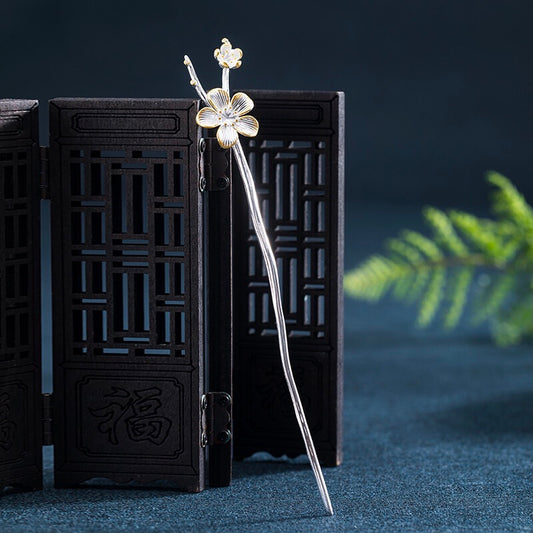
Modern Jade Designs in Cultural Dialogue
These current designs are included for their materials and visual dialogue with China’s long jade tradition. They are modern jewelry—not replicas of Liangzhu objects and not evidence of uninterrupted Neolithic symbolism.

Jade and the Magnolia Line
A study in how a hard stone can be paired with a soft floral silhouette, shifting jade from ritual form to personal ornament.

Stone, Silver, and the Orchid
The quiet contrast of pale jade and silver highlights material, polish, and the refined botanical line of later Chinese decorative art.

Jade Worn at the Wrist
A contemporary wearable composition that invites comparison with the ring-shaped and body-worn jades found in ancient contexts—without copying them.
Frequently Asked Questions
What is Liangzhu jade culture?
It is the system of jade production, ritual use, visual symbols, and social ranking associated with Liangzhu society in the late Neolithic lower Yangtze.
How old is Liangzhu culture?
It dates to about 3300–2300 BCE, or roughly 5,300–4,300 years before present.
What did a Liangzhu jade cong mean?
It clearly carried high ritual and status value, but its precise Neolithic meaning is unknown. The later “earth” explanation should not be projected backward as proven fact.
Were Liangzhu jades made of jadeite?
Usually not. Many are nephrite, while some are serpentinite or other jade-like stones. Jadeite was not the standard Liangzhu material.
Is the Liangzhu emblem the same as taotie?
No secure identity has been established. The Liangzhu deity-and-animal image predates Shang-Zhou bronze masks by many centuries.
How did artisans carve jade without modern machines?
They used repeated sawing, drilling, abrasion, grinding, polishing, and fine incision, with abrasives doing much of the cutting.
Why are some ancient jades white?
Burial alteration can make jade chalky or opaque. The white surface often developed after deposition and was not necessarily the original color.
Is a cong-form jade ring a bracelet?
Sometimes it may have been wearable, but archaeologists use size, wear, placement, and context before identifying a short cong-form object as a bracelet.
References
- UNESCO World Heritage Centre. Archaeological Ruins of Liangzhu City: Nomination and Advisory Body Evaluation, 2019.
- Zhejiang Provincial Institute of Cultural Relics and Archaeology. Fanshan: Excavation Report of the Liangzhu Culture Cemetery. Cultural Relics Press.
- Zhejiang Provincial Institute of Cultural Relics and Archaeology. Yaoshan. Cultural Relics Press.
- Liangzhu Museum. Collections and exhibition materials on Liangzhu jade. Accessed August 12, 2026.
- Zhejiang Provincial Museum. Collection and research materials on the “King of Cong.” Accessed August 12, 2026.
- National Cultural Heritage Administration of China. Materials on the Archaeological Ruins of Liangzhu City. Accessed August 12, 2026.
- Xu Lin. “Discussion on Liangzhu Tremolite Jade Materials and Their Sources.” Palace Museum Journal, 2022, no. 10.
- Journal of Gems and Gemmology. Study of serpentinite jade from the Fuquanshan site, 2024.