The Chinese Showcase journal Chinese symbols
What Does Xuanwu Symbolize? The Black Tortoise and Snake
Xuanwu, the Black Tortoise of the North, is often shown with a snake coiled around its shell. Discover what the pair symbolizes, where it appears in Chinese art, and how it relates to the Daoist god Zhenwu.

Xuanwu, the Black Tortoise, is the guardian of the north in the Chinese Four Symbols. Its traditional image shows a turtle or tortoise entwined with a snake. The emblem corresponds to the north, winter, and water. Its use as a directional guardian gives the pair an association with protection, while the tortoise also carries a wider association with longevity in Chinese culture. [1] [2] [3]
Look at the two heads in the bronze sculpture below. The tortoise lifts its chin as the snake bends down toward it. Their bodies meet at the shell, but the two animals remain recognizable. This encounter is one of the clearest ways to recognize the Xuanwu turtle-snake motif in Chinese art.
Xuanwu at a Glance
| Common English name | Black Tortoise |
|---|---|
| Traditional image | A tortoise or turtle entwined with a snake |
| Direction, season, and phase | North, winter, and water |
| Cosmological group | The Four Symbols, alongside the Azure Dragon, Vermilion Bird, and White Tiger |
| Daoist association | Zhenwu, a deity associated with guarding the north |
What Does the Name Xuanwu Mean?
Xuan can mean dark or mysterious, and wu means martial. The name is sometimes rendered as “Dark Warrior.” The more familiar English name, Black Tortoise, describes the emblem and its traditional color. In his commentary on the Chuci, Hong Xingzu explained the name by associating darkness with the north and the martial quality with the animals’ scales and armor. [2]
The name describes an image with two parts. On a painted surface, the shell is often the largest shape and the snake is a thin line curling across it. In sculpture, the snake can rise above the shell, making the second head just as prominent as the first. [4] [5]
Why Does the Black Tortoise Have a Snake?
The snake is part of the traditional emblem. A Western Han roof-tile rubbing in Taiwan’s National Museum of History shows the two animals together within a round border. The shell anchors the design, while the snake curves around it to fit the available space. A Tang tomb brick in Beijing’s Palace Museum shows the pair in a different format, with the two animals turning their heads toward each other. [4] [5]
Why these two animals came together in the first place remains an open question. As a visual reading, the low, broad shell can suggest steadiness and endurance, while the raised head and looping body of the snake suggest movement and alertness. That reading helps explain the appeal of the design. In its early cosmological setting, the pair identifies the northern quarter of the sky. [1] [4] [5]

The Black Tortoise of the North
The Huainanzi places Xuanwu in the north and links that direction to water and winter. Together with the Azure Dragon of the east, the Vermilion Bird of the south, and the White Tiger of the west, Xuanwu helped organize the sky into four sectors. The northern sector contained seven traditional lunar lodges. [1]
These directions also appear in descriptions of life on the ground. The Book of Rites places the Vermilion Bird at the front, Xuanwu at the rear, the dragon on the left, and the tiger on the right in a marching formation. On some early tomb bricks, the guardian animals frame a doorway. Placement makes a difference in both examples. The figure’s position tells the viewer which quarter or boundary it represents. [3] [6]
How Is Xuanwu Related to Zhenwu?
The name Xuanwu also has a religious history. In Daoist tradition, Zhenwu is a northern guardian deity closely associated with Mount Wudang. A Daoist scripture tells of a prince who gives up his claim to the throne to cultivate the Way on the mountain. The Forbidden City’s Qin’an Hall, dedicated to Zhenwu, shows the importance this deity later held at court. [2] [7] [8]
The animals and the deity can appear in the same composition. In some images Zhenwu is a human figure with the tortoise and snake at his feet. A sculpture with just the two animals presents the older directional emblem, which could also recall the deity in a Daoist setting. Inscriptions, neighboring figures, and the setting help establish how a work was understood. [2] [8]

How to Recognize Xuanwu in Chinese Art
Start with the shell and trace what crosses it. A snake can pass over the top, loop around a leg, or disappear behind the shell and emerge near the tortoise’s head. Follow the curve until you can see whether the artist has given it a head of its own. This is especially helpful on worn bronzes or small reliefs. [4] [5]
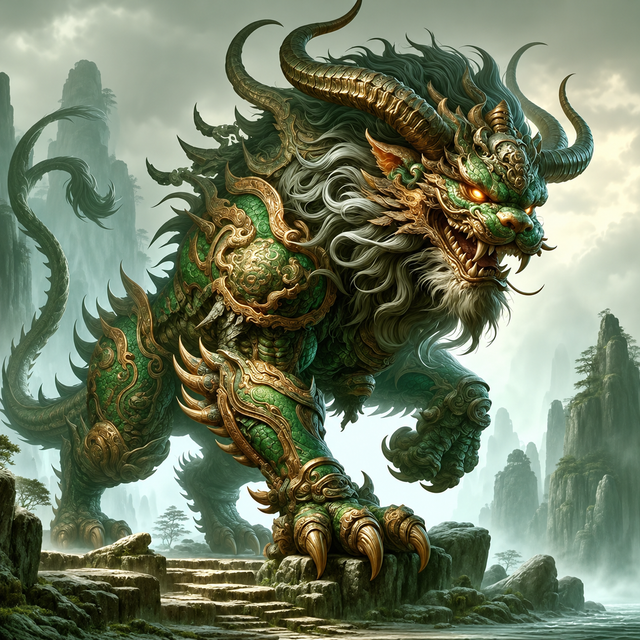
Modern fantasy art sometimes gives the tortoise a dragon-like head or places the pair in a storm. The snowy cover illustration draws on the traditional link to winter. The illustration below emphasizes water and adds horns and a dragon-like face. For comparison, the bronze and stone sculptures in this article both show the snake as a separate animal coiled around the shell.

Frequently Asked Questions About Xuanwu
What is Xuanwu the god of?
In Daoist worship, the closely related deity Zhenwu is a guardian of the north. In the older Four Symbols system, Xuanwu is the emblem of the northern sky and is associated with winter and water.
Is Xuanwu a turtle or a tortoise?
Black Tortoise and Black Turtle are both used in English. Xuanwu is a mythological emblem usually shown as a shelled animal entwined with a snake. The name identifies the motif without specifying a biological species.
Why does the Black Tortoise have a snake?
The tortoise and snake together form the traditional northern emblem. The two appear together in surviving Han-period designs. The reason the animals were originally paired is uncertain.
What does the name Xuanwu mean?
Xuan can mean dark or mysterious, and wu means martial. “Dark Warrior” reflects the words themselves, while “Black Tortoise” is the conventional English name for the emblem.
What does the Xuanwu turtle-snake motif symbolize?
The pair represents the north among the Four Symbols and is associated with winter and water. In protective settings, such as tomb entrances, it also acts as a directional guardian.
Is Xuanwu the same as Zhenwu?
The names are historically connected. Xuanwu commonly names the tortoise-and-snake emblem, while Zhenwu refers to the Daoist guardian deity often shown in human form with the two animals at his feet.
Jewelry with Turtle-Shell and Snake Motifs

Sterling Silver Turtle-Shell Bracelet
A silver turtle-shell charm echoes the patterned shell at the center of the Xuanwu design.
View product details
Fine Silver Snake Zodiac Pendant
A coiled snake is the focal point of this fine silver pendant. The product link opens the Snake option.
View product details
Xuanwu Tortoise and Snake Wide Band Ring
A sculpted snake coils around a tortoise on this silver-tone wide band, capturing the traditional Xuanwu motif.
View product detailsRelated Reading
References
- Huainanzi, “Treatise on the Patterns of Heaven” (Tianwen xun).
- Chuci, “Far Roaming” (Yuan you), with Hong Xingzu’s commentary, also cited in the Palace Museum’s reference entry on Zhenwu.
- Book of Rites (Liji), “Summary of the Rules of Propriety, Part I” (Qu li shang).
- National Museum of History, Taipei. Han Xuanwu roof-tile rubbing, collection no. 78-00016.
- The Palace Museum, Beijing. Tang tomb brick with Xuanwu design, collection no. Xin 00118946.
- National Museum of China, Beijing. Exhibition of pictorial bricks from the Hexi Corridor, 2021.
- Wondrous Scripture of Zhenwu of the North, Spoken by the Primordial Heavenly Worthy (Yuanshi Tianzun Shuo Beifang Zhenwu Miaojing).
- The Palace Museum, Beijing. Historical notes on Qin’an Hall and its dedication to Zhenwu.
Stories, symbols and everyday objects
Our journal explores Chinese culture and design. Traditions and interpretations vary by region and source. For a purchase, use the specifications on the individual product page.
About Chinese ShowcaseQuestions or corrections? Contact us ↗