The Chinese Showcase journal Chinese symbols
What Is a Taotie in Chinese Mythology?
Taotie is one of the Four Fiends in Chinese mythology and the name of an animal mask found on Shang and Zhou bronzes. Explore its links to greed, ritual vessels and the dragon’s nine sons.
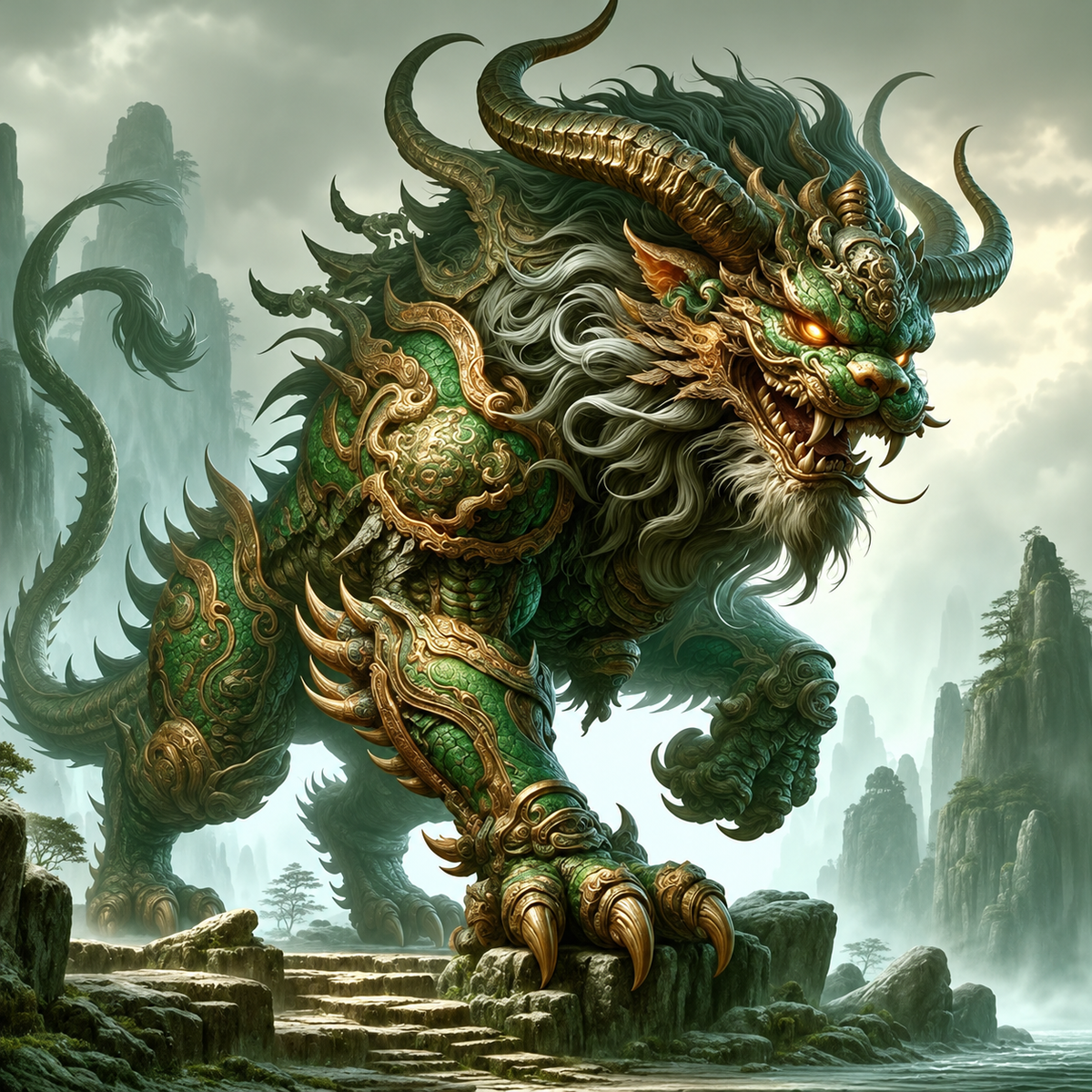
In Chinese mythology, Taotie is a figure associated with insatiable appetite and greed, and one of the Four Fiends named in the Zuo Zhuan. In Chinese art, the same word is the conventional name for the animal-face motif found on many Shang and early Western Zhou ritual bronzes. The literary figure and the bronze design have been linked for centuries. The original meaning of the bronze masks remains open to interpretation. [1] [3] [4] [5]
A modern illustration might show Taotie with a full body, a flowing mane and a mouth full of teeth. A bronze vessel gives you a different view. The eyes often dominate the design, and the rest of the animal can dissolve into a mirror arrangement of horns, jaws and scrolls. Both images help explain why the name has endured across such different works.
Taotie at a Glance
| Name | Taotie, pronounced tāo tiè in Mandarin |
|---|---|
| Meaning | A glutton or a figure associated with greed |
| Early textual sources | Zuo Zhuan and Lüshi Chunqiu |
| Mythological connection | One of the Four Fiends |
| Art-historical meaning | A stylized animal face on Shang and early Western Zhou ritual bronzes |
| Visual clues | Prominent paired eyes, a central axis and mirrored details |
Taotie and the Four Fiends
The Zuo Zhuan, in its account for the eighteenth year of Duke Wen, describes a depraved descendant of the Jinyun clan. He covets food and drink and is just as hungry for wealth and possessions. People give him the name Taotie. In the same account, Shun banishes Taotie, Hundun, Qiongqi and Taowu to the edges of the realm. Together they are known as the Four Fiends. [1]
The passage tells us what earns Taotie his name. His appetite extends from what can be eaten to what can be accumulated. Calling someone a taotie in this context singles out a greed that reaches beyond the table. The word can also describe a voracious eater.

What Does Taotie Look Like?
One influential description comes through an old commentary on the Classic of Mountains and Seas (Shanhai Jing). The northern mountains section describes a man-eating creature called paoxiao. It has a sheep’s body, a human face, tiger teeth, human hands and eyes beneath its armpits. Its cry is compared to an infant’s. The commentator Guo Pu identifies this creature with Taotie, a reading that helps explain why later retellings borrow these physical details. [2]
Contemporary artists have room to interpret that strange combination. The horned ink drawing below places a second face near the chest. The placement draws attention to a part of the body where readers might look after hearing about the unusual position of the eyes. The drawing’s long horns and extra mouth are features of this modern rendition.

Why Is the Bronze Animal Mask Called Taotie?
A passage in the Lüshi Chunqiu (Annals of Lü Buwei) describes a Taotie on a Zhou ding, a type of ritual cauldron. The figure has a head but no body. When it tries to devour a person, the harm comes back upon itself. The author treats the image as a warning, giving us an early example of someone reading the design as a lesson about excess. [3]
Centuries later, Song antiquarians used the term taotie for animal-face designs when cataloguing ancient bronzes. The name became familiar, and museum labels today use “taotie,” “animal mask” and “animal-face motif.” The Zhou vessel in the written account and the masks in modern museum cases give us evidence from different periods. The connection tells us how later people understood the design. What Shang founders and patrons originally called these faces, and what they meant to them, remains uncertain. [3] [4] [5]

How to Recognize the Taotie Pattern
Begin with the eyes. Then trace a line between them down the center of the face. On some bronzes that line follows a projecting ridge, or flange. Next compare the shapes to either side. The horns may curve in opposite directions, with a similar arrangement of brows, jaws and curls beneath them. In some examples you can also read the two halves as animal heads seen in profile, facing each other. [5] [6]
The late Shang rectangular fangding at The Metropolitan Museum of Art (49.135.2) offers a clear example of the animal-mask design. For a different vessel shape, look at the late Shang animal-mask jiao, a flared three-legged vessel, in the Palace Museum collection. Its large eyes, long horns and tusks are organized around a raised central ridge. The National Museum of China’s late Shang Taotie-patterned zun gives another example of the design on a ritual vessel. Comparing these objects helps show which features recur and how much the details vary. [6] [7] [8]
Is Taotie a Dragon?
Taotie appears among the dragon’s nine sons in some later versions of that story. The Ming scholar Yang Shen places Taotie fifth on his list. He describes Taotie’s love of food and drink and uses it to explain the figure’s placement on a ding lid. The association joins a familiar appetite to a familiar vessel. The Zuo Zhuan gives the figure an earlier role among the Four Fiends, and the list of the dragon’s sons varies by source. [1] [9]
Dragonlike horns, scales and a curled tail are common choices in modern fantasy art. Here, a watercolor uses a sweeping blue-green tail to carry the eye across the page, then brings it back to a wide, tooth-filled jaw. The creature’s appetite still drives the image, even as the artist gives it a new form.

Taotie and Animal-Motif Jewelry
A silver Taotie pendant carries the guide’s central motif. Two other pieces explore the expressive faces of the guardian lion and the tiger.


Frequently Asked Questions
What does Taotie mean in Chinese?
Taotie refers to a glutton or to a figure associated with a great appetite for food or wealth. In Chinese art, it also names a stylized animal-face motif.
What are the Four Fiends in Chinese mythology?
The Four Fiends named in the Zuo Zhuan are Hundun, Qiongqi, Taowu and Taotie. The account presents Taotie as a deeply greedy figure.
Is Taotie a dragon?
Some later stories count Taotie among the dragon’s nine sons. Early texts give Taotie a role of its own, and lists of the dragon’s sons vary.
Where did Taotie come from?
Early literary accounts include the Zuo Zhuan and the Lüshi Chunqiu. Separately, the animal masks later called taotie can be seen on much older Shang and early Western Zhou bronzes.
How do you identify a Taotie pattern?
Look for two prominent eyes arranged around a central axis. Mirrored horns, brows or jaws often frame the face, though the details vary across vessels.
References
- Zuo Zhuan (The Commentary of Zuo), Duke Wen, year 18.
- Shanhai Jing (Classic of Mountains and Seas), “Classic of the Northern Mountains,” the account of paoxiao at Mount Gouwu, with Guo Pu’s commentary.
- Lüshi Chunqiu (Annals of Lü Buwei), “Xian Shi” (“Foreknowledge”).
- The Palace Museum, Beijing. “Bronze Taotie Motifs,” discussing Song antiquarian catalogues and interpretations of the animal face.
- The Metropolitan Museum of Art. “Shang and Zhou Dynasties: The Bronze Age of China,” Heilbrunn Timeline of Art History.
- The Metropolitan Museum of Art. Rectangular Cauldron (Fangding), late Shang dynasty, 12th–11th century BCE, object 49.135.2.
- The Palace Museum, Beijing. Collection entry for the late Shang jiao with an animal-face motif, registration no. Xin 00104810.
- National Museum of China. Collection entry for the late Shang zun with a Taotie motif.
- Yang Shen. Collected Works of Sheng’an (Sheng’an Ji), “The Dragon’s Nine Sons.”
Stories, symbols and everyday objects
Our journal explores Chinese culture and design. Traditions and interpretations vary by region and source. For a purchase, use the specifications on the individual product page.
About Chinese ShowcaseQuestions or corrections? Contact us ↗