The Chinese Showcase journal Chinese symbols
Ksitigarbha Staff Meaning in Buddhist Art and Practice
Learn how a monk’s ringing staff became an emblem of Ksitigarbha’s vow to relieve suffering, and how to recognize it in Buddhist art.
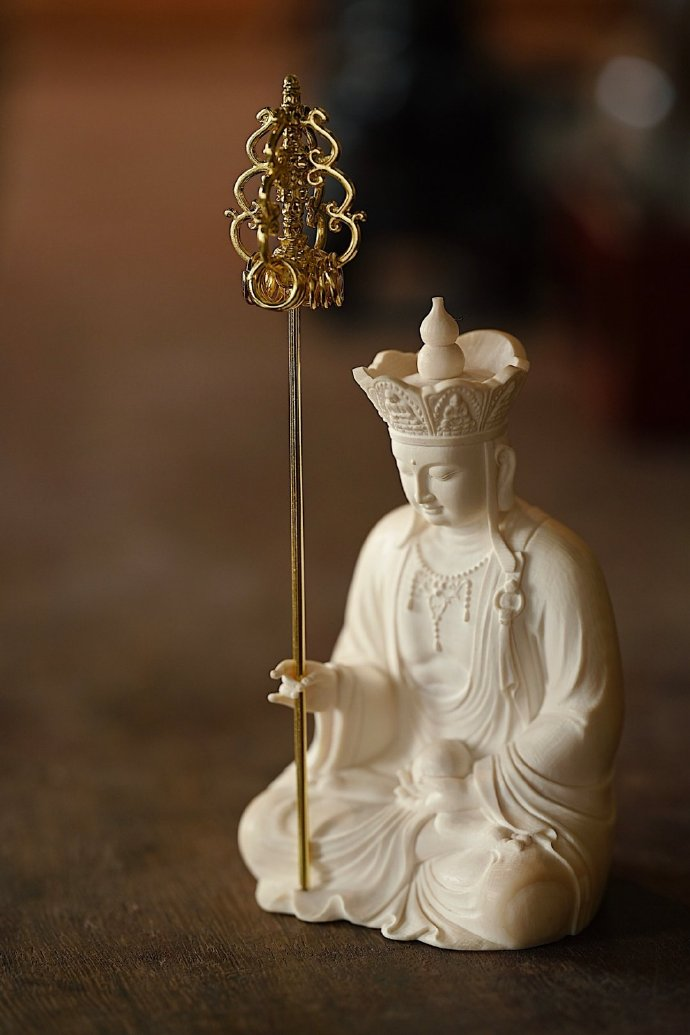
The Ksitigarbha staff is a Buddhist monk’s ringing staff called a khakkhara in Sanskrit and a xizhang in Chinese. Small rings hang from the staff head and chime when it moves. In images of Ksitigarbha, six rings can represent the six realms of existence and the reach of the bodhisattva’s compassion. [1] [2] [6]
Look first at the rings on the staff in the opening photograph. An object that seems still in a sculpture was designed to make itself heard. For a monk on the road, the sound announced his arrival. In Chinese praise verses for Ksitigarbha, the sound carries as far as the gates of hell. [1] [5] [6]
Ksitigarbha Staff at a Glance
| Buddhist name | Khakkhara in Sanskrit, xizhang in Chinese and shakujō in Japanese |
|---|---|
| Also called | A ringing staff or tin staff |
| Recognizable feature | A staff head with loose rings that strike against one another |
| Traditional use | Signaling a monk’s arrival and warning small creatures along the path |
| Six rings in art | A common reference to the six realms |
| Companion emblem | The wish-fulfilling jewel, or cintāmaṇi |
What Is the Buddhist Monk Stick with Rings Called?
“Buddhist monk stick” describes the object in everyday English. Buddhist sources call it a khakkhara. The working part is the head. Smaller rings hang from one or more larger loops, with enough freedom to move and strike each other. Some artists add a lotus, a jewel or other ornament above the loops. The blue bead in the photograph sits inside an ornate frame, while the loose rings hang lower down. [1] [8] [11]
The term tin staff refers to the Chinese name xizhang. Historical examples use several metals. The Famen Temple Museum’s Tang dynasty twelve-ring staff was made with silver and gold, and a staff head recorded by Japan’s National Institutes for Cultural Heritage is bronze. The rings and their sound are more helpful clues to the type of object than the English material name. [7] [11]

How Buddhist Monks Used a Ringing Staff
The monastic instructions appended to the Sutra on the Ringing Staff associate the staff with travel, old age and the alms round. The rings could alert small creatures in a monk’s path. At a donor’s door, the monk could shake the staff to signal that he had arrived. The instructions also ask the monk to keep the staff quiet when approaching a Buddha image and describe how to carry it when traveling with others. Both making a sound and observing silence had a place in monastic etiquette. [1] [6]
The head is the part that makes the staff recognizable when it is reproduced at a much smaller scale. A sculptor can show a hand wrapped around the shaft, a projecting loop above it, and a few suspended rings. Those details are enough to suggest the monk’s movements to a viewer looking at a motionless figure.
Why Ksitigarbha Carries a Staff
Ksitigarbha, also written Kṣitigarbha, is called Dizang in Chinese and Jizō in Japanese. The Ten Wheels Sutra praises his patience and stability by likening him to the earth, and compares the depth of his meditation to a hidden treasury. It also describes him appearing in monastic form with his retinue. The robes and walking staff in many images give the bodhisattva the familiar appearance of a person who travels to help others. [2] [3] [6]
The Sutra of Ksitigarbha’s Original Vows tells of a woman named Guangmu, who learns that her late mother is suffering in an unfavorable realm. Her wish to help her mother grows into a vow to help others facing the same suffering. The vow explains why his image is so closely associated with the rescue of beings in the realms of suffering. [4]
In a Chinese devotional verse, Ksitigarbha shakes the staff to open the gates of hell. The sutra tells the larger story of the vow, and the verse gives it a scene that worshippers can picture. The ringing that once made a monk’s arrival known becomes the sound that announces help to those in the most difficult circumstances. [4] [5]

What the Six Rings and Twelve Rings Mean
In some Ksitigarbha images the six rings stand for the six realms: gods, humans, asuras, animals, hungry ghosts and hell beings. Both the Tsz Shan Monastery Buddhist Art Museum and The Met explain the six rings in their examples through this tradition. The emphasis falls on the range of Ksitigarbha’s vow. The beings in hell belong to a larger group that also includes creatures along a monk’s path. [6] [12]
The Sutra on the Ringing Staff gives a different interpretation for its four-branched, twelve-ring design. It connects the branches with the Four Noble Truths, the teachings on suffering and the way to its cessation, and the twelve rings with the twelve links of dependent origination. The Tang staff from Famen Temple gives an example of this elaborate form in a ritual setting. The counts refer to different designs and the teachings associated with them. [1] [7]

How to Recognize the Staff and Jewel in Buddhist Art
Ksitigarbha often carries a staff in one hand and a wish-fulfilling jewel in the other. A Qing illustrated edition of the Sutra of Ksitigarbha’s Original Vows places both objects in his hands and shows the Ten Kings standing around him. In the Chinese praise verse the staff opens the gate, and the jewel shines through the darkness. Together they help identify Ksitigarbha in scenes that include several figures. [5] [8]
Some objects were made separately and could come loose. A late Kamakura gilded bronze in the National Palace Museum still holds its jewel. Its other hand is shaped as if it were gripping an object, and the museum suggests that a staff may once have been there. The National Museum of Taiwan History preserves a separate metal staff that belongs to a wooden Ksitigarbha figure. Comparing the two shows how the long shaft and the sculpted hand could fit together. [9] [10]

Jewelry with Buddhist Motifs


Frequently Asked Questions
What does Ksitigarbha mean?
Ksitigarbha is commonly rendered “Earth Treasury” or “Earth Store.” In the Ten Wheels Sutra, the bodhisattva’s patience is compared to the stability of the earth and his meditation to the depth of a hidden treasury. [2] [3]
What is the Buddhist staff called?
The ringed Buddhist monk stick is called a khakkhara in Sanskrit, a xizhang in Chinese and a shakujō in Japanese. “Ringing staff” describes the sound its loose rings make. [2] [6]
Who are the eight great bodhisattvas?
The group named in The Maṇḍala of Eight includes Avalokiteśvara, Maitreya, Ākāśagarbha, Samantabhadra, Vajrapāṇi, Mañjuśrī, Sarvanīvaraṇaviṣkambhin and Kṣitigarbha. [13]
What is the mantra of Ksitigarbha?
The Vairocanābhisaṃbodhi Sutra gives the form Namaḥ samantabuddhānāṃ, ha ha ha vismaye svāhā. Other Buddhist ritual texts transmit other forms. [14] [15]
References
- Sutra on the Ringing Staff (Dedao Ticheng Xizhang Jing), Taishō 785, including the appended instructions on carrying the staff.
- Dharma Drum Institute of Liberal Arts, Glossaries for Buddhist Studies, entry for xizhang.
- Mahāyāna Sutra of the Great Assembly on the Ten Wheels of Ksitigarbha, Taishō 411, vol. 1.
- Sutra of Ksitigarbha’s Original Vows, Taishō 412, vol. 1, account of Guangmu.
- Dharma Drum Mountain. Teaching on the praise verse for Ksitigarbha, including the staff and jewel.
- The Metropolitan Museum of Art. Jizō, Bodhisattva of the Earth Store (Kshitigarbha), Kamakura period, collection record 42589.
- Baoji Municipal Bureau of Cultural Heritage. Famen Temple Museum’s Tang dynasty gilded silver twelve-ring staff.
- The Palace Museum, Beijing. Study of the formation of the Ksitigarbha triad at Mount Jiuhua and Qing-period illustrations.
- National Palace Museum, Taipei. Standing Ksitigarbha Bodhisattva, late Kamakura gilt bronze, collection record 24699.
- National Museum of Taiwan History. Metal staff from a wooden Ksitigarbha figure, accession 2004.028.1063.0002.
- Japan Search, National Institutes for Cultural Heritage. Head of a Monk’s Staff, collection record cobas-72012.
- Tsz Shan Monastery Buddhist Art Museum. Standing Kṣitigarbha Bodhisattva, collection entry 23.
- 84000. The Maṇḍala of Eight, English translation and source notes.
- The Vairocanābhisaṃbodhi Sutra, translated by Rolf W. Giebel, BDK English Tripiṭaka.
- Buddha Tooth Relic Temple & Museum, Singapore. Bodhisattva Kshitigarbha, overview of recitation traditions.
Stories, symbols and everyday objects
Our journal explores Chinese culture and design. Traditions and interpretations vary by region and source. For a purchase, use the specifications on the individual product page.
About Chinese ShowcaseQuestions or corrections? Contact us ↗