The Chinese Showcase journal Chinese symbols
Eight Auspicious Symbols of Buddhism Meaning: A Visual Guide
Explore the eight auspicious symbols of Buddhism and their meaning, with 10 illustrations, Chinese Bajixiang variations, and related Buddhist designs.
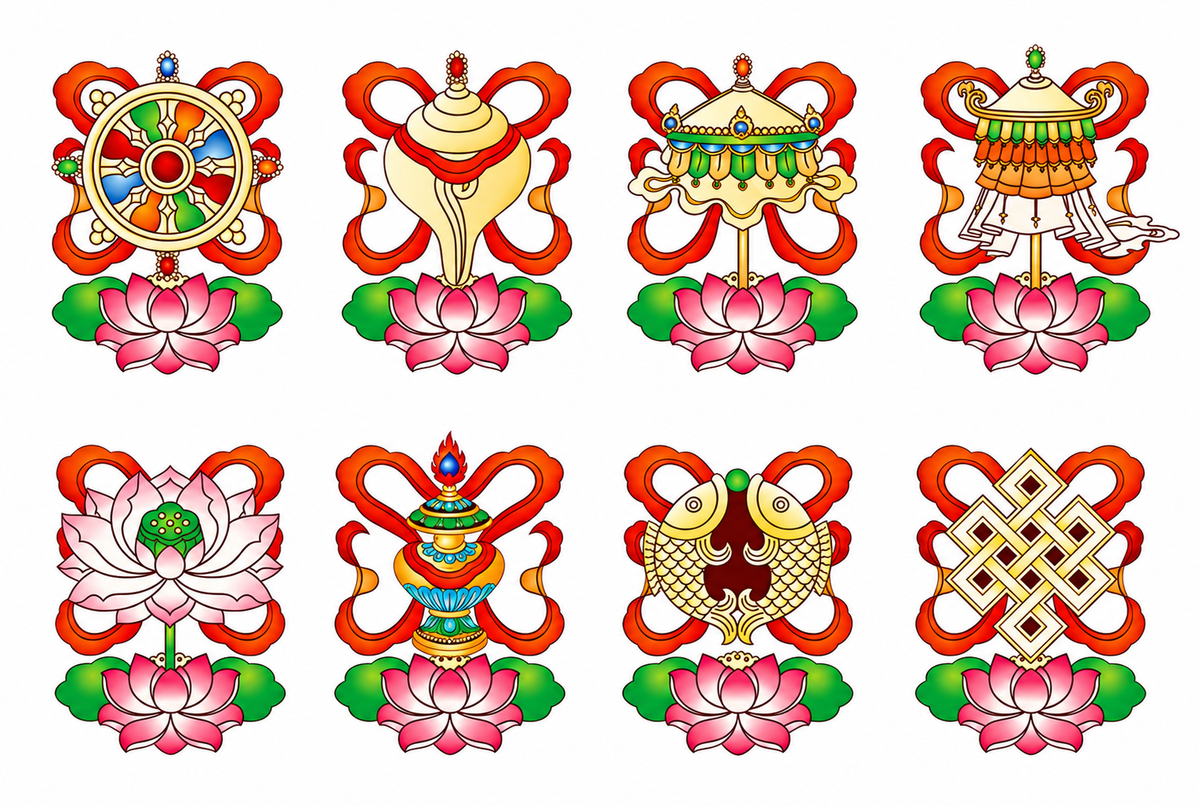
The eight auspicious symbols of Buddhism express ideas of teaching, protection, purity, flourishing, freedom, and awakened understanding. Their meaning becomes easier to remember when each idea is connected with a recognizable form: a sounding conch, a sheltering parasol, a blooming lotus, or an interlaced knot.
In Chinese decorative art, this group is commonly known as Bajixiang, the Eight Auspicious Emblems, and is also called the Buddhist Eight Treasures. These images appear both as sacred objects and as patterns, allowing spiritual ideas to become part of the visual language of ceramics, textiles, and metalwork.
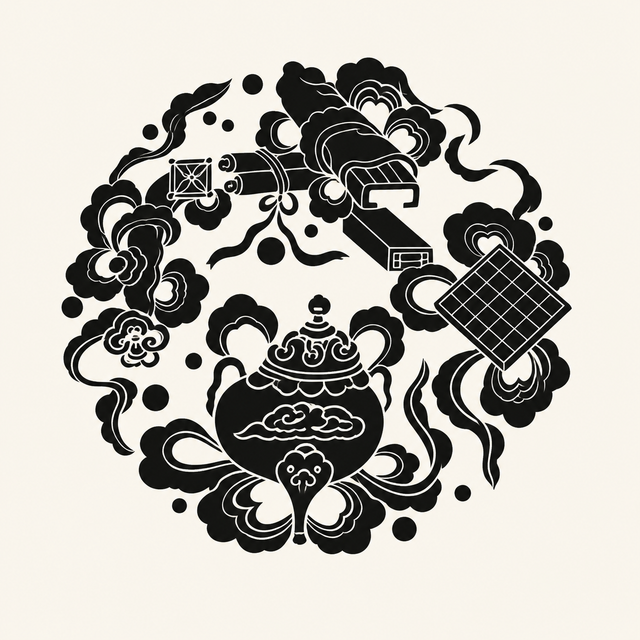
This guide explains the eight emblems individually, using eight black-and-white motifs adapted from a supplied Chinese pattern-book page and two additional colored illustrations. It also explains a naming difference that matters when comparing Chinese and Tibetan examples: the white canopy or cover in some Chinese lists and the victory banner in many Tibetan lists.
Eight Auspicious Symbols and Their Meanings at a Glance
| Symbol | Meaning | How to recognize it |
|---|---|---|
| Dharma wheel | Buddhist teaching and its continuing transmission. | Hub, rim, and spokes. |
| Conch shell | The far-reaching sound of the Dharma. | A pale spiral shell and tapering end. |
| Precious parasol | Shelter and protection. | An umbrella-like cover with a central shaft. |
| Victory banner | Triumph over spiritual obstacles. | A ceremonial standard with hanging tiers. |
| Lotus flower | Purity and awakening. | An open, layered blossom. |
| Treasure vase | Abundance and fulfillment. | A rounded vessel with a decorated upper part. |
| Golden fish | Freedom and fearlessness. | A paired fish composition. |
| Endless knot | Interconnection and continuity. | Repeated interlacing lines. |
The victory-banner grouping is shown here. Some Chinese Bajixiang sources instead name a white canopy or cover alongside the parasol; that difference is explained below.
Understanding the Eight Auspicious Symbols
A common Tibetan Buddhist grouping consists of the Dharma wheel, conch, precious parasol, victory banner, lotus, treasure vase, pair of golden fish, and endless knot. Museum collections preserve these forms as three-dimensional altar ornaments as well as decoration on other objects.
Chinese museum descriptions also document an eight-emblem group containing both a parasol and a canopy, called a white cover or heavenly canopy in translation. The supplied black-and-white set follows that vocabulary. The differences are worth retaining: the meaning of an emblem should be read with its cultural setting and form.
The overview below uses the familiar victory-banner grouping. The individual sections then compare it with the Chinese pattern set. Ribbons, lotus supports, and cloud-like curves may surround an emblem without changing the number of principal symbols.

1. Dharma Wheel Meaning: The Teaching in Motion

The Dharma wheel represents the Buddhist teaching and its continuing transmission. A wheel's movement offers an expressive way to picture a teaching that is put into practice and shared, while its coherent circular structure gives the image a strong visual center.
Look for a hub, a surrounding rim, and connecting spokes. The colored overview shows an eight-spoked version. The black-and-white example simplifies that structure into a different ornamental arrangement, with a central swirl and ribbons around the circumference.
This comparison is useful when reading patterns. Artists adapt the wheel to fit a small panel or a curved surface, so a decorative illustration may vary in its visible details. The complete group and the accompanying documentation help identify the subject.
2. Conch Shell Meaning: The Sound of the Dharma

The white conch is associated with the far-reaching sound of Buddhist teachings. Its traditional meaning connects the voice of the Dharma with an invitation to awaken and to act for the welfare of others.
In the colored chart, it appears as a single pale shell with a tapered end. The Chinese panel turns the subject into a paired composition: two rounded spiral shells rise above a large flower, with leaves and buds on either side.
The pair does not add a ninth emblem. It is a decorative way of giving the conch a balanced outline. The repeated spirals also make an effective visual rhythm, translating the idea of a resonant sound into curves that the eye can follow.
3. Precious Parasol Meaning: Shelter and Protection

The precious parasol expresses protective shelter. Its symbolism grows naturally from the experience of standing beneath an umbrella's shade, and Buddhist explanations connect that shelter with relief from suffering and obstacles.
A parasol is usually recognizable by its upper cover and central shaft. Fringes, jewels, and hanging cloth can make the ceremonial version much more elaborate than an everyday umbrella. The supplied pattern uses successive layers and long ribbon curls to fill its panel.
Its balanced structure contributes to the sense of care and steadiness associated with the motif. The curved upper form spreads outward, while the shaft gives the ornament a clear direction and supporting axis.
4. Victory Banner and the Chinese Canopy

In many Tibetan Buddhist lists, the victory banner signifies triumph over obstacles and negative qualities. It is a spiritual victory, understood through the Buddhist path and the overcoming of what hinders it.
The banner in the colored overview has a tiered, hanging form. The black-and-white panel shown here instead belongs to the Chinese white-canopy or cover tradition described in the supplied book. Its broad fringed top, long stem, and draped ribbons emphasize ceremonial shelter and dignity.
Chinese explanations connect the cover with encompassing protection and purity. A careful comparison therefore keeps the names distinct: a canopy should be identified as a canopy when the source does so, while the victory-banner meaning belongs to the banner grouping. Their similar hanging ornaments can otherwise make them easy to confuse.
5. Lotus Flower Meaning: Purity and Awakening

The lotus is associated with purity and spiritual awakening. Its familiar growth from muddy water into a clear, open flower gives the symbolism a memorable natural image. Buddhist art uses the blossom both as an independent emblem and as a support beneath sacred figures and objects.
The pink lotus in the overview has distinct pointed petals and a visible central seedpod. The black-and-white pattern is more freely stylized, with a large layered blossom and smaller flowers arranged along surrounding stems.
The two versions show the difference between identifying a symbol and drawing a botanical specimen. A decorative floral emblem can become fuller, rounder, or more symmetrical while retaining its role in the documented set. The lotus supports under other emblems also help unite the entire group.
6. Treasure Vase Meaning: Abundance and Fulfillment

The treasure vase carries associations of abundance, flourishing, and the fullness of spiritual benefit. Chinese descriptions also connect it with the completeness of blessings and wisdom, giving the vessel a meaning that extends beyond material possessions.
Its rounded body and stable foot make it a particularly grounded shape within the group. The narrow upper part gathers attention toward a jewel, leaf-like ornament, or decorated opening. In the black-and-white motif, three upright forms lift the eye above the neck.
Ribbons add movement without disturbing the vessel's balance. The result joins the idea of containing something precious with a visual impression of fullness and stability.
7. Golden Fish Meaning: Freedom and Fearlessness

The pair of golden fish is associated with freedom and fearlessness, pictured through fish moving easily through water. Buddhist interpretation connects that image with release from the dangers and restrictions of suffering.
The colored chart arranges the fish upright and facing one another. In the Chinese panel, they swim horizontally in opposite directions, surrounded by water-like lines and leafy forms. Their repeated body markings give the design a lively rhythm.
Paired fish also have broader auspicious meanings in Chinese ornament. Context matters when interpreting a particular object: two fish on a contemporary accessory can recall the visual theme without making that accessory a complete Buddhist emblem set.
8. Endless Knot Meaning: Connection and Continuity

The endless knot combines continuity with interconnection. Buddhist explanations relate it to linked aspects of understanding and practice, including the union of wisdom and compassion. Its unbroken-looking woven structure makes those relationships visible.
In Chinese decorative language, the motif is commonly called panchang. Its repeated crossings offer an image of lasting connection and continuation. Following one strand with the eye becomes part of the experience of looking.
The supplied panel places the geometric knot above a lotus base and surrounds it with ribbons and small floral forms. Firm angular turns and soft curves contribute different kinds of movement, allowing the emblem to feel both ordered and animated.
How the Emblems Become Decorative Patterns

The second colored illustration makes the possibilities of ornament particularly clear. Fish coil within a rounded arrangement, shells narrow into graceful points, and ribbons surround the central objects. Its flower is especially stylized, so the clearer lotus in the overview is the more useful identification example.
Chinese craftsmen also adapted the group to different materials. A Ming Xuande blue-and-white bowl in the Palace Museum places the emblems within a scrolling lotus design. Three-dimensional sets of precious-metal ornaments take a different approach, giving each emblem its own support and physical presence.
On a continuous surface, stems and ribbons can connect one emblem with the next. In separate panels, balanced outlines and comparable visual weight help the subjects belong together. The black-and-white examples show how small openings and fine lines can keep a detailed ornament readable.
Appreciating the Symbols in Everyday Objects
Start with the shape and its context. A shell's spiral, a pair of fish, or the crossing lines of a knot may be immediately recognizable. Inscriptions, companion motifs, and the object's intended use can help explain the particular association.
When choosing a related gift, consider the recipient's interests and beliefs alongside the stated materials and dimensions. A lotus can communicate an appreciation of purity and growth; an interlaced knot can suggest lasting connection. Their meaning becomes personal through the intention shared between people.
Contemporary jewelry uses these themes in many ways. Some pieces explicitly refer to the Eight Treasures, while others feature a single related flower or animal. Reading the listing carefully makes the connection clearer and helps avoid assigning a religious identity to an object solely from its appearance.
The Chinese Showcase Edit
Symbols, Made Wearable
Explore an Eight Treasures-inspired design alongside lotus and paired-fish pieces, each offering its own connection to the motifs in this guide.


The lotus and double-fish designs feature individual motifs. Product pages provide current dimensions, options, and availability.
Frequently Asked Questions
What is the meaning of the eight auspicious symbols of Buddhism?
The group brings together Buddhist ideas of teaching, protection, purity, flourishing, freedom, and interconnection. Each emblem expresses a different aspect, and explanations vary with the tradition and context.
What are the eight Buddhist auspicious symbols?
A common Tibetan grouping includes the Dharma wheel, conch, parasol, victory banner, lotus, treasure vase, pair of golden fish, and endless knot. Chinese Bajixiang descriptions may name a white canopy or cover in place of the banner.
What does Bajixiang mean?
Bajixiang is the Chinese name for the Eight Auspicious Emblems. In this context, Buddhist Eight Treasures is another name for the group.
Why does the Chinese example show a canopy?
The supplied pattern-book page follows a Chinese naming tradition that includes both parasol and white canopy or cover. The colored overview uses the familiar victory-banner list. They are presented with their own names rather than treated as identical objects.
Is a prayer wheel the same as the Dharma wheel emblem?
A rotating prayer-wheel pendant has a drum-like form. The Dharma wheel emblem is usually a spoked circular design. Both connect with Buddhist culture, but their forms and uses differ.
Does every double-fish or lotus accessory represent Buddhism?
A single motif may also belong to broader Chinese ornament. The design, listing, companion symbols, and intended setting help establish the connection.
Do these symbols guarantee a particular outcome?
They convey religious ideas, cultural associations, and personal goodwill. A decorative item can express an intention or reminder without promising a particular event or result.
A Shared Language of Good Wishes
The eight auspicious symbols of Buddhism bring distinct shapes into a coordinated visual world. A wheel turns, a shell suggests sound, a flower opens, and a knot leads the eye through repeated crossings. Meaning and form support one another.
Recognizing the emblems makes their decoration more rewarding. It also helps preserve the particular traditions behind them, allowing their religious significance and artistic inventiveness to remain visible together.
References
- The Palace Museum, Beijing. Eight Treasures, glossary entry, and Blue-and-White Bowl with Eight Auspicious Emblems Supported by Scrolling Lotus, Ming Xuande period. Chinese names, meanings, and a ceramic example.
- Smithsonian National Museum of Asian Art. Set of the Eight Auspicious Emblems, accession S2018.37.1a-b-8a-b. Documentation of a Tibetan altar set.
- The Walters Art Museum. Incense Burner with Design of the Eight Auspicious Symbols, accession 44.543. Documentation of an eighteenth-century Chinese cloisonne object.
- Buddha Dharma Education Association / BuddhaNet. The Eight Auspicious Symbols. Buddhist interpretations of the emblems.
- Pattern-book page and two colored illustrations supplied for this article. The eight monochrome panels were separated and cleaned; captions were removed from the colored overview. Visual comments on stylization and composition refer to these illustrations.
Stories, symbols and everyday objects
Our journal explores Chinese culture and design. Traditions and interpretations vary by region and source. For a purchase, use the specifications on the individual product page.
About Chinese ShowcaseQuestions or corrections? Contact us ↗