The Chinese butterfly pattern is a decorative motif whose meaning changes with context. It may convey a wish for longevity, the joy of meeting or the vitality of flowers in bloom. In some Miao cultural traditions, the butterfly also carries ancestral meaning. There is no single interpretation that fits every butterfly design.
A butterfly's spread wings, curling antennae and varied markings make it an expressive subject for ornament. A lone butterfly can become a visual focal point; a pair creates a relationship; a group introduces rhythm. To understand the motif, look not only at the butterfly but also at its companions, the object it decorates and the cultural tradition behind it.
Chinese Butterfly Symbolism at a Glance
| Design or context | Meaning or association | Basis for interpretation | Important limit |
|---|---|---|---|
| Many butterflies on a Kangxi vase | Longevity | Butterfly / advanced-age homophone; Palace Museum object record | This interpretation is documented for the vase, not universal to every butterfly design. |
| Paired butterflies on a Yongzheng enamel plate | Joyful encounter (xi xiang feng) | National Palace Museum catalogue description | A pair alone does not establish a romantic or wedding meaning. |
| Butterflies among flowers | Spring and natural vitality | Visual interpretation of blossoms and flying butterflies | A compositional reading, not a fixed historical name for all flower-and-butterfly patterns. |
| Butterfly Mother in some Miao traditions | Life origins and ancestral memory | Miao Ancient Songs narrative described by China's intangible cultural heritage website | Requires community and cultural context; not every butterfly is a Miao motif. |
What Is a Chinese Butterfly Pattern?
A butterfly pattern uses the butterfly as its principal decorative element. Designs often preserve recognizable features—an elongated body, antennae and two pairs of wings—while simplifying, exaggerating or rearranging them to suit the medium.
A front-facing butterfly emphasizes symmetry. A butterfly shown at an angle suggests flight and direction. Dots, curved lines, floral details and open spaces can enrich the wings without closely copying a particular species. The same basic silhouette can therefore support both naturalistic and highly stylized designs.

Butterfly Motifs in Qing-Dynasty Decorative Art
| Object and collection | Period | Recorded dimensions (cm) | Decorative features |
|---|---|---|---|
| Five-color butterfly vase Palace Museum |
Qing dynasty, Kangxi period | Height: 44 Mouth diameter: 12 Foot diameter: 13 |
Colorful butterflies in varied poses, with dragonflies between them |
| Copper-bodied painted-enamel flower-and-butterfly plate National Palace Museum |
Qing dynasty, Yongzheng period (1723–1735) | Height: 1.6 Diameter: 15.4 |
Yellow ground, flowers and paired butterflies described as “joyful encounter” |
Measurements and period labels follow the two museum records named in References. These are dimensions of individual objects, not standard sizes for butterfly patterns. This selection is illustrative, not a statistical sample.
Surviving Qing objects offer specific evidence of how butterfly decoration was used. They are useful examples, not proof of a single date or place of origin for the entire motif.
A Kangxi five-color butterfly vase
The Palace Museum's Kangxi-period five-color butterfly vase shows colorful butterflies in varied positions, with dragonflies between them. The museum connects its many butterflies with a wish for longevity through the butterfly/old-age wordplay. Changes in wing color and posture give the surface a lively, varied rhythm. See the Palace Museum's object record.
A Yongzheng flower-and-butterfly enamel plate
The National Palace Museum's Yongzheng-period copper-bodied painted-enamel plate combines flowers on a yellow ground with paired butterflies. Its catalogue calls the paired arrangement xi xiang feng, or “joyful encounter.” It demonstrates how flowers and butterflies can create an ordered yet animated composition. See the National Palace Museum's object record.
What Does the Butterfly Motif Symbolize?
Longevity through a Chinese homophone
The word die, meaning butterfly, sounds like die, a word associated with advanced age. This makes the butterfly suitable for some birthday and longevity designs. The Palace Museum explicitly uses this interpretation for its Kangxi butterfly vase. It should not, however, be applied automatically to every butterfly ornament. Source: Palace Museum.
Joyful meeting and companionship
Two butterflies facing or moving toward one another create a visual relationship. The “joyful encounter” interpretation recorded for the Yongzheng enamel plate provides a documented example. In contemporary design, pairs may also suggest companionship or intimacy, but two butterflies alone do not establish a wedding or romantic meaning. Source: National Palace Museum.
Flowers, spring and natural vitality
As a visual reading, a butterfly among blossoms can evoke a garden in bloom. Flowers anchor the composition while wings add movement. This can suggest spring and vitality without requiring a fixed auspicious name for every combination.
Butterfly Mother: A Distinct Miao Cultural Context
In some Miao traditions, the butterfly carries a deeper meaning related to the origins of life. China's intangible cultural heritage website describes a narrative in the Miao Ancient Songs in which a maple tree gives rise to Butterfly Mother. It also identifies butterfly motifs among the animal themes found in Miao embroidery. Read the heritage article on Miao embroidery.
This context is different from the longevity wordplay used to interpret certain Qing objects. Miao communities and regional embroidery traditions are diverse. A butterfly in a contemporary accessory should not be called a Butterfly Mother motif solely because it resembles a butterfly; that identification requires cultural or maker documentation.
Four Common Butterfly Compositions
Single butterfly: a clear focal point
One butterfly can stand alone as a compact ornament. An open-wing design emphasizes balance; an angled pose introduces direction. The outline is especially important when a motif is reduced to a small scale.
Paired butterflies: visual dialogue
Pairs can face each other, turn away or circle a flower. Position, distance and size change the mood of the design. A symmetrical pair feels formal, while an offset pair can appear more playful.
Flowers and butterflies: stillness and movement
A flower-and-butterfly design works through the relationship between the blossom, stems and wings. Moving the butterfly away from the exact center can create space and a sense of motion. Companion flowers should be identified carefully before assigning a specific symbolic meaning.
Multiple butterflies: repetition with variation
Groups create rhythm through changes in angle, scale and color. The Kangxi vase offers a historical example of varied butterflies distributed across a vessel rather than repeated as identical units.

Using Butterfly Motifs in Modern Design
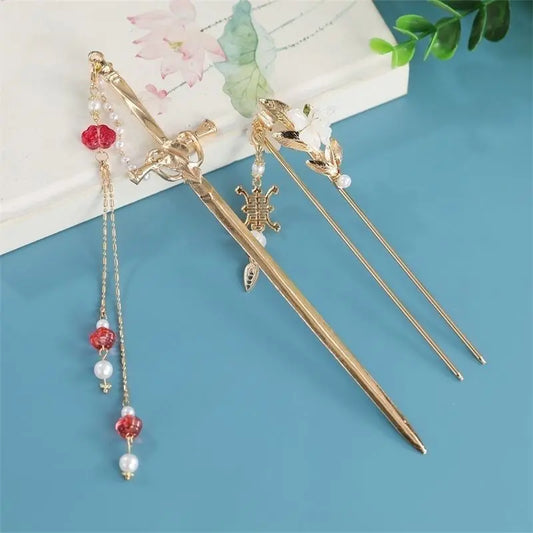
Butterfly motifs can be adapted to jewelry, hair accessories and textile designs. A pendant highlights the complete silhouette. A hairpin may combine wings with hanging elements that move as the wearer turns. A ring compresses the design into a small focal point, making the relationship between outline, color and empty space particularly important.
For textiles, a single butterfly can be an accent, while repeated units create a border or all-over pattern. These are design possibilities rather than evidence that every modern composition descends from one historical workshop or tradition.
When describing a butterfly-inspired product, separate visible details from cultural interpretation. Explain the shape, color and arrangement first, then add any documented symbolism. Material, measurements and construction should come from the individual product listing, not from the motif itself.
Three Butterfly-Inspired Picks from Chinese Showcase
These contemporary accessories explore the butterfly motif in three different forms: a pendant, a hairpin and a ring.

A spread-wing butterfly pendant with vivid blue details and two hanging drops.
View product details →
Two blue butterflies and a flowing tassel bring movement to an updo.
View product details →
A colorful butterfly centerpiece translates the motif into a compact ring design.
View product details →Frequently Asked Questions
What does the butterfly pattern mean in Chinese art?
Depending on the object and context, it can express longevity, joyful encounters or natural vitality. In some Miao traditions, butterflies also relate to ancestral and life-origin narratives.
Why can butterflies symbolize longevity?
The Chinese word die, meaning butterfly, sounds like die, a term associated with advanced age. The Palace Museum explicitly connects the many butterflies on a Kangxi five-color vase with a wish for longevity.
Do two butterflies always symbolize romantic love?
No. Paired butterflies can suggest companionship or a joyful meeting, but their meaning depends on the documented design. A Yongzheng enamel plate is described by the National Palace Museum as using paired butterflies called xi xiang feng, or joyful encounter.
Is every butterfly motif a Miao butterfly-mother design?
No. Butterfly Mother belongs to particular Miao cultural narratives. A butterfly shape alone is not enough to identify a design as Miao or assign it an ancestral meaning.
How do butterfly and bat motifs differ?
Look at the complete form: butterfly designs usually emphasize an insect body, antennae and patterned wings, while bat designs emphasize an animal head and membrane-like wings. Highly stylized examples require contextual evidence.
Conclusion
The Chinese butterfly pattern joins an appealing natural form with several distinct cultural meanings. It can express a wish for longevity, evoke an encounter among flowers or carry ancestral significance within a particular tradition. Its meaning is best understood by bringing together what is visible and what is documented.
For a broader introduction beyond decorative patterns, read What Does Butterfly Mean in Chinese Culture? Explore related motifs in our guides to the Chinese phoenix pattern and the Chinese gourd pattern.
References
- Palace Museum — Five-color butterfly vase, Kangxi period.
- National Palace Museum — Painted-enamel plate with flowers and butterflies on a yellow ground, Yongzheng period.
- China Intangible Cultural Heritage website — Miao embroidery: preservation, transmission and innovation.