The Chinese flowing-cloud pattern (流云纹, liú yún wén) is a dynamic branch of the Chinese cloud-motif tradition. It is recognized by curling cloud heads, long streaming tails, and continuous C- and S-shaped curves that suggest clouds gathering, stretching, and moving through the sky. Its visual roots lie in ancient spiral and hooked-cloud ornament; the fluid language became especially important from the Warring States and Han periods onward. In later auspicious contexts, flowing clouds could evoke favorable weather, celestial space, ascent, continuity, and good circumstances—but no single meaning applies to every object or period.
流云纹
Liú yún wén
Flowing-Cloud Pattern
Streaming curls and cloud tails
Table of Contents

What Is the Chinese Flowing-Cloud Pattern?
Flowing-cloud pattern is a descriptive name for cloud ornament that emphasizes motion. Rather than presenting a compact, self-contained cloud, the design draws the eye along extended curves. A cloud head gathers the form into a spiral or rounded lobe; a body carries it across the surface; and one or more narrowing tails create direction, speed, and rhythm.
There is no single canonical drawing. Museum catalogues may describe particular examples as cloud-vapor patterns, curled clouds, scrolling clouds, tufted flowing clouds, or ruyi clouds. “Flowing cloud” is most useful when the movement of the line is the dominant feature. Identification should therefore combine shape with date, medium, neighboring motifs, and the terminology used in an archaeological report or collection catalogue.
- Rounded, spiral, C-shaped, or S-shaped cloud heads
- Long tails that taper, split, or sweep horizontally
- A visible direction of movement rather than a static cloud silhouette
- Alternating tight curls and open curves that create visual breathing space
- Frequent interaction with dragons, phoenixes, cranes, immortals, mountains, or auspicious words

Origins and Historical Development
Early spirals, hooked forms, and cloud-thunder ornament
The visual ancestry of Chinese cloud ornament reaches back to spirals and curving designs on prehistoric pottery. Whether every early spiral was understood as a cloud cannot be proven, so later symbolism should not be projected automatically onto Neolithic objects.
Shang and Zhou bronzes developed dense systems of cloud-and-thunder, hooked, and coiled ornament. These patterns established an enduring visual grammar of rotation, repetition, and continuous growth. Most were more compact and geometric than later flowing clouds, but they supplied structural ideas that subsequent artists could loosen and extend.
Warring States and Han: movement becomes central
During the Warring States period, curvilinear ornament on lacquer, bronze, jade, and textiles became increasingly animated. Clouds intertwined with dragons, phoenixes, birds, beasts, and figures. Instead of merely filling a background, the lines organized space and directed the viewer around the object.
The Han dynasty marks a major flowering of cloud-vapor design. C- and S-shaped curves varied in scale, joined and separated, and moved around animals, celestial beings, chariots, mountains, and stars. On murals, carved stones, lacquer, bronzes, ceramics, and silk, clouds could create a realm beyond ordinary terrestrial space.
Textiles from the Mawangdui Han tombs include forms described in modern scholarship as tufted or tassel-like flowing clouds. A cloud head concentrates several whorls, while fine extensions give the composition direction. In funerary or celestial imagery, clouds could contribute to ideas of ascent and an extraordinary realm; in other settings they might function mainly as dynamic ornament.
Wei-Jin through Tang: expanded celestial space
Buddhist and Daoist imagery gave cloud forms new spatial roles. From the Northern and Southern Dynasties through Sui and Tang, murals and sculpture used streaming clouds around flying figures, sacred beings, heavenly palaces, haloes, and mountains. Cloud tails could echo scarves and flames, making bodies appear suspended in air.
Tang design often favored generous curves, balanced fullness, and open rhythm. Clouds interacted with flowers, birds, and foreign-influenced decorative forms circulating through long-distance exchange. This did not erase earlier Chinese conventions; it expanded the vocabulary available to workshops.
Song-Yuan: refined line and modular pattern
Song landscape painting explored mist, clouds, and atmospheric depth, while decorative arts translated cloud movement into restrained line, ceramic painting, carved surfaces, and textile repeats. A flowing unit could follow the curve of a vessel or become a border without losing its sense of air and direction.
Yuan textiles and ceramics combined clouds with dragons, phoenixes, cranes, lotus, jewels, and other motifs. Repetition required designers to convert free movement into modules: a head, an extension, and a connecting turn could repeat seamlessly across cloth while still appearing spontaneous.
Ming-Qing: rich symbolic combinations
In Ming and Qing art, cloud designs appeared across court robes, silk, embroidery, ceramics, lacquer, furniture, metalwork, and architectural painting. Flowing clouds could form a background for dragons and cranes, surround longevity medallions, or connect motifs across a large surface.
A Ming robe studied by the China National Silk Museum uses flowing clouds as a ground behind round longevity medallions and cranes. The cloud layer is not incidental: it unifies the fabric and keeps the eye moving between larger emblems. In architecture, multicolored cloud painting brought rhythm to beams and ceilings, while specific palettes and compositions reflected workshop rules, building status, and restoration history.
Composition, Line, and Repetition
The most successful flowing-cloud designs balance freedom and order. If every curl is identical, the result becomes mechanical; if every line changes direction unpredictably, the pattern loses coherence. Artisans therefore alternate compressed spirals with longer open sweeps.
One cloud head and an extended tail occupy a corner, handle, or panel.
Cloud units connect horizontally or around a circular object.
Different sizes create depth around figures, birds, or mountains.
Curves circle a dragon, phoenix, medallion, or central emblem.
Dense clouds unify a textile or painted architectural surface.
Overlapping heads suggest atmosphere and spatial depth.
Material changes the line. Bronze casting favors compact relief; lacquer supports lively painted or carved movement; porcelain allows elastic brushwork; embroidery builds clouds with satin stitch, couching, gold thread, or contrasting outlines. On architecture, broad curves must remain legible from a distance. The motif is therefore a structural family, not a design copied unchanged from one medium to another.

Meaning and Cultural Significance
Clouds are linked with rain, and timely rain was essential to agriculture. In later auspicious art, clouds could therefore suggest favorable weather, well-being, and beneficial conditions. Their position above the earth also connected them visually with heaven, sacred mountains, immortals, and exceptional appearances.
Flowing movement adds ideas of ascent, continuity, transformation, and unobstructed progress. With a dragon, clouds evoke the creature’s command of weather and cosmic energy. With cranes, they may help create a setting associated with transcendence or longevity. With bats and longevity characters, they become part of a more explicit blessing composition.
Where Was the Pattern Used?
Bronze, jade, and lacquer
Early metal and jade objects used spirals, hooks, and incised or relief curves that contributed to the later cloud vocabulary. Lacquer’s smooth surface encouraged longer, freer brush lines, making it especially suited to cloud movement intertwined with animals and abstract forms.
Ceramics
Cloud ornament became increasingly visible on ceramics, adapting to bowls, jars, vases, dishes, and architectural wares. Painted clouds can be quick and airy; molded, carved, or incised examples are more tactile. They may appear as borders, isolated clusters, or settings for dragons and phoenixes.
Textiles and clothing
Weaving and embroidery turned flowing clouds into repeatable systems. The curves could occupy the ground of a fabric, surround roundels, move across shoulders and sleeves, or join dragons, cranes, flowers, waves, and auspicious characters. Movement of the garment made the cloud field appear even more animated.
Murals and architecture
In murals, clouds separate earthly and celestial zones, carry figures, or guide the eye across a wall. Architectural painting uses enlarged curves and strong color contrasts so the motif remains visible from below. Buildings of different regions and ranks followed different practices, so “traditional Chinese cloud painting” should not be treated as one uniform formula.
How Does It Differ from Similar Cloud Motifs?
| Motif | Recognition | Difference |
|---|---|---|
| Flowing cloud | Long tails and clear directional movement | A shape-based term emphasizing flow |
| Cloud-vapor pattern | Broad atmospheric curls and moving vapor | A wider category; can include flowing forms |
| Curled-cloud pattern | Strong spiral or coiled head | Emphasizes the curl, not necessarily a long tail |
| Cloud-head pattern | Compact lobed terminal | Emphasizes the head unit rather than the stream |
| Ruyi cloud | Three-lobed ruyi-like contour | More standardized silhouette |
| Cloud-thunder pattern | Dense squared or angular spirals | More geometric and strongly linked to early bronze ornament |
| Xiangyun | Many possible auspicious cloud shapes | A meaning-based umbrella term rather than one structure |
Modern Design and Cultural Preservation
Flowing clouds now appear in fashion, jewelry, packaging, interiors, public art, animation, games, and digital interfaces. Their long curves are useful for connecting elements, framing text, and creating calm motion. A successful reinterpretation preserves the design logic—gathered heads, tapered tails, rhythm, and negative space—rather than adding random curls to signal “Chinese style.”
Museum photography, archaeological publications, pattern databases, and digital tracing make historical designs easier to study. Designers should still identify the source object and date whenever possible. A newly traced or AI-assisted illustration should be labeled as a reconstruction, not passed off as a photograph of an original artifact.
Flowing-Cloud Elements in Contemporary Design
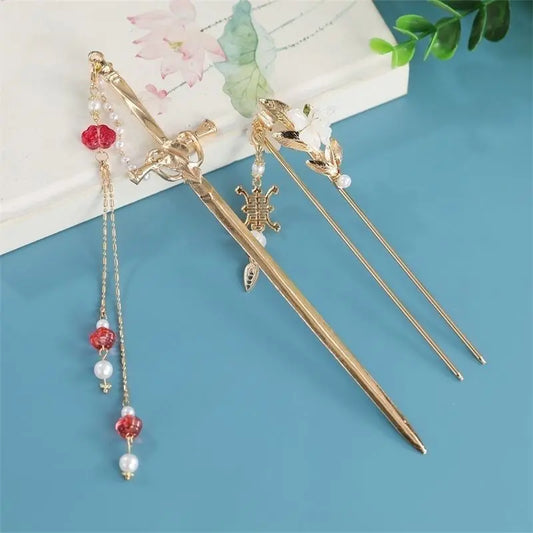
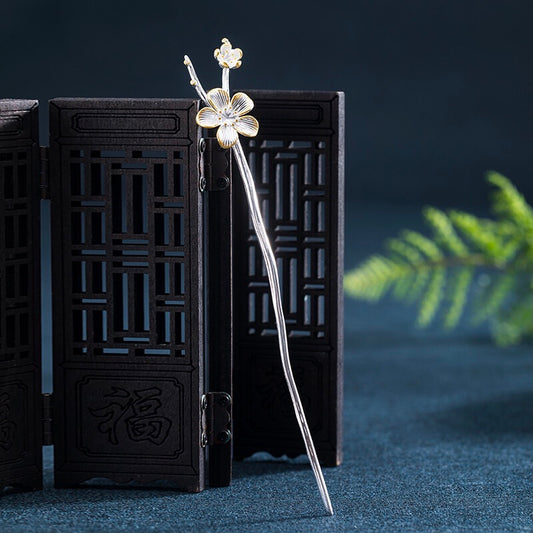
In contemporary accessories, flowing-cloud elements are often expressed through curling silhouettes, open scrollwork, layered enamel, and rhythmic carved lines. The following designs show how this visual language can be adapted without presenting modern pieces as reproductions of historical artifacts.

Peacock Blue Auspicious Cloud Hairpin Pair
The enamel curves turn cloud scrolls into a crisp, wearable silhouette.
$36.99 USD
Explore the Design
Cloud and Green Jade Drop Earrings
Open cloud curves create an airy transition to the green jade drops.
$36.99 USD
Explore the Design
S925 Silver Sun Wukong Cloud Ring
The energetic cloud carving suits the article’s theme of movement and mythic atmosphere.
$76.99 USD
Explore the DesignFrequently Asked Questions
What does the Chinese flowing-cloud pattern mean?
In later auspicious contexts it can suggest favorable weather, celestial atmosphere, ascent, continuity, and good circumstances. Meaning varies by period and object.
What is the Chinese name for the flowing-cloud pattern?
It is written 流云纹 and romanized liú yún wén. “Flowing-Cloud Pattern” is the recommended English translation.
When did flowing-cloud patterns first appear?
Their visual roots lie in early spiral, hooked, and cloud-thunder ornament. Clearly fluid cloud-vapor designs became especially prominent from the Warring States and Han periods.
Is flowing cloud the same as xiangyun?
No. Flowing cloud describes a moving visual structure, while xiangyun is a broad meaning-based category for auspicious clouds. A flowing cloud can also be a xiangyun.
How is it different from the cloud-head pattern?
A cloud head is a compact lobed terminal. A flowing cloud extends that or another curled head into a long directional tail.
How is it different from yunleiwen?
Yunleiwen usually uses dense angular or squared spirals. Flowing clouds rely on rounder, more open curves and stronger directional movement.
Where was the motif used?
It appears on textiles, clothing, lacquer, bronze, jade, ceramics, murals, architecture, furniture, metalwork, and modern jewelry.
Does every flowing cloud symbolize good luck?
No. Clouds can also indicate weather, sky, motion, sacred space, or atmospheric depth, and some examples are mainly decorative.
References
- Palace Museum. “Interlocking Cloud Pattern.” Accessed July 31, 2026.
- Palace Museum Journal. “A Study of the Phoenix Motifs on ‘Longevity Embroidery’ from the Mawangdui Han Tomb.” 2023, no. 6.
- National Museum of China. Study of cloud ornament on a Han-dynasty bronze rhinoceros vessel. Journal of the National Museum of China, 2024, no. 3.
- China National Silk Museum. “Conservation of a Ming Round-Collared Robe with Cloud, Crane, and Longevity-Medallion Silk.” 2021.
- Hunan Museum and Institute of Archaeology, Chinese Academy of Sciences, eds. Han Tomb No. 1 at Mawangdui, Changsha.
- Yang Hong. Research on historical information in the architectural painting of the Hall of Mental Cultivation precinct, Palace Museum.
- Tian Zibing. A History of Chinese Arts and Crafts.
- Wu Shan. Complete Collection of Chinese Patterns.