The Chinese cloud-head pattern (云头纹, yún tóu wén) is a stylized cloud motif recognized by its rounded lobes, inward curls, and a head-like silhouette that often resembles the top of a ruyi scepter or a lingzhi fungus. Its visual ancestry reaches back to early hooked, spiral, and cloud-vapor designs, while the compact ruyi-shaped form became especially prominent in later decorative arts. Historically it could evoke the sky, auspicious atmosphere, elevated status, and wishes for favorable circumstances; today it remains a versatile emblem of good fortune and graceful continuity.
| Chinese name | 云头纹 |
|---|---|
| Pinyin | Yún tóu wén |
| Recommended English name | Cloud-Head Pattern |
| Related terms | Ruyi cloud, ruyi-shaped cloud, cloud-vapor motif |
| Historical development | Rooted in early spiral and hooked-cloud designs; increasingly standardized in medieval and late-imperial decorative arts |
| Common media | Jade, bronze, lacquer, ceramics, textiles, embroidery, architecture, furniture, and jewelry |
| Key features | Rounded lobes, curled ends, symmetrical or scrolling construction, and a compact cloud “head” |
| Common meanings | Auspiciousness, favorable circumstances, heavenly atmosphere, continuity, and refined elegance |
Table of Contents
- What Is the Cloud-Head Pattern?
- How to Recognize It
- Origins and Historical Development
- Composition and Visual Features
- Meaning and Cultural Significance
- Use Across Materials and Regions
- How It Differs from Similar Motifs
- Modern Use and Cultural Continuity
- Recommended Products
- FAQ
What Is the Chinese Cloud-Head Pattern?
The cloud-head pattern is not a literal drawing of meteorological clouds. It is a decorative abstraction: artists reduce a cloud mass to one or several rounded lobes, then emphasize its movement with inward spirals, hooked tips, or flowing tails. A single unit may sit at the end of a border, crown another motif, or form the terminal of a larger cloud scroll. Repeated units may create collars, medallions, textile borders, or all-over surfaces.
The English term “cloud-head pattern” is useful because it describes the compact, recognizable end unit. “Ruyi cloud” is also common, particularly when the upper contour has three lobes resembling a ruyi scepter head. However, the two labels are not always interchangeable: cloud-head is the broader descriptive category, while ruyi cloud refers more specifically to a ruyi-like version.

How to Recognize a Cloud-Head Motif
Begin with the outer contour. A typical cloud head has a broad, rounded crown and two smaller lobes or curled shoulders. The lower edge may narrow into a stem, split into twin hooks, or connect with a winding band. In a ruyi-shaped example, the silhouette is often close to a soft three-lobed heart or mushroom cap. In a more energetic cloud-vapor composition, the same head may trail long ribbons, flame-like curves, or repeated spirals.
Four clues are especially useful:
- Lobed silhouette: the boundary is rounded rather than sharply geometric.
- Inward motion: hooks and spirals turn toward the center, giving the design a gathered, circulating rhythm.
- Modular construction: one cloud head can be repeated, mirrored, rotated, or linked to a scrolling stem.
- Context: it often appears with dragons, phoenixes, cranes, bats, flowers, waves, mountains, or auspicious characters.
Identification should remain contextual. A single S-curve on an ancient object is not automatically a cloud head, and a three-lobed form may also represent lingzhi, ruyi, petals, or another stylized plant. Dating, material, neighboring motifs, and archaeological documentation matter.
Origins and Historical Development
Shang and Zhou foundations
Early Chinese ornament already favored spirals, hooked lines, and repeating curls. Shang and Zhou bronzes, jades, and other ritual objects contain cloud-thunder patterns and hooked motifs that supplied a visual vocabulary for later cloud designs. A Shang jade phoenix in the National Museum of China, for example, carries a hooked-cloud pattern on its high crest. Western Zhou to early Spring and Autumn hooked-cloud ornaments show how widely the curling language circulated.
These early forms should not be retroactively assigned every later auspicious meaning. Their precise significance depended on ritual setting and object type, and much remains open to scholarly interpretation. What can be observed securely is the persistence of coiled lines, mirrored hooks, and dense rhythmic repetition.
Warring States and Han: clouds become animated
During the Warring States and Han periods, cloud imagery often became more fluid. Long, sweeping curves created a world of moving vapor inhabited by birds, beasts, immortals, chariots, or celestial beings. Han decorative art frequently uses yunqi wen—cloud-vapor patterns—to suggest an expansive, animated atmosphere rather than a single isolated emblem.
A Western Han painted and gilded jade pillow in the National Museum of China combines birds, beasts, figures, and cloud-vapor designs. Such compositions show how cloud forms could organize movement across a surface and connect earthly imagery with an imagined celestial realm.
Wei, Jin, Sui, and Tang: flowing elegance
From the Wei and Jin through the Sui and Tang dynasties, clouds were increasingly used around Buddhist, Daoist, courtly, and celestial subjects. Painting, sculpture, metalwork, textiles, and architectural decoration developed supple bands and buoyant curls. The motif could indicate height, sacred space, flight, or the arrival of an extraordinary being.
Tang designs often feel open and rhythmic. Cloud lobes may expand into broad scrolls, combine with flowers and birds, or balance dense ornament with generous negative space. Their role was both symbolic and compositional: clouds separated zones, framed figures, and guided the eye.
Song and Yuan: modular refinement
Song artisans refined the motif through controlled line, balanced proportion, and close observation of nature, while decorative workshops continued to abstract it into repeatable units. In textiles and ceramics, cloud heads could form borders or punctuate larger compositions.
Yuan textiles provide striking evidence of the cloud head as a modular structural device. Cloud collars could be built from four symmetrical ruyi-shaped heads arranged around the neck and shoulders. A surviving kesi cloud-collar fragment associated with the National Silk Museum demonstrates how a cloud unit could determine an entire garment ornament rather than merely fill empty space.
Ming and Qing: the mature ruyi cloud head
In Ming and Qing decorative arts, the ruyi-shaped cloud head became especially recognizable. Palace terminology describes transformed clouds with lingzhi-like or ruyi-like outlines, and the pattern appears on imperial textiles, porcelain, lacquer, furniture, architectural painting, accessories, and festival objects. It may stand alone, form a border, or merge with dragons, bats, peaches, cranes, and longevity symbols.
Late-imperial designs range from restrained single-line outlines to richly colored, layered clouds. Court workshops favored order and symmetry, while regional crafts adapted the motif to local materials, stitches, carving techniques, and color preferences.
Composition, Line, Repetition, and Combined Motifs
The cloud-head pattern succeeds because it is both readable and flexible. Its most basic form has a central upper lobe flanked by two smaller curls. Designers can lengthen the side hooks, compress the crown, add interior spirals, or attach a scrolling tail without losing the basic identity.
Common construction methods
- Single terminal: one cloud head ends a stem, band, handle, or corner.
- Mirror pair: two heads face each other to form a balanced bracket or frame.
- Continuous scroll: heads repeat along a winding line to create a border.
- Radial medallion: units rotate around a center, producing a flower-like ring.
- Four-direction collar: large ruyi-shaped lobes extend toward the chest, back, and shoulders.
- Layered cloud bank: overlapping heads create depth around dragons, mountains, or celestial figures.
Line quality changes with technique. Jade carving encourages clean relief and incised curls; bronze casting supports dense repeat patterns; porcelain painting allows elastic brushwork; embroidery builds lobes with satin stitch, couching, gold thread, or contrasting outlines. The motif’s identity therefore lies less in one fixed drawing than in a family of related structures.

Frequent motif combinations
Clouds often work as a setting rather than the main subject. Dragons moving through clouds convey dynamic celestial power; cranes among clouds can evoke transcendence and longevity; bats with clouds intensify wishes for good fortune; mountain-and-cloud arrangements create a cosmic landscape. On textiles, cloud heads may alternate with flowers, waves, geometric borders, or shou characters. The combined meaning depends on the complete composition, not the cloud alone.
Symbolism and Cultural Significance
The cloud-head pattern commonly suggests auspicious conditions. Clouds bring rain, and well-timed rain has long been associated with agricultural well-being. Their elevated position also connected them visually with heaven, sacred mountains, immortals, and extraordinary events. In court art, cloud ornament could contribute to an atmosphere of rank, ceremony, or cosmic order.
The ruyi-like silhouette adds another layer. Ruyi literally conveys the idea of things proceeding “as wished,” so ruyi-shaped clouds became natural vehicles for blessings, celebration, and favorable outcomes. Repeating curls may also suggest continuity and unbroken vitality, while the soft, balanced contour conveys harmony and elegance.
These meanings were not fixed in every period. Early hooked motifs cannot automatically be read as straightforward “good luck” symbols, and the modern marketing phrase “wealth cloud” is not a universal historical category. Scholars distinguish documented object context from later popular interpretation. A responsible reading therefore asks when an object was made, who used it, what accompanied the pattern, and how the design was named in reliable catalogues.
Use Across Materials, Regions, and Settings
Bronze and jade
On early bronze and jade, curling units were carved, incised, or cast into compact surfaces. The resistant materials encouraged concise, controlled forms. On pendants and fittings, hooked clouds could follow an animal’s body or occupy a crest, wing, or edge. Later jade objects sometimes use openwork cloud heads to connect separate elements while maintaining visual lightness.
Lacquer, ceramics, and metalwork
Lacquer permits both shallow engraving and deep carving, making layered cloud banks especially effective. On ceramics, painted clouds can be airy and fast, while molded or incised versions become tactile borders. Cloisonné and other enamel techniques translate the curves into wire cells filled with color, producing crisp outlines and jewel-like surfaces.
Textiles and clothing
Textiles made cloud heads mobile. Woven, embroidered, or kesi clouds could encircle robes, occupy shoulder panels, frame dragons, or create cloud collars. Because cloth bends with the body, the repeated lobes appear to open and close as the wearer moves. Regional embroidery traditions varied in stitch, palette, density, and associated motifs, so visual comparison should not erase local craft identities.
Architecture, furniture, and daily objects
Cloud heads occur on bracket decoration, painted beams, roof ornaments, railings, screens, furniture aprons, carved panels, mirrors, boxes, and handles. In these settings, the shape often solves a practical design problem: it softens a corner, closes a border, joins two curves, or creates a ceremonial visual accent.
How Is It Different from Similar Chinese Patterns?
| Motif | How to recognize it | Main distinction |
|---|---|---|
| Cloud-head pattern | Compact lobed head with inward curls | A structural cloud unit or terminal |
| Xiangyun, auspicious cloud | Broad family of stylized lucky clouds | Meaning-based umbrella term; may include long tails and many shapes |
| Yunleiwen, cloud-thunder pattern | Dense angular or squared spirals | More geometric and especially associated with early bronzes |
| Ruyi motif | Three-lobed head derived from or associated with a ruyi scepter | May appear without any cloud context |
| Lingzhi motif | Fungus-like cap, often with a naturalistic stem | Botanical and strongly linked with longevity |
The categories overlap because Chinese designers deliberately transformed one elegant curve into another. A ruyi head can become a cloud, a cloud can resemble lingzhi, and a scroll can grow floral details. Museum cataloguing, object context, and period terminology are more reliable than shape alone.
Modern Application and Cultural Continuity
Today, cloud-head forms appear in jewelry, fashion, logos, packaging, interior screens, public architecture, digital interfaces, and festival graphics. Good contemporary design does more than paste an old motif onto a surface. It preserves the pattern’s underlying logic—balanced lobes, circulating curves, modular repetition—while adjusting scale, color, and material for a new use.
Craft preservation also depends on knowledge transmission. Museum catalogues, archaeological reports, pattern archives, apprenticeships, and collaboration with skilled makers help distinguish informed reinterpretation from vague “traditional-style” decoration. Consumers can support continuity by seeking clear material descriptions, credible craft information, and respectful attribution.
Recommended Cloud-Inspired Products
These three currently listed designs translate cloud curves into wearable objects. Each recommendation is selected for a direct visual or thematic connection to the article.

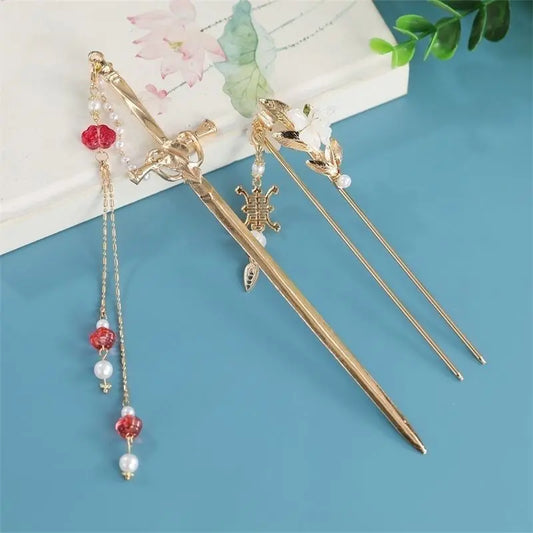
Ruyi Cloud Tassel Hairpin
Its ruyi-cloud silhouette and suspended tassel echo the graceful movement of traditional cloud ornament.
$24.99 USD
View Product
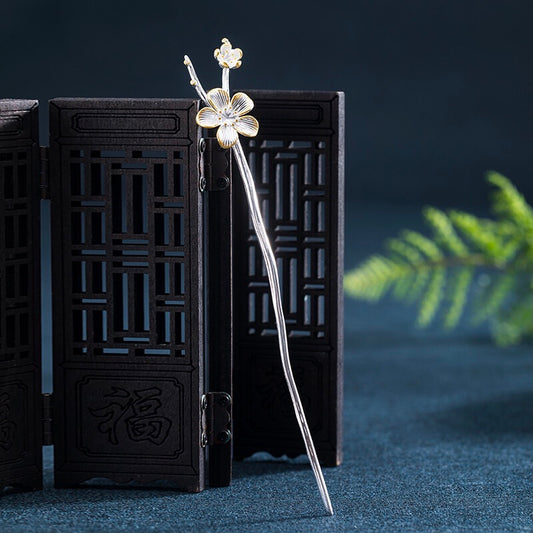
Chanhua Cloud Pattern Pearl Hairpin
Silk-thread craft, pearls, and cloud curves connect the motif with contemporary Hanfu styling.
$24.99 USD
View Product
Vintage Blue Enamel Cloud Pattern Bangle
The enamel outlines make the repeating cloud curves crisp, colorful, and easy to recognize.
$36.99 USD
View ProductFrequently Asked Questions
What does the Chinese cloud-head pattern symbolize?
It commonly symbolizes auspicious circumstances, connection with the heavens, graceful continuity, and the wish that events unfold favorably. The exact meaning depends on period, object, and accompanying motifs.
What is the Chinese name for the cloud-head pattern?
It is written 云头纹 and romanized yún tóu wén. “Cloud-head pattern” is the clearest general English translation.
Is the cloud-head pattern the same as an auspicious cloud?
Not exactly. “Auspicious cloud” or xiangyun is a broad category based on favorable meaning, while cloud head describes a compact lobed design unit. A cloud-head motif can be used as an auspicious cloud.
Is the cloud-head pattern the same as yunleiwen?
No. Yunleiwen usually consists of tight geometric cloud-and-thunder spirals, especially on early bronzes. Cloud-head patterns are generally rounder, more lobed, and often ruyi-shaped.
Why does a cloud-head motif look like a ruyi?
Later decorative clouds and ruyi heads share a three-lobed contour. Artists intentionally moved between these forms, reinforcing the association with favorable wishes.
When did the pattern first appear?
Its visual roots lie in ancient spiral, hooked-cloud, and cloud-thunder ornament found in early Chinese material culture. The mature, standardized ruyi-like cloud head developed gradually and became particularly widespread in medieval and Ming-Qing decorative arts.
Where is the cloud-head pattern used?
It appears on jade, bronze, lacquer, porcelain, textiles, clothing, embroidery, architecture, furniture, jewelry, and modern graphic design.
Does every cloud motif mean good luck?
No. Clouds can mark the sky, movement, sacred space, weather, rank, or atmosphere. Auspicious readings are common, but they should not be imposed on every object without historical context.
References
- Palace Museum. “Ruyi-Style Cloud-Head Pattern.” Accessed July 30, 2026.
- National Museum of China. “High-Crested Jade Phoenix Pendant.” Accessed July 30, 2026.
- National Museum of China. “Hooked-Cloud Pattern Ornament.” Accessed July 30, 2026.
- National Museum of China. “Painted and Gilded Jade Pillow with Bird, Beast, and Cloud-Vapor Designs.” Accessed July 30, 2026.
- China (Hainan) Museum of the South China Sea. “Clouds Unfolding and Gathering: The Cloud Pattern.” May 29, 2024.
- Chengdu Museum. “Patterns: The Visual Language of the Bronze Age.” 2025.
- China National Silk Museum. “Kesi Cloud-Collar Fragment with Moon Rabbit.” Accessed July 30, 2026.
- Tian Zibing. A History of Chinese Arts and Crafts.
- Wu Shan. Complete Collection of Chinese Patterns.
Related Reading
- Chinese Cloud and Thunder Patterns: Yun Lei Wen
- Auspicious Clouds Pattern (Xiangyun): Meaning, Symbolism & Spiritual Significance
- Bao Xiang Hua Flower Pattern: A Classic Traditional Motif
- Traditional Chinese Jinwen Pattern
- What Does Ruyi Mean in Feng Shui?
- What Is Cloisonné Enamel?