Buyi culture connects rice fields, village life, indigo textiles, and the storytelling voice. A blue-and-white wax-resist cloth, a woven garment border, a bowl of colored sticky rice, or a seated musical performance can each open a different window onto its history.
The Buyi, also written Bouyei in English, are one of China's officially recognized ethnic groups. The National Ethnic Affairs Commission gives a population of 3,576,752 in 2020, or approximately 3.58 million. Guizhou is the main center of settlement, with communities also in Yunnan, Sichuan, and elsewhere. Dress, speech, and celebrations differ across these communities. [1]

Buyi People at a Glance
| English names | Buyi; Bouyei |
|---|---|
| Population in China | 3,576,752 in 2020, approximately 3.58 million [1] |
| Main distribution | Guizhou, especially Qiannan and Qianxinan, with communities in Anshun, Guiyang, Liupanshui, Yunnan, Sichuan, and other areas |
| Language | Buyi, closely related to Zhuang |
| Writing | A modern Latin-based alphabet and traditional recording practices found in some manuscripts |
| Representative traditions | Indigo dyeing, wax-resist textiles, brocade, embroidery, Bayin seated singing, rice cultivation, and festival foodways |
| Important festivals | Third Month Third, Sixth Month Sixth, and local new-rice observances |
| National heritage examples | Buyi Bayin seated singing (2006), Buyi Third Month Third festival (2011), and Buyi dress (2014) [15] [12] [5] |
Who Are the Buyi People, and Where Do They Live?
Guizhou is the principal home of the Buyi people. Qiannan Buyi and Miao Autonomous Prefecture and Qianxinan Buyi and Miao Autonomous Prefecture are important centers, alongside communities around Anshun, Guiyang, and Liupanshui. Many traditional settlements connect waterways, cultivated land, and surrounding hills. [1]
Buyi life is not confined to Guizhou's villages. In Hekou, Yunnan, for example, local accounts describe communities teaching embroidery, music, and festival food preparation. Such examples show how a shared identity can coexist with distinctive local experiences. [2]
The Buyi Name and Historical Formation
The National Ethnic Affairs Commission connects Buyi historical formation with populations described under the broad ancient label Baiyue. It also emphasizes historical and linguistic connections with the Zhuang. Buyi became the standardized ethnic name in 1953. [3]
Ancient population labels should not be mapped directly onto modern ethnic categories. Their scope changed across time and place. Similarly, discussions of connections between Buyi history and the ancient Yelang polity should not become the unqualified claim that the Buyi are its sole descendants. A more careful account considers long-term settlement, agriculture, migration, and exchange across the region.
The Buyi Language and Writing
Buyi is closely related to Zhuang. The traditional classification used by the National Ethnic Affairs Commission places it in the Zhuang-Tai branch of the Zhuang-Dong grouping and distinguishes three regional speech areas. [1]
A Latin-based Buyi writing scheme was adopted in 1956 and approved for experimental use in 1957. Revisions followed in 1981 and 1985. Language use and literacy vary by community and generation: the ethnic population figure should not be treated as a count of Buyi speakers. [4]
It is also misleading to say that Buyi communities had no written practices whatsoever before the modern alphabet. Some traditional ritual manuscripts used Chinese characters phonetically or adapted character forms to record material. These local manuscript practices and the standardized modern alphabet are distinct subjects. [1]
Indigo Clothing and Regional Diversity
Blue, indigo, and white feature prominently in many Buyi clothing traditions. Garments bring together dyeing, weaving, patterned borders, embroidery, and sewing. Women's festive ensembles may include a headcloth, jacket, apron, belt, skirt or trousers, and embroidered shoes; the combinations vary by locality and occasion. Men's historical clothing includes both long and short garments. [5]

Rather than looking for one standard Buyi costume, ask where a garment comes from, when it was made, and whether it was intended for daily wear, a ceremony, or a contemporary performance. Buyi dress entered China's national intangible cultural heritage list in 2014. The protected cultural practice includes making knowledge and social uses, not just finished clothes. [5]

Wax-Resist Dyeing: How Blue-and-White Patterns Are Made
Wax-resist dyeing is not simply painting white designs onto blue cloth. Wax protects selected areas of the fabric during dyeing; removing it reveals the contrast between resisted and dyed areas.
The national heritage record for Anshun wax-resist dyeing discusses both Miao and Buyi traditions. It locates Buyi examples around Zhenning, Guanling, and Huangguoshu, and describes natural subjects alongside geometric forms such as spirals, waves, and diamonds. Anshun's entry was added to the national list as an extension in 2008. [6]
Brocade, Embroidery, and Textile Patterns
Wax-resist dyeing, brocade weaving, and embroidery can appear together in clothing, but they create patterns in different ways.
| Technique | How the pattern is formed |
|---|---|
| Wax-resist dyeing | Wax shields selected areas while the surrounding cloth takes up dye. |
| Brocade weaving | Patterns are built into the cloth through the arrangement of warp and weft threads. |
| Embroidery | Needle and thread add designs to an existing fabric. |
The University of Hong Kong Libraries' digital exhibition Gifts from Lanmama includes a Buyi brocade garment panel with a blue ground and repeated diamond and grid-like patterns. It offers a specific object to examine, rather than an abstract claim about all Buyi textiles. [7]
Color, repeat, density, borders, and technical skill deserve attention even when a motif has no verified symbolic interpretation. Textile traditions across southern China have also developed through exchange, so shared techniques do not erase the particular histories of their makers. [8]
Villages, Stone Houses, and Rice-Growing Landscapes
Traditional Buyi dwellings include raised, partly raised, and ground-level forms. Materials and layout reflect local terrain and household needs. Stone construction is especially recognizable in some parts of central Guizhou, but it is not the only Buyi architectural tradition. [9]

At Shitouzhai near Huangguoshu, stone buildings form a distinctive village landscape. Reporting on local conservation also shows that protecting architectural character must be considered alongside residents' needs and village renewal. A settlement is more than its walls: water, fields, routes, and gathering places all help explain how it works. [10]
Sticky Rice, Sour Flavors, and Shared Meals
Rice and glutinous rice are important in Buyi foodways. Rice cakes, wrapped rice preparations, and colored sticky rice can be shared as hospitality or festival gifts. Pickled vegetables and sour preparations also feature in regional accounts, though household preferences differ. [9]
Why is festival rice different colors?
Traditional colored rice is prepared using plant materials to tint the grains before steaming. Plants, processing methods, and resulting color combinations vary locally. Accounts from Hekou describe families teaching preparation and sharing the rice during celebrations; reports from Guizhou connect it with hospitality, gifts, and reunion. [2] [11]
These foods are not exclusive to one ethnic group. Explaining a local recipe and its occasion of use is more informative than claiming that every colorful rice dish belongs uniquely to the Buyi.
Third Month Third, Sixth Month Sixth, and New Rice
Third Month Third
Known as San Yue San in Chinese, this festival falls on the third day of the third lunar month. The heritage account for Wangmo describes ancestor remembrance, meals with relatives, colored rice, and antiphonal singing. Embroidered balls also appear in descriptions of traditional courtship. The Buyi festival entered the national heritage list in 2011, through an entry submitted by Wangmo County. Its documented local practices should not be generalized to every community. [12]
Sixth Month Sixth
Liu Yue Liu, the sixth day of the sixth lunar month, is another important celebration associated with agricultural life and hopes for a good harvest. Today's public programs can combine inherited customs with new entertainment. In Pianpo near Guiyang, reporting on the 2025 festival described cultural performances and song alongside concerts and rice-field activities. [13]
New-rice observances
New-rice observances follow the harvest cycle, so their dates vary. In some places, newly ripened grain is offered to ancestors before the harvest food is shared. The agricultural timing matters more than assuming one fixed date for all Buyi communities. [9]
Bayin Seated Singing and the Storytelling Voice
Bayin zuochang, often translated as Buyi eight-tone seated singing, combines instrumental accompaniment with singing and narrative. Associated especially with Buyi communities in Qianxinan, it has a seated ensemble format and uses instruments such as bowed fiddles, a moon lute, and percussion. It belongs to a world of stories, celebrations, and social gatherings. [14]
Buyi Bayin seated singing entered China's first national intangible cultural heritage list in 2006, under the category of quyi, or narrative performing arts. The entry was submitted by Xingyi. It is therefore inaccurate to describe it simply as a dance performed by eight people. [15]
Antiphonal folk songs offer another setting for expression. The Wangmo festival record describes exchanges that respond to particular people and situations, reminding us that a song can be an interaction as well as a musical work. [12]
Buyi Culture in Contemporary Life
Heritage does not live only in museums or on festival stages. In Hekou, community accounts describe older practitioners teaching embroidery, discussing tunes, and passing skills to younger people through workshops and local cultural spaces. Continuity depends on these relationships. [2]
Respectful engagement means crediting makers, paying fairly for handwork, asking before photographing people or ritual spaces, and distinguishing ordinary life from a tourist performance. Modern clothing, urban residence, and new designs do not make someone's identity less genuine. Cultural transmission gives people ways to understand, use, and reinterpret inherited knowledge.
Common Misunderstandings
- “All Buyi people live in stone houses.” Stone construction is distinctive in some areas, not universal.
- “Any blue-and-white wax-resist cloth is Buyi.” Attribution requires evidence about its maker and origin.
- “The Buyi have no writing.” Modern Buyi has an alphabet, while some older manuscripts preserve other recording practices.
- “Historical connections with the Zhuang mean there are no differences.” Connections coexist with distinct modern identities and local histories.
- “Everyone celebrates Sixth Month Sixth in the same way.” Local practice and contemporary programs vary.
- “Heritage listing means a tradition must never change.” Safeguarding knowledge need not prevent new uses and forms of expression.
Cultural Symbols and Related Craft Inspiration
These contemporary Chinese craft items have broad connections to ornament and handwork. They are not presented as Buyi-made heritage objects, and their appearance is not evidence of a Buyi origin.
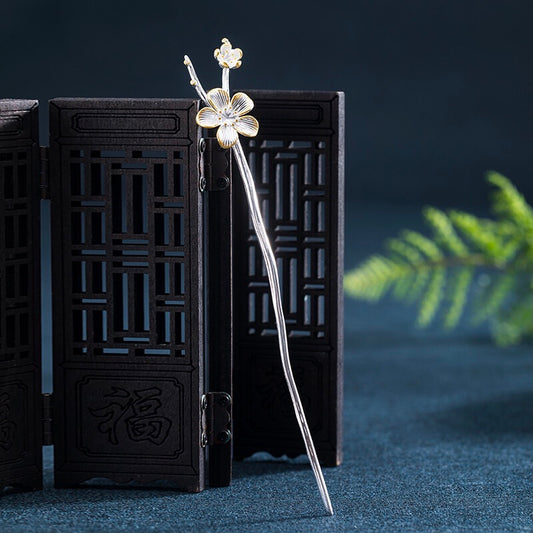 Plum Blossom Silver Hairpin
A contemporary Chinese floral hair ornament, not a reproduction of Korean Chinese ceremonial jewelry.
$46.99 DIY Chinese Embroidery Set
A hands-on introduction to stitching and layered textile construction in a modern craft kit.
$36.99 Bamboo Tea Cup Mat Set
A contemporary household object that highlights bamboo as a durable and versatile craft material.
$76.99Frequently Asked Questions
Where do the Buyi people live?
Mainly in Guizhou, especially Qiannan and Qianxinan, with communities in Anshun, Guiyang, Liupanshui, Yunnan, Sichuan, and elsewhere.
How many Buyi people live in China?
The National Ethnic Affairs Commission gives a population of 3,576,752 for 2020, approximately 3.58 million. This is a dated figure, not a live estimate.
What is distinctive about Buyi clothing?
Many traditions use blue, indigo, and white with weaving, dyeing, and embroidery. Garments vary by region and occasion.
How does wax-resist dyeing differ from brocade?
Wax-resist dyeing creates a design through resisted and dyed areas; brocade creates its pattern during weaving.
What are important Buyi festivals?
Third Month Third and Sixth Month Sixth are representative celebrations, alongside local new-rice observances and other holidays. Practices differ by locality.
Is Bayin seated singing a dance?
It is a narrative performing art combining singing with instrumental accompaniment. Buyi Bayin seated singing entered China’s first national intangible cultural heritage list in 2006.
References and Further Reading
Most linked sources are in Chinese. Population figures refer to 2020. Historical descriptions of customs should not be assumed to describe all families today.
- National Ethnic Affairs Commission: Buyi Overview. Population, distribution, and language; population dated 2020.
- Hekou County Government: Buyi Cultural Transmission. Local teaching, food preparation, and cultural practice in Yunnan.
- National Ethnic Affairs Commission: Buyi Historical Development. Historical names and connections; ancient categories require care.
- National Language Resource Monitoring and Research Center for Minority Languages: Buyi. Language surveys and development of the modern writing scheme.
- China Intangible Cultural Heritage Network: Buyi Dress. National entry, 2014; regional dress types and making practices.
- China Intangible Cultural Heritage Network: Wax-Resist Dyeing. Anshun extension entry, 2008; Miao and Buyi traditions.
- University of Hong Kong Libraries: Brocade Old Jacket Trim. A specific Buyi textile in the Gifts from Lanmama digital exhibition.
- National Office for Philosophy and Social Sciences: Exchange in Southern Ethnic Craft Traditions. Shared techniques and cultural exchange.
- National Ethnic Affairs Commission: Buyi Customs. Traditional housing, food, and festivals; not a universal description of contemporary families.
- CRI Online: Shitouzhai Village Conservation. Stone architecture and village renewal near Huangguoshu.
- Guizhou CPPCC Newspaper: Heritage Celebrations in Buyi Villages. Colored rice, rice cakes, and contemporary festivities.
- China Intangible Cultural Heritage Network: Buyi Third Month Third. Wangmo national entry, 2011; local festival and song practices.
- People’s Daily Online: Pianpo Sixth Month Sixth Festival. A contemporary festival program reported in 2025.
- China Intangible Cultural Heritage Network: An Introduction to Buyi Cultural Traditions. Bayin and other representative cultural practices.
- China Intangible Cultural Heritage Network: Buyi Bayin Seated Singing. National entry, 2006; narrative performing arts, Xingyi.