Wuhu iron painting is a sculptural art made by forging iron into lines and assembling those lines like brushwork in a Chinese ink painting. Originating in Wuhu, Anhui, it turns a blacksmith’s hammer, anvil, and fire into tools for creating landscapes, flowers, birds, figures, and calligraphy. The craft is not paint applied to metal: the iron itself becomes the “ink,” while open space becomes an active part of the composition.
Information Snapshot
What Is Wuhu Iron Painting?
Wuhu iron painting, often called tiehua in English-language descriptions, is a form of metalwork designed according to the principles of Chinese painting. Artisans heat, hammer, cut, bend, chisel, weld, and file iron components, then assemble them into a complete image. From a distance, the finished work can resemble black ink on pale paper. Up close, its ridges, joints, shadows, and changing reflections reveal that the “brushstrokes” are three-dimensional.
The art therefore sits between painting, sculpture, and forging. Its identity does not come from iron alone. What makes it iron painting is the deliberate translation of brush rhythm, composition, negative space, and pictorial subject matter into forged metal.

Origins: Fire, Iron, and Chinese Painting
Official heritage records place the emergence of Wuhu iron painting in the Qing dynasty, during the Kangxi era. The craft is closely associated with the Wuhu blacksmith Tang Peng—also remembered as Tang Tianchi—and the painter Xiao Yuncong. Their names symbolize the meeting of two knowledge systems: the blacksmith’s command of heat and metal, and the painter’s command of line and composition.
Local accounts describe Tang Peng studying painting and adapting its visual effects to forged iron. Stories about his encounters or exchanges with Xiao Yuncong are important to Wuhu’s cultural memory, but their detailed conversations should be read as transmitted narrative rather than a complete documentary record. The historically safe conclusion is that iron painting developed through contact between local forging skills and literati painting aesthetics.
Iron painting did not replace the brush with a hammer in a literal one-to-one way. It translated the logic of brushwork into another material—one that resists, bends, hardens, and casts a shadow.
Over time the craft expanded from small compositions to screens, hanging panels, and large architectural works. In 2006, Wuhu iron painting forging was included in the first batch of China’s national intangible cultural heritage list as a traditional craftsmanship project.

Materials, Tools, and the Forging Process
Traditional descriptions emphasize iron that can be repeatedly heated and forged. Exact alloy, thickness, and preparation vary by workshop and by the scale of the work. Common tools include a forge or heating source, hammers, anvils, chisels, punches, pliers, files, clamps, and joining equipment. Modern workshops may use updated heating and welding systems while retaining hand-controlled shaping and composition.

1. Designing the composition
The maker begins with a pictorial plan. Subject, scale, visual weight, and empty space must all be considered before iron components are joined.
2. Preparing and heating the iron
Bars, strips, or pieces are selected according to the lines and masses required. Heating makes the material workable, but temperature control matters: overheated or unevenly heated metal can lose clarity or strength.
3. Forging lines and textures
Hammering, lifting, pressing, bending, cutting, drilling, and chiseling create branches, leaves, rock contours, feathers, architectural lines, or calligraphic strokes. A single form may be reheated many times.
4. Layering and joining
Components are arranged from foreground to background and joined by welding or other fastening methods. The artisan continuously checks silhouette and negative space, because an extra line can make the image feel heavy.
5. Filing, correcting, and finishing
Joints are refined, edges are corrected, and the surface is cleaned and protected. The final work is mounted so that both the iron structure and the shadows it casts remain visible.
Terminology varies: official and local descriptions list operations such as forging, drilling, lifting, pressing, welding, filing, cutting, riveting, and chiseling. These words identify a repertoire of techniques, not one rigid sequence for every artwork.


Why Does Iron Painting Look Like Ink Painting?
The strongest works use iron as a line rather than merely as a solid mass. Thick and thin sections suggest pressure changes in a brushstroke. Dense clusters create visual weight; open areas suggest water, mist, sky, or distance. Slightly irregular hammered surfaces catch light differently throughout the day, giving a static image subtle movement.
Chinese painting also shaped its composition. A mountain scene need not fill every part of the frame. Empty space may carry as much meaning as the metal itself. Near and distant forms can be separated by line density rather than Western-style tonal modeling. Some scholarship and local interpretation connect this restraint with painting traditions influential in Anhui, including Xin’an-school aesthetics, but individual works and makers should be assessed rather than reduced to a single stylistic label.
Traditional Motifs and Cultural Meaning
Common subjects include pine, bamboo, plum blossom, orchids, birds, animals, figures, calligraphy, and mountain-and-water landscapes. Their meanings draw from the larger vocabulary of Chinese art, but symbolism is contextual rather than automatic.
- Pine often evokes endurance and longevity.
- Bamboo is associated with resilience, integrity, and an upright character.
- Plum blossom can suggest perseverance because it flowers in the cold season.
- Landscape invites contemplation of scale, movement, and the relationship between people and nature.
- Calligraphy tests the artisan’s ability to preserve the energy and proportion of written strokes in iron.

Iron Painting Compared with Related Metal Arts
| Form | Main method | Visual emphasis |
|---|---|---|
| Wuhu iron painting | Forged iron components shaped and assembled by hand | Chinese-painting line, negative space, pictorial composition |
| Cast-iron decoration | Molten metal poured into a mold | Repeatable volume and molded relief |
| Metal relief | Sheet metal hammered or repoussé-worked into raised surfaces | Modeled planes and three-dimensional depth |
| Paper cutting | Paper cut into positive and negative shapes | Flat silhouette and connected cut structure |
| Laser-cut wall art | Digitally designed sheet cut by machine | Clean repeatability; may imitate silhouette but lacks hand-forged line |
These categories can overlap in contemporary design, but “iron painting” should not be used as a generic label for every black metal wall panel. Provenance, process, workshop, and the quality of hand-forged line matter.
Formats, Display, and Care
Iron paintings may be framed as wall panels, made as screens, integrated into architectural decoration, or developed as smaller desk pieces. Lighting is especially important: side light reveals texture, while a pale backing helps the dark line remain legible.
Because iron is vulnerable to moisture and corrosion, stable indoor humidity, clean hands, and gentle dusting are preferable. Avoid abrasive polish unless a qualified conservator or the maker recommends it. For older or valuable works, inspect welds, mounting points, surface coatings, and any active rust before cleaning.
Living Heritage: Protection, Innovation, and Challenges
National listing gives Wuhu iron painting a formal protection framework, but transmission depends on people and practice. Contemporary initiatives include master-apprentice teaching, vocational education, public demonstrations, exhibition centers, and cultural tourism. Wuhu has also promoted technical standardization to document key processes and improve sustainable production.
Innovation appears in subject matter, scale, interior design, souvenirs, and collaborations with new technologies. These experiments can expand audiences, yet they also create a central challenge: keeping the forged line, structural judgment, and painterly composition that distinguish the craft from inexpensive machine-cut decoration.
Authentic transmission does not require every object to repeat an old model. It requires makers and audiences to understand which qualities are essential, which belong to a particular historical period, and which are contemporary reinterpretations.
Cultural Symbols and Craft Inspiration
The following active store pieces connect with botanical line, metal craftsmanship, and Chinese decorative symbolism. They are contemporary accessories, not Wuhu iron paintings, historical artifacts, or evidence of the traditional forging process.

Bamboo and Resilient Line
A botanical metal design that echoes bamboo’s association with resilience and upright character.
From $66.99
Botanical Metalwork
Enamel and metal turn bamboo leaves into a wearable contemporary motif.
$26.99
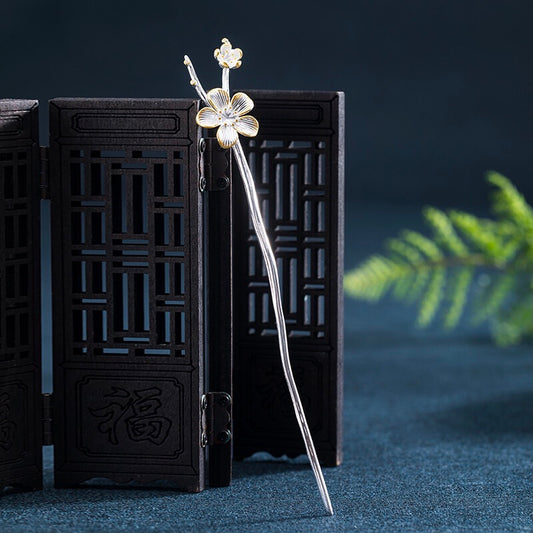
Branch, Flower, and Negative Space
An open branch structure shows how line and empty space can work together in small-scale metal design.
$24.99Frequently Asked Questions
What is Wuhu iron painting made of?
It is primarily made from forgeable iron shaped into lines, textured pieces, and structural elements, then joined and mounted as a pictorial composition.
Is iron painting painted on an iron plate?
No. In traditional Wuhu iron painting, the iron itself forms the image. It is forged and assembled rather than used merely as a surface for paint.
Where did iron painting originate?
It originated in Wuhu, Anhui Province, and is generally traced to the Qing dynasty’s Kangxi era.
Who is associated with its creation?
The blacksmith Tang Peng, also remembered as Tang Tianchi, and the painter Xiao Yuncong are central to its origin narrative. Detailed anecdotes should be distinguished from firmly documented facts.
Is Wuhu iron painting national intangible cultural heritage?
Yes. Wuhu iron painting forging was included in China’s first national intangible cultural heritage list in 2006 as project VIII-39, sequence 389.
How is iron painting made?
Artisans design the composition, heat and forge the iron, create lines and textures through multiple hand processes, assemble the components, refine the joins, and apply an appropriate finish and mounting.
Why are landscapes, bamboo, and pine common?
They belong to the established subject vocabulary of Chinese painting and allow artisans to explore expressive line, symbolic associations, depth, and negative space.
How is it different from laser-cut metal wall art?
Traditional iron painting depends on hand-forged variation, assembled structure, and a painterly understanding of composition. Laser cutting typically produces a digitally defined silhouette from sheet metal.
How should an iron painting be cared for?
Keep it dry, avoid abrasive cleaning, dust it gently, and watch for active rust or weakened joints. Valuable or historic works should be assessed by a qualified conservator.
Is every modern metal landscape an iron painting?
No. The name should be supported by process, provenance, workshop attribution, or a clear relationship to the Wuhu tradition.
References
- China Intangible Cultural Heritage: Wuhu Iron Painting Forging Technique
- Wuhu Municipal Government: Active Transmission of Iron Painting
- Wuhu Municipal Government: Contemporary Development of the Craft
- Wuhu Administration for Market Regulation: Standardization Work
- Wuhu Culture and Tourism Bureau: Cultural Development and Transmission