The Chinese Showcase journal China Intangible Cultural Heritage
What Is Painted Enamel? Brushwork on Copper in Qing China
Explore Qing dynasty painted enamel on copper, from brushwork and firing to museum examples and the differences between painted enamel, cloisonné, and falangcai.
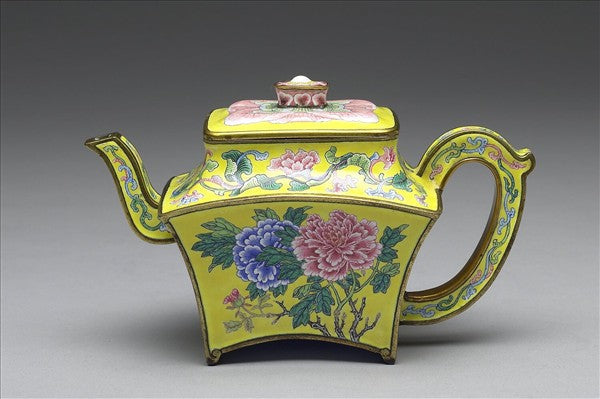
Painted enamel is a technique in which artisans brush enamel colors onto a prepared surface and fire them to set the design. In Qing China, copper was a common base. A smooth enamel ground gave painters room to shade petals, trace the folds of clothing, and arrange a landscape on the side of a vessel. [1]
On the Kangxi-period teapot shown above, blue and pink peonies sit against a bright yellow ground. The brushwork follows the shape of each panel, while the gilded edges mark the corners of the pot. Turn the vessel and another spray of flowers comes into view. [2]
Painted Enamel at a Glance
| Technique | How the design is made | Base material |
|---|---|---|
| Painted enamel on metal | Brushwork on a prepared enamel ground | Copper and other metals, including gold |
| Cloisonné enamel | Colors filled into compartments formed by metal wires | Usually a metal body |
| Falangcai porcelain | Overglaze enamel colors painted and fired onto porcelain | Porcelain |
How Is Painted Enamel Made?
The metalworker first shapes the vessel. In the copper-based method described by the Palace Museum, a coat of white enamel is applied and fired to create a smooth painting surface. The painter then uses colored enamel preparations to lay out the design. Some pieces also have painted gold details. The painted work is fired again so the colors bond to the prepared surface. [1]
A pale ground can give the painter an even surface to work on. The finished vessel can still have a rich yellow, blue, or other colored background. In the copper peony teapot, the shading along the edges of the flowers gives the petals depth. The peonies also sit at different angles on the vessel’s four sides, so the shape of the object determines the order in which the painting is seen. [2]
How Did Painted Enamel Develop in Qing China?
During the Kangxi reign, European painted enamel influenced experiments in the Qing imperial workshops. The Palace Museum’s catalogue records that artisans from Guangzhou and Europe worked in the court’s enamel workshop. The resulting pieces often joined imported techniques with vessel forms and motifs that were already familiar in Chinese decorative art. [3] [4]
A Kangxi-period flower basket in the Palace Museum makes that combination easy to see. Four lobes give the basket the outline of a begonia blossom. The yellow exterior carries large pink peonies and small lotus flowers. A sky-blue interior comes into view above the rim, and smaller sprays of flowers run along the handle. The museum identifies the strong yellow ground as a feature of mature Kangxi painted enamel. [3]
Guangzhou, historically known as Canton in English, was also a center of production. Its maritime trade connected local makers with objects and designs from abroad. Museum researcher Xia Gengqi dates the start of Guangzhou production to the Kangxi reign and records that substantial numbers of Guangzhou enamels reached the Qing court as tribute during the Qianlong reign. [5]
How Do Painted Enamel, Cloisonné, and Falangcai Differ?
Look first at the body of the object, then at the lines between colors. On painted metal enamel, the petal edges, leaves, and figures can all be formed with the brush. In cloisonné, thin metal strips are shaped and fastened to the body to form compartments. The artisan fills those compartments with enamel. After firing, the surface is commonly polished to bring the metal lines and the enamel into view. [1]

The two methods can appear on a single vessel. A Qianlong-period gold ewer in Beijing’s Palace Museum has a scrolling lotus design in cloisonné around its body. Four framed panels hold painted enamel plaques with scenes including landscapes and women in a garden. Following the lotus scroll leads the eye around the vessel, while the framed plaques draw attention to separate scenes. [6]

Falangcai is the name commonly used for Qing painted enamel on porcelain. The Palace Museum’s Kangxi yellow-ground peony bowl recalls the colors of copper painted enamels, with flowering branches spread across a bright background. The workshop process used a porcelain body supplied by the imperial kilns at Jingdezhen. The court workshops painted and refired it. A scientific study of excavated fragments also documents the use of low-temperature overglaze enamel colors. [7] [8]
How to Look at a Painted-Enamel Object
Look over the rim as well as around the outside. On the Kangxi copper incense burner below, the flowers stand out against yellow enamel on the body. The interior is pale blue, and the museum records a blue reign mark on white enamel on the underside. Those three areas become visible from different angles. The decoration takes account of how the object sits on a table and how it looks when it is picked up. [9]

On a plate, the painter can use a round field to lead the eye across a scene or around its edge. On a Qianlong gold cup and saucer set in Beijing’s Palace Museum, red bats punctuate a scrolling floral pattern. The flowers recur around the saucer, while the bats give the eye places to pause. [10]

On the flower basket, the largest peonies make the first impression. The smaller flowers on the handle come into view when you look more closely. Moving around the object reveals how the painter used the rim, the curves, and the spaces your hand would naturally touch.
The Chinese Showcase Edit
Enamel Jewelry from Chinese Showcase
Three contemporary pieces that use painted or hand-applied enamel on bird, butterfly, and floral motifs.


Frequently Asked Questions
What is painted enamel?
It is a decorative technique in which enamel colors are brushed onto a prepared surface and fired. Qing examples on metal often use a copper body.
How can you tell painted enamel from cloisonné?
Look at how the color boundaries are made. Painted enamel uses brushwork to define the design. Cloisonné uses metal wires to enclose the areas that are filled with color.
Is falangcai painted enamel?
Falangcai is painted enamel on porcelain. In Qing imperial production, white porcelain bodies supplied by Jingdezhen were painted and refired in the court workshops.
Why are some Kangxi painted enamels yellow?
Bright yellow grounds became a feature of mature Kangxi painted enamel. The ground sets off flowers and foliage painted in pink, blue, green, and other colors.
Sources and Objects Mentioned
- Palace Museum, Beijing. Enamel Techniques and Their Development at Court. Museum lecture and glossary describing painted enamel and cloisonné processes.
- National Palace Museum, Taipei. Copper Square Teapot with Peony Decoration in Painted Enamels, Kangxi reign. Collection record 1599.
- Palace Museum, Beijing. Kangxi-Marked Begonia-Shaped Basket with Painted-Enamel Peonies. Collection record Gu 00116765.
- National Palace Museum, Taipei. The Establishment of Qing Court Painted Enamel in the Kangxi Reign. National Palace Museum Research Quarterly, volume 24, number 3.
- Xia Gengqi. Production Centers and Technical Characteristics of Qing Painted Enamel. Palace Museum research on court workshops, Guangzhou, and other production centers.
- Palace Museum, Beijing. Qianlong-Marked Gold Ewer with Cloisonné and Inset Painted Enamel. Collection record Gu 00011449.
- Palace Museum, Beijing. Yellow-Ground Falangcai Bowl with Peonies, Kangxi reign. The catalogue describes the relationship between copper enamels and painted enamels on porcelain.
- Palace Museum Journal. Scientific Analysis and Technical Study of Black-Ground Falangcai Porcelain Excavated from the Palace Museum’s South Storehouse, 2018, issue 1.
- National Palace Museum, Taipei. Copper Incense Burner in Painted Enamels, Kangxi reign. Collection record 61736.
- Palace Museum, Beijing. Qianlong-Marked Gold Painted-Enamel Cup and Saucer with Floral Scrolls. Museum collection catalogue.
Image credits. The teapot and incense burner are from the National Palace Museum, Taipei. The floral detail, workshop image, and crane panel were supplied for this article. Product photographs are from the Chinese Showcase listings.
Stories, symbols and everyday objects
Our journal explores Chinese culture and design. Traditions and interpretations vary by region and source. For a purchase, use the specifications on the individual product page.
About Chinese ShowcaseQuestions or corrections? Contact us ↗