Information Snapshot
| Chinese name | 桑蚕丝织 / 蚕桑丝织 |
|---|---|
| Pinyin | Sāngcán sīzhī / Cánsāng sīzhī |
| Common English name | Chinese mulberry silk weaving / Chinese sericulture and silk craftsmanship |
| Silk source | Cocoons of the domesticated silkworm Bombyx mori, traditionally raised on mulberry leaves |
| Fiber type | Natural protein fiber, with a fibroin core naturally coated by sericin |
| Core stages | Mulberry cultivation, silkworm raising, cocooning, reeling, yarn preparation, dyeing, warping, weaving and finishing |
| Basic weave structures | Plain weave, twill and satin, plus gauze, figured, brocade and tapestry techniques |
| Traditional textile terms | Juan, ling, sha, luo, duan, jin and kesi |
| Important heritage regions | Zhejiang, Jiangsu and Sichuan, including areas around Hangzhou, Jiaxing, Huzhou, Suzhou and Chengdu |
| UNESCO status | Inscribed in 2009 on the Representative List of the Intangible Cultural Heritage of Humanity |
| Care priorities | Avoid strong alkalis, chlorine bleach, excessive heat, prolonged soaking, direct sun and rough friction |
What Is Chinese Mulberry Silk Weaving?
Mulberry silk begins with sericulture: the cultivation of mulberry trees and the raising of silkworms. When mature silkworms spin cocoons, they produce extremely fine filaments. Several filaments are commonly reeled together to make raw silk of a usable and reasonably consistent thickness.
The raw silk may then be combined, twisted, degummed, dyed and prepared for weaving. Longitudinal warp threads form the framework of the cloth, while transverse weft threads pass across them. Changing the way those threads interlace changes the fabric’s strength, drape, transparency, texture and luster.
Chinese mulberry silk weaving therefore joins agriculture, material knowledge, textile engineering and visual design. The China Silk Museum describes the heritage as extending from mulberry cultivation and silkworm raising to reeling, dyeing, weaving and associated customs.

A Brief History of Chinese Silk
Early silk dates should be treated as archaeological interpretations rather than origin legends presented as established fact. The National Museum of China states that sericulture was practiced at least 4,000–5,000 years ago and cites cocoons from the Qianshanyang site in Zhejiang.

Why Does Mulberry Silk Have Its Distinctive Luster?
A silk filament contains a fibroin core naturally coated with sericin. Fibroin provides much of the fiber’s structure, while sericin binds and protects the filaments within the cocoon.
Mulberry silk does not reflect light like a flat sheet of plastic. Its fine, irregular cross-section redirects light at slightly different angles, producing a softer, more changeable luster. The final appearance also depends on filament quality, yarn thickness, twist, degumming, weave, dyeing, finishing and wear.
Satin often looks especially glossy because longer floats place more yarn on the surface with fewer visible interlacing points. The Palace Museum notes that longer warp floats can improve satin luster and softness, although they may also reduce durability.

From Mulberry Leaf to Woven Cloth
The exact sequence varies by region, textile and workshop. These ten stages provide a practical overview rather than a single universal recipe.
1Growing Mulberry and Raising Silkworms
Silkworms are supplied with suitable mulberry leaves in a carefully managed environment. Temperature, humidity, cleanliness and feeding schedules affect development.
2Mounting and Cocooning
Mature silkworms are moved to structures that provide spaces for cocoon formation. Cocoon size, shape, cleanliness and filament quality influence later processing.
3Sorting and Stabilizing Cocoons
Cocoons are sorted by quality and intended use. Those selected for continuous reeling are normally dried or heated before the moth can break the filament.
4Cooking and Finding the Ends
Warm water softens the sericin coating. Workers brush or agitate the surface to locate loose filament ends; this does not necessarily remove all sericin.
5Reeling
Filaments from several cocoons are drawn together, guided and wound as one raw-silk strand. Reeling draws long filaments; spinning uses shorter fibers.
6Combining, Twisting and Degumming
Raw silk may be doubled or twisted for strength, firmness or crepe texture. Degumming removes some or most sericin, generally revealing a softer hand and clearer luster.
7Dyeing
Silk may be dyed as loose fiber, yarn or finished cloth. Traditional production used multiple dye systems, so not every historical-looking textile is naturally dyed.
8Warping, Drafting and Reeding
Warp yarns are arranged, wound onto a beam and drawn through heddles and the reed. For dense or patterned cloth, preparation can be as demanding as weaving.
9Weaving
The loom separates selected warp threads to create a shed. A shuttle or another device carries the weft through that opening, and the reed beats it into place.
10Finishing
Cloth may be washed, stretched, softened, pressed or otherwise finished. Finishing affects hand, width, stability, drape and surface appearance.


Plain Weave, Twill, Satin and Gauze
| Structure or method | How it works | Typical appearance | Practical note |
|---|---|---|---|
| Plain weave | Weft passes alternately over and under successive warp threads. | Even, stable and balanced | Usually less reflective than satin. |
| Twill | Interlacing points progress to form diagonal lines. | Supple, often dense, with a visible diagonal | Direction and scale can change the surface dramatically. |
| Satin | Longer warp or weft floats dominate the face. | Smooth, fluid and highly lustrous | Long floats may snag or abrade more easily. |
| Leno or gauze | Warp threads twist around one another to secure the weft. | Open, light and transparent but stable | Requires specialized warp control. |
| Figured weaving | Individual or grouped warp threads are controlled to form designs. | Patterns are woven into the cloth | “Jacquard” describes pattern control, not a fiber. |
| Tapestry weaving | Colored wefts work only where each part of a design requires them. | Painterly areas of color and detailed motifs | Used in traditions such as kesi. |
Understanding Traditional Chinese Silk Textiles
Historical Chinese textile names do not always correspond perfectly to modern English fabric categories. Meanings can also change across periods and regions.
Juan 绢
Commonly a fine, compact plain-weave silk used for clothing, painting, calligraphy and artwork mounting.
Ling 绫
Often a figured silk in which twill-based structures create subtle patterns for dress and mounting textiles.
Sha 纱
Generally a light, open silk gauze, although the precise construction varies by period and source.
Luo 罗
Associated with leno structures in which warp threads cross or twist to hold the weft, producing an airy yet stable textile.
Duan 缎
Satin. Its smooth face comes from weave structure, not silk content alone; viscose and polyester can also form satin.
Jin 锦
A broad category of richly patterned figured textiles often translated as brocade. Song brocade, Shu brocade and Nanjing Yunjin are distinct traditions.
Kesi 缂丝
A tapestry-weaving technique in which colored wefts are inserted only where required, allowing sharply defined, painterly imagery.
Why names matter
A generic silk garment should not be relabeled as Song brocade, Shu brocade, Yunjin or kesi without evidence of the actual technique and origin.

How to Identify Mulberry Silk
Read the fiber label
Look for a specific statement such as “100% mulberry silk” or a declared percentage in a blend. “Silky,” “silk touch,” “ice silk” and “art silk” do not establish the presence of natural silk.
Separate fiber names from fabric names
Satin, chiffon, georgette and organza usually describe structure, appearance or a commercial fabric category. None of these terms proves that a product is mulberry silk.
Understand momme weight
Momme expresses fabric weight. A higher number generally means more material per unit area, but it does not prove purity or overall quality. A lightweight scarf is not inferior merely because it has a lower momme weight than bedding.
Do not trust touch or shine alone
Viscose and polyester can imitate silk’s smooth hand and drape. Genuine silk may also be crisp, matte, sand-washed or textured after finishing.
Treat burn tests as inconclusive
A burn test damages the textile, presents a fire risk and is easily distorted by blends, dyes and finishing agents. For valuable or disputed products, an accredited laboratory is more dependable. China’s GB/T 44945—2024 specifies quantitative chemical analysis for mixtures of mulberry and tussah silk, illustrating why precise identification requires standardized testing.
Mulberry Silk, Tussah Silk and Silk-Like Fibers
| Material | Source | Common characteristics | Natural silk? |
|---|---|---|---|
| Mulberry silk | Domesticated silkworms traditionally fed mulberry leaves | Fine filament, smooth surface and soft, shifting luster | Yes |
| Tussah silk | Several wild or semi-domesticated silkworm species | Often more textured, with naturally tan or golden tones before processing | Yes |
| Viscose or rayon | Regenerated cellulose | Soft and fluid, capable of imitating silk’s drape | No |
| Polyester | Synthetic polymer | Durable, easy to care for and capable of a very glossy satin surface | No |
| Silk blend | Silk combined with another fiber | Performance depends on percentages and construction | Partly |
These are broad tendencies rather than foolproof visual rules. Bleaching, dyeing, spinning and finishing can substantially change a textile’s color, hand and luster.
Chinese Sericulture as UNESCO Intangible Heritage
UNESCO inscribed Sericulture and Silk Craftsmanship of China in 2009. The element is centered in communities in Zhejiang and Jiangsu and around Chengdu in Sichuan.
The listing recognizes a connected body of practice that includes mulberry cultivation, silkworm raising, silk reeling, thread preparation, textile design, weaving, apprenticeship and customs associated with sericulture communities.
The China Silk Museum identifies silk-floss making, ling and juan, Hangzhou luo, Song brocade, Shu brocade and Suzhou kesi among the practices represented in this wider heritage system. These are regional traditions with different tools and methods—not interchangeable names for the same cloth.
Heritage, Sustainability and Other Fact Boundaries
Handmade and machine-made
Modern silk production uses mechanized reeling, powered looms and electronic pattern control. Handweaving remains important for specialized structures, restoration, artistic work and cultural transmission. Neither method guarantees quality by itself.
Silk is not automatically a heritage product
A garment made from mulberry silk does not automatically qualify as Song brocade, Shu brocade, Nanjing Yunjin or kesi. Such names require evidence of technique, origin and production.
Natural is not automatically sustainable
Environmental impact depends on mulberry cultivation, water, energy, cocoon processing, dyes, wastewater treatment, transport, durability and end-of-life handling.
Legend and archaeology are different evidence
The story of Leizu teaching sericulture is culturally significant, but it is an origin legend. Archaeological objects, textile traces and scientific dating belong to a different category of evidence.
How to Care for Mulberry Silk
Always follow the permanent care label first. Dyes, weave structures, linings, embroidery and decorative threads can require different treatments even when the base fabric is mulberry silk.
- Use cool water only if the care label permits washing.
- Choose a mild, pH-neutral detergent intended for silk or wool.
- Do not use chlorine bleach or strong alkaline cleaners.
- Avoid prolonged soaking, scrubbing, twisting and wringing.
- Press out moisture gently with a clean towel and dry in shade.
- Iron at low temperature according to the label, preferably with a pressing cloth.
- Keep silk away from rough jewelry, exposed zippers and abrasive bags.
- Clean before storage and keep away from direct sun and excess humidity.
- Do not spray perfume, cosmetics or insect repellent directly onto the fabric.
Complex brocades, kesi, metallic-thread textiles, antique silk and heavily stained pieces are better handled by an experienced textile conservator or specialist cleaner.
Related Silk-Thread Crafts
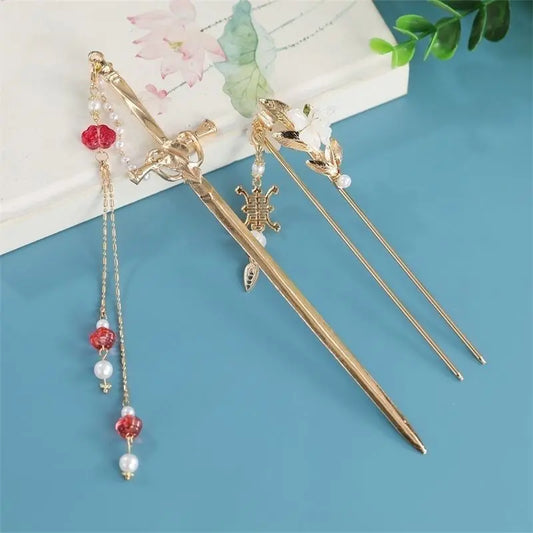
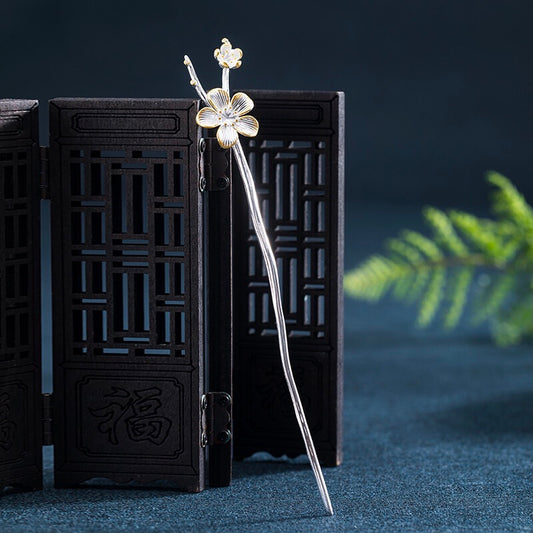
These currently available products connect to silk-thread flower making and Chinese hair ornaments. They are included for material and craft context; they are not presented as examples of loom-woven brocade or UNESCO-certified sericulture products.
Three Picks from Chinese Showcase
Three contemporary shop selections inspired by this article’s materials, motifs, or wider decorative themes. These products are not historical artifacts. Check each product page for current specifications, price, and availability.

Traditional Chinese Silk Thread Osmanthus Hair Clip – Handmade Ethnic Hair Accessory for Women
View product details
Handcrafted Ginkgo Tassel Earrings – Alloy, Shell Flowers & Silk Thread, Traditional Chinese Hanfu Accessories for Women
View product details
Blue Silk Velvet Peony Tassel Hairpin – Traditional Chinese Non-Heritage Cloisonné & Silk Flower Hair Accessory
View product detailsFrequently Asked Questions
What is mulberry silk?
It is a natural protein fiber obtained from cocoons made by domesticated silkworms traditionally raised on mulberry leaves.
Are mulberry silk and pure silk the same?
Mulberry silk is one type of natural silk. “Pure silk” is broader and may refer to mulberry, tussah or another natural silk, so check the specific label.
Is satin always made from silk?
No. Satin is a weave structure and can be made from silk, viscose, polyester or other fibers.
Does a higher momme number mean better silk?
Not necessarily. It generally means a heavier fabric, not automatically better fiber, construction or workmanship.
Does mulberry silk shrink?
Some silk fabrics change dimensions when wet or heated. The result depends on weave, finishing and washing method, so follow the care label.
When did UNESCO list Chinese sericulture?
Sericulture and Silk Craftsmanship of China was inscribed in 2009.
Are Song brocade, Shu brocade and Yunjin the same?
No. They are separate traditions with different regional histories, structures, looms and design systems.
Can a home burn test confirm mulberry silk?
No. It can offer limited clues but cannot reliably determine species, purity or blend percentage. Professional testing is more dependable.
References
- UNESCO — Sericulture and Silk Craftsmanship of China
- UNESCO — Decision 4.COM 13.22
- China Silk Museum — Main Elements of China’s Sericulture Heritage
- National Museum of China — Jade Silkworm
- The Metropolitan Museum of Art — Chinese Textiles
- The Palace Museum — Gold-Woven Satin Robe
- National Standard Information Public Service Platform — GB/T 44945—2024