Chinese Ronghua (绒花, róng huā) are three-dimensional ornaments made by arranging dyed silk floss around fine wire, then twisting, trimming, shaping, and assembling the fibers into flowers, birds, insects, fruit, and other forms. In English, “Chinese silk velvet flowers” helps describe their soft surface, but Ronghua are not normally cut from velvet fabric. Their cultural importance lies in the union of silk, patient handwork, wearable design, and regional craft knowledge associated especially with Nanjing and Yangzhou.
| Chinese name | 绒花 |
|---|---|
| Pinyin | róng huā |
| Recommended English | Chinese Ronghua; Chinese silk velvet flowers |
| Core materials | Dyed mulberry-silk floss, fine copper wire, and fittings such as hairpins, brooch backs, or earring hooks |
| Key visual features | A fine velvety surface, softly radiant silk fibers, concealed wire structure, and dimensional petals, leaves, wings, or fruit |
| Historical context | Part of China's long tradition of wearing flowers and making artificial floral ornaments; the exact origin of the present technique remains uncertain |
| Living craft centers | Nanjing and Yangzhou are especially important; related local traditions also exist elsewhere |
| Heritage status | Listed in 2007 in the first Jiangsu provincial intangible cultural heritage list as “Ronghua Making Technique,” code JSⅦ-20, with Nanjing and Yangzhou as applicant regions |
| Common associations | Prosperity, celebration, seasonal beauty, marriage, longevity, and good wishes—depending on motif and setting |
What Is Ronghua?
Ronghua is a silk-floss modeling craft. Its surface looks soft and almost feathered because many fine silk fibers are held together, clipped, and shaped rather than woven into cloth. A slim wire hidden inside the material acts like a skeleton: it gives a maker enough control to curve a petal, open a butterfly wing, or arrange a cluster of stamens without losing the delicate texture of silk.
The word is best retained as Ronghua in English. “Velvet flower” is useful as a descriptive translation, yet it can wrongly suggest a flower cut from commercial velvet. “Silk velvet flower” is more precise because it points to both the material and the visual effect.

History and Development
China has a very long history of wearing fresh and artificial flowers. Floral ornaments appeared in court dress, seasonal celebrations, weddings, theater, religious offerings, and everyday adornment. Ronghua developed within this wider world of silk production, flower wearing, and ornamental craftsmanship.
Evidence becomes clearer in later periods. By the Ming and Qing dynasties, artificial flowers and elaborate floral head ornaments were well established in urban workshops and elite consumption. Palace collections preserve many kinds of flower-shaped ornaments, but a museum object should only be called Ronghua when its catalog and material analysis support that identification. Similar appearance alone is not enough.
Nanjing became one of the best-known centers of the craft, supported by urban markets, festive customs, and skilled family workshops. Yangzhou also developed a strong tradition. In 2007, the “Ronghua Making Technique” was included in the first batch of Jiangsu provincial intangible cultural heritage, with Nanjing and Yangzhou named as applicant regions. This is an important provincial recognition; it should not be casually rewritten as a national-level designation.
Materials and Hidden Structure
The quality of a piece depends on more than expensive materials. Fiber length, evenness, dye consistency, wire thickness, hand tension, trimming angle, and the sequence of assembly all affect whether the surface appears lively or coarse.

How Are Ronghua Velvet Flowers Made?
Terminology varies among workshops, and several actions may be combined, but the craft usually follows a sequence like this:

How to Recognize Handcrafted Ronghua
Look closely at the surface and structure. Genuine silk-floss construction usually shows many short, fine fibers meeting along a hidden central wire. The edge appears soft rather than cut from a flat textile sheet. Petals and leaves can curve independently because their internal wires are modeled one by one.
Handmade work may show slight, intentional variation between two petals or mirrored wings. This is different from carelessness: good handwork still has balanced density, neat joins, coherent proportions, and secure mounting. A product described only as “Ronghua style” may imitate the appearance with flocking, molded plastic, synthetic chenille, or machine-made components. That does not automatically make it unattractive, but it is not the same material process.
Motifs, Symbolism, and Cultural Meaning
Ronghua is popularly linked with rónghuá (荣华), a phrase associated with glory and prosperity. The sound connection helps explain why the craft is often discussed as an auspicious ornament. It should be understood as a popular cultural association rather than proof of the word's historical etymology.
| Peony | Often associated with beauty, distinction, and prosperity; especially suited to festive and bridal settings. |
|---|---|
| Lotus | Can suggest purity and integrity, and may carry Buddhist associations in religious contexts. |
| Pomegranate | Its many seeds support associations with abundance and numerous descendants, especially in marriage imagery. |
| Peach | Commonly connected with longevity and birthday wishes. |
| Butterfly | May evoke spring, transformation, elegance, or romantic themes; meanings change with accompanying motifs. |
| Magpie | Frequently linked with joyful news and celebration. |
| Phoenix | Often expresses ceremonial dignity, auspiciousness, and feminine splendor in bridal or formal design. |
No motif has a single meaning in every place and period. Color, occasion, wearer, accompanying symbols, and local custom all influence interpretation. Modern marketing often compresses these associations into fixed “lucky meanings,” but historical practice was more flexible.
Regional and Contextual Variation
Nanjing Ronghua is widely recognized for fine silk handling, dimensional modeling, and richly layered floral or animal forms. Yangzhou Ronghua belongs to the same broad craft family while reflecting its own workshop lineages, local aesthetics, and market history. Beijing and other northern centers also preserve related artificial-flower traditions shaped by court consumption and urban craftsmanship.
These traditions should not be treated as interchangeable labels. A flower made today in one region may share materials and steps with another region while differing in density, color, mounting method, preferred subjects, or inherited terminology. The safest description identifies the maker, place, materials, and process rather than relying on appearance alone.
Ronghua and Related Chinese Floral Crafts
| Craft | Main material | How the form is built | Typical surface |
|---|---|---|---|
| Ronghua | Silk floss and fine wire | Fibers are aligned, wired, twisted, clipped, shaped, and assembled | Soft, dense, velvety, with a subtle silk sheen |
| Chan Hua | Fine thread over a shaped frame | Thread is wrapped around paper, cardboard, or metal components | Smooth, linear, and visibly thread-wrapped |
| Tongcao flowers | Pith paper from the rice-paper plant | Thin sheets are cut, dyed, pressed, and assembled | Light, matte, petal-like sheets |
| Textile silk flowers | Woven silk or other fabric | Petals are cut from cloth and often heated, pressed, or molded | Flat fabric grain or molded textile surface |
| Diancui | Historically, kingfisher feathers on metal | Feather pieces were set onto a metal base | Brilliant blue feather mosaic; blue Ronghua should not be mislabeled as Diancui |
Modern Use, Revival, and Responsible Preservation
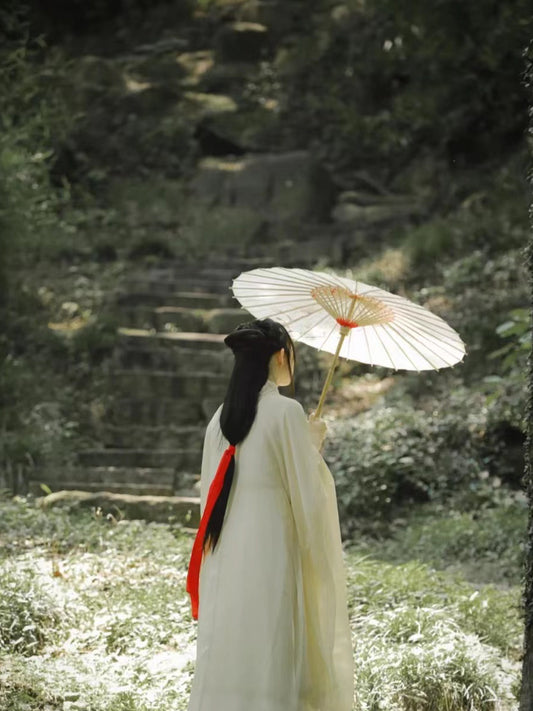
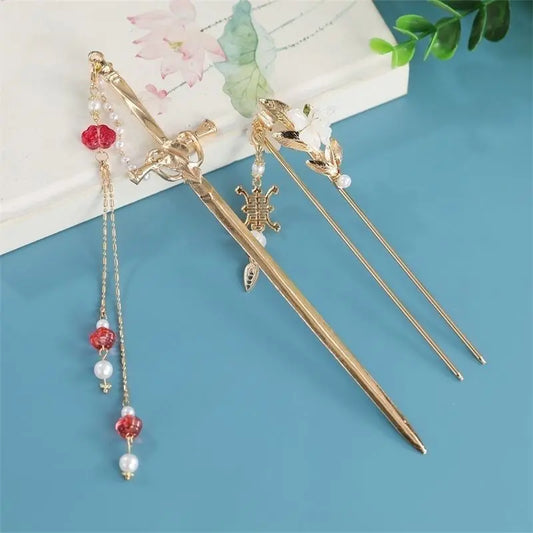
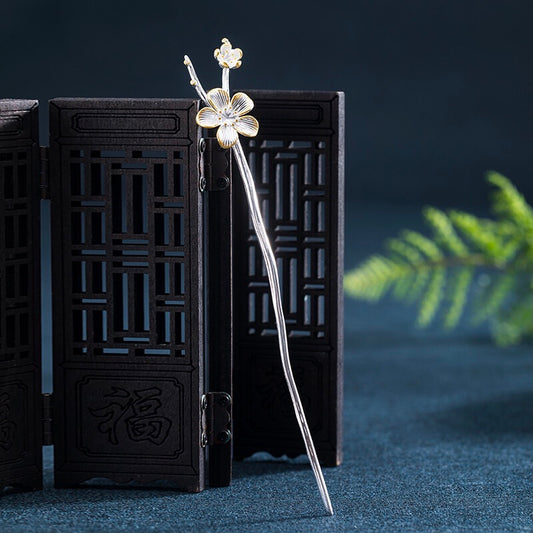
Contemporary makers adapt Ronghua into hairpins, brooches, earrings, bridal headpieces, Hanfu accessories, framed art, and small sculptural objects. Museums, heritage centers, workshops, educational programs, film and television costume design, and social media have all helped a new audience encounter the craft.
Revival is strongest when it preserves more than a visual style. The complete chain—silk preparation, dyeing, splitting, alignment, wiring, trimming, modeling, and assembly—contains the knowledge. Fair payment for skilled labor, clear maker credit, careful teaching, and honest material descriptions matter as much as popularity.
“Handmade” and “natural” also do not automatically mean environmentally perfect. Dye chemistry, water use, silk sourcing, copper, adhesives, packaging, and material waste all deserve attention. Responsible practice makes specific claims instead of treating sustainability as a decorative label.

How to Care for Ronghua
- Keep the piece dry and away from steam, perfume, hairspray, and oily cosmetics.
- Store it in a rigid box so the petals and wire framework are not compressed.
- Avoid long exposure to direct sunlight, which can fade dyed silk.
- Remove dust with a very soft, clean brush; do not rub the fibers.
- Lift the ornament by its metal fitting or stronger base rather than by a petal or wing.
- If a component bends, ask the maker for guidance before reshaping it repeatedly.
When buying, look for a clear material description, close-up surface photographs, maker or workshop attribution, and an explanation of the process. These cues help distinguish a fully handcrafted silk-floss piece from a machine-made imitation.
Ronghua Forms to Explore
The following contemporary pieces illustrate how one heritage technique can move between a hairpin, earrings, and a dual-purpose brooch. They are included as examples of wearable form and motif—not as evidence for historical claims made elsewhere in this article.
Three Picks from Chinese Showcase
Three contemporary shop selections inspired by this article’s materials, motifs, or wider decorative themes. These products are not historical artifacts. Check each product page for current specifications, price, and availability.

Traditional Chinese Velvet Flower Iris Earrings – Handmade Ronghua Ear Hooks for Hanfu and Qipao
View product details
Handmade Heritage Velvet Flower Brooch – Song Brocade & Bamboo Design, Retro Chinese Hanfu Accessory for Women
View product details
Blue Iris Handmade Velvet Flower Hairpin – Silk Thread Sandalwood Chinese Hair Stick
View product detailsFrequently Asked Questions
What are Chinese Ronghua flowers made of?
Traditional Ronghua are mainly made from dyed mulberry-silk floss arranged around fine copper wire. The silk creates the soft surface, while the hidden wire lets the maker bend petals, leaves, and wings into shape.
Are Ronghua real flowers?
No. Ronghua are handcrafted ornaments inspired by flowers, birds, insects, fruit, and other motifs. They can be worn as hair ornaments, brooches, earrings, or ceremonial accessories.
Did Ronghua originate in the Tang dynasty?
The Tang dynasty is often mentioned in popular origin stories, but the exact beginning of the present Ronghua technique is not securely documented. It is safer to place Ronghua within China's long history of flower wearing and artificial-flower making, with clearer evidence of flourishing production in later periods.
Is Ronghua a national-level intangible cultural heritage item?
The Ronghua making technique was included in Jiangsu Province's first provincial intangible cultural heritage list in 2007, with Nanjing and Yangzhou named as applicant regions. It should not be described as a national-level listing unless a separate official record is cited.
Why are handmade Ronghua expensive?
A refined piece requires careful silk preparation, even fiber alignment, controlled twisting, precise trimming, shaping, and assembly. Much of its value lies in skilled labor, consistent tension, and the maker's ability to turn soft fibers into a stable three-dimensional form.
What is the difference between Ronghua and Chan Hua?
Ronghua uses aligned silk floss and wire to create a clipped, velvety surface. Chan Hua generally builds forms by wrapping fine thread around a shaped frame, producing a smoother, more linear texture.
Can Ronghua get wet?
It is best to keep Ronghua dry. Water, steam, perfume, and high humidity can disturb the silk fibers, affect dyes, and weaken adhesives or metal fittings. Remove dust gently with a clean, soft brush.
What does Ronghua symbolize?
Ronghua is popularly associated with prosperity through the sound connection between ronghua and the phrase for glory and wealth. Individual meanings also depend on the motif and context, so symbolism should be treated as a cultural association rather than a fixed rule.
References
- Jiangsu Provincial People's Government. Notice on the First Batch of Jiangsu Provincial Intangible Cultural Heritage, 2007.
- Nanjing Folk Customs Museum / Nanjing Intangible Cultural Heritage Museum. Ronghua craft display and inheritance materials. Accessed August 2026.
- Nanjing Federation of Social Sciences. Intangible Cultural Heritage Inheritor Classroom: Nanjing Ronghua, 2021.
- Nanjing University Art & Culture Innovation Lab. ZHI Art: Nanjing Traditional Craft Intangible Cultural Heritage Virtual Exhibition—Ronghua. Accessed August 2026.
- Nanjing Museum Administration. Materials on Ronghua preservation, exhibitions, and inheritors. Accessed August 2026.
- Jiangsu intangible cultural heritage protection and list materials. Accessed August 2026.