Chanhua is a Chinese wrapped-thread flower craft that turns silk thread, paper forms, and fine wire into dimensional flowers, birds, fruit, insects, and auspicious ornaments. Its surface can resemble embroidery, yet it does not depend on fabric; its volume can resemble velvet flowers, yet it is built through wrapping rather than clipped silk floss.
A small Chanhua ornament may contain dozens of individually wrapped components. Each petal or leaf begins as a carefully shaped form, is covered with aligned thread, and is then folded, curved, joined, and assembled. The result is both graphic and sculptural: a design made from lines that becomes a three-dimensional object.

Chinese Chanhua at a Glance
| Chinese name | 缠花 |
|---|---|
| Pinyin | Chánhuā |
| Common English terms | Chinese wrapped-thread flowers, silk-thread wrapped flowers, or wrapped-thread flower craft |
| Main materials | Silk or embroidery thread, paper or card forms, copper or iron wire, adhesive, beads, and accessory findings |
| Core method | Wrapping aligned thread around shaped forms, then folding and assembling the parts |
| Representative regions | Hubei, Fujian, Taiwan, and communities maintaining Minnan or Hakka traditions |
| Traditional uses | Hair ornaments, wedding decorations, ritual flowers, children's accessories, hanging ornaments, and household display |
| Important caution | “Chanhua” does not refer to one nationally uniform style or one single heritage-list designation |
What Is Chinese Chanhua?
The word chan means to wind or wrap, while hua literally means flower. In practice, “flower” can refer more broadly to an ornamental pattern. Makers use thread to cover a shaped paper-and-wire structure, producing a smooth surface of closely aligned lines.
The wrapped pieces can remain flat or be bent into volume. A flower may be assembled from separate petals, a butterfly from mirrored wings, and a bird from many small feather-shaped units. Pearls, beads, metallic thread, tassels, and hairpin bases may be added after the principal forms are complete.
Chanhua belongs to the wider world of Chinese artificial-flower and ornamental crafts. Its identity lies not in flower imagery alone, but in the relationship between the inner form, the wrapping direction, the tension of the thread, and the final assembly.
Regional Chanhua Traditions
Yingshan Chanhua
Centered in Yingshan County, Hubei, this tradition is known for compact, intricate, and highly flexible compositions. It draws on visual ideas associated with paper cutting, embroidery, weaving, painting, and small-scale sculpture.
Minnan Spring Flowers
Known as chun zai hua in parts of Fujian and Taiwan, these flowers have been closely associated with weddings, celebrations, and family ritual. Red and pink forms are especially familiar, although local styles and rules differ.
Hakka Wrapped Flowers
Hakka traditions in parts of northern Taiwan include floral, bird, insect, and aquatic forms. Uses may include hair ornaments, children's caps, bridal objects, lamps, pendants, and flowers prepared for ritual display.
Regional names should not be treated as interchangeable labels. A Minnan wedding flower, a Hakka ritual flower, and a contemporary Yingshan hair ornament may share wrapping techniques while belonging to different social and ceremonial systems.
How Old Is the Chanhua Craft?
Popular introductions often state that Chanhua began in the Ming dynasty and flourished in the Qing. That wording is difficult to verify for every regional tradition. Official cultural-asset documentation from Taiwan notes that the craft's origin is not clearly recorded in surviving official sources; local records, folk studies, and oral history indicate that wrapped flowers were present there by the Qing period at the latest.
The movement of people between Fujian and Taiwan helped carry customs and household skills across the strait. In Hubei, Yingshan Chanhua developed within the cultural landscape of the Dabie Mountains and survived largely through family and apprenticeship transmission.
A responsible history therefore avoids assigning all Chanhua to one inventor, one court, or one exact dynasty. It is better understood as a group of long-lived folk practices shaped by local marriage customs, ritual life, domestic craft, and changing markets.
Materials Used in Chanhua
- Silk or embroidery thread: creates the visible surface and gives the work its soft sheen.
- Paper or card: forms the concealed body of petals, leaves, wings, fruit, and other components.
- Fine metal wire: reinforces edges and allows the finished unit to bend and hold its shape.
- Adhesive: secures paper layers, thread ends, and assembled components.
- Pearls, beads, stones, and metallic details: add centers, highlights, and movement.
- Hairpin, clip, brooch, or earring findings: adapt the wrapped forms for contemporary wear.
Natural silk can produce an especially subtle luster, but modern makers also use rayon and embroidery thread. Material choice does not by itself determine cultural authenticity. Provenance, technique, regional knowledge, and honest labeling matter as much as fiber content.
How Is Chanhua Made?
The complete image is planned, then separated into petals, leaves, wings, berries, or other workable units.
Each outline is transferred to paper or card and cut. Wire may be paired with the edge when the piece needs structure.
Colors are matched to the composition. Silk may be divided and aligned to achieve a consistent width and sheen.
Thread is wound evenly around the form. Corners, pointed tips, and curves require careful tension so the paper is fully covered.
The wrapped unit is bent, pinched, curved, or layered to turn a flat component into a dimensional one.
Components are joined, arranged, and attached to a pin or decorative base. Beads, stamens, tassels, and other details are added last.
Contemporary Yingshan practice has described the work through a longer sequence that includes drawing, dividing forms, cutting, color selection, preparing silk, wrapping, changing thread, turning, joining, and final shaping. Names and order vary between makers, but precision remains central.
Common Motifs and Their Meanings
Flowers
Peony, plum blossom, chrysanthemum, lotus, lily, jasmine, and other flowers appear frequently. Their meanings depend on occasion and locality. In wedding settings, floral abundance can communicate celebration, continuity, and hopes for a flourishing household.
Fruit and seeds
Pomegranate is especially associated in some marriage traditions with many descendants because of its numerous seeds. Peach, gourd, berries, and other fruit forms may suggest longevity, blessing, seasonality, or simply visual richness.
Birds, butterflies, and animals
Phoenixes, magpies, butterflies, fish, deer, and tortoises add movement and narrative. A symbol's meaning should be read together with the object, wearer, region, and ceremony rather than assigned through shape alone.
Color
Red is prominent in many festive and bridal forms, but color customs are not universal. Some regional wedding practices historically distinguished relatives or roles through different flowers and colors. Modern jewelry uses a much broader palette.
Traditional Uses of Chanhua
Wrapped flowers have been used as hair ornaments, bridal decorations, offerings, children's accessories, household display, pendants, and ceremonial objects. In some communities, their meaning came from who wore or displayed them, when they were used, and how they were passed between family members.
Industrial artificial flowers and changing wedding customs reduced everyday demand during the twentieth century. Because many techniques were transmitted within families or through apprenticeship, the disappearance of a few makers could also mean the loss of local forms and terminology.
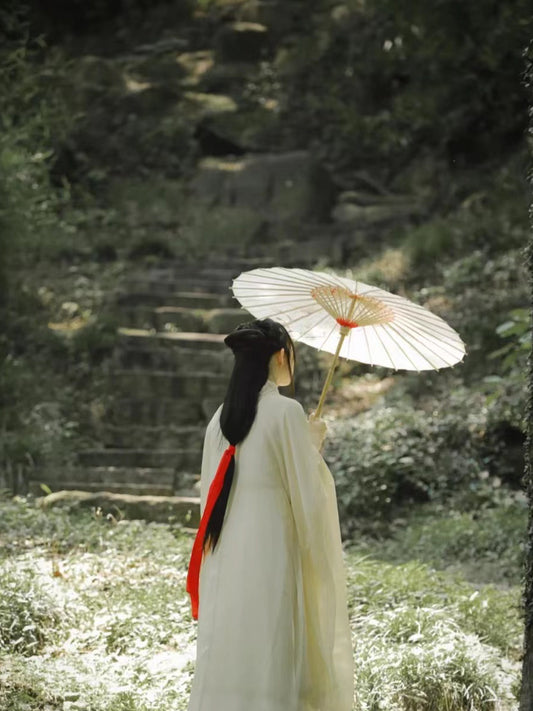
Today, Chanhua appears in museum education, cultural festivals, craft workshops, Hanfu styling, stage costume, jewelry, brooches, fans, and interior decoration. These uses show living adaptation, but a contemporary fashion piece should not automatically be described as an unchanged historical bridal or ritual object.
Chanhua, Ronghua, Pith Flowers, and Embroidery
Chanhua
Thread is wrapped around paper-and-wire forms, leaving an orderly lined surface. Separate units are folded and assembled into volume.
Ronghua
Silk floss is dyed, brushed, clipped, shaped, and attached to wire, producing a soft velvet-like surface rather than a wrapped one.
Pith flowers
Thin sheets cut from plant pith are shaped into translucent, lightweight petals. Their material appearance differs clearly from thread wrapping.
Embroidery builds images with stitches on fabric, while Chanhua can stand independently from a textile ground. These crafts may be combined in contemporary work, but outward resemblance is not enough to identify technique.
The Aesthetic Language of Wrapped Thread
Chanhua's beauty begins with line. Seen closely, the viewer notices the direction and density of individual threads. From a greater distance, those lines merge into smooth fields of color. The object therefore carries qualities of drawing, embroidery, and sculpture at the same time.
Successful work depends on even tension, clean corners, controlled color changes, and balanced assembly. More complexity is not always better. A restrained flower with well-proportioned petals may show greater skill than a crowded ornament with no clear visual center.
Because many components remain slightly flexible, flowers and leaves can be adjusted after assembly. This gives the finished ornament a lively quality: petals open at different angles, branches turn toward light, and tassels respond to movement.
Safeguarding and Contemporary Revival
Yingshan Chanhua is recognized within Hubei's provincial intangible cultural heritage system. Cultural institutions, representative practitioners, universities, exhibitions, and workshops have helped document and teach the craft. In Fujian and Taiwan, Minnan and Hakka wrapped-flower traditions are also maintained through cultural-asset programs, community practice, and specialist instruction.
Safeguarding is more than reproducing a fashionable flower. It includes recording regional vocabulary, marriage and ritual knowledge, old templates, color conventions, family histories, and the decisions of living makers. Innovation is valuable when it is transparent about what has been retained, adapted, or newly invented.
How to Care for Chanhua Ornaments
- Keep the ornament dry and avoid perfume, hairspray, and cleaning liquids.
- Store it in a rigid box so petals, wire stems, and tassels are not crushed.
- Lift the piece by its hairpin or main support rather than by a petal or leaf.
- Remove dust with a clean, very soft brush; do not rub the thread surface.
- Protect bright colors from prolonged direct sunlight.
- If a component bends, adjust the supporting wire slowly instead of pulling the thread.
Contemporary Chanhua Designs
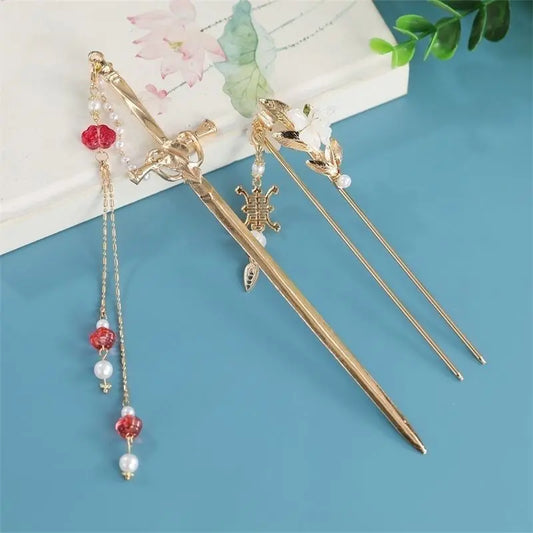
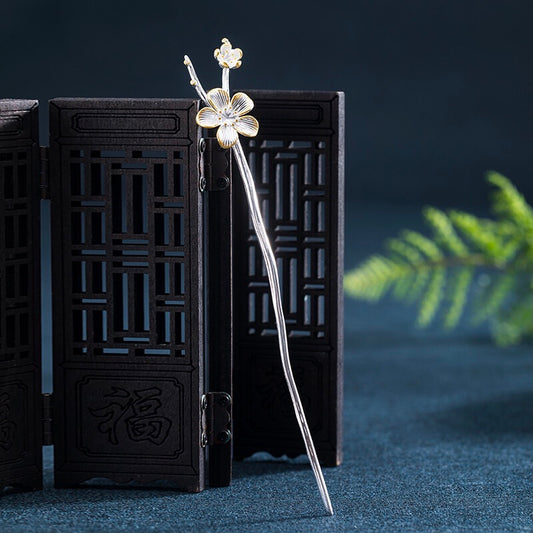
The following six active store selections use wrapped-thread construction in contemporary hair accessories. They illustrate different floral, botanical, butterfly, cloud, pearl, and tassel compositions. They are modern wearable designs, not historical artifacts or universal examples of one regional ceremonial style.

Closely wrapped berry forms and branching stems create a compact, richly colored botanical composition.
$36.99
Wrapped wings, warm color, and a freshwater-pearl accent translate butterfly imagery into a light hair ornament.
$36.99
Thread-wrapped flowers, beads, and suspended details balance a stable floral cluster with gentle movement.
$36.99
A curved wrapped-thread cloud form is paired with pearls for a restrained contemporary interpretation.
$24.99
Teal wrapped flowers, sandalwood, pearls, and a hanging element combine color, texture, and movement.
$26.99
Slender wrapped leaves and small pearls emphasize the linear rhythm possible in Chanhua construction.
$36.99Frequently Asked Questions
What does Chanhua mean?
Chan means to wind or wrap, and hua means flower. The name refers to forming decorative objects by wrapping thread around shaped supports.
Is Chanhua one national intangible cultural heritage project?
No. Chanhua includes several regional traditions with different protection and registration histories. Yingshan Chanhua, for example, is safeguarded within Hubei's provincial ICH system.
Is Chanhua the same as Ronghua?
No. Chanhua wraps thread around a form, while Ronghua uses prepared silk floss to create a soft velvet-like surface.
Is a spring flower the same as Chanhua?
Minnan spring flowers are a regional form within the broader wrapped-flower tradition. Not every Chanhua object should be called a spring flower.
Does Chanhua always use natural silk?
No. Traditional and contemporary makers may use silk, rayon, or embroidery thread. Materials should be described accurately.
Can Chanhua depict subjects other than flowers?
Yes. Birds, butterflies, fish, fruit, animals, characters, and geometric or auspicious forms can all be made with wrapped components.
Was Chanhua invented in the Ming dynasty?
That claim is popular but not securely documented for every regional tradition. Available evidence supports a long folk history, with some regional records clear by the Qing period.
How can I identify wrapped-thread construction?
Look for aligned threads covering paper-and-wire forms, visible shaped edges, and multiple wrapped units assembled into a dimensional design.
How should a Chanhua hairpin be stored?
Keep it dry in a rigid box, protect it from pressure and direct sunlight, and avoid pulling individual petals or threads.
Are modern Chanhua accessories historical reproductions?
Not automatically. Many are contemporary designs using or adapting wrapped-thread techniques and should be labeled as such.
References
- China Intangible Cultural Heritage: Yingshan Chanhua in Hubei heritage presentation and contemporary design
- Bureau of Cultural Heritage, Taiwan: Wrapped-Flower Craft (Spring Flowers)
- Xinhua News Agency: Chanhua craft, materials, process, and contemporary use
- Public documentation from Hubei cultural institutions concerning the provincial safeguarding of Yingshan Chanhua.
- Regional studies of Minnan spring flowers, Hakka wrapped flowers, marriage customs, and domestic craft transmission.