Chinese decorative art often communicates through repetition. A flower can suggest a season, an animal can embody a virtue, and a geometric unit can turn a simple line into an image of connection. The Chinese lock pattern, most accurately called suoziwen (锁子纹), belongs to this last group. Its interlocking units resemble linked rings, chain mail, or compact three-way joints arranged into a continuous field.
The word “lock” can be misleading in English. Suoziwen is not merely a picture of a padlock. It is primarily a geometric lock-chain pattern in which one unit catches, supports, or visually continues into the next. The linked construction gives the design its traditional associations with continuity, mutual protection, unity, lasting relationships, and blessings that do not easily break apart.
| Term | Basic form | Common association |
|---|---|---|
| Suoziwen (锁子纹) | Linked rings, interlocking Y-shaped units, or chain-like repeats | Continuity, connection, mutual support, protection |
| Linked-loop pattern | Round or transformed loops joined in sequence | Unbroken fortune and enduring relationships |
| Stacked interlock | Tightly connected forked or triangular units | Collective strength and defensive structure |
| Lock-shaped motif | The visible outline of a physical lock | Keeping peace, health, or good fortune close |
| Longevity lock | A wearable metal, jade, or carved lock-shaped ornament | Family wishes for health, safety, and long life |
What Is the Chinese Lock Pattern?
Suoziwen is a family of Chinese geometric patterns built from repeated units that appear to link together. Some examples resemble small rings passing through one another. Others use shallow arcs to form triangular connections. The version in the reference image has three branches meeting around a central point, creating a compact Y-shaped unit with an outer angular contour. Repetition turns this isolated form into an ordered surface.
The pattern may be called a lock-chain pattern because its visual logic resembles a chain: no unit stands entirely alone. Each part appears connected to adjacent parts, and the design becomes stronger and more complete as it expands. This distinguishes suoziwen from a decorative drawing of a lock, key, or keyhole.

Traditional terminology is not always completely uniform. Historical records, museum descriptions, craft manuals, and modern pattern books may use related terms such as linked-lock pattern, interlocking-loop pattern, or suowen. Individual examples also vary by region, material, period, and workshop. It is therefore more accurate to understand suoziwen as a design family rather than one rigid symbol with a single authorized outline.
How Is Suoziwen Constructed?
The beauty of the lock pattern comes from disciplined repetition. The designer first establishes a small unit, such as a loop, paired arc, forked Y, or compressed chain link. That unit is then translated, reflected, or rotated so that the open edges align with the next unit.
Two-Direction Repetition
A two-direction repeat extends horizontally or vertically. It is suitable for borders on sleeves, collars, table textiles, architectural beams, ceramic rims, and furniture edges. The eye follows the linked units along a path, making the pattern feel continuous even when it occupies a narrow band.
Four-Direction Repetition
A four-direction repeat expands upward, downward, left, and right. It can cover a full field of silk, brocade, wallpaper, lacquer, or carved wood. The negative space between the linked units is as important as the line itself. When carefully proportioned, the gaps form secondary hexagons, diamonds, or floral compartments.
Rotation and Mutual Support
The three-branch version has rotational balance. Each arm occupies roughly one-third of the circle around the center. When these units repeat, one arm appears to receive or answer the arm of another unit. This visual interdependence explains why the pattern so readily suggests cooperation and mutual support.
In weaving, the unit must also respect the structure of warp and weft. Curves may become slightly stepped, and fine spaces may be simplified. In embroidery, the outline can be softened with thread. In carving or metalwork, the same design often becomes broader and more angular so that thin sections do not break.
The Historical Development of the Chinese Lock Pattern
One widely cited explanation connects suoziwen with the construction of chain mail. A suit of chain mail is made from many small metal rings interlinked into a flexible protective surface. A single ring provides little defense; the combined network distributes force and creates strength. Traditional pattern scholarship links this physical structure with the chain-like and stacked-ring forms of suoziwen.
Chinese textual references to fine interlinked armor help explain the name. In visual culture, the practical arrangement could be abstracted into a repeated geometric surface. The pattern did not need to reproduce every metal ring literally. Craftspeople simplified the linked logic into arcs, forked units, and compact loops that were easier to weave, paint, embroider, or carve.
Related forms appear in discussions of Song decorative design, including architectural color-pattern traditions. By the Ming and Qing periods, lock-chain patterns were widely recognized in textile decoration. Pattern histories describe linked-loop and stacked-interlock examples in brocade and embroidery, while literary discussions often cite the “suozi brocade back cushion” mentioned in Dream of the Red Chamber as evidence that lock-pattern textiles belonged to refined interiors.
This development should not be reduced to one exact invention date. Geometric interlocking designs can emerge in several crafts, and surviving objects do not always preserve the names once used by their makers. What is clear is that the lock pattern became an established part of the Chinese geometric vocabulary and was especially visible in later imperial-period textiles and decorative arts.
Main Types of Chinese Lock Pattern
Linked-Loop Suoziwen
This form uses circles, oval loops, or transformed round compartments joined in sequence. It may also be described through names such as linked rings, ancient-coin loops, or nine-linked rings. The internal spaces can remain empty or hold small flowers, auspicious characters, or geometric details.
Stacked Interlock Pattern
The stacked type is denser. Its single unit can resemble a paired Y, a shallow triangular loop, or an interlocking fragment of armor. Repeated units overlap visually and seem to brace one another. This makes an effective ground pattern because it fills space evenly without requiring a large central subject.
Three-Branch Lock Pattern
The motif in the user's reference belongs to a visually distinctive three-branch group. A central junction divides into three short channels, each enclosed by an angular outer line. The result resembles a chain element viewed as a simplified symbol. It can be repeated directly, offset in alternating rows, or combined with hexagonal compartments.

Flower-Filled Lock Pattern
Craftspeople often combine a geometric skeleton with natural imagery. A lock pattern can create compartments that hold lotus, peony, plum blossom, or small roundels. The geometry supplies order; the flower supplies seasonal color and an additional auspicious meaning. The result is richer than either element alone.
What Does the Chinese Lock Pattern Symbolize?
The cultural meaning of suoziwen comes mainly from its linked structure. These associations are traditional readings, not claims that a pattern has supernatural power.
Continuity and an Unbroken Bond
Because one link follows another without an obvious end, the design can suggest continuity. It may express a relationship that lasts, a family line that continues, or a tradition passed from one generation to the next. In a wedding context, connected rings can be read as a wish for enduring companionship.
Protection Through Connection
The chain-mail association introduces a second idea: protection is created collectively. One ring is limited, but many rings can form armor. As decoration, the pattern can therefore suggest security, steadiness, and people supporting one another. It is a visual metaphor, not actual protective equipment.
Unity and Mutual Support
Every unit appears to depend on nearby units. This makes suoziwen suitable for representing cooperation, family connection, community, or shared responsibility. Its meaning lies not in uniformity alone but in the way separate parts participate in a larger whole.
Prosperity That Continues
When round links are combined with flowers or coin-like compartments, they can suggest prosperity without interruption. The blessing becomes especially clear when peonies, lotus flowers, bats, or auspicious characters fill the open spaces. The geometric framework carries the idea of continuity while the secondary motif defines what is hoped to continue.
Enduring Affection
Interlocked units are difficult to separate visually, so they can represent commitment and “hearts joined together.” The association is appropriate for marriage gifts and commemorative objects, although the exact meaning always depends on the surrounding motifs and the occasion.
Where Was Suoziwen Used?
Textiles are among the most natural homes for lock patterns. Brocade can repeat a small unit across a wide field, producing a surface that looks intricate from nearby and calm from a distance. Embroidery can place the pattern on collars, sleeves, hems, cushions, canopies, bags, and household furnishings.
In garments, a small lock pattern works well as a quiet ground behind larger dragons, flowers, birds, or roundels. It can also appear alone on areas where a large pictorial motif would be too dominant. The regular scale gives the cloth visual richness without making every section compete for attention.
Architectural decoration uses the same principle. A continuous band can follow a beam, frame a panel, or organize the border of painted and carved surfaces. The repeated joints naturally emphasize edges and transitions. Lacquer, wood, metal, and ceramic crafts can adapt the motif through engraving, inlay, painting, openwork, or relief.

Material changes the character of the pattern. Woven silk makes the interlocks soft and fine. Gold thread gives them brilliance. Carved wood produces stronger shadows, while metal engraving emphasizes precision. A successful adaptation preserves the linked rhythm even when the lines become thicker or more angular.
How Is Suoziwen Different From Related Patterns?
Suoziwen and Huiwen
Huiwen, or the meander pattern, is built from repeated right-angle turns resembling the Chinese character 回 or a continuous squared spiral. It emphasizes directional turning. Suoziwen emphasizes links, forks, and joined units. Both can form borders or all-over grounds, but their internal logic is different.
Suoziwen and the Endless Knot
The endless-knot or pan-chang pattern appears to be formed from one continuous cord weaving over and under itself. Suoziwen more often looks like multiple repeated units connected into a field. Both can suggest continuity, but the endless knot emphasizes a single unbroken path while the lock pattern emphasizes linked components.
Suoziwen and Tortoiseshell Pattern
Chinese tortoiseshell pattern, or guibeiwen, is organized around connected hexagons or elongated hexagons. The shape of the cell is its defining feature. Suoziwen is recognized by its chain-like, ring-like, or forked interlocking units, even when the negative spaces happen to form hexagons.
Suoziwen and a Lock-Shaped Motif
A lock-shaped motif represents the outline of a physical lock. It may have a rounded, ruyi-shaped, lotus-shaped, fish-shaped, or ingot-like body. Suoziwen is an abstract repeating structure. A designer can combine them, but they should not be treated as identical.
The Relationship Between Suoziwen and the Chinese Longevity Lock
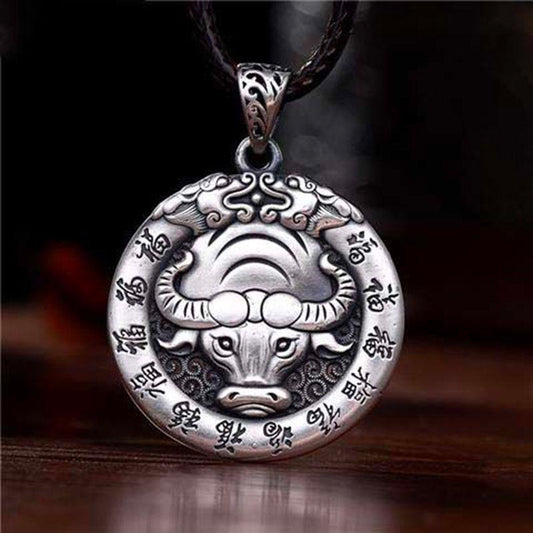
The Chinese longevity lock, commonly called changmingsuo (长命锁), is a wearable lock-shaped ornament traditionally associated with family wishes for a child's health, safety, and long life. It may be made from silver, gold, jade, or other materials and decorated with characters and auspicious images.
Common lock designs include ruyi silhouettes, floral forms, fish, lotus, gourds, the “Five Sons” theme, qilin imagery, and phrases wishing long life or good fortune. The lock shape gives visual form to the hope of “keeping” peace and blessing close. It represents family affection and a social custom, not a guarantee against illness or misfortune.
Suoziwen and the longevity lock share ideas of connection and keeping something precious secure, but they belong to different design categories. One is primarily a repeating geometric pattern; the other is an object and jewelry form. A longevity lock can itself be decorated with suoziwen, ruyi clouds, flowers, or meanders, bringing both traditions together.
Using the Chinese Lock Pattern in Modern Design
Suoziwen adapts well to contemporary jewelry, textiles, packaging, interiors, and graphic identity because its geometry is modular. A designer can enlarge one unit into a central emblem, reduce it into a subtle texture, or use a two-direction repeat as a border.
The strongest modern designs preserve the connection logic. Simply placing unrelated Y shapes next to one another may imitate the silhouette without maintaining the interlocking rhythm. Spacing, line weight, negative space, and the meeting points between units should be tested at the final production scale.
Color can be contemporary without erasing the pattern's identity. Indigo and ivory create a quiet textile effect; gold on dark lacquer feels formal; monochrome linework suits packaging and digital applications. The pattern does not need dragons, clouds, red backgrounds, and gold borders all at once to appear Chinese.
Respectful use also requires accurate naming. A new illustration inspired by a traditional pattern should be described as an interpretation rather than a historical artifact. When a surviving textile or museum object is reproduced, its source, date, collection, and image rights should be checked.
Recommended Chinese Longevity-Lock Jewelry
These pieces use the physical longevity-lock form rather than the repeating suoziwen structure. They are suitable for readers who appreciate the lock as a cultural expression of family care, continuity, and good wishes.

Double-Fish Longevity-Lock Pendant
This silver pendant combines a traditional lock silhouette with paired fish, joining wishes for continuity with a lively aquatic motif.
View Product
Hetian Jade Ruyi Lock Earrings
The compact lock-shaped studs combine pale jade with a ruyi-inspired outline, offering a quieter everyday interpretation of the longevity-lock form.
View Product
Pearl and Red Agate Longevity-Lock Necklace
Pearls, red agate, turquoise-colored details, and a tassel give this lock necklace the layered character of a traditional-inspired statement piece.
View ProductFrequently Asked Questions
What is the Chinese lock pattern called?
It is commonly called suoziwen (锁子纹), which can be translated as lock-chain pattern or interlocking-link pattern. The term describes a family of repeating geometric designs rather than one fixed outline.
What does the Chinese lock pattern mean?
Its linked structure is associated with continuity, lasting relationships, unity, mutual support, protection, and prosperity that continues. The exact meaning changes according to the surrounding motifs and use.
Is suoziwen a picture of a padlock?
No. Suoziwen is primarily an abstract repeating pattern based on linked or interlocking units. A picture shaped like a physical lock is better described as a lock-shaped motif.
Where did suoziwen come from?
Traditional pattern scholarship commonly connects it with the interlinked construction of chain mail. Related lock-chain forms entered textile, architectural, and decorative vocabularies and became especially familiar in Ming- and Qing-period crafts.
What is the three-branch Chinese lock pattern?
It is a suoziwen variant built around a Y-shaped central junction with three balanced arms. Repeated by rotation and translation, it creates an interlocking field suitable for textiles, borders, and surface decoration.
What is the difference between suoziwen and huiwen?
Huiwen uses repeated right-angle turns or squared spirals. Suoziwen uses linked rings, curved triangular forms, or forked interlocking units. Both can be continuous borders, but they are constructed differently.
Is the Chinese lock pattern the same as the endless knot?
No. The endless knot usually appears as one cord weaving continuously over and under itself. Suoziwen generally looks like multiple repeated units linked into a larger surface.
What is a Chinese longevity lock?
A longevity lock, or changmingsuo, is a lock-shaped ornament associated with family wishes for health, safety, and long life. It is an object and jewelry form, not the same thing as a repeating lock-chain pattern.
Can suoziwen be used in modern design?
Yes. Its modular geometry suits jewelry, fashion, packaging, interiors, and digital graphics. Good adaptations preserve the interlocking rhythm and identify new artwork as an interpretation rather than a historical artifact.
Does the Chinese lock pattern provide protection?
It symbolizes protection in a cultural and decorative sense, partly through its association with connected armor and secure bonds. A motif does not provide guaranteed physical or supernatural protection.
Conclusion
The Chinese lock pattern is a lesson in how geometry can carry cultural memory. Suoziwen turns small rings, arcs, and forked units into a connected field in which every part appears to support another. That structure explains its enduring associations with continuity, unity, protection, lasting affection, and blessings that extend through time.
It is also important to name the design accurately. Suoziwen is a repeating interlocking pattern; a lock-shaped motif depicts a physical lock; and the longevity lock is a wearable object associated with family good wishes. Understanding these differences makes the pattern easier to recognize and allows modern designers to draw from it with greater clarity and respect.
References
- History of Classic Chinese Textile Patterns, chapter on geometric patterns, including the concept, forms, and symbolism of suoziwen.
- History of Classic Chinese Textile Patterns, Zhejiang Sci-Tech University National Experimental Teaching Center.
- Study of the Pattern Meaning and Cultural Symbolism of Traditional Longevity Locks.
- Gold and Silver Filigree Craftsmanship, China Intangible Cultural Heritage Network.
- Auspicious China Through Traditional Patterns, People's Daily Online Culture.
Recommended Categories