The Chinese Showcase journal Chinese culture
Chinese Buddhism and Its History, Beliefs and Traditions
How Buddhist teachings reached China, took shape in translation and temple life, and found expression in pilgrimage, sculpture, and devotional objects.
Chinese Buddhism refers to the Buddhist traditions that took shape across Chinese-speaking communities and the wider historical regions of China. Chinese-language Buddhist traditions developed primarily within Mahayana Buddhism and include Chan and Pure Land practice. Tibetan Buddhist lineages and Theravada traditions among Dai and other communities in the southwest have their own histories, scriptures, and institutions.
Buddhism arose in South Asia. Its teachings reached China over centuries through overland and maritime travel, then took new forms in translation, monastic life, pilgrimage, and art. That history explains why a temple might place a solemn image of Shakyamuni in its main hall and a smiling Budai by the entrance, or why one monastery can practice both Chan meditation and the recitation of Amitabha’s name.
What Do Chinese Buddhists Believe?
The Three Jewels and Taking Refuge
The Three Jewels (三宝, sānbǎo) are the Buddha, the Dharma and the Sangha. The Buddha is the awakened teacher and exemplar. The Dharma is the teaching and the path it opens. The Sangha is the community that preserves and practices it. In formal usage, sangha can refer specifically to the monastic community or to those who have attained insight. In everyday temple language, it can also describe a wider community of practitioners. To take refuge (皈依, guīyī) is to turn to the Three Jewels for guidance and commit oneself to practice. Some temples hold a public refuge ceremony. Refuge and undertaking the Five Precepts are related commitments, and temples can confer them separately or together.
The Four Noble Truths and the Middle Way
The Four Noble Truths describe duḥkha, the suffering and instability that mark conditioned experience, its origin in craving, its cessation and the path leading to cessation. A pleasant experience can be genuinely pleasant and still be unable to provide lasting security. The teachings ask what happens when we cling to pleasant experiences, resist change or treat something temporary as a permanent possession. Nirvāṇa (涅槃, nièpán) names liberation, understood in this context as the ending of the craving and ignorance that sustain the cycle of rebirth.
In the traditional first sermon, the Middle Way avoids indulgence in sensual pleasure and severe self-mortification. It is expressed as the Noble Eightfold Path. Right view and intention cultivate wisdom. Right speech, action and livelihood guide ethical conduct. Right effort, mindfulness and concentration train the mind. These are mutually supporting aspects of practice.
Karma, Rebirth and Non-Self
Karma (业, yè) concerns intentional action and its consequences. An early discourse identifies intention as central to karma because intention is expressed through what people do, say and think. Traditional Buddhist teachings apply that causal account across lifetimes. Rebirth belongs to saṃsāra, the ongoing cycle of birth and death. The teaching of non-self (无我, wúwǒ) examines the body, feeling, perception, mental formations and consciousness and finds that all change with conditions. Buddhist accounts of rebirth explain continuity through causes and conditions. A changing sequence can carry consequences forward without an independent, permanent soul passing from body to body. Different schools explain that continuity in different ways.
The Bodhisattva Path and Emptiness
Mahāyāna traditions give particular prominence to the bodhisattva (菩萨, púsà), a being who aspires to awakening for the benefit of all beings. The path joins wisdom with compassion through qualities such as generosity, ethical conduct, patience and meditation. Guanyin, the Chinese name of Avalokiteśvara, gives this ideal a recognizable form as a bodhisattva associated with responding to suffering.
Emptiness (空, kōng) concerns the absence of inherent, independent existence. A living thing or a relationship comes about through conditions and changes as those conditions change. It still matters how people respond to it. This helps explain why Mahāyāna texts can investigate emptiness while also urging concrete acts of compassion.
The History of Chinese Buddhism
Buddhism is securely attested in China by the Eastern Han dynasty. It grew through networks that linked South Asia, Central Asia and East Asia, as monks, translators, merchants and pilgrims carried texts and practices along overland and maritime routes. The tradition that Emperor Ming dreamed of a golden figure and sent envoys west became associated with White Horse Temple in Luoyang. The dream belongs to the history of how Buddhists remembered their beginnings. An imperial edict dated 65 CE, preserved in the Book of the Later Han, provides firmer evidence. It refers to Buddhist observances associated with Liu Ying, the Prince of Chu. The edict establishes that Buddhism was known in court circles by then, while its exact date of arrival remains uncertain.
Eastern Han to the Northern and Southern Dynasties
In the second century, Luoyang became an early center of Buddhist translation. An Shigao, a monk from Parthia, translated texts concerned with meditation and the workings of the mind. Lokakṣema, who came from the Kushan world, helped make early Mahāyāna scriptures available in Chinese, including a text on the perfection of wisdom. Translators and local collaborators had to decide when to keep the sound of a foreign word and when to convey its meaning in Chinese. The resulting vocabulary gave later readers ways to debate and teach ideas such as liberation, meditation and emptiness.
During the centuries of political division after the Han, Buddhist communities developed in both northern and southern centers. Around the beginning of the fifth century, Kumārajīva led a translation team in Chang’an. His versions of the Lotus Sutra and the Diamond Sutra became widely read. In the south, Buddhist nuns built their own communities and took part in cross-cultural networks. Baochang’s sixth-century Biographies of Buddhist Nuns records that the fourth-century nun Jingjian led a community and received ordination with three other women from an assembly of monks. In the 430s at Jiankang, now Nanjing, visiting Sri Lankan nuns, including a senior nun recorded as Tiesaluo, took part with monks led by Saṅghavarman in full ordinations for women. Participation by both communities is known as dual ordination.
Sui and Tang Dynasties
Under the Sui and Tang dynasties, monasteries, translation projects and commentarial traditions developed across China. Zhiyi’s teachings on the Lotus Sutra took shape around Mount Tiantai. During the Tang, Xuanzang’s team brought a wide range of Indian texts into Chinese, Shandao taught devotion to Amitābha, and scholars such as Fazang developed Huayan’s reading of the Flower Garland Sutra. The growth of different traditions reflected the questions people brought to common scriptures, from how to meditate to how to live as a bodhisattva.
The Four Major Persecutions of Buddhism in Imperial China
Chinese historical writing groups four major suppressions of Buddhism under the name Sān Wǔ Yī Zōng (三武一宗), referring to three rulers whose titles contain Wu and to Later Zhou Emperor Shizong. The campaigns took place across five centuries. Each court set its own rules for ordination, religious property and the use of temple buildings.
| Ruler and dynasty | Date | What the court did |
|---|---|---|
| Emperor Taiwu, Northern Wei | 446 | In the wake of unrest in the north, the court issued severe orders against Buddhist monasteries, images and clergy. Monks were killed and temples suppressed. Buddhist patronage resumed under his successor in 452. |
| Emperor Wu, Northern Zhou | 574 and 577 | The court abolished Buddhist and Daoist institutions in Northern Zhou in 574 and required clergy to return to lay life. After conquering Northern Qi in 577, it extended the measures to those territories. |
| Emperor Wuzong, Tang | Peak in 845 | The Huichang suppression closed monasteries and shrines, confiscated property and forced many monks and nuns to resume lay status. Court orders treated religious land, labor and tax exemptions as political and economic questions. The next emperor reversed major restrictions after 846. |
| Emperor Shizong, Later Zhou | 955 | The court abolished many temples without official authorization, regulated ordination and requisitioned a large share of bronze Buddhist images for coinage. Authorized monasteries could continue operating under tighter controls. |
The Northern Zhou emperor in this sequence and Emperor Wu of Liang were separate rulers. Xiao Yan of Liang promoted Buddhism at his southern court, decades before the Northern Zhou suppression. Looking at each edict in its own setting also explains why Buddhist transmission continued through later revivals, other courts, local communities and networks beyond the reach of any one decree.
Song, Yuan, and Ming Dynasties
During the Song, Chan gained a strong place in public monasteries and developed a substantial literature of sayings, encounters and monastic rules. Devotion to Amitābha continued alongside Chan. A person might learn meditation from a Chan teacher, recite Amitābha’s name, or commission a scripture in memory of a relative. Woodblock printing also made large collections of Buddhist texts reproducible. The scriptures and practices that circulated this way reached readers and patrons outside monastic study halls.
From the Yuan onward, different Buddhist lineages received support in different settings. Yuan rulers patronized Tibetan Buddhist teachers and commissioned Buddhist art in Himalayan styles. At the early Ming court, the Yongle emperor commissioned sculptures, textiles and ritual objects associated with Tibetan Buddhism. In late Ming Chinese-language Buddhism, the monk Zhuhong taught laypeople and brought Chan and Pure Land practice together in his writing and teaching.
Buddhism in the Dali Kingdom
The Dali Kingdom (937–1253) was an independent polity centered on the Erhai basin in what is now Yunnan. Its rulers developed a Buddhist culture with ties to Chinese-language scripture, regional ritual and art that traveled across southwestern China and neighboring parts of Asia. Buddhism had already flourished under the preceding Nanzhao kingdom. At the Dali court, Buddhist images and rites could express royal authority as well as devotion and hopes for protection.
A surviving example is the late twelfth-century Scroll of Buddhist Images, associated with the painter Zhang Shengwen and held by the National Palace Museum. The long handscroll shows King Duan Zhixing making an offering, then unfolds into a sequence of Buddhist figures and scenes. The museum relates sections of it to the Heart Sutra and practices for the protection of the kingdom. The royal portrait and liturgical images show that court patronage supported the making and use of devotional objects. Bronze figures of Acuoye Guanyin, a regional form of Avalokiteśvara, give another view of Buddhist devotion in Dali. The Three Pagodas of Chongsheng Temple provide a surviving architectural counterpart. The tallest pagoda is associated with the Nanzhao period, and the group records a sacred site in use across dynastic changes.
Buddhism under the Qing Dynasty
Qing Buddhism included Chinese-language Chan and Pure Land communities as well as Tibetan Buddhist lineages. The Manchu court patronized Tibetan teachers, commissioned images and ritual works and built sites where religious ceremony could also serve imperial diplomacy. In 1744, the Qianlong emperor converted Yonghegong in Beijing from a former imperial residence into a Geluk monastery. At Chengde, the court commissioned temple complexes with architectural forms associated with different regions. The Putuo Zongcheng Temple drew on the Potala Palace as a model, placing a reference to Lhasa in the landscape of the Qing summer court.
Qing emperors took different personal approaches to religion. Shunzhi cultivated close relationships with Chan monks, including Yulin Tongxiu. The Palace Museum preserves a gold-ink copy of the Diamond Sutra associated with his court. The Palace Museum’s chronology records that in 1660 Yulin dissuaded him from renouncing the world. Some accounts describe a shaving of the head and associate Shunzhi with the Dharma name Xingchi, a name taken in Buddhist life. Historians have stronger evidence for his court’s account of his death from smallpox in 1661 than for the later story that he left the throne and lived as a monk on Mount Wutai. A Dharma name or tonsure can establish ties to a teacher. Full monastic ordination requires further evidence.
Buddhist communities in the region developed in multiple languages and settings. The Chinese-language traditions discussed here developed primarily in the Mahāyāna world. Tibetan Buddhism developed its own lineages, liturgies and scholastic traditions across the Tibetan and Himalayan world. The Pali-based Theravāda practiced historically among Tai-speaking Dai communities in Xishuangbanna also belongs to the history of Buddhism in the southwest and has longstanding connections to mainland Southeast Asia. Chinese Buddhist scriptures, teachers and ordination traditions traveled to Korea, Japan and Vietnam, where local communities adapted them in different ways. The traffic also ran toward China, as monks traveled there to study or seek texts.
In the early twentieth century, the monk Taixu used schools, lectures and publishing to rethink how Buddhists were educated. The Wuchang Buddhist Institute, founded in 1922, exemplifies how new forms of education grew from older traditions of Buddhist study and exchange.
How Buddhist Scriptures Were Translated into Chinese
Translation was often collaborative. A scholar or monk who knew the source language explained or recited the text, Chinese-speaking assistants discussed the sense of the passage, and editors shaped the result into written Chinese. A translator’s name on a sutra may thus identify the person who guided a team. As texts circulated, readers compared earlier and later versions and worked out how words such as prajñā, wisdom, should be understood.
Kumārajīva’s early fifth-century Chinese Lotus Sutra and Diamond Sutra became influential in part through their readable style and repeated use. In the seventh century, Xuanzang’s project produced a much larger translation of the Perfection of Wisdom collection, traditionally arranged in 600 fascicles. In different ways these workshops shaped the Chinese vocabulary of Buddhist philosophy. Translators also brought across rules for ordination and daily monastic life, the practical texts that supported Buddhist institutions.
Catalogues were needed to make the growing collection usable. Zhisheng’s Kaiyuan Catalogue of Buddhist Teachings, completed in 730, identified translations and assigned works to groups. The effort to catalogue, copy, and later print collections helped create what readers call the Chinese Buddhist canon, or Dàzàngjīng (大藏经). Different editions preserve different selections of sutras, monastic rules, commentaries, histories, and Chinese writings. Some Indian and Central Asian works survive complete through translations of this kind.
The Eight Schools of Chinese Buddhism
A widely used later classification groups Chinese-language Buddhism into eight historical schools or traditions. The terms describe different kinds of affiliation. Some identify a lineage or a body of teachings, some emphasize a scripture or practice, and Vinaya concerns the discipline needed to sustain a monastic community. A monastery or practitioner could draw on several of these traditions.
- Chan Buddhism (禪宗) stresses awakening through the practice of meditation and the direct realization of Buddhist teachings. The Chinese word chán comes from the Indian term dhyāna, meaning meditation. Chan communities also studied scriptures, followed monastic codes and developed a literature of teaching encounters. Chan is known as Zen in Japanese, Seon in Korean and Thiền in Vietnamese.
- Pure Land Buddhism (淨土宗) centers on Amitābha Buddha and the aspiration to be reborn in his Pure Land, Sukhāvatī, where conditions favor progress toward awakening. The Chinese term niànfó means recollecting the Buddha and often refers to reciting Amitābha’s name. Visualization and other devotional practices also appear in Pure Land scriptures and commentaries.
- Tiantai (天台宗) takes its name from Mount Tiantai and gives a central place to the Lotus Sutra. Zhiyi’s works explain how to relate different Buddhist teachings and develop meditative calming and contemplation. The tradition later informed Tendai in Japan.
- Huayan (華嚴宗) takes its name from the Flower Garland Sutra. Its teachers explored how things arise in dependence on one another and how the whole is present in each particular thing. Fazang’s image of a golden lion uses the relationship between the metal and the lion’s form to help explain these ideas.
- Faxiang, or Chinese Yogācāra (法相宗), studies consciousness, perception and the way mental habits shape experience. The translations of Xuanzang and the commentaries of his disciple Kuiji helped establish its technical vocabulary in Chinese.
- Sanlun, or the Three Treatises school (三論宗), draws on Chinese translations of Indian Madhyamaka works. Its thinkers explored emptiness by examining claims that things possess a fixed, independent nature. Jizang was a major interpreter of those treatises.
- Vinaya, or the Discipline school (律宗), concerns ordination, precepts and the rules for communal monastic life. Daoxuan was an influential interpreter of the Dharmaguptaka Four-Part Vinaya, which became a major basis for Chinese-language monastic discipline.
- Esoteric Buddhism (密教) includes ritual traditions involving mantras, mandalas, consecration and instruction from qualified teachers. Tang figures such as Amoghavajra translated texts and transmitted rituals. Some of these teachings traveled from Tang China to Japan, where they helped shape Shingon. Tibetan Buddhist lineages also use esoteric practices and have their own distinct histories of transmission.
Important People in the History of Chinese Buddhism
The history of Chinese Buddhism includes people born far beyond China, as well as Chinese monks, nuns and lay practitioners. Each helped change what could be taught, read or practiced in Chinese. Their biographies also show how ideas moved through translation rooms, pilgrim routes, convents and ordinary households.
Translators and Pilgrims
An Shigao and Lokakṣema show how varied the earliest translation projects were. One brought practical meditation and analytical texts into Chinese, while the other made early Mahāyāna works available. Two centuries later, Kumārajīva, who came from Kucha, worked with a team in Chang’an. His version of the Lotus Sutra became central to later Chinese Buddhist reading and commentary.
Faxian departed in 399 in search of Buddhist teachings and monastic texts. He reached India overland, visited Sri Lanka, and returned to China by sea. His own travel account describes places, communities and practices he encountered. Yijing followed a maritime route through Śrīvijaya on his way to India. His writings describe monastic education, daily practice and discipline in the communities he knew.
Xuanzang (玄奘) and the Journey to Nālandā
Xuanzang (c. 602–664) traveled to South Asia during the Tang dynasty to study Buddhist doctrine and obtain texts in their source languages. At Nālandā, in present-day Bihar, he studied with the scholar Śīlabhadra. He visited monastic and pilgrimage sites, returned to Chang’an in 645 and led a team that translated scriptures, treatises and monastic materials into Chinese. His translations helped Chinese readers study Yogācāra and the large body of literature on the perfection of wisdom.
Xuanzang’s observations became the Great Tang Dynasty Record of the Western Regions, compiled with the monk Bianji. The record describes routes, monasteries and local customs, together with traditions the traveler heard along the way. It remains a source for the religious geography of seventh-century South and Central Asia. Centuries later, his journey became the basis for the novel Journey to the West.
Jianzhen (鉴真), Known in Japan as Ganjin
Jianzhen (688–763) was a Tang monk and teacher of the Vinaya, the rules governing monastic life and ordination. Japanese monks invited him to teach and help establish a formal ordination lineage. After several attempts at the sea crossing, Jianzhen reached Japan and entered Nara in 754. He helped establish an ordination platform at Tōdai-ji and founded Tōshōdai-ji in 759, creating a center for the study of monastic discipline. His work strengthened ordination in a country where Buddhism had already been practiced and supported for generations.
Emperor Wu of Liang (梁武帝), Xiao Yan
Emperor Wu of Liang, born Xiao Yan, ruled from 502 to 549. His court at Jiankang sponsored monasteries, public lectures and the study of Buddhist scriptures. In a surviving discourse addressed to the clergy, he urged monks and nuns to abstain from alcohol and meat, connecting abstention with compassion and the karmic consequences of killing. His position helped shape the place of vegetarianism in Chinese monastic life. His repeated visits to Tongtai Monastery became the most dramatic examples of how far he was willing to take his patronage.
Why Did Emperor Wu Give Himself to Tongtai Monastery?
The ceremonies are described as shěshēn (舍身), the ritual offering of one’s person. At Tongtai, the ruler could take on the role and clothing of a Buddhist devotee. At several of the ceremonies, members of the court made a monetary offering to redeem him. He then went back to the palace. Each return is part of the story. Xiao Yan continued to rule after these episodes. Many accounts count four occasions. The Book of Liang explicitly calls three of them self-offerings, while the History of the Southern Dynasties also identifies the 546 stay that way.
| Year | What the histories record |
|---|---|
| 527 | Emperor Wu made a self-offering at Tongtai and returned to the palace within days. |
| 529 | He held a large Buddhist assembly and offered himself again. The History of the Southern Dynasties describes him wearing Buddhist robes, sleeping on plain bedding and teaching the Nirvana Sutra. Officials brought money to redeem him. |
| 546 | The Book of Liang describes a visit and scripture lectures. The History of the Southern Dynasties also describes his self-offering and a redemption payment led by the crown prince and other officials. |
| 547 | He again held a major assembly and offered himself at Tongtai. The annals record another monetary redemption by officials and his return to the palace. |
How Did Buddhist Patronage Affect Liang’s Finances?
The redemption payments were a conspicuous part of wider court spending on monasteries and religious ceremonies. For 529 and 547, the Book of Liang records the sum in each case as yī yì wàn (一億萬) in cash. The wording conveys the scale claimed by the annals. The financial record is too incomplete to calculate the modern value, the share paid out of the state treasury, or the share of total dynastic spending. The entries put the courtiers at the center of the payments. Temple building and public assemblies also committed money, materials and labor.
Criticism came from within the Liang administration. In a memorial preserved in the History of the Southern Dynasties, the official Guo Zushen objected to the wealth and scale of Buddhist institutions. He also warned that clergy fell outside ordinary household registers, which mattered to a government that depended on registered households for taxes and service. His memorial shows that the cost of religious patronage and pressure on state resources were already matters of debate. Later writers made temple expenditure a prominent explanation for Liang’s decline. The administrative record of the rebellion also points to decisions about a northern commander, military defeats and divisions inside the imperial family.
How Did Hou Jing’s Rebellion End Emperor Wu’s Reign?
In 547, Emperor Wu accepted the allegiance of Hou Jing, a northern general who had broken with the Eastern Wei leadership. Defeats in the north left Hou based at Shouyang. When the Liang court renewed negotiations with Eastern Wei, Hou feared he might be exchanged for Xiao Yuanming, a captured Liang prince. He rose against Liang in 548 and won the cooperation of another imperial prince, Xiao Zhengde. Hou’s forces besieged Taicheng, the walled palace district of Jiankang. The long siege brought severe hunger, and the palace district fell in 549.
Hou Jing held the emperor under guard inside the palace. The Comprehensive Mirror for Aid in Government records that his meals were restricted. The History of the Southern Dynasties says he became gravely ill and could no longer eat. The histories preserve the detail that he asked for honey and received none before his death. He died in the Jingju Hall in 549. Han Yu later called it a death by starvation in his 819 memorial against welcoming a relic of the Buddha. The earlier accounts document confinement, deprivation and serious illness, leaving the precise medical cause of death uncertain. The rebellion devastated the capital, and Liang continued under successors until 557.
Nuns and the Growth of Monastic Communities
Jingjian is among the earliest Chinese Buddhist nuns whose life is recorded. In Baochang’s account, she sought Buddhist texts and instruction, taught other women, and helped build the community at Bamboo Grove Nunnery. The journey of Tiesaluo and other Sri Lankan nuns to Jiankang reveals another part of this history. Women traveled overseas with ritual knowledge that Chinese nuns could draw on in developing ordination procedures involving both women’s and men’s communities.
Teachers and Commentators
Zhiyi shaped Tiantai by bringing scriptural interpretation and meditation into a common framework. Jizang made the reasoning of the Three Treatises accessible through his commentaries. Shandao was an influential interpreter of the Contemplation Sutra and explained how devotion to Amitābha could guide people seeking rebirth in the Pure Land. Daoxuan organized and commented on monastic rules, while Fazang clarified Huayan teachings on the interdependence of all things.
Huineng is revered in Chan as the sixth patriarch. The Platform Sutra, the text most closely associated with him, shaped later accounts of his life and of sudden awakening. The surviving versions were formed and revised after his lifetime. They are especially valuable for understanding how early Chan communities represented awakening and transmission. Amoghavajra, a translator and ritual master active in the eighth century, helped give Tang Esoteric Buddhism an influential body of Chinese ritual texts.
Who Are the Figures in Chinese Buddhism?
The search phrase “Chinese Buddhism gods” can point to several kinds of sacred figures. A Buddha is an awakened one. A bodhisattva is committed to awakening for the benefit of beings. An arhat, called luohan in Chinese, is an accomplished disciple liberated from the cycle of suffering. Guardian figures, including the Four Heavenly Kings, watch over sacred space in many temple settings. The figures have different roles in Buddhist stories, images, and worship.
| Figure | Role and visual clues |
|---|---|
| Shakyamuni 释迦牟尼佛 |
The historical Buddha. Artists may show him meditating, teaching, or touching the earth at the moment of awakening. |
| Amitabha 阿弥陀佛 |
The Buddha of Infinite Light and central figure in Pure Land devotion. A Western Pure Land triad often pairs him with Guanyin and Mahasthamaprapta. |
| Guanyin 观音 |
Avalokiteshvara, the bodhisattva of compassion. A vase, willow branch, small Buddha in the crown, or a Water-Moon pose can help identify particular forms. |
| Maitreya 弥勒 |
The future Buddha. Chinese tradition links him with Budai, the smiling monk carrying a cloth bag. Other images give Maitreya a princely appearance. |
| Ksitigarbha 地藏 |
A bodhisattva whose vows concern beings in difficult realms. Chinese images often show a monastic figure with a staff or jewel. |
| Manjushri and Samantabhadra 文殊、普贤 |
Manjushri embodies wisdom and often rides a lion. Samantabhadra is associated with vows and practice and is commonly shown on an elephant. |
Why Do Images of the Buddha Look Different?
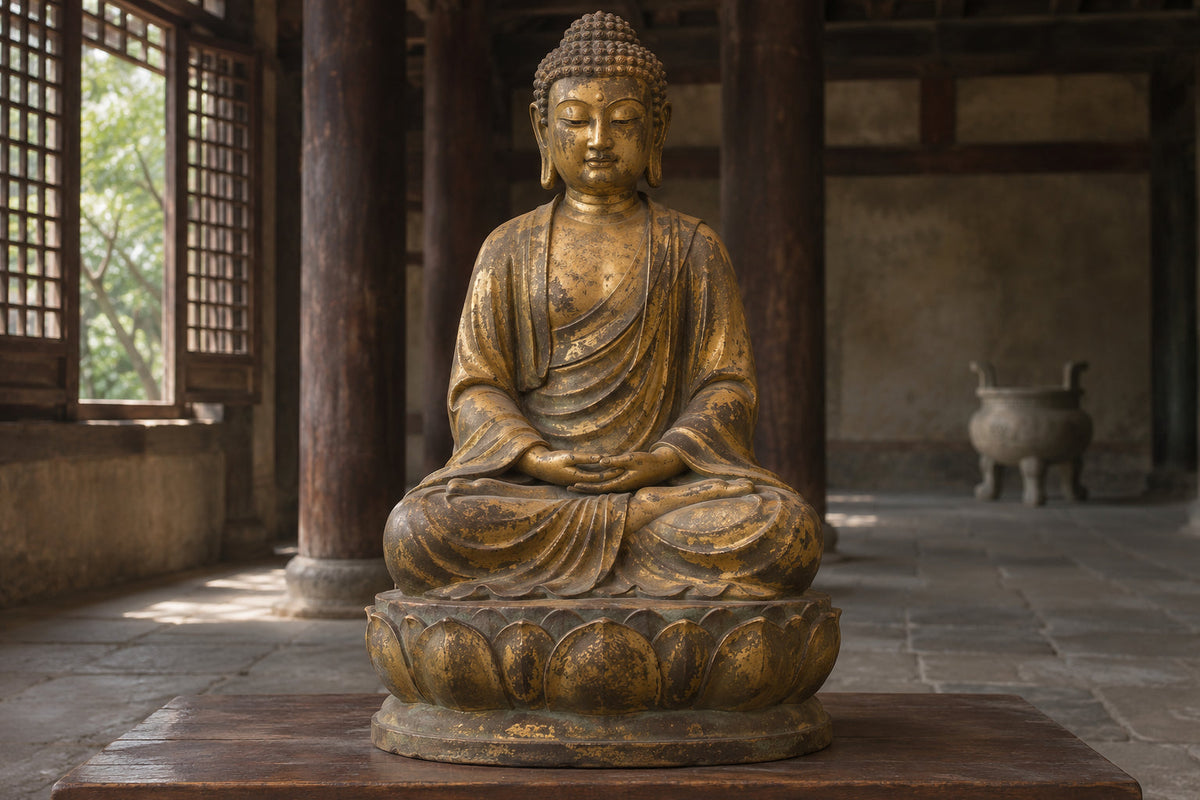
Compare the face, clothing, posture, and objects in the hands. The seated figure in plain robes may portray Shakyamuni, while the grinning, round-bellied figure beside a fabric sack is usually Budai (布袋). The Metropolitan Museum of Art identifies Budai as a monk of the tenth century whom Chinese tradition came to honor as an incarnation of Maitreya. “Laughing Buddha” is a popular English nickname for this figure.


Different places and centuries also portrayed the same Buddha in different ways. An inscription, the surrounding figures, or the room in which an image originally stood can clarify its identity. For an example of an attribute with a specific devotional role, see the guide to Ksitigarbha’s staff.
Chinese Buddhist Symbols and Their Meanings
The lotus often forms a seat for Buddhas and bodhisattvas and evokes purity and awakening. Lotus forms also helped shape the baoxiang hua, a composite floral motif found in Buddhist decorative art. The Dharma wheel recalls the teaching of the Buddha, famously described as setting the wheel in motion. The endless knot, conch, pair of fish, and lotus also belong to a set of Eight Auspicious Symbols in Tibetan Buddhist art, with versions of the group found in Chinese decorative arts. A Qing tapestry sutra cover in The Met’s collection shows how such motifs could be arranged on an object made to protect a text.
How Do Chinese Buddhists Practice?
The Five Precepts and Monastic Discipline
For lay practitioners, the Five Precepts (五戒, wǔjiè) are commitments to refrain from killing, taking what is not given, sexual misconduct, false speech and intoxicants that lead to heedlessness. A layperson can undertake these trainings while living with a family and working. The Vinaya (律, lǜ) provides detailed rules for ordained monks and nuns, including celibacy and procedures for communal life. The Four-Part Vinaya of the Dharmaguptaka tradition became a principal basis of full monastic ordination in Chinese Buddhism. Monastery schedules and local customs add further structure. Observing a lay precept and receiving full ordination are distinct commitments.
Recitation, Chanting and Meditation
Chinese Buddhist practice can involve chanting sūtras, bowing, sitting meditation and reciting the name of a buddha or bodhisattva. Name recitation is called niànfó (念佛) when it centers on a buddha. In Pure Land practice, many recite “Namo Amituofo” (南无阿弥陀佛), an expression of homage to Amitābha Buddha. Recitation may be silent, voiced in unison or coordinated with walking. Pure Land communities often describe their practice through faith, aspiration and recitation.
Chan (禅, chán) lineages teach methods such as attending to the breath, silent illumination and investigating a huàtóu (话头), a pivotal question used in meditation. Temple schedules frequently bring several forms of practice together. Dharma Drum Mountain, for example, describes breath meditation, silent illumination, huàtóu practice and Buddha-name recitation within its own Chan tradition. Laypeople may practice at home, attend services or join a retreat according to the time they have.

Offerings, Merit and Festivals
An offering of flowers, a lamp or incense may express reverence at a temple or home altar. Donating food or supporting a community can be an act of generosity. In a dedication of merit (回向, huíxiàng), practitioners direct the merit of chanting or good deeds toward the benefit of others, such as deceased relatives or all sentient beings. The intention gives these acts a place in ethical and devotional practice.
Communal festivals make some of these practices visible. At Buddha's Birthday, many Chinese Buddhist communities observe a bathing ceremony in which participants pour water over an image of the infant Buddha. In one field account at Hsi Lai Temple in California, the officiant explained the act through the cultivation of purity of mind. At Ullambana (盂兰盆, Yúlánpén), some communities dedicate offerings to the Three Jewels on behalf of deceased parents and ancestors. Dates and ritual forms vary by temple and tradition.
Chinese Buddhist Scriptures and Where to Start
The Chinese Buddhist canon is a library of texts. It includes early discourses preserved in Chinese translation, Mahāyāna sūtras, monastic rules and scholastic treatises, as well as commentaries and other works compiled in East Asia. Editions differ in their contents. The Chinese Buddhist Electronic Text Association, known as CBETA, makes several major collections searchable, including the Taishō Tripiṭaka and the Jiaxing Canon. One teaching lineage can use a selection of this material according to its liturgy and practices.
- Heart Sutra (心经, Xīnjīng). This brief Perfection of Wisdom text presents Avalokiteśvara's insight into the emptiness of the five aggregates. Its brevity makes it suitable for recitation. A translation with notes is helpful when you study how it moves from familiar elements of experience to statements about emptiness.
- Lotus Sutra (法华经, Fǎhuá Jīng). This longer Mahāyāna text uses stories and parables to explain how the Buddha teaches according to the needs of different listeners. The One Vehicle describes the underlying orientation toward Buddhahood. Chapter 25, the Universal Gate chapter on Avalokiteśvara, also circulates independently in Chinese Buddhist practice.
- Diamond Sutra (金刚经, Jīngāng Jīng). This dialogue between the Buddha and Subhūti asks what it means to give and practice without grasping at fixed ideas about oneself or others. The British Library's Chinese woodblock-printed copy from Dunhuang bears a date of 868 CE. The scroll is material evidence of how this scripture was circulated.
- Pure Land sūtras (净土经典, Jìngtǔ jīngdiǎn). The shorter Amitābha Sutra describes Sukhāvatī, the Western Pure Land. The longer Infinite Life Sutra tells of the vows that establish it. The Contemplation Sutra presents forms of visualization and contemplation. These texts help explain the religious aims behind the recitation of Amitābha's name.
Start with the text that addresses the practice you are trying to understand. A reader who has heard the Heart Sutra chanted can read it slowly alongside commentary. A reader interested in Guanyin can begin with Chapter 25 of the Lotus Sutra. For Pure Land devotion, the shorter Amitābha Sutra offers a compact account of the setting and aspiration of the practice. English translations differ in the Chinese, Sanskrit or Tibetan versions they follow, so check the translator's introduction if you want to compare wording.
Books for Studying Chinese Buddhism
Chün-fang Yü’s Chinese Buddhism: A Thematic History connects key figures, schools, and devotional traditions. Erik Zürcher’s The Buddhist Conquest of China offers a detailed study of Buddhism’s early centuries and the evidence for its spread. Gao Zhennong’s Chinese Buddhism (中国佛教), a Chinese-language survey cited by Baidu Baike, offers an additional starting point. A reader seeking a practice text can begin with the Heart Sutra and a translation that identifies its textual basis.
How to Read Chinese Buddhist Art
Chinese Buddhist art ranges from an image small enough to set on an altar to a Buddha carved into a mountainside. Start with the relationship between the figure and its setting. A central Buddha and attendant bodhisattvas can organize attention in a cave or hall. A donor carved below the main figures records a different role in the same work. A painting of a Buddha’s realm can bring together architecture, music, water, flowers and worshippers. The material, date, inscription and original setting help explain why each image takes the form it does.
The Silk Roads and the Making of Local Styles
Art moved with manuscripts, merchants, pilgrims and monastics across overlapping routes. Gandhara, in what is now parts of Pakistan and Afghanistan, developed Buddhist images within a cosmopolitan artistic world. Portable sculpture helped transmit ways of showing the Buddha’s body, robes and attendant figures. Workshops in North India and the oasis communities of Central Asia contributed other models. Chinese patrons and craftspeople made new combinations shaped by particular sites and commissions. The deep folds of a robe or a halo might invite comparison with an earlier object elsewhere, while an inscription and an excavation context give firmer evidence for identifying a work’s place and date.
Yungang, Longmen, Mogao and Leshan
The fifth- and sixth-century Yungang Grottoes near Datong, Shanxi, include large rock-cut images made under the Northern Wei. Tall Buddhas command the interior of major caves, while smaller figures and carved architectural forms fill surrounding surfaces. At the Longmen Grottoes near Luoyang, Henan, patrons sponsored niches and images cut into limestone along the Yi River. Northern Wei and Tang commissions are both prominent. The large Tang group at Fengxian Temple sets a seated Vairocana Buddha among attendants and guardians. Longmen’s inscriptions also preserve the names and aspirations of donors who commissioned individual works.
At the Mogao Caves near Dunhuang, Gansu, sculpture and painting share an interior. Artisans often modeled earthen material over supports of wood and reeds, then painted the figures. Wall paintings on prepared surfaces show Buddhist narratives, donors and envisioned Pure Lands. In Cave 61, a tenth-century landscape of Mount Wutai brings temples, roads and travelers into a single extensive scene. In a very different setting, the 71-meter Leshan Giant Buddha in Sichuan faces the confluence of the Min, Dadu and Qingyi rivers. Its cliff gives the seated figure a scale inseparable from the surrounding landscape. Work began during the Tang dynasty.


Wood, Gilt Bronze and Ritual Textiles
Images made for an altar offer a closer view of the tools and choices of their makers. The Metropolitan Museum of Art’s Northern Wei Buddha Maitreya Altarpiece, dated about 525–530, gathers a Buddha and smaller figures into a gilt-bronze ensemble. Its base, figures and halo can be seen together at close range. An eleventh-century Liao image of Water-Moon Guanyin in the same museum was assembled from multiple blocks of willow and retains traces of pigment. The bodhisattva sits with one knee raised, a pose that changes the line of the body and the way it occupies the space around it.
Textiles carry their own forms of craftsmanship and devotion. A thangka is a portable image in Tibetan traditions, often a painting on cloth, and it can depict a deity, lineage or mandala. A mandala orders a sacred realm and can guide ritual and visualization. Its design can also be woven. The Met’s Vajrabhairava Mandala, made in China around 1330–1332 under the Yuan, is a cut-silk tapestry, or kesi. The work links Tibetan Buddhist iconography with the skills of a Chinese weaving workshop. Prints, paintings and textiles each offer different ways to repeat, transport or display sacred images.

What You See in a Chinese Buddhist Temple
Many Han Buddhist monasteries organize their principal buildings along an axis with courtyards in between. The entrance gate, or shānmén, marks the transition from the street or mountain path into the precinct. A Hall of the Heavenly Kings commonly houses the four guardian figures. The main Buddha hall provides space for offerings and ceremonies. Statues might center on Śākyamuni, three Buddhas, or a group chosen for a monastery’s own commitments. A side hall or a building farther in can be dedicated to Guanyin, arhats, ancestors or other figures. The plan guides movement and reflects the everyday needs of a community.
Bell and drum towers sometimes flank the first courtyard. Their instruments can mark services and the rhythm of communal life. A scripture hall or library may preserve canonical texts, printed editions or printing blocks. Monks’ housing, kitchens and other working spaces can occupy side courts. At Beijing’s Ming-period Zhihua Temple, completed in 1444, documented features include a courtyard sequence, bell and drum towers and a scripture hall with a rotating sutra cabinet. These are ways to understand an example. A mountainside, a dense city plot or a different lineage can produce its own arrangement.

How the Stupa Became a Pagoda
The South Asian stupa was a sacred monument associated with relics and commemoration. A mound could shelter relics or other deposits and offer a focus for walking around it in reverence. In China, builders developed many versions of this monument, often called tǎ, or pagoda. Some versions adopted the stacked roofs and repeated stories of a Chinese tower. Builders used timber, brick and stone in different places and periods. The timber Sakyamuni Pagoda at Fogong Temple in Yingxian, Shanxi, dates to 1056, during the Liao dynasty. Its tiers, interlocking timber brackets and interior images offer one example of how a Buddhist monument could be built on the scale of a multi-story wooden structure.
Tibetan Buddhist complexes give other examples of sacred planning. At the Jokhang in Lhasa, a courtyard opens into a major Buddhist hall, with rooms arranged around the complex. At the Potala Palace, chapels and reliquary spaces form part of a terraced ensemble rising above the city. Assembly spaces, shrines and routes for circumambulation can shape how Tibetan Buddhist sites are used. Each complex has its own history of building and renewal, and its layout reflects its terrain, purpose and community.
Famous Buddhist Sacred Places in China
The Four Sacred Buddhist Mountains
Four pilgrimage mountains are traditionally associated with four bodhisattvas. The associations give visitors a way to understand which images and practices receive special attention at each site.
- Mount Wutai (五台山), Shanxi. Pilgrims venerate Mañjuśrī, known as Wenshu in Chinese and associated with wisdom. The mountain’s five broad summits give it its name. In its wider temple landscape, Foguang Temple’s Tang East Hall, dated 857, preserves a timber structure and an ensemble of clay figures. The famous panorama of Wutai at Dunhuang shows how far the mountain’s reputation traveled.
- Mount Emei (峨眉山), Sichuan. The mountain is associated with Samantabhadra, or Puxian, and with the practice of a bodhisattva’s vows. A succession of temples occupies slopes and higher ground. Emei and the nearby Leshan Giant Buddha belong to the same UNESCO listing, while the mountain temples and riverside carving offer distinct experiences of place.
- Mount Putuo (普陀山), Zhejiang. The island is associated with Guanyin, or Avalokiteśvara, the bodhisattva of compassion. It has been identified in Chinese tradition with Potalaka, Guanyin’s dwelling place. Temple buildings and coastal paths relate that association to the experience of visiting an island.
- Mount Jiuhua (九华山), Anhui. This mountain is associated with Kṣitigarbha, or Dizang, known for vows to aid beings in suffering. His presence in the mountain’s devotional life gives Jiuhua a special place among pilgrimage destinations and helps explain the prominence of his image there.
White Horse Temple, Lingyin and Shaolin
White Horse Temple (白马寺) near Luoyang is widely remembered as China’s first Buddhist monastery. A founding tradition places it in the Eastern Han, often dated to 68 CE, and tells of scriptures carried to the capital by a white horse. That story has shaped the site’s place in Buddhist memory. The standing temple complex reflects many later periods of work, including Ming and Qing rebuilding. Its surviving buildings and the traditional foundation date provide different kinds of historical evidence.
Lingyin Temple (灵隐寺) stands in the hills near West Lake in Hangzhou, Zhejiang. Its institutional tradition traces its foundation to the fourth-century monk Huili. Across a stream, the limestone of Feilai Feng, or Flying Peak, holds niches and figures from periods including the Five Dynasties, Song and Yuan. Seeing the carvings beside the monastery makes it possible to compare two ways of using the setting. Built halls direct visitors through courtyards, while the rock-cut figures follow the ledges and hollows of the hillside.


Near Mount Song in Henan, Shaolin Temple (少林寺) belongs to the historic monuments of Dengfeng and is closely associated with Chan tradition. Its Pagoda Forest preserves groups of funerary monuments for monks. Their heights and shapes vary. Seen together, they record generations of a community through its memorial architecture, as a counterpart to the halls that served its day-to-day religious life.
How Did Shaolin Temple Help Li Shimin?
In 621, Shaolin monks helped the future Tang emperor Li Shimin (李世民) in his campaign against Wang Shichong, the ruler of a rival state based at Luoyang. Li Shimin was then the Prince of Qin and a commander for the Tang dynasty founded by his father, Li Yuan. The monks took control of a fortified position near their estate and captured Wang Renze, Wang Shichong’s nephew and a commander on his side. The episode tied a local dispute over temple property to the Tang struggle for control of the Luoyang region.
Why Was the Cypress Valley Estate Important?
Shaolin held land at the Cypress Valley Estate, or Baigu Zhuang (柏谷庄), from the Sui period. It lay by Mount Huanyuan, on the route between Luoyang and Dengfeng, where Wang Shichong’s forces held a fortified position. Control of the position mattered to the contending armies. For the monastery, the area was also a source of income. Recovering control of its property gives a concrete reason why the conflict mattered to the monks. Li Shimin’s letter praises their decision to side with the Tang.
| Date | What the sources record |
|---|---|
| May 23, 621 | In Meir Shahar’s reconstruction of the campaign, the monks seized the position at Mount Huanyuan and took Wang Renze prisoner. |
| May 26, 621 | Li Shimin sent a letter thanking the monks. He was still the Prince of Qin and would later become Emperor Taizong. |
| 625 | An order restored forty qing of monastic land, measured in a traditional unit of area, and a water mill. |
| 728 | The monastery erected a stele preserving the 621 letter, land documents and a history written by the Tang official Pei Cui. |
What Did Shaolin Receive from the Tang?
The letter of thanks was followed by a separate process over the monastery’s legal status and property. The records describe a temporary closure in 622, a reopening in 624 and the restoration of land and the mill in 625. Later officials were still reviewing the property claim in 632. Shaolin’s decision to preserve these documents on stone shows their lasting importance to the monastery. They tied its estate rights to a service the Tang court had formally recognized.
How Did the Story of the Thirteen Monks Develop?
A roster preserved on the stele names thirteen monks honored for their role. Pei Cui’s account identifies Zhicao, Huiyang and Tanzong among the figures involved. The dated letter and the monastery’s account explain what the intervention achieved for the Tang. The rescue of Li Shimin in person belongs to the later popular telling. It reached a wide audience through the 1982 film The Shaolin Temple. Detailed written accounts of Shaolin staff practice come from later centuries, especially the Ming. Those sources describe techniques and training, while the Tang records document the military episode and its consequences for the monastery.
Tibetan Buddhism and Its Place in Buddhist History
Tibetan Buddhism developed on the Tibetan Plateau and across the Himalayan region. It brings together Mahāyāna teachings on the bodhisattva path, philosophical study, monastic discipline and Vajrayāna ritual and meditation. Teachers transmit texts and practices through lineages. Nyingma, Kagyu, Sakya and Geluk are four major traditions, each with its own history of teaching and institutions. In many monasteries, the daily rhythm includes recitation, study and communal ceremony, while practices involving initiation and visualization are taught within particular lineages.
How Buddhism Took Root in the Tibetan Empire
The Tibetan Empire grew from the Yarlung dynasty between the seventh and ninth centuries. Early connections with Nepal, India and the Tang court brought people, texts and images to Tibet. Lhasa’s Jokhang Temple is traditionally linked to Songtsen Gampo, a seventh-century ruler. Its surviving early carvings show the influence of Newar artisans from the Kathmandu Valley. Tibetan imperial records and inscriptions offer a second kind of evidence. The Old Tibetan Annals, preserved among manuscripts from Dunhuang, record events from 641 to 764.
Under the eighth-century king Tri Songdetsen (also written Trisong Detsen), royal patronage helped establish Samye, usually described as Tibet’s first Buddhist monastery. An inscribed pillar from around 779 documents the court’s commitment to Buddhism. The building of monasteries and work on translation gave Buddhist study a more durable institutional base. Later traditions credit the Indian scholar Śāntarakṣita and the ritual teacher Padmasambhava with helping establish Buddhism in Tibet. The traditions about these teachers and the dated inscriptions illuminate different parts of the story.
Why Are Tibetan and Mongolian Buddhism So Closely Related?
Mongolian Buddhism shares a large part of its teaching and ritual heritage with Tibetan Buddhism, particularly the Geluk tradition. The relationship grew through exchanges among teachers, monasteries and rulers over several centuries. In the thirteenth century, Kublai Khan patronized the Sakya teacher Phagpa at the Yuan court. In the late sixteenth century, the Tümed Mongol leader Altan Khan gave the Geluk teacher Sonam Gyatso the title Dalai Lama. Tibetan Buddhist teachings took root in Mongolian settings, and Mongol rulers became influential patrons of the Tibetan lineages they supported.
Mongolian teachers, artists and communities developed their own institutions, translations and pilgrimage traditions. The Erdene Zuu monastery near Karakorum and the bronze sculptures of Zanabazar (1635–1723), the first Jibzundamba Khutugtu, show how shared Buddhist forms became part of Mongolian history. A Mongolian monastery can share texts, images and ritual forms with Tibetan monasteries while also observing ceremonies associated with local teachers and places.
Sacred Places in Tibetan Buddhism
| Sacred site | Why it matters |
|---|---|
| Jokhang Temple, Lhasa | Home to the revered Jowo Shakyamuni image. Devotees visit the temple and walk the surrounding pilgrimage circuit. |
| Samye Monastery | An early monastic foundation associated with Tri Songdetsen and the establishment of Buddhist translation and study. |
| Potala Palace, Lhasa | A former residence of the Dalai Lamas with chapels, ceremonial halls and reliquary stupas. |
| Mount Kailash, or Gang Rinpoche | A mountain revered by Tibetan Buddhist pilgrims and by several other religious traditions. Circumambulation is central to its pilgrimage life. |
What Is the Potala Palace’s Connection to Buddhism?
The Potala Palace rises on Red Mountain above Lhasa. Tibetan tradition associates the site with a palace of Songtsen Gampo. The standing structure largely comes from seventeenth-century construction. The Fifth Dalai Lama commissioned the White Palace, built from 1645 to 1648. The complex served as a residence, a setting for ceremonies and a center of government. Under the regent Desi Sangye Gyatso, the Red Palace was built from 1690 to 1694. Chapels and richly decorated stupas enshrine relics and commemorate important teachers, including the Fifth Dalai Lama. The palace takes its name from Mount Potalaka, the abode of Avalokiteśvara in Buddhist tradition. The building’s religious role can be read in the movement from residential quarters to shrines, assembly spaces and reliquaries.
Khata, Prayer Wheels, Thangkas and Prayer Flags
Khata (哈达). A khata is a ceremonial scarf offered to show respect, welcome a guest, express gratitude or convey good wishes. People may present one to a teacher or place it before a sacred image. White scarves are common in Tibetan settings and often suggest sincerity and purity. Blue is common among Mongolian khadag scarves. Local custom and the occasion shape which colors people use and how they make the offering.
Prayer wheel (转经筒). A prayer wheel is a cylinder that contains rolls printed with mantras. Many contain Oṃ maṇi padme hūṃ, the six-syllable mantra associated with Avalokiteśvara. Devotees turn a handheld wheel or a row of mounted wheels as part of prayer and pilgrimage. In Tibetan Buddhist settings, wheels are generally turned clockwise. The action accompanies remembrance of the mantra and the dedication of merit.
Thangka (唐卡). A thangka is a portable religious image, often painted on prepared cloth and mounted in brocade. Other examples are made with appliqué or embroidery. A painting may present a Buddha, a sequence of teachers, a set of narrative scenes or a mandala. Thangkas can support teaching, devotion and guided visualization. A lineage portrait and a mandala serve different purposes, even when both hang from a textile mount.
Prayer flags (经幡). Printed cloth flags carry prayers, mantras or auspicious figures. People raise them at monasteries, homes and pilgrimage places, including mountain passes. In Tibetan Buddhist practice, the wind is understood to carry the aspirations expressed in the flags. Some show the wind horse, or lungta, at the center of the design. The motifs and arrangement vary with the type of flag and local practice.
Chinese Buddhism, India, Japan, Thailand and Daoism
How Chinese Buddhism Grew from Indian Buddhist Traditions
Buddhism began in the Indian subcontinent. Chinese monasteries received teachings on ethics, meditation and liberation, disciplinary texts and a wide range of Mahāyāna scriptures and treatises. Texts and practices traveled through Central Asian translation networks and by sea as well as through direct links to South Asia. The traditions that reached China can be traced to different communities and periods, from early discourses preserved in the Chinese Āgamas to later teachings on emptiness, consciousness and ritual.
Chinese translation made these sources available to a new readership. Chinese texts can also preserve works for which the full Indic-language text is lost. Translation involved choosing what to transliterate and what to render by meaning. Over time, Chinese commentators organized bodies of texts into new teaching systems. Tiantai centered its reading on the Lotus Sutra, while Huayan built a vision of the interdependence of phenomena around the Flower Garland Sutra. Nālandā, Chan monasteries and Japanese ordination centers belong to a history of exchange that produced distinct institutions in each place.
How Chinese Buddhism Helped Shape Japanese Buddhism
Early traditions date the formal introduction of Buddhism to the Japanese court to the sixth century, through diplomatic contact with Baekje on the Korean peninsula. Exchange with Chinese monasteries later brought Japanese pilgrims and clerics into direct contact with Chinese Buddhist teaching and practice. The Chinese Vinaya monk Jianzhen helped establish a formal ordination platform in eighth-century Nara. In the early ninth century, Saichō and Kūkai studied in Tang China. Saichō is associated with Japan’s Tendai tradition, which draws on Chinese Tiantai. Kūkai studied with the esoteric teacher Huiguo and transmitted teachings that took shape as Japan’s Shingon tradition.
Later Japanese Zen lineages developed through further encounters with Chinese Chan. The names Chan and Zen are related readings of the Chinese character 禅, used for meditation. Japanese Pure Land teachers such as Hōnen likewise worked with scriptures preserved in Chinese and organized their own communities around the recitation of Amitābha’s name. Texts, ordination and forms of meditation crossed the sea at different times; the resulting schools took root in Japanese institutions and religious life.
How Chinese and Thai Buddhist Traditions Compare
In Thailand the predominant tradition is Theravāda, which transmits its canonical scriptures in Pāli. Many Thai temple communities observe Visakha Bucha to commemorate the Buddha’s birth, awakening and passing away. That observance offers a comparison with the spring Buddha’s Birthday celebrations and bathing ceremonies held in many Chinese Buddhist temples. Both honor the Buddha through forms that developed in different places. Theravāda traditions also have longstanding connections to Tai-speaking communities on the mainland and in southwestern China.
How Buddhism and Daoism Interacted in China
Chinese Buddhists and Daoists developed distinct scriptures, lineages and accounts of the religious path. Buddhists take refuge in the Buddha, Dharma and Sangha and pursue awakening. Daoist ritual traditions may center on ordination registers, priests’ petitions to a celestial bureaucracy and rites for the living and the dead. Both traditions took root in communities already concerned with honoring ancestors and maintaining relations between households and the unseen world.
The influence can be traced in specific texts. Early translators used familiar Chinese words such as dào, or path, to convey Buddhist concepts in particular passages. Choice of vocabulary gave readers a point of entry, and later commentators refined its religious meanings. In the other direction, Daoist Lingbao scriptures formed around the turn of the fifth century adapted ideas about karmic rebirth and salvation, placing them within a Daoist liturgical and cosmological framework. Interactions also produced polemics. The story of Laozi traveling west to teach the people there became a point of dispute over the relative age and authority of the traditions.
Annual rites illustrate how distinct traditions can share a calendar and concerns. On the fifteenth day of the seventh lunar month, Buddhist observances associated with Yulanpen draw on the story of Maudgalyāyana’s attempt to help his deceased mother, with gifts to the monastic community central to the rite. Daoist Zhongyuan traditions connect the date with the Earth Official and petitions for pardon. Local festivals can bring Buddhist services, Daoist rites and household offerings together. Reading the liturgy, identifying the officiants and noticing who receives an offering can help a visitor understand which tradition is being practiced in a given setting. See also the guide to the Northern Dipper in Daoist practice.
Buddhism’s Place in Chinese Culture
Translation brought new ways of speaking about suffering, compassion, and liberation into Chinese. It also created practical problems for readers. A monastery might hold several translations of the same sutra with different wording. Catalogues and commentaries helped readers identify versions, trace the names of translators, and decide how a text fit into a course of study.
From cliff shrines to handscrolls, Buddhist stories offered ways to learn by looking and listening. At Dunhuang, paintings of scriptural scenes gave visible form to Pure Lands, assemblies of bodhisattvas, and stories of the Buddha’s previous lives. Manuscripts from the same region preserve sermons, poems, and illustrated texts. The dated Diamond Sutra scroll of 868, now at the British Library, records a lay sponsor’s dedication to his parents. Its printed frontispiece and text connect a devotional act with the history of publishing.
Temples and households shaped this history together. Lay gifts could sponsor an image or a new copy of a scripture. Monastic libraries and lecture halls supported study. Poets and painters drew on Buddhist vocabulary and forms of attention, while families brought devotion into mourning, commemoration, and pilgrimage. The range of evidence is why Chinese Buddhism belongs in histories of literature and material culture as well as histories of religion.
What Does Journey to the West Have to Do with Buddhism?
The Ming novel Journey to the West (Xīyóu Jì) builds its story around the Tang monk Xuanzang’s pilgrimage to obtain Buddhist scriptures. The earliest surviving complete printed edition dates to 1592. In the novel, the pilgrim becomes Tang Sanzang, often called Tripitaka in English. He travels with Sun Wukong, Zhu Bajie and Sha Wujing. These companions, their battles and many of the obstacles belong to a literary tradition that grew up around the historical journey.
Buddhist ideas structure the pilgrimage. Guanyin recruits protectors for the monk and intervenes at moments of danger. The travelers have to confront desire, anger and pride, and the hardships test their discipline and compassion as much as their ability to defeat monsters. The novel also draws on Daoist stories of immortals, celestial officials and alchemy, alongside gods and spirits familiar from popular worship. Its mixture of reverence and satire lets readers see how a scripture-seeking journey became part of Chinese popular imagination. Xuanzang and Bianji’s seventh-century travel record offers the historical counterpart.
Chinese Buddhist Jewelry and Devotional Objects
Buddhist imagery appears on beads, pendants, amulet boxes, and other pieces worn or carried close to the body. Their function depends on how they are made and used. A prayer strand can count recitations. A portable shrine can hold a text or image. A pendant can carry a motif that the wearer connects with a teaching or memory.
Prayer Beads and Mala
Chinese prayer beads are often called fózhū (佛珠) or niànzhū (念珠). A practitioner advances one bead at a time while repeating a Buddha name or mantra. Long strands of 108 beads are common, with shorter strands and different arrangements in use as well. The Smithsonian’s National Museum of Asian Art documents a Tibetan mala made with seeds, cotton cord, and shell, coral, turquoise, and silver components. It shows how materials and bead arrangements can be specific to a practice.

Bead forms also carried meaning at court. A Qing chaozhu court necklace at the Smithsonian draws on Buddhist prayer-bead design. The necklace belonged to a court dress tradition in which the arrangement of beads and their materials conveyed status. Its shape records a historical connection between devotional forms and ceremonial dress.
Pendants, Inscriptions, and Portable Shrines
A Tibetan ga’u is a small portable shrine or amulet container. The Met’s Amulet Box of a Noblewoman records an example designed to hang from a necklace and hold consecrated material. Other examples held miniature images or cloth. The object’s contents and setting are part of understanding its role.
In present-day jewelry, lotus emblems, images of Guanyin, and inscribed passages bring Buddhist visual language into portable form. The Heart Sutra is associated with the perfection of wisdom. The six-syllable mantra oṃ maṇi padme hūṃ is closely associated with Avalokiteshvara, especially in Tibetan traditions. For an inscription, read the text and check how it relates to the tradition you intend to honor. When a piece is represented as a devotional object, its maker, contents, and provenance matter.
Buddhist Jewelry from Chinese Showcase


Frequently Asked Questions
How is Chinese Buddhism different from other Buddhist traditions?
Chinese Buddhism shares teachings such as karma, compassion, and liberation with other Buddhist traditions. It developed a large Chinese-language canon, schools such as Chan and Tiantai, and regional practices such as pilgrimage to the Four Sacred Mountains. Tibetan and Theravada communities in the wider historical regions of China also have distinct lineages.
What are the main beliefs of Chinese Buddhism?
Chinese Buddhist traditions share refuge in the Buddha, Dharma and Sangha and such teachings as the Four Noble Truths, karma and non-self. Mahāyāna traditions give particular attention to the bodhisattva path, compassion and wisdom. Temples and lineages differ in the practices and scriptures they emphasize.
Why is the Chinese Buddha often shown smiling?
The round-bellied figure with a broad smile is usually Budai, a Chinese monk remembered as an incarnation of Maitreya. Sculptures of Shakyamuni more often show a meditating or teaching figure in robes.
Do Chinese Buddhists worship Buddha statues?
Many Chinese Buddhists bow, chant or make offerings before images of buddhas and bodhisattvas. An image can be a focus of veneration and a reminder of qualities to cultivate. The identity matters. For example, a statue of Śākyamuni represents the historical Buddha, while one of Guanyin represents the bodhisattva of compassion.
Do Chinese Buddhists drink alcohol?
The fifth lay precept calls for refraining from intoxicants that lead to heedlessness. Many laypeople who undertake that precept abstain from alcohol. Individual observance varies, and ordained monks and nuns observe the discipline of their ordination.
What are the five Buddhist actions of immediate karmic consequence?
The traditional list includes killing one's mother, killing one's father, killing an arhat, maliciously drawing the blood of a buddha and deliberately causing a schism in the monastic Sangha. In traditional accounts, “immediate” refers to the next rebirth following death. The category is called pañcānantarya in Sanskrit and 五无间业 in Chinese.
What do Chinese Buddhists do before bed?
Evening practice can include reading or chanting a sūtra, reciting Amitābha's name or sitting quietly. Dharma Drum Mountain, for example, describes bedtime as one possible time for evening home liturgy. The routine depends on a person's tradition, teacher and circumstances.
Do Chinese Buddhists believe in Jesus?
Jesus is central to Christianity. The traditional objects of Buddhist refuge are the Buddha, Dharma and Sangha. Individual Buddhists may regard Jesus with respect or take part in interfaith dialogue, as the Chinese Buddhist teacher Hsing Yun did. This expresses a personal or communal approach to another religion.
Can LGBTQ+ people practice Chinese Buddhism?
Yes. LGBTQ+ people participate in Buddhist lay practice. The third lay precept addresses sexual misconduct, and communities vary in how they understand relationships and apply their teachings. Taiwanese Buddhist nun and scholar Shih Chao-hwei has explicitly argued for welcoming and supporting same-sex couples from a Buddhist perspective. Monastic ordination has separate rules, including celibacy.
Does Chinese Buddhism have one holy book?
Chinese Buddhism has a canon containing many scriptures and collections of teachings. A temple may recite the Heart Sutra regularly, while a Pure Land community may emphasize the Amitābha Sutra and related texts. These selections reflect the community's practice within a much larger body of literature.
What are the four sacred Buddhist mountains in China?
The traditional four are Mount Wutai, Mount Emei, Mount Putuo, and Mount Jiuhua. They are associated with Manjushri, Samantabhadra, Guanyin, and Ksitigarbha, respectively.
What was Shaolin Temple’s connection to Li Shimin?
Shaolin monks aided the Prince of Qin, Li Shimin, in 621 by taking a fortified position near their estate and capturing Wang Renze. Li thanked them by letter. A later order in 625 restored forty qing of land and a water mill, and the 728 stele preserved the documents.
What are Buddhist prayer beads used for?
A prayer strand helps count repetitions of a Buddha name, mantra, or other devotion. Short bracelets and longer strands differ in use across communities and practices.
Did Emperor Wu of Liang become a Buddhist monk?
Emperor Wu repeatedly performed ceremonial self-offerings at Tongtai Monastery. At the end of these stays he returned to the palace and resumed imperial duties. The two major dynastic histories differ in how they describe the 546 visit, which explains the counts of three or four such occasions.
Did Hou Jing starve Emperor Wu of Liang to death?
Hou Jing confined Emperor Wu after taking Taicheng in 549. The sources record restricted food, grave illness and the emperor’s unanswered request for honey. Han Yu later called it starvation. The earlier accounts leave the exact cause of death uncertain.
What were the four major persecutions of Buddhism in China?
The traditional list includes those under Northern Wei Emperor Taiwu in 446, Northern Zhou Emperor Wu beginning in 574, Tang Emperor Wuzong in 845, and Later Zhou Emperor Shizong in 955. The restrictions varied. They included closing temples, returning clergy to lay life, confiscating property and regulating ordination.
Was the monk in Journey to the West a real person?
The novel’s Tang Sanzang is based on Xuanzang, a Tang monk who studied in India and returned to China in 645. Sun Wukong and the other fantastic companions belong to the novel and earlier storytelling. Xuanzang’s travel record documents the historical pilgrimage.
How are Chinese and Indian Buddhism connected?
Buddhism originated in the Indian subcontinent. Teachings, texts, ordination traditions and ritual specialists reached China through several routes. Chinese translations and commentaries preserved much of that material and supported the growth of schools such as Tiantai, Huayan and Chan.
What did Chinese Buddhism contribute to Buddhism in Japan?
Chinese versions of Buddhist scriptures, monastic ordination, Tiantai and esoteric teachings, and Chan lineages all influenced Japanese traditions. The Tang monk Jianzhen helped establish formal ordination in Nara. Japanese travelers also studied in China and developed distinct traditions after returning.
How did Daoism and Buddhism influence each other?
Some early Buddhist translators used familiar Chinese terms for new ideas. Daoist Lingbao scriptures adapted teachings about karmic rebirth. Buddhist Yulanpen and Daoist Zhongyuan rites also came to share a date and similar concerns for the dead, with distinct texts and ritual authorities.
Why are Tibetan Buddhism and Mongolian Buddhism so closely related?
Mongolian Buddhist communities adopted many Tibetan lineages, scriptures and ritual practices, especially from the Geluk school. Mongol rulers also patronized Tibetan teachers. Monasteries such as Erdene Zuu and teachers such as Zanabazar show how a distinct Mongolian tradition grew within those relationships.
What does a Tibetan khata symbolize?
A khata is a ceremonial scarf expressing welcome, respect, gratitude or good wishes. White Tibetan scarves often convey sincerity and purity. Blue is common among Mongolian khadag scarves. The occasion and the community shape the meaning of a particular offering.
Why is the Potala Palace important in Tibetan Buddhism?
The seventeenth-century palace served as the residence of the Dalai Lamas and a place for ceremonies and government. The White Palace held residential and ceremonial spaces. The Red Palace contains chapels and reliquary stupas, making the complex a major religious monument.
Did the Shunzhi emperor become a Buddhist monk?
Shunzhi’s study with Chan teachers and interest in renunciation are documented. Evidence for completed monastic ordination is lacking. The Palace Museum’s chronology records his death in the Hall of Mental Cultivation in 1661. The account that he lived as a monk on Mount Wutai comes from later legend.
References and Further Reading
History, Translation, and Schools
- Baidu Baike. “Chinese Buddhism” (中国佛教), entry 364238. Consulted for the historical divisions, translation sections, and eight-school outline.
- Gao Zhennong. Chinese Buddhism (中国佛教). Shanghai Academy of Social Sciences Press, 1986. Bibliographic record at CiNii Books.
- Chün-fang Yü. Chinese Buddhism: A Thematic History. University of Hawai‘i Press, 2020.
- Erik Zürcher. The Buddhist Conquest of China: The Spread and Adaptation of Buddhism in Early Medieval China. Third edition. Brill, 2007.
- T. H. Barrett, Literary Evidence on Han Buddhism, SOAS Research Online
- Baochang’s Biographies of Buddhist Nuns and Faxian’s travel record, BDK America translations
- Max Deeg, The ‘Fearless Mountain’ That (Almost) Disappeared, Cardiff University repository
- Xuanzang and Bianji, The Great Tang Dynasty Record of the Western Regions, BDK America translation
- Emperor Wuzong’s Edict on the Suppression of Buddhism, Columbia University Asia for Educators
- Robert H. Sharf, On Pure Land Buddhism and Ch’an/Pure Land Syncretism in Medieval China
- Huayan Buddhism, Stanford Encyclopedia of Philosophy
- Chün-fang Yü, The Renewal of Buddhism in China: Zhuhong and the Late Ming Synthesis, Columbia University Press
- The Wuchang Ideal: Buddhist Education and Identity Production in Republican China
- Geoffrey C. Goble, Chinese Esoteric Buddhism: Amoghavajra, the Ruling Elite, and the Emergence of a Tradition, Columbia University Press
- Fo Guang Shan. Buddhist Textbook, volume 4, Buddhist History. See the lesson on the development of eight Chinese Mahayana schools.
- Chinese Buddhist Electronic Text Association. Introduction to the CBETA Catalogue and Zhisheng’s 730 Kaiyuan Catalogue.
- Bukkyō Dendō Kyōkai. Zen Texts, glossary on Xuanzang’s Chinese Perfection of Wisdom collection, Taishō no. 220.
Doctrine, Texts, and Practice
- SuttaCentral, Setting in Motion the Wheel of the Teaching (SN 56.11), translated by Bhikkhu Sujato
- Stanford Encyclopedia of Philosophy, Buddha, sections on non-self and karma
- Dharma Drum Mountain, guidance on regular practice at home
- Chinese Buddhist Electronic Text Association, CBETA Electronic Buddhist Text Archive
- 84000, The Heart of the Perfection of Wisdom, the Blessed Mother (Toh 21)
- BDK America, The Lotus Sutra, translated by Tsugunari Kubo and Akira Yuyama
- BDK America, The Three Pure Land Sutras, translated by Hisao Inagaki
- Asian Art Museum, An Introduction to Buddhism in Japan
- Smithsonian National Museum of Asian Art, Theravada
- 84000, The Hundred and Eight Names of Avalokiteśvara (Toh 900), glossary on the five actions of immediate consequence
- Fo Guang Shan, Hsing Yun's I Am a Monk (volume five), publication notes on religious dialogue
- Shih Chao-hwei, The Dharma Discussion on the Issue of Marriage Equality, indexed by the National Taiwan University Buddhist Studies database
- British Library. The Diamond Sutra, Or.8210/P.2, dated 868.
Art, Temples, and Pilgrimage
- The Metropolitan Museum of Art. Buddhism along the Silk Road
- UNESCO World Heritage Centre. Yungang Grottoes
- UNESCO World Heritage Centre. Longmen Grottoes and its nomination dossier
- UNESCO World Heritage Centre. Mogao Caves
- Getty Conservation Institute and Dunhuang Academy. The Conservation of Cave 85 at the Mogao Grottoes, Dunhuang
- UNESCO World Heritage Centre. Mount Emei Scenic Area, including Leshan Giant Buddha Scenic Area
- The Metropolitan Museum of Art. Buddha Maitreya (Mile) Altarpiece, object 38.158.2a–g
- The Metropolitan Museum of Art. Bodhisattva Avalokiteshvara in Water Moon Form, object 28.56
- The Metropolitan Museum of Art. Vajrabhairava Mandala, object 1992.54
- University of Chicago, Center for the Art of East Asia. A Ming Buddhist Temple and Its Architecture
- UNESCO World Heritage Centre Tentative Lists. Wooden Structures of Liao Dynasty, Yingxian Pagoda
- UNESCO World Heritage Centre. Historic Ensemble of the Potala Palace, Lhasa
- UNESCO World Heritage Centre. Mount Wutai
- Meir Shahar. “Epigraphy, Buddhist Historiography, and Fighting Monks: The Case of the Shaolin Monastery.” Asia Major 13, no. 2 (2000), pp. 15–36.
- Meir Shahar. The Shaolin Monastery: History, Religion, and the Chinese Martial Arts. University of Hawaiʻi Press, 2008.
- Mamoru Tōnami. The Shaolin Monastery Stele on Mount Song, translated by P. A. Herbert. Scuola Italiana di Studi sull’Asia Orientale, 1990.
- Hong Kong Film Archive. The Shaolin Temple (4K Digitally Restored Version), programme note on the 1982 film.
- China Culture. White Horse Temple
- Lingyin Temple. Brief History and Stone Carvings on Flying Peak
- The Metropolitan Museum of Art. Buddhist Monk Budai. Qing dynasty, collection object 42545.
- The Metropolitan Museum of Art. Sutra Cover with Eight Buddhist Treasures. Qing dynasty, collection object 78284.
- The Metropolitan Museum of Art. Seated Buddha, Probably Shakyamuni, object 1974.268.8a–c.
Prayer Beads and Portable Shrines
- Smithsonian National Museum of Asian Art. Prayer Beads (Mala) from a Set for Chöd Practice, S2015.28.12.2.
- Smithsonian National Museum of Asian Art. Chinese Court Necklace, Blue Glass, F2022.3.1.
- The Metropolitan Museum of Art. Amulet Box of a Noblewoman, collection object 39462.
Imperial Buddhism, the Qing Court and the Dali Kingdom
- Wei Shou, Book of Wei, vol. 114, “Treatise on Buddhism and Daoism.”
- Linghu Defen and others, Book of Zhou, vol. 5, annals of Emperor Wu.
- Sima Guang, Comprehensive Mirror for Aid in Government (Zizhi Tongjian), vol. 292, Later Zhou Shizong’s reforms.
- Xiao Yan, Emperor Wu of Liang, preface in “An Emperor’s Discourse on Karma and Vegetarianism,” Chinese Autobiographical Writing, University of Washington.
- Yao Silian, Book of Liang (Liang shu), vols. 3 and 56, the annals of Emperor Wu and biography of Hou Jing.
- Li Yanshou, History of the Southern Dynasties (Nan shi), vols. 7 and 70, the annals of Emperor Wu and biography of Guo Zushen.
- Sima Guang, Comprehensive Mirror for Aid in Government (Zizhi Tongjian), vols. 161–162, on Hou Jing’s rebellion and the emperor’s death.
- Han Yu, Memorial on the Bone of the Buddha (819).
- Mark Strange, “Representations of Liang Emperor Wu as a Buddhist Ruler in Sixth- and Seventh-century Texts,” Asia Major 24, no. 2 (2011), pp. 53–112.
- The Palace Museum, “Chronology of the Shunzhi Emperor,” and Wang Maohe’s study of early Qing monks at court.
- UNESCO World Heritage Centre, Mountain Resort and its Outlying Temples, Chengde.
- Christian Daniels, “Buddhist Kingship and Governance in the Dali Kingdom, 1140s to 1200,” Journal of Southeast Asian Studies 54, no. 4. DOI 10.1017/S0022463423000747.
- National Palace Museum, Zhang Shengwen, Scroll of Buddhist Images. Denver Art Museum, Acuoye Guanyin, accession 1983.13.
Buddhism Across Asia, Daoism and Literature
- British Library, International Dunhuang Programme, “Buddhist Travellers and Pilgrims.”
- Tōshōdai-ji, English temple history. Kyoto National Museum, The Buddhist Legacy of Jianzhen (Ganjin) and His Successors (2021).
- Tokyo National Museum, Kūkai and the Treasures of Shingon Buddhism.
- Anthony C. Yu, trans., The Journey to the West, revised edition, University of Chicago Press.
- Stephen R. Bokenkamp, “Daoism and Buddhism in China,” Ho Center for Buddhist Studies, Stanford University.
- Stephen F. Teiser, The Ghost Festival in Medieval China, Princeton University Press.
Tibetan and Mongolian Buddhist History, Places and Objects
- British Library, International Dunhuang Programme, Old Tibetan Annals.
- Rubin Museum of Himalayan Art, Project Himalayan Art, “Jokhang Temple, Lhasa,” “Potala Palace,” and “Kailash.”
- Rubin Museum of Himalayan Art, Project Himalayan Art, “Erdeni Juu Monastery,” “Maitreya,” and “Mongol Empire.”
- Burke Museum, Scarf, Khata, accession 1998-99/1. Asia and Pacific Museum, A Sacrificial Scarf, Khadak.
- Rubin Museum of Himalayan Art, Project Himalayan Art, “Prayer Wheel” and “Thangka.”
The cover and two illustrations were generated for this article. Five supplied photographs appear in the text. The temple photographs show the original inscriptions on the plaques.
Stories, symbols and everyday objects
Our journal explores Chinese culture and design. Traditions and interpretations vary by region and source. For a purchase, use the specifications on the individual product page.
About Chinese ShowcaseQuestions or corrections? Contact us ↗