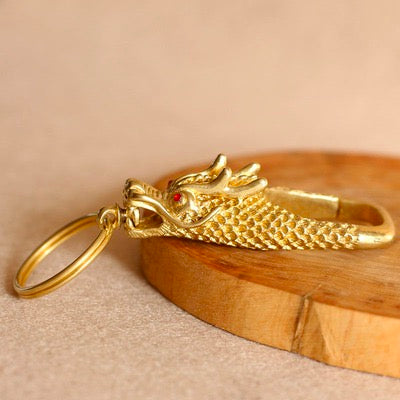
The Chinese chi pattern is a decorative design built around a sinuous, dragonlike creature known in English by the romanized name chi. It appears in many forms: a single animal turning through a circular field, two creatures facing or crossing one another, or several bodies interlaced into a dense surface pattern. The motif is especially associated with ancient jade and bronze, but later examples also occur on ceramics, lacquer, textiles, furniture, and architectural decoration.
The most important point is that the chi pattern is not one fixed drawing. Its body, head, limbs, tail, horns, and degree of abstraction change across periods and materials. Museum catalogues sometimes identify a creature as a chi even when it does not match the popular modern description of a strictly hornless dragon. Reliable identification therefore depends on the complete design, its historical context, its material, and comparisons with securely catalogued objects.
Information Snapshot
What Is a Chi Pattern?
A chi pattern depicts one or more chi, legendary creatures belonging to the broad visual world of Chinese dragons. The term chi here refers to the creature and should not be confused with the unrelated word often translated as vital energy. In English-language writing, the motif may be described as a chi pattern, a chi-dragon pattern, or, when the bodies are emphatically curled and intertwined, a coiled chi pattern. The traditional term often romanized as panchi literally emphasizes a chi in a coiled or winding posture.
Unlike a natural animal, the chi is a product of artistic convention. A designer may combine a feline head, a serpentine body, clawed limbs, hooked joints, a curling tail, or cloudlike extensions. On some objects the body is easy to follow from head to tail. On others it dissolves into scrolls and interlocking curves until the animal becomes almost inseparable from the surrounding ornament.

Is a Chi Always a Hornless Dragon?
Modern summaries frequently define the chi as a hornless dragon. That description can be a useful starting point, but it should not be treated as an absolute visual rule. A jade sword fitting in the National Museum of China, for example, is catalogued with a coiled chi design even though the animal has a long horn. Historical artists did not follow a single zoological checklist, and later copyists sometimes combined features from different dragon traditions.
For this reason, the absence of horns does not prove that a creature is a chi, and the presence of a horn does not automatically exclude it. The safest method is to consider posture, body construction, surrounding ornament, material, date, and museum comparison together.
Historical Development
Early Background
Dragonlike images existed in China long before the chi pattern became a recognizable category. Neolithic jades and Shang and Zhou bronzes contain many powerful animal and dragon forms, but it would be misleading to label every early coiled creature as a chi. The specific vocabulary of chi ornament emerged gradually from a much wider field of ancient animal imagery.
Spring and Autumn Period
According to the National Museum of China, chi designs begin to appear on jade during the Spring and Autumn period, although they were not yet common. This stage is important because it shows the motif taking shape within the sophisticated jade-carving traditions of the Eastern Zhou era. Curving bodies and increasingly fluid surface organization prepared the way for later, more complex compositions.
Warring States Period
The Warring States period was a major phase in the development of the motif. Chi bodies could be stretched, compressed, mirrored, or woven into dense arrangements. On bronze vessels and mirrors, shallow relief and repeated curves made the surface appear to move. The Palace Museum preserves a Warring States bronze tripod with a coiled chi design, while the National Museum of China has catalogued a bronze mirror whose three chi interlace around the central knob like climbing vines.

Warring States jade also demonstrates the motif's flexibility. On discs, sword fittings, pendants, and other ornaments, the creature may appear in relief against a field of grain-like or cloudlike patterns. In some compositions a chi interacts with a phoenix or with curling clouds, creating a visual system in which animal, atmosphere, and abstract line are closely connected.
Qin and Han Periods
The Qin and especially the Han periods continued and expanded this visual language. During the Western Han, chi ornament flourished on jade. Sword fittings are particularly important: the animal may stretch across the face of a guard or slide over the curved surface of a scabbard fitting. The body is often energetic and muscular, while limbs and tail turn sharply to fill the available space.

Bronze mirrors offered a different challenge. Their circular surfaces encouraged rotational compositions, with heads, tails, and limbs arranged around the central knob. Some are clearly readable as individual animals; others approach abstraction. This transition between creature and ornament is one reason chi designs can be difficult to classify from a small or blurred image.
Later Transformations
The chi never disappeared after the Han. It continued to be reinterpreted in later decorative arts. The Palace Museum notes that chi imagery was widely used in jade from the Song period onward, although later forms differ from Han prototypes and may look more reptilian. Yuan jade sometimes pairs two chi with a lingzhi fungus, joining an archaizing animal form to an auspicious plant. Ming furniture uses openwork chi in aprons, spandrels, and side panels, turning the animal into an architectural framework. Qing workshops carried the motif into jade, ceramics, furniture, and luxury objects, often with highly polished surfaces and intricate combinations.
These later works are not simply copies of antiquity. They show how artists selected, reassembled, and modernized older visual resources. A Ming or Qing chi may express antiquarian learning while still belonging fully to the taste and technology of its own time.
How to Identify the Motif
No single feature is enough to identify every chi. The following clues work best when considered together.
1. A Body Designed for Turning
The creature usually has a long, flexible body that bends through the composition. It may form a C-curve, an S-curve, a circle, or a series of tight hooks. Even when the body is short and muscular, the design suggests rotation rather than a static side view.
2. Strongly Curled Limbs and Tail
Legs, paws, joints, and tail often curl back toward the body. These turns help the artist fill an awkward surface, especially the face of a jade fitting, the rim of a disc, or the round field of a mirror. In more abstract examples, a limb may resemble a cloud scroll.
3. A Distinctive but Variable Head
Many chi have a broad or feline-looking head, a curling snout, prominent eyes, and small ears. Others are more serpentine. Horns may be absent, short, or clearly present. The head is useful evidence, but it should never be the only criterion.
4. Interlacing and Surface Rhythm
Multiple chi can cross, face, pursue, or mirror one another. The negative spaces between their bodies are often as carefully designed as the animals themselves. On worn objects, following these empty spaces may make the composition easier to understand.
5. Adaptation to the Object
A chi motif rarely floats without regard to its support. It bends around a central hole, grows along a furniture apron, fills the curved face of a vessel, or follows the outline of a pendant. Good identification therefore begins with the relationship between motif and object.

Materials and Object Types
Jade
Jade is one of the most important media for chi imagery. Carvers used low relief, high relief, openwork, incised lines, and undercutting to distinguish overlapping bodies. Chi appear on discs, pendants, sword fittings, garment hooks, brush rests, and other objects. Light sliding across polished jade reveals details that can disappear in a frontal photograph, so museum lighting and multiple viewing angles matter.
Bronze
On bronze vessels and mirrors, the motif can be cast in shallow relief or organized into repeating bands. Patina, corrosion, and wear may obscure individual bodies, but repeated eyes, jaws, limbs, and tails can still reveal the underlying structure. Circular mirrors are especially suited to revolving groups of chi.
Ceramics
Later potters adapted coiled chi to moulded, carved, painted, pierced, and relief decoration. The motif could wrap around a vessel, form a handle, or occupy a medallion. A Song-period qingbai washer in the Palace Museum demonstrates how a chi design could be transferred to a pale glazed ceramic surface.
Wood and Furniture
In carved wood, chi bodies become structural ornament. They may form openwork spandrels, frame a panel, support the raised ends of a table, or combine with floral and longevity motifs. Ming furniture examples show that a creature inherited from ancient art could be transformed into elegant linear joinery and silhouette.
Textiles, Lacquer, and Metalwork
Embroidered, woven, incised, painted, or inlaid chi designs depend heavily on line. Textiles favor continuous movement, while lacquer and metalwork can emphasize contrast between the body and its ground. These media also reveal how the motif entered daily life beyond ritual bronze and elite jade.

Meaning and Symbolism
It is tempting to assign one universal meaning to the chi pattern, but historical decoration rarely works so simply. The motif's significance depends on date, object type, owner, surrounding imagery, and later interpretation.
At a broad level, the chi's coiling body can suggest vitality, motion, and contained power. Its connection with the dragon family may give it an auspicious or elevated character. On later objects, an archaic-looking chi can also signal knowledge of antiquity and respect for the material culture of earlier dynasties.
More specific meanings often come from combinations. A chi paired with lingzhi may participate in a longevity theme. Several chi arranged around a longevity character can reinforce a wish for long life. A design combined with clouds, phoenixes, flowers, or bats creates a different symbolic field. The added elements provide evidence that the chi alone cannot.
Claims that the chi has one fixed place among a standard set of dragon sons should also be treated cautiously. Lists of dragon offspring vary in later literature and popular culture, and they do not provide a reliable key for identifying every historical chi design.
How to Look at a Chi Design
- Begin with the outline of the object. Is the motif responding to a circle, a rectangular fitting, a vessel wall, or an architectural frame?
- Locate the head or heads. Eyes, mouth, ears, and snout are usually more diagnostic than an isolated curl.
- Trace each body. Follow the back and belly separately. This helps distinguish an animal from a cloud scroll and reveals whether several creatures overlap.
- Find the limbs and tail. Hooked extensions may be legs, claws, horns, or branches of surrounding ornament.
- Study the negative space. Circular openings and spaces between bodies often organize the entire design.
- Check the technique. Casting, incision, relief, openwork, and moulding produce different visual effects and can help narrow the object's context.
- Compare with catalogued examples. Use museum records with secure dates and materials rather than relying on a single simplified internet diagram.
This method is especially useful for online images. Low resolution can turn a claw into a spiral or merge two animals into one. A cautious description such as “dragonlike coiled animal” is better than a confident historical label when provenance and detail are unavailable.
A Cultural Symbol in Contemporary Design
Contemporary artists and designers continue to work with the chi pattern because its structure adapts easily to new formats. A coiled body can become the outline of a pendant, the openwork of a hair ornament, the border of a textile, the relief on a vessel, or a graphic emblem. Its visual energy survives even when the historical details are simplified.
Responsible adaptation begins with distinction. A modern design inspired by chi imagery should not be presented as an archaeological replica unless it follows a documented object closely and is clearly labelled as such. A contemporary dragonlike ornament may share the motif's curling rhythm without claiming the date, status, or ritual function of an ancient jade or bronze.
Neutral language helps preserve that boundary. Terms such as “chi-inspired cultural symbol,” “contemporary interpretation,” or “dragonlike coiled motif” describe the visual connection without turning a modern design into false historical evidence. This approach allows tradition to remain a living resource while respecting the specificity of museum objects.
Cultural Symbols in Contemporary Design
The following contemporary designs were selected for their relationships to dragon imagery, coiling movement, jade, wood, and traditional ornament. None is presented as an ancient chi object or an archaeological reproduction.

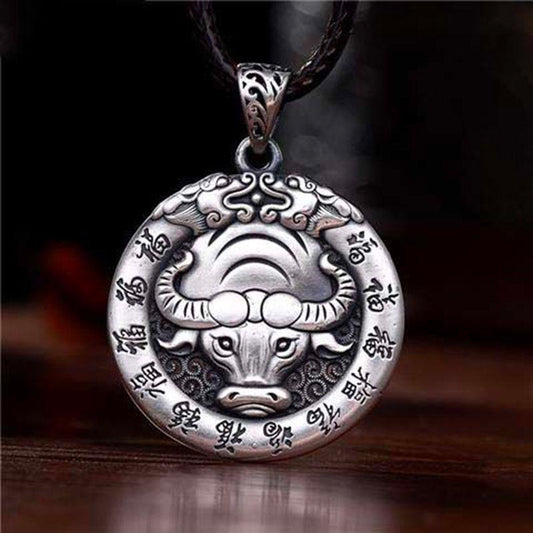
Dragon Head in Three Dimensions
A sculptural interpretation of a dragon head in silver. It relates to the wider dragon-image tradition but does not reproduce a documented chi artifact.
View the design
A Modern Coiled Dragon
Its compact circular composition offers a modern parallel to the turning movement found in many historical dragon-pattern designs.
View the design
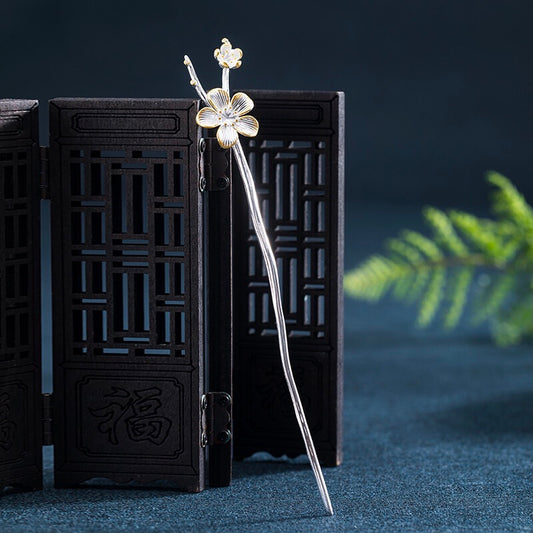
Wood, Jade, and Plum Blossom
This ornament shows how traditional materials and botanical symbols can be recombined in a contemporary wearable form.
View the design
Jade and the Lotus
A contemporary pairing of jade and a botanical motif. It illustrates the continued adaptation of traditional materials without claiming a chi-pattern connection.
View the designFrequently Asked Questions
What does the word chi mean in this article?
It is the romanized name of a legendary dragonlike creature used in Chinese decorative art. It is not the same word as the term often translated as vital energy.
Is the chi pattern the same as a dragon pattern?
Chi imagery belongs to the broader family of dragon designs, but “dragon pattern” is a much wider category. Calling every dragon a chi would erase important differences in period, posture, and visual convention.
Does a chi always have no horns?
No. Hornlessness is a common modern description, but museum objects catalogued with chi designs can include horned creatures. Identification should consider the entire composition and its historical context.
When did chi designs first appear on jade?
The National Museum of China states that they begin to appear during the Spring and Autumn period, when they were still uncommon. They became especially prominent in the Warring States and Western Han periods.
What is a coiled chi pattern?
It is a chi design that emphasizes a curled, winding, or interlaced posture. The bodies may circle an opening, cross one another, or form a continuous ornamental field.
How can I distinguish chi from kui?
Kui motifs are often strongly side-facing and conventionally described as having one visible leg, particularly in early bronze decoration. Chi usually emphasize a flexible, turning body and more complex curling or interlacing. Worn or abstract examples still require expert comparison.
What materials commonly carry chi decoration?
Jade and bronze are central to its early history. Later examples also appear on ceramics, carved furniture, lacquer, textiles, metalwork, and architectural elements.
Does the chi pattern always symbolize good fortune?
Not in one simple, universal way. It can carry auspicious associations, vitality, or antiquarian prestige, but precise meaning depends on the object, period, and accompanying motifs.
Can a photograph alone prove the age of a chi object?
No. Dating requires evidence such as provenance, material analysis, manufacturing technique, excavation context, inscriptions, and comparison with securely dated works. A decorative resemblance by itself is not enough.
How should a modern chi-inspired design be described?
Use language such as “chi-inspired,” “contemporary interpretation,” or “coiled dragonlike cultural symbol.” Avoid describing a modern object as ancient or as a direct replica unless documentation supports that claim.
Explore Related Cultural Themes
References
- The Palace Museum, terminology entry for the chi as a legendary dragonlike creature.
- National Museum of China, jade sword-scabbard fitting with a coiled chi design.
- National Museum of China, bronze mirror with an interlaced coiled chi design.
- The Palace Museum, Warring States bronze tripod with a coiled chi design.
- The Palace Museum, Warring States jade disc with chi, phoenix, and cloud imagery.
- The Palace Museum, Han-period archer's-ring-shaped jade pendant with a chi design.
- The Palace Museum, Yuan-period jade brush rest with two chi and lingzhi.
- The Palace Museum, Ming-period carved hardwood table with openwork chi decoration.
- The Palace Museum, Song-period qingbai washer with an impressed coiled chi design.