Information Snapshot
| Chinese name | 木雕 |
|---|---|
| Pinyin | Mùdiāo |
| Common English name | Chinese wood carving / Chinese woodcarving traditions |
| Basic definition | Subtractive shaping of wood through cutting, chiseling, incising, piercing and related methods |
| Main forms | Carving in the round, relief carving, openwork, pierced carving, incised carving and combined techniques |
| Common woods | Boxwood, camphorwood, basswood or linden, ginkgo, longan and various hardwoods |
| Common tools | Saws, axes, mallets, flat chisels, gouges, V-tools, knives, files and polishing tools |
| General workflow | Selecting and drying wood, planning, roughing out, refining, detailing and optional surface treatment |
| Traditional settings | Architecture, furniture, devotional images, ritual objects, screens, household furnishings and sculpture |
| Regional case studies | Dongyang, Yueqing, Chaozhou, Ningbo, Putian, Quanzhou, Jianchuan and Huizhou |
| Heritage status | Several regional traditions are national intangible cultural heritage projects in China; this is not the same as UNESCO inscription |
What Is Chinese Wood Carving?
Wood carving belongs to the wider history of Chinese woodworking, but not every wooden structure is a carving. Mortise-and-tenon joints and dougong bracket sets primarily solve structural problems. They may carry carved decoration, yet their engineering function should not be confused with carving itself.
A wooden object enters the field of carving when material is deliberately removed to create a figure, pattern, image, inscription or sculptural form. The result may remain attached to a building or piece of furniture, or exist as an independent object.
Wood carving also differs from woodcut printmaking. In carving, the shaped wooden form is generally the finished work. In woodblock printing, the block is a matrix: it is inked so that an image can be transferred to paper or another surface.
A Cautious History of Wood Carving in China
Wood survives less readily than stone, ceramic or bronze. Moisture, insects, fire, rebuilding and ordinary wear have removed much of the early record, so the history of Chinese wood carving cannot be reduced to one invention date.

How Wood Shapes the Art
Wood is not a neutral surface beneath a design. Its grain, hardness, moisture, color, defects and available size influence nearly every decision a carver makes.
Boxwood is dense and fine-grained, allowing small details to remain crisp. The Chinese term huangyangmu means boxwood, not “yellow poplar.” Camphorwood is associated with larger architectural, furniture and multilayer carving in parts of southern China. Basswood or linden is comparatively workable, while ginkgo appears in screens, furniture and lacquered carving. Longan wood is important in some Fujian traditions.
There is no universally best carving wood. A maker considers scale, intended use, seasoning, grain direction and whether the surface will remain natural or receive lacquer, pigment or gold leaf. Cutting with the grain usually offers greater control; working against it increases the risk of splintering.
Major Wood-Carving Techniques
Carving in the Round
This approach creates a substantially three-dimensional form viewed from several directions. Figures, animals and devotional images often use it. A work intended for a niche may have a highly developed front and a simpler back, so “in the round” does not mean every side must receive equal detail.
Relief Carving
In relief, figures project from a supporting background. The projection may be shallow, deep, high or arranged in overlapping layers. Architectural panels, doors, furniture, screens and bed fittings frequently use relief because it organizes narrative and ornament within a bounded surface.
Openwork and Pierced Carving
Openwork removes parts of the background so light can pass through the design. Regional terms for openwork, pierced carving and through carving often overlap. Whatever the name, the maker must balance visual openness with the strength of the remaining wood.
Incised and Recessed Carving
Incised lines sit below the original surface and can define feathers, hair, textile patterns, inscriptions and background texture. Recessed carving may be useful on doors or furniture because the design does not project as far into spaces exposed to regular contact.
Traditional Tools and the Carving Process

Tool sets vary by workshop. Broad axes and saws remove large amounts of timber. Flat chisels establish planes, gouges shape curved surfaces, and V-tools cut fine lines. Mallets, knives, files, abrasive materials and polishing tools may also be used. Modern workshops sometimes combine mechanical roughing with hand refinement; the presence of a power tool alone does not settle the artistic quality or heritage identity of a work.
Choose timber for scale, grain and condition, then dry it appropriately to reduce later movement.
Use drawings, templates or, in some figure-carving traditions, a clay model. Root and split-wood carving may begin from the material’s natural shape.
Remove excess wood and establish the silhouette, balance and major levels before fragile details are attempted.
Develop faces, feathers, drapery, foliage and background textures with progressively smaller tools.
Preserve expressive tool marks, polish selected areas or prepare the surface for wax, lacquer, pigment or gilding.
No sequence applies to every tradition. Ningbo lacquer work and Yueqing root carving, for example, follow different priorities.
Representative Regional Traditions
Popular accounts sometimes promote a fixed group of “Four Great Chinese Wood Carvings,” but the list changes between sources. The following are better understood as distinct case studies rather than a complete national ranking.
Dongyang Wood Carving
Known especially for pictorial relief and architectural or furniture decoration. Shallow, deep, high and multilayer relief appear alongside openwork and other methods. Many works retain the timber’s natural color, but Dongyang is not limited to shallow relief.
Yueqing Boxwood Carving
Associated with compact sculptural work in fine-grained boxwood. Official project records distinguish traditional figure carving, root carving and split-wood carving. Its precise origin date remains uncertain.
Chaozhou Wood Carving
Used extensively in temples, ancestral halls, residences, furniture and ritual furnishings. Multilayer openwork and gilded lacquer surfaces are highly visible, although natural-finish carving also belongs to the tradition.
Ningbo Zhujin Lacquered Carving
Integrates carving with red lacquer, color, decorative painting and gilding. Wedding beds, sedan chairs, devotional images and household furnishings demonstrate why its surface process is as important as its sculptural relief.
Putian and Quanzhou
These Fujian centers include devotional sculpture, architectural carving, furniture, relief and freestanding work. They share a wider southern coastal setting but should not be collapsed into one uniform “Fujian style.”
Jianchuan and Huizhou
Jianchuan carving is closely connected with Bai architecture and household space in Yunnan. Huizhou wood carving belongs to the broader “Three Carvings of Huizhou” alongside brick and stone carving.
Architecture, Furniture and Independent Sculpture
Architectural carving appears on beams, brackets, lintels, doors, windows, railings and screens. Structural safety limits how deeply a load-bearing member can be pierced. Carvings installed high above the viewer may use stronger silhouettes and deeper shadows than a piece intended for close inspection.
Furniture carving must accommodate touch, movement, joints and daily use. A dramatic undercut may work on a ceremonial bed but be impractical on a frequently handled chair. Devotional and ritual images gain meaning through placement, ceremony, repainting and repeated use, not only through their appearance as isolated museum objects.
Freestanding carving gives greater attention to volume, center of gravity and multiple viewing angles. Even then, a work designed for a shelf or niche may retain a clear primary front.

Animal, Floral and Auspicious Motifs
Chinese wood-carving subjects include religious figures, historical characters, theater stories, animals, plants, landscapes, inscriptions and scenes of local life.
A bat may evoke good fortune through the sound relationship between the Chinese words for bat and blessing. Fish may suggest abundance through the association between fish and surplus. Peaches, pine trees and cranes often occur in wishes for longevity. Peonies can be linked with prosperity, while dragon-and-phoenix combinations may appear in ceremonial or wedding settings.
These associations are not a fixed codebook. A dragon on a temple beam, ancestral-hall panel, domestic cabinet or contemporary ornament may carry different implications. Meaning depends on combinations, inscriptions, location, date and use.

How to Appreciate and Examine a Wood Carving
- Follow the grain. Does it reinforce drapery, leaves or the movement of an animal’s body?
- Read the layers. In relief, can foreground and background remain legible without becoming visually crowded?
- Study negative space. In openwork, do the remaining bridges of wood support fragile details?
- Consider viewing distance. Architectural carving may be designed for strong shadows and an upward gaze.
- Look beyond “handmade” claims. Controlled variation can suggest handwork, but tool marks alone cannot prove an artist, date or origin.
A reliable assessment of an antique carving also considers timber species, construction, surface coatings, wear, repairs and provenance. Darkened wood, cracks or irregular knife marks are not sufficient proof of age.
Conservation and Care
Wood continuously responds to environmental moisture. Rapid changes can cause expansion, shrinkage, warping, joint movement and cracking. Stability is more useful than applying one universal humidity number, because bare wood, lacquered wood, painted sculpture and gilded carving respond differently.
Keep carvings away from direct sunlight, radiators, fireplaces, air-conditioning vents, damp walls and standing water. Support the whole object when moving it rather than lifting it by fingers, branches or openwork edges.
Fresh holes, recurring wood powder, mold, enlarging cracks, loose joints or flaking lacquer require specialist assessment. Painted, lacquered, gilded, antique or architecturally installed carvings should not be scrubbed, sanded, recoated or dismantled as a casual home project.
Safeguarding a Living Craft
Safeguarding involves more than storing old objects. It includes supporting artisans, recording regional vocabulary and tools, maintaining apprenticeship, preserving workshop archives and sustaining the architectural and ritual settings in which carving remains meaningful.
China’s national intangible cultural heritage system recognizes several regional traditions, including Dongyang wood carving, Yueqing boxwood carving, Chaozhou wood carving and Ningbo Zhujin lacquered wood carving, as well as regional projects under the broader “wood carving” category. Recognition concerns living skills and their communities; it does not turn every recent carving from a listed region into a national cultural relic.
Cultural Symbols in Contemporary Design
Traditional wood carving offers more than a catalog of motifs. Its deeper resources include respect for grain, layered composition, structural openwork and the relationship between ornament and use. Contemporary designers may translate these principles into jewelry, interiors, furniture and other media.
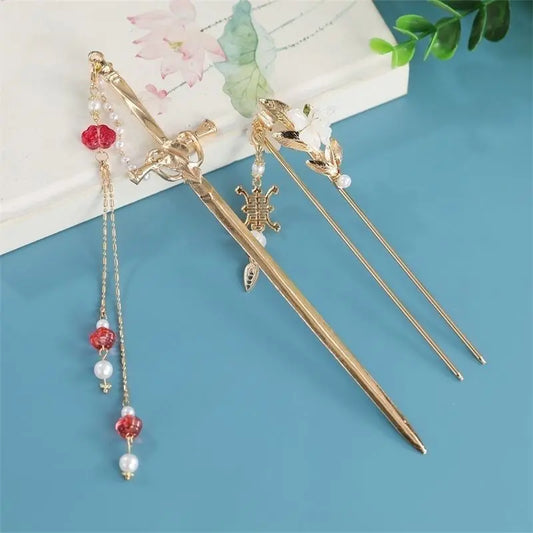
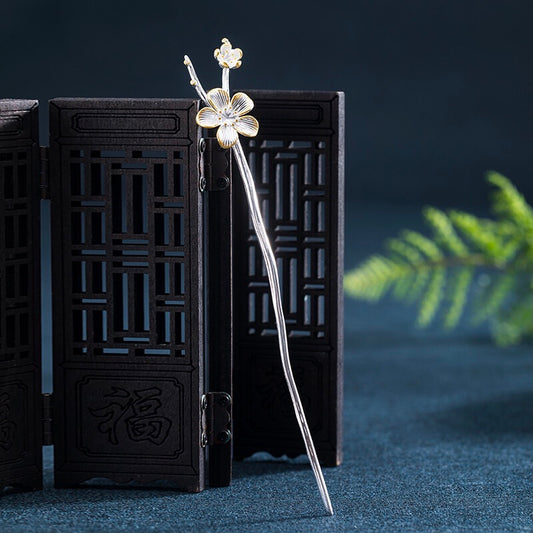
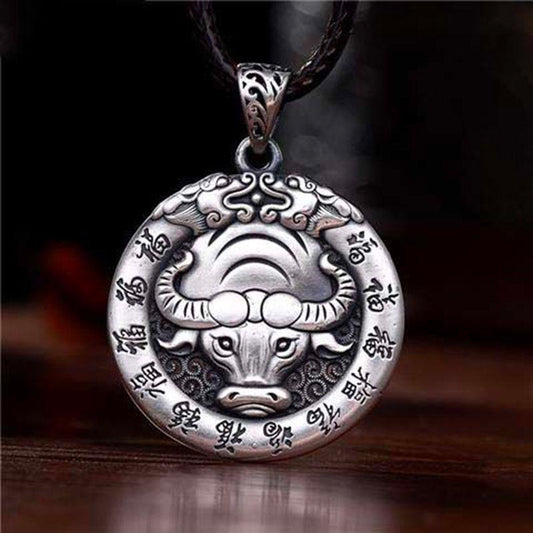
The current designs below use wood or motifs also found across Chinese decorative arts. They are contemporary interpretations—not antique carvings, not documentation of the photographed works above, and not presented as works belonging to a national intangible cultural heritage project.

Plum Blossom and Wood
A contemporary use of the plum blossom, a motif often associated with endurance and renewal.

Peacock and Tassel
The bird motif is translated into a compact contemporary ornament with contrasting red accents.

Lotus and Dragonfly
Floral and insect forms are reorganized for a modern wearable setting rather than copied from one historical carving.

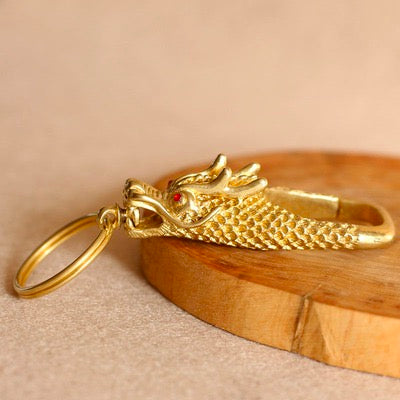
Dragon in Three Dimensions
A dragon motif is translated into a compact sculptural form in a material different from carved wood.
Frequently Asked Questions
What is Chinese wood carving?
It is a broad group of traditions that shape wood by cutting, chiseling, incising and piercing. It includes architecture, furniture, devotional images, ritual objects and freestanding sculpture.
How is wood carving different from woodcut printing?
In carving, the wooden form is usually the finished work. In woodcut printing, the carved block is inked to transfer an image onto paper or another surface.
How old is Chinese wood carving?
Prehistoric finds show very early wood shaping in China, but preservation is incomplete. They do not establish an uninterrupted lineage to every modern regional tradition.
What are the main carving techniques?
Common forms include carving in the round, shallow and high relief, openwork, pierced carving and incised carving. Many objects combine several methods.
Are there official “Four Great Wood Carvings”?
No single list is universally accepted. Regional traditions are more accurately discussed as distinct case studies rather than one fixed national ranking.
Which wood is best for carving?
There is no universal best choice. Grain, scale, intended use, seasoning and surface treatment all influence selection.
Why does wood carving crack?
Wood expands and contracts as environmental moisture changes. Rapid humidity shifts, heat, sunlight, internal stress and insufficient seasoning can contribute.
Why are some carvings gilded?
Surface treatment reflects regional practice and purpose. Some Chaozhou and Ningbo works use lacquer and gold leaf, while many other works emphasize natural timber.
Do carved motifs have one fixed meaning?
No. Dragons, phoenixes, bats, fish and flowers may have familiar associations, but interpretation depends on combinations, inscriptions, region, date and use.
How can hand carving be recognized?
Variation in depth and tool direction can provide clues, but many modern works combine machine roughing with hand finishing. Photographs alone are not reliable authentication.
Should old carvings be oiled?
Not as a general rule. Oil can darken wood, attract dirt, alter coatings and complicate conservation, especially on painted, lacquered or gilded surfaces.
Is every regional carving a heritage object?
No. Intangible heritage recognition protects living knowledge and community transmission; it does not automatically turn every newly made carving into a protected relic.
References
- China Intangible Cultural Heritage Network and Digital Museum, “Dongyang Wood Carving.”
- China Intangible Cultural Heritage Network and Digital Museum, “Yueqing Boxwood Carving.”
- China Intangible Cultural Heritage Network and Digital Museum, “Chaozhou Wood Carving.”
- China Intangible Cultural Heritage Network and Digital Museum, “Ningbo Zhujin Lacquered Wood Carving.”
- China Intangible Cultural Heritage Network and Digital Museum, “The Three Carvings of Huizhou.”
- China Intangible Cultural Heritage Network and Digital Museum, “Wood Carving: Putian Wood Carving.”
- China Intangible Cultural Heritage Network and Digital Museum, “Wood Carving: Quanzhou Wood Carving.”
- China Intangible Cultural Heritage Network and Digital Museum, “Wood Carving: Jianchuan Wood Carving.”
- The Palace Museum, collection and conservation materials concerning wooden sculpture and architectural components.
- National Museum of China, collection and exhibition materials concerning wooden figures and carved wood.
- National Forestry and Grassland Administration of China, LY/T 3148—2019, General Technical Requirements for Wood Carvings and Wood-Carving Products.
- Canadian Conservation Institute, basic care guidance for furniture and wooden objects.