The Chinese Showcase journal Chinese symbols
What Is a Rope-Pattern Jade Ring? Shengwen, Jiaosiwen, and Niusiwen
A rope-pattern jade ring gives stone the appearance of twisted cord. See how the pattern was carved, how to identify a jade huan, and what surviving rings reveal about ancient Chinese jewelry.
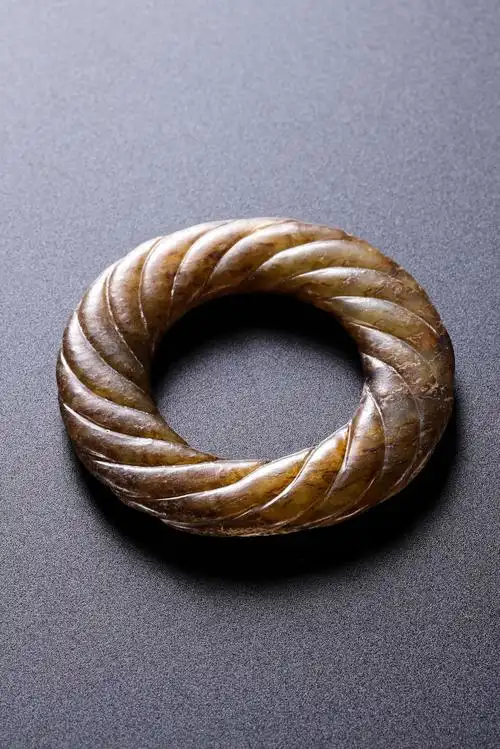
A rope-pattern jade ring is a circular jade ornament with diagonal grooves or ridges arranged to look like twisted cord. Chinese terms for this family of designs include shengwen (rope pattern), jiaosiwen (twisted-silk pattern), and niusiwen (twisted-thread pattern). These terms describe the visual effect, from a few broad twists to closely spaced lines that follow the curve of the jade. [1] [2] [3]
The book photograph below labels its example as a jade ring from the Warring States period. It has a large central opening and a continuous outer edge. Faint diagonal lines run across the muted green and brown surface. Start at the section where those lines are clearest and follow them toward the edge. The circular outline stays simple, but the surface looks as though it is turning.

Rope-Pattern Jade Rings at a Glance
| Object | Rope-pattern jade ring or jade huan |
|---|---|
| Chinese search terms | Shengwen, jiaosiwen, niusiwen |
| Visual clues | A closed ring with repeating diagonal grooves or ridges |
| Period in the book photograph | Warring States period |
| Documented use | A ring could be worn as an ornament or serve as a component of a suspended jade set |
What Are Shengwen, Jiaosiwen, and Niusiwen?
Look at a short piece of twisted cord. Each strand emerges at an angle, crosses the visible surface, and passes behind the rest. The rope pattern borrows that repeated movement. The book label explains the design through two cords twisted together, with each cord made up of finer strands. Makers could suggest that structure with broad divisions or add thin lines within it to make the resemblance to silk more pronounced. [1] [2] [3]
The National Museum of China holds a round green jade ornament decorated with slanting incised lines. Its grooves stay separate as they go around the ring. The light catching the jade between them supplies the look of raised strands. The museum traces early examples of rope decoration to Liangzhu jade bangles, some with the pattern concentrated on the outer surface. It identifies the Spring and Autumn and Warring States periods as a time when rope-pattern jades flourished. [1]
An example cataloged by the National Palace Museum in Taipei dates from the late Warring States to the early Western Han. It is just over five centimeters across, with a 3.9-centimeter opening and closely spaced twisted lines. Its slim face shows how a narrow band could still carry the pattern clearly. [9]
How Do You Tell a Jade Huan, Jue, and Bi Apart?
A huan is a closed ring. A typical jue has a narrow split that runs from the outer edge into the central opening. The book page places a Warring States rope-pattern ring near a dragon-pattern jue of the Spring and Autumn period. These names describe two different aspects of the objects. The words rope pattern and dragon pattern identify their decoration, while huan and jue identify their shapes. [4]
A bi also has a central opening, often surrounded by a broad flat face. The ancient glossary Erya classifies a bi, a huan, and a yuan by comparing the body’s width with the hole’s diameter. In that scheme a wider body suggests a bi, a comparatively large hole suggests a yuan, and a more even balance suggests a huan. Catalog descriptions can vary because surviving objects have a range of proportions. [5] [6]
How Was a Rope Pattern Worked Around the Ring?
Ancient jade working could involve cutting a blank, drilling the opening, grinding the surfaces to shape, carving the decoration, and polishing. A rope pattern poses a particular layout problem. The outer edge is longer than the inner edge. Each slanting line must follow the rounded face while keeping an even visual spacing, and the last group of grooves must meet the first without a conspicuous break. [7]
The pale ring in the photograph below shows fine, closely spaced lines. They catch the light at different angles as they run around the face. The strongly raised ridges on the ring in the cover photograph create the same twisted appearance at a larger scale. A viewer can compare a single row of marks and then see how it changes as the jade curves away from the light.

How Were Jade Rings Worn?
Small holes and connecting pieces can offer clues. A Warring States rope-pattern ring in the Palace Museum measures 8.3 centimeters across and only 0.3 centimeters thick. It has two concentric bands joined at six points. Three small holes between the bands may have taken cords for suspension. On some connecting sections, the twisted pattern changes direction, making the joins part of the decoration. [2]
A jade ring could also sit near the top of an assembled ornament. Research published by the Henan Museum describes examples with strings of beads and curved jade pendants suspended below a ring or disc. Painted wooden figures from a Warring States Chu tomb at Changtaiguan show sets containing rings, beads and arcs hanging from the waist. The photograph of a loose ring gives a good view of its surface. Its size, wear, and excavation record would help determine how that particular ring was used. [8]
What Meaning Can the Circle and Twisted Pattern Carry?
Today, a complete circle can suggest reunion or continuity. The way the diagonal grooves connect can also evoke a bond that goes on around the ring. Those associations come from looking at the shape. To understand the role of a specific ancient object, an excavation record, nearby ornaments, or traces of suspension offer more direct evidence.
Follow one strand of the carved design from the inner opening to the outer edge. It occupies very little space. Repeat it across the polished face, and it is enough to make the whole ring look like a length of twisted cord joined end to end.
Frequently Asked Questions About Rope-Pattern Jade Rings
What is a rope-pattern jade ring?
It is a round jade ornament with angled grooves or ridges that resemble twisted cord. A complete circular example is often called a jade huan.
Do shengwen, jiaosiwen, and niusiwen refer to the same pattern?
They are overlapping terms for rope-like or twisted-strand decoration. Catalogs may favor one name depending on the design and how fine or pronounced its grooves are.
When were rope-pattern jade rings made?
Early rope decoration appears on Liangzhu jade bangles. It flourished on jade ornaments in the Spring and Autumn and Warring States periods and continued into the early Han.
What is the difference between a jade huan and a jade jue?
A jade huan has a continuous outer edge. A typical jade jue has a split from its outer edge to the opening.
Were ancient jade huan worn as finger rings?
Surviving jade huan vary in size. Archaeological examples show that rings could be hung with a cord or form part of an assembled ornament. Dimensions and find context help establish how each object was worn.
What does the rope pattern symbolize?
The unbroken circle and repeating strands can suggest continuity, reunion, or connection to a modern viewer. The archaeological context helps interpret the original use of an individual ring.
Jade Jewelry to Explore

Jade Disc and Red Bead Bracelet
A round jade disc sits in a strand of red beads, linking a familiar circular form with the article’s discussion of ornaments assembled on a cord.
View product details
Hetian Jade and Red Agate Cloud Ring
Hetian jade and South Red agate sit at opposite ends of this adjustable finger ring, with a blue cloud detail beside the red stone.
View product details
Hetian Jade Lotus Seedpod Bangle
A carved jade lotus seedpod finishes one end of this sterling silver bangle. Its curved band offers another way to wear jade in a circular form.
View product detailsRelated Reading
References
- National Museum of China, Twisted-Silk Pattern Jade Ring, collection entry.
- The Palace Museum, Jade Ring with Twisted-Silk Pattern, Warring States period, accession Gu 00085254.
- The Palace Museum, glossary entry on rope ornament or taowen.
- The Palace Museum, Jade Jue, Xinglongwa culture, accession Xin 00116105.
- Erya, “Explaining Objects,” as discussed in the National Museum of China exhibition Ancient Chinese Jade Art.
- Xu Lin, “Notes on the Names of Jade Bi, Huan, and Yuan,” Palace Museum publication.
- Shanghai Museum, Fine Materials and Skilled Workmanship, on ancient jade production.
- Henan Museum, Seven-Huang Jade Ornament with Strings of Beads, collection study.
- National Palace Museum, Taipei, Jade Huan Ring with Skein Pattern, late Warring States to early Western Han, collection no. Gu Yu 002179.
Stories, symbols and everyday objects
Our journal explores Chinese culture and design. Traditions and interpretations vary by region and source. For a purchase, use the specifications on the individual product page.
About Chinese ShowcaseQuestions or corrections? Contact us ↗