The Chinese Showcase journal Chinese symbols
Peace Dove Meaning: The Dove of Peace in Chinese Culture
A dove carrying an olive branch brings news that it is safe to return. Explore the story behind the peace dove, its role in Chinese art, and three ways artists turn the bird into an ornament.
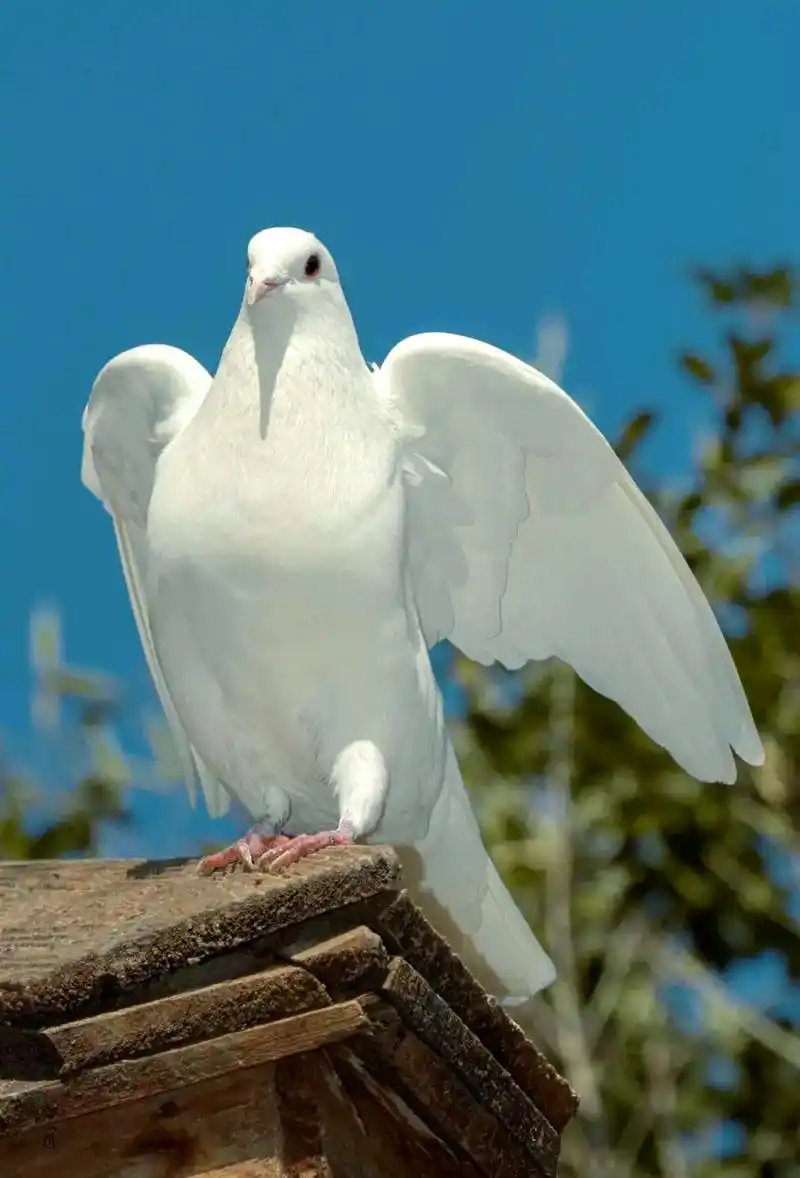
The peace dove, also called the dove of peace, is a widely recognized symbol of peace, reconciliation, and hope after conflict. Its familiar form is a white dove in flight, often with an olive branch in its beak. Chinese painters adopted the motif in the twentieth century and placed it alongside flowers, children, and other familiar subjects. [1] [2] [3] [4]
The black-and-white patterns reproduced here show how much of the idea can be conveyed by shape alone. A single rising branch identifies the central dove, a circle of wings suggests a flock, and a fan of tail feathers gives a small bird the appearance of flight.
The Peace Dove at a Glance
| Common name | Peace dove or dove of peace |
|---|---|
| Recognizable features | A white bird, often with outstretched wings and an olive branch |
| Main associations | Peace, reconciliation, and the hope of returning to ordinary life |
| Modern milestone | Picasso’s lithograph on a 1949 peace-congress poster in Paris |
| Chinese art examples | Qi Baishi’s Peace and Yu Fei’an’s Peonies and Two Doves |
Why Does the Dove of Peace Carry an Olive Branch?
The combination recalls the story of Noah’s ark in Genesis. During the flood, Noah sent a dove out to look for a place to land. It returned empty-beaked the first time. After seven more days, he released it again. The dove returned at evening with a freshly plucked olive leaf, a sign to Noah that the waters had gone down. [1]
Artists often enlarge the leaf into a small branch with several leaves. The branch shows at a glance that the dove has found something growing outside the ark. The idea of being able to return, settle, and begin again helps explain why such a small object can carry a wish for peace. A United Nations peace stamp uses the same pairing of a white dove and an olive branch. [2]

How Did Picasso Popularize the Peace Dove?
In 1949, a lithograph by Pablo Picasso was used on a poster for the World Congress of Partisans for Peace in Paris. The white bird stands against a dark ground with its wings folded. The High Museum of Art identifies the model as a pigeon Picasso received from Henri Matisse. Reproduced on the congress poster, the image reached people well beyond the artist’s studio. [3]
A dove can be immediately recognizable with very few marks. The rounded head, pointed beak, and sweep of the wing are enough to suggest a living bird. That is one reason the image works across formats as different as a large poster and a tiny stamp. The opening ceremony of the Olympic Games uses another form of the same symbol, the ceremonial release of doves represented on stage. [2] [5]

What Does the Dove Mean in Chinese Culture?
Doves and pigeons were already familiar in everyday Chinese life. In Beijing, the traditional craft of making pigeon whistles grew around the custom of flying pigeons. As the flock flew over a courtyard, air passing through the little whistles produced sound. The role of the homing pigeon offers another familiar image. A bird taken away from its loft can return there carrying a message. [6] [7]
In 1952, Qi Baishi painted Peace and Flowers and a Dove of Peace. The Beijing Fine Art Academy also preserves studies showing his attention to the bird. His paintings brought the international emblem into the language of Chinese flower-and-bird painting, where a small turn of the head or an expanse of unpainted paper can do as much as a carefully drawn feather. [4]
In Yu Fei’an’s Peonies and Two Doves, the peonies carry a wish for prosperity and the two birds bring a wish for peace. The National Art Museum of China reads the combination as a blessing for prosperity and safety. Jiang Zhaohe’s Child and Dove brings the meaning down to a more intimate scale. It lets the viewer see what peace makes possible through a quiet encounter between a child and a bird. [8]

How to Read Single Doves, Pairs, and Flocks
A dove carrying a branch directs the eye to its beak, as if news has just arrived. Two birds resting together draw attention to their relationship. Artists and viewers can read a pair as a wish for companionship and a peaceful household. The comparison has a basis in the habits of real birds. Both rock pigeon parents care for and feed their young. In a celebratory setting, the pair can also carry a wish for that companionship to last. [9]
In the circular pattern above, the eight outer birds repeat a simple silhouette. As their positions turn around the ring, the wings pull the eye from one bird to the next. The larger dove at the center has a distinct eye, feather markings, and a spray of leaves that rises into the open space. Those details let it remain the focus even as the outer birds suggest movement.
The two separate designs use different kinds of line. The open design sets curling lines around widely spread wings. The darker design uses narrow lines to spread its tail feathers like a fan. A closer look at that tail shows how the artist can suggest flight even with the branch removed from the composition. The body and wing angle orient the bird, and the open space ahead leaves room for it to move.

Frequently Asked Questions About the Dove of Peace
What does the peace dove symbolize?
The peace dove symbolizes peace, reconciliation, and hope after conflict. A white dove carrying an olive branch is its best-known form.
Are “peace dove” and “dove of peace” the same symbol?
Yes. Both terms refer to the dove used as an emblem of peace. Different versions show it flying or perched, with or without an olive branch.
Why does the dove of peace carry an olive branch?
The motif recalls Noah’s dove bringing back an olive leaf after the flood in Genesis. Artists often depict the leaf as a branch to convey news that it is safe to return and begin again.
Did Picasso create the original dove of peace?
The dove and olive leaf appear in the much older story of Noah. Picasso helped popularize the modern peace emblem when his white dove appeared on the poster for a 1949 peace congress in Paris.
What do doves represent in Chinese art?
In modern Chinese art, doves can express wishes for peace and safety. Paired doves can also evoke companionship and household harmony, with surrounding motifs helping to establish the meaning.
Does a peace dove have to be white?
White is common in peace imagery. A black silhouette or simple outline can convey the same meaning through the bird’s wings, the olive branch, and the surrounding context.
Jewelry with Bird and Peace Motifs

Magpie and Blossom Branch Hairpin
A colorful magpie rests on a flowering branch, a traditional pairing associated with joy and welcome news.
View product details
Blue Crane Tassel Earrings
A crane with spread wings recalls the bird shapes in the article. Blue accents and a fine tassel give each earring movement.
View product details
Lotus Peace Buckle Spinner Ring
The round peace buckle motif expresses a wish for safety and well-being. The blue-green center sits in a lotus setting.
View product detailsRelated Reading
References
- Genesis 8:6–12, the dove sent out by Noah after the flood.
- United Nations, “UN Stamps Promote Peace ‘One Stitch at a Time’,” on the embroidered Dove of Peace stamp.
- High Museum of Art, Pablo Picasso, World Congress of Peace Partisans, 1949, lithograph on paper.
- Beijing Fine Art Academy, “Doves of Peace: From Picasso to Qi Baishi,” with Qi Baishi’s Peace and Flowers and a Dove of Peace, both dated 1952.
- International Olympic Committee, official explanation of the opening and closing ceremonies.
- Beijing Municipal People’s Government, 2024 Beijing Social Science Popularization Week report on traditional pigeon whistle making.
- Smithsonian Institution, “Tails of Bravery,” on the homing pigeon’s role as a messenger.
- National Art Museum of China, Ode to Peace exhibition, featuring Yu Fei’an’s Peonies and Two Doves and Jiang Zhaohe’s Child and Dove.
- Cornell Lab of Ornithology, Rock Pigeon Life History, on care of young.
Stories, symbols and everyday objects
Our journal explores Chinese culture and design. Traditions and interpretations vary by region and source. For a purchase, use the specifications on the individual product page.
About Chinese ShowcaseQuestions or corrections? Contact us ↗