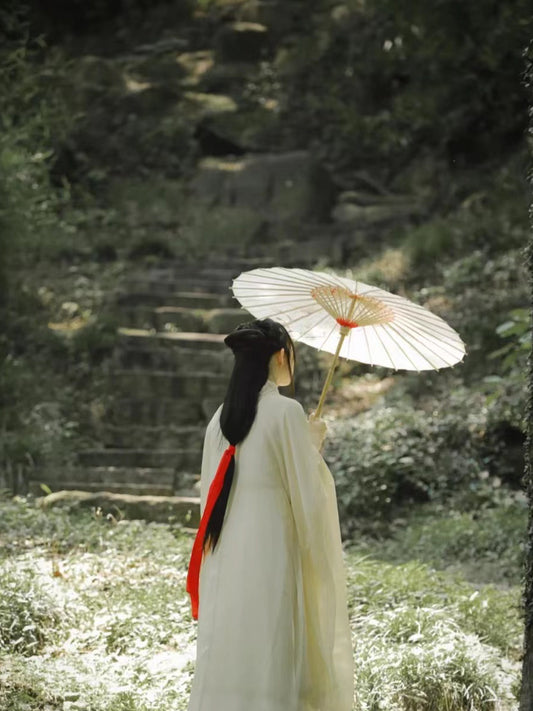
A Chinese oil-paper umbrella is easy to recognize: a bamboo frame opens beneath a circular paper canopy, hand-painted lines follow the ribs, and tung oil gives the surface a warm translucent sheen. Known in Chinese as youzhisan or you zhi san (油纸伞), it began as practical protection from rain and sun but gradually became part of weddings, regional craft traditions, theater, photography, literature, and interior decoration.
The object looks simple when closed. Once opened, however, it reveals the work of bamboo splitters, frame makers, paper workers, painters, and oilers. In some established regional methods, one umbrella passes through dozens of specialized operations before it is ready to use. Its cultural value therefore comes from both the finished image and the network of knowledge hidden inside it.
| Feature | Traditional role | Why it matters |
|---|---|---|
| Bamboo ribs and shaft | Create the folding skeleton | Require strength, flexibility, accurate drilling, and balanced assembly |
| Paper canopy | Provides a light surface for shelter and painting | Must be attached smoothly and tolerate oiling and repeated opening |
| Tung oil | Helps harden and water-resistant the paper | Gives the canopy its characteristic finish and practical function |
| Thread and adhesive | Bind ribs, canopy, and edge | Hold the mechanism together while allowing movement |
| Painting and calligraphy | Add landscape, flowers, birds, or literary imagery | Turn everyday rain gear into a regional art object |
| Round opened form | Creates even shelter | Often interpreted as completeness, harmony, or reunion |
What Is a Chinese Oil-Paper Umbrella?
An oil-paper umbrella is a folding umbrella whose canopy is traditionally made from paper treated with oil. The frame is usually bamboo, although some regional processes also use particular woods for the shaft, runner, or other structural parts. The paper is attached to the opened frame, decorated, dried, and coated with tung oil to improve durability and resistance to water.
The Chinese name 油纸伞 can be broken down directly: you means oil, zhi means paper, and san means umbrella. English spellings vary, so readers may encounter “oil-paper umbrella,” “oiled-paper umbrella,” “Chinese paper umbrella,” “youzhisan,” or “you zhi san.” “Oil-paper umbrella” is the clearest general term.
Not every decorative paper parasol sold today follows a traditional oil-paper process. Some are intended primarily for performance, display, weddings, or photography and may use fabric, synthetic paper, printed canopies, or modern coatings. A genuine handmade oil-paper umbrella should be evaluated by its materials and process, not only by its circular shape.

When Were Oil-Paper Umbrellas Invented?
The history should be separated into three layers: early shade and rain covers, folding-umbrella legends, and the later development of paper canopies treated with oil. These are related, but they are not the same invention.
The Lu Ban's Wife Legend
A widely repeated Chinese legend credits the wife of the master carpenter Lu Ban with making an early collapsible rain cover. In the story, she split bamboo into strips, covered the structure with animal hide, and created something that opened like a canopy and closed like a staff. The details and even her name vary across retellings.
This account is valuable as craft folklore, but it should not be treated as documented proof that one identifiable person invented the modern oil-paper umbrella in the fifth century BCE. The legendary object used hide rather than oiled paper, and the story explains the ingenuity of the folding form more than the precise origin of the later craft.
From Silk and Fabric Covers to Paper
Ancient Chinese covers and ceremonial canopies were made in multiple forms and materials. Some were symbols of rank as well as practical shade. As paper production developed and paper became more available, craftspeople could adapt it to umbrella canopies. Oil treatment made the surface more suitable for wet weather.
The China Intangible Cultural Heritage Network states that paper gradually replaced silk on umbrella surfaces after the development of papermaking and that oil-paper umbrellas appeared by the Song period. Other popular histories describe broader developments after the Han and Tang periods. Rather than assigning one exact birthday, it is safer to see the object as the result of accumulated innovations in papermaking, bamboo craft, folding mechanisms, adhesives, and tung-oil treatment.
Expansion of Regional Production
Oil-paper umbrellas were produced in several parts of China, including areas of Sichuan, Hunan, Guangdong, Fujian, Zhejiang, Jiangxi, Guizhou, and Yunnan. Local bamboo, paper, climate, painting styles, market networks, and ceremonial customs shaped distinct regional traditions.
Industrial umbrellas made from metal, nylon, and plastic eventually displaced handmade paper umbrellas from much everyday use. That change did not end the craft. It shifted its value toward heritage, design, ceremony, performance, tourism, collecting, and cultural education.
What Are Oil-Paper Umbrellas Made Of?
There is no universal material list for every workshop, but traditional examples rely on a small group of natural materials whose quality determines how the umbrella opens, closes, and ages.
Bamboo
Bamboo is used for ribs because it can be split into narrow strips while retaining useful flexibility. Artisans select mature, straight material without severe cracking or insect damage. Depending on regional practice, different bamboo varieties may be chosen for inner ribs, outer ribs, or the shaft.
The bamboo may be cut, soaked, steamed or heated, dried, shaved, polished, drilled, and sorted. Consistency matters. If several ribs differ in length, thickness, or curvature, the umbrella will open unevenly and place stress on the canopy.
Paper
Traditional descriptions mention bark paper, cotton paper, and other tough absorbent papers. The paper must be light enough to open easily but strong enough to survive pasting, drying, painting, oiling, and repeated movement. It is usually attached in sections or as a prepared circular surface, depending on the method.
Tung Oil
Tung oil comes from the seeds of the tung tree. Applied in controlled coats, it penetrates and hardens on the paper, adding water resistance and a characteristic warm tone. The umbrella must dry properly between stages. Excessive or uneven oil can affect appearance, flexibility, and drying.
Thread, Adhesive, Wood, and Pigment
Thread binds the ribs and helps secure edges. Adhesive joins the canopy to the frame. Some workshops use specific woods for handles or moving components. Mineral, plant, or modern pigments may be used for decoration, depending on the workshop and period.
How Are Chinese Oil-Paper Umbrellas Made?
Production varies by region, so the familiar online list of six steps is only a summary. The official description of Luzhou's Fenshui tradition records more than ninety operations, including specialized processes for preparing the support, threading the ribs, finishing the border, pasting paper, applying oil, and heating or adjusting components.
1. Selecting and Preparing Bamboo
The maker chooses suitable bamboo and cuts it to working lengths. Nodes and rough fibers are removed. Strips are split and shaved according to their role in the frame. Seasoning, soaking, steaming, or gentle heat may be used to stabilize and shape the material.
2. Making the Ribs and Folding Mechanism
Ribs must be measured, drilled, and grouped accurately. Holes allow thread or fasteners to connect the pieces. The artisan assembles the runner, shaft, and rib system, then tests whether the skeleton opens evenly and closes without catching.
3. Threading and Reinforcing the Frame
Decorative and structural thread can form a web beneath the canopy. This thread helps organize the ribs and may become visible when the umbrella is viewed from below. Edge binding strengthens areas exposed to frequent handling.
4. Pasting the Paper
The paper is cut and carefully pasted onto the fully opened frame. Wrinkles, weak seams, or trapped air can spoil the final surface. The canopy must dry under controlled conditions before finishing continues.
5. Painting and Calligraphy
Some umbrellas remain plain or use a single ceremonial color. Others are decorated with plum blossom, lotus, peony, birds, mountain-and-water landscapes, literary scenes, or calligraphy. The painting must work with the radial structure rather than ignore it.

6. Applying Oil and Drying
Tung oil is brushed across the paper in an even layer. The maker controls absorption, thickness, and drying so that the canopy becomes more resistant to water without losing its ability to fold. Some traditions apply more than one treatment.
7. Trimming, Testing, and Finishing
The edge is trimmed and reinforced, the handle and decorative fittings are completed, and the umbrella is repeatedly opened and closed. The maker checks balance, tension, seams, and surface defects before the piece leaves the workshop.
Where Are Chinese Oil-Paper Umbrellas Made?
Luzhou, Sichuan
Fenshui oil-paper umbrellas from Jiangyang District, Luzhou, are among the best-documented traditions. The craft was included in China's second group of national intangible cultural heritage projects in 2008. Official documentation connects the local tradition with materials such as tung oil, nan bamboo, water bamboo, wood, and bark paper, and describes its detailed handmade process.
Hunan
Xiangtan's oil-paper umbrella tradition draws on regional bamboo, wood, and tung-oil resources. Contemporary heritage projects there combine older techniques with updated designs, workshops, and cultural tourism. Hunan examples show how a local craft can continue without pretending that daily life has not changed.
Zhejiang
Paper-umbrella craftsmanship survives in parts of Zhejiang, including traditions associated with Hangzhou-area districts. Artisans continue to hand-cut bamboo and use paper treated with tung oil, while introducing new painted subjects and event-related designs.
Fujian, Jiangxi, Guizhou, Yunnan, and Other Regions
Fuzhou, Wuyuan, Chishui, Yunnan villages, and other locations maintain their own paper-umbrella knowledge. Some emphasize practical rain use; others are now better known for wedding umbrellas, decorative canopies, performances, or heritage demonstrations. Materials and names should therefore be attributed to the specific tradition whenever possible.
What Are Oil-Paper Umbrellas Used For?
The original use is practical shelter. A properly made and maintained oil-paper umbrella can provide shade and protection from ordinary rain. However, buyers should check the maker's instructions because some modern decorative umbrellas are not designed for heavy rain or strong wind.
Oil-paper umbrellas have also been used at weddings and other ceremonies. A red umbrella can accompany a bride, create a festive procession, or serve as a meaningful photographic prop. Customs differ across regions and families, so one local practice should not be described as universal to all Chinese weddings.
Today the umbrella may appear in dance, opera, theater, film, hanfu styling, shop displays, hotels, tea rooms, festivals, and cultural education. Open umbrellas can form ceiling installations or colorful street decorations. Smaller pieces may be collected as painting surfaces or displayed as craft objects.

What Do Oil-Paper Umbrellas Symbolize?
Completeness and Reunion
When opened, the canopy forms a circle. In Chinese visual culture, the circle can suggest wholeness, harmony, and reunion. This is one reason an umbrella can feel appropriate in family and wedding settings.
Family Continuity
A popular folk explanation notes that you zhi, “oil paper,” sounds similar to you zi, “to have children.” This near-homophone has encouraged associations with descendants and family continuity. It is best described as later wordplay or folk symbolism rather than the historical reason the object was invented.
Good Wishes and Protection
An umbrella physically shelters the person beneath it, so it naturally lends itself to symbolic readings of care and protection. Red wedding umbrellas may add wishes for joy and a smooth new beginning. Such symbolism expresses hope; it does not make the object a guaranteed supernatural safeguard.
Growth and Resilience
Bamboo provides the structure. Its straight growth, flexible strength, and ability to remain useful after splitting have long made it a rich cultural image. In an umbrella, those associations can support ideas of resilience and steady progress.
Romance and Nostalgia
Rain, old streets, painted paper, and the intimate circle beneath an umbrella have made the object a powerful romantic image. Modern photography often uses it to evoke classical elegance, memory, or a slower pace of life.
Oil-Paper Umbrellas in Chinese Art, Literature, and Romance
In versions of The Legend of the White Snake, an umbrella helps connect Xu Xian and Bai Suzhen during their meeting near West Lake. The object becomes more than weather protection: it creates an occasion for trust, return, and emotional connection.
Oil-paper umbrellas also became closely associated with the atmosphere of Dai Wangshu's poem Rainy Alley. Without needing to quote the poem, later visual culture remembers its narrow lane, rain, solitude, and umbrella as an image of longing and modern Chinese lyricism.
On the canopy itself, painting can follow Chinese ink traditions or folk-color aesthetics. Landscapes may open between the ribs, blossoms may circle the center, and calligraphy may balance empty space. The best decoration respects the umbrella's radial movement and the way the image changes as it opens and closes.
How to Choose and Care for an Oil-Paper Umbrella
Before Buying
- Ask whether the canopy is real paper, fabric, or a synthetic material.
- Confirm whether the umbrella is intended for rain, sun, performance, or decoration.
- Look for evenly spaced ribs and smooth opening without twisting.
- Check that the paper is firmly attached and that seams lie flat.
- Distinguish hand painting from printed decoration when that matters to you.
- Read the maker's material and care information rather than relying on the word “traditional.”
After Use
If the umbrella becomes wet, open it in a ventilated place and allow it to dry fully before closing. Keep it away from prolonged harsh sunlight, heaters, and very damp storage. Do not force a stuck mechanism, scrub the paper, or leave the closed canopy wet.
Store the umbrella where the ribs will not be crushed. Dust can usually be removed gently with a soft dry cloth or brush, but the exact method depends on the pigments and coating. For a collectible or highly decorated piece, follow the maker's instructions.
Three Picks from Chinese Showcase
Three contemporary shop selections inspired by this article’s materials, motifs, or wider decorative themes. These products are not historical artifacts. Check each product page for current specifications, price, and availability.

Handmade Oil Paper Umbrella – “A Thousand Miles of Rivers and Mountains” Design | Intangible Cultural Heritage | Thickened Bamboo Hanfu Parasol
View product details
Chinese style retro oil paper umbrella
View product details
Chinese Purple Bamboo liu Su Waist Fan
View product detailsFrequently Asked Questions
What is a Chinese oil-paper umbrella?
It is a traditional folding umbrella usually made with a bamboo frame, paper canopy, thread, adhesive, and tung-oil treatment. It can serve practical, ceremonial, artistic, and decorative purposes.
How do you pronounce you zhi san?
The Mandarin term is yóu zhǐ sǎn, written 油纸伞. It literally means oil-paper umbrella. English writing may combine the words as youzhisan or separate them as you zhi san.
Who invented the oil-paper umbrella?
Chinese folklore credits Lu Ban's wife with an early collapsible umbrella made from bamboo and hide. This is an invention legend, not firm evidence that one person created the later oiled-paper form.
When were oil-paper umbrellas invented?
They developed over time from earlier canopies and folding umbrellas as papermaking and oil treatment advanced. Chinese intangible-heritage documentation states that oil-paper umbrellas appeared by the Song period.
What are Chinese oil-paper umbrellas made of?
Traditional examples commonly use bamboo or wood for the structure, strong paper for the canopy, tung oil for water resistance, plus thread, adhesive, pigments, and edge-binding materials.
How are oil-paper umbrellas made?
Artisans prepare bamboo, shape and drill the ribs, assemble and thread the frame, paste the paper, paint the canopy, apply tung oil, dry the surface, finish the edge, and test the mechanism. Detailed regional methods can involve many more operations.
Are oil-paper umbrellas waterproof?
Tung-oil treatment makes a properly produced canopy water-resistant and suitable for ordinary rain. Performance varies, and many modern decorative parasols are not intended for heavy rain or strong wind.
What are oil-paper umbrellas used for?
They have been used for rain and shade, weddings, ceremonies, theater, dance, festivals, hanfu photography, interior display, cultural education, and collecting.
What do oil-paper umbrellas symbolize in China?
Depending on region and occasion, they may suggest reunion, harmony, family continuity, good wishes, shelter, romance, resilience, or festive celebration. No single meaning applies everywhere.
Why are red oil-paper umbrellas used at weddings?
Red is associated with celebration, while the umbrella shelters the bride and creates a complete circular form. Regional customs may interpret it as a wish for joy, protection, and a harmonious marriage.
Where are Chinese oil-paper umbrellas made?
Noted traditions are found in Sichuan, Hunan, Zhejiang, Fujian, Jiangxi, Guizhou, Yunnan, Guangdong, and other regions. Each uses its own materials, techniques, and decorative language.
How should an oil-paper umbrella be stored?
Dry it fully while open after exposure to moisture, then store it in a ventilated place away from crushing pressure, prolonged strong sunlight, heaters, and excessive humidity.
Conclusion
The Chinese oil-paper umbrella is not simply an old version of modern rain gear. It brings together bamboo engineering, paper craft, tung-oil finishing, painting, regional identity, and social custom. Its folding mechanism demonstrates practical intelligence, while the opened canopy offers a circular surface for color, story, and ceremony.
Understanding the umbrella also means separating evidence from legend and regional practice from universal claims. Lu Ban's wife belongs to a meaningful craft story; Song-period documentation provides a more cautious historical marker; and living traditions such as Luzhou's Fenshui craft show how detailed knowledge survives through makers. Whether used in light rain, a wedding, a performance, or a quiet room, the umbrella remains a graceful example of function becoming culture.
References
- Umbrella-Making Skills: Oil-Paper Umbrella Craft, China Intangible Cultural Heritage Network.
- Once Neglected, Oil-Paper Umbrella Gets Back Its Shine, China Daily.
- Xiangtan Oil-Paper Umbrella: Revitalization of a 600-Year-Old Craft, China Daily regional channel.
- Artisan's Passion on Oil-Paper Umbrella Pays Off, China Daily.
- Preserving the Oil-Paper Umbrella of Rainy Alley, China Intangible Cultural Heritage Network.
- China's Bamboo-Related Intangible Cultural Heritage and Innovation in Bamboo Weaving, UNESCO publication.
Recommended Categories