The Chinese Showcase journal Chinese Ethnic Group
The Mosuo People: Matrilineal Families and Living Traditions at Lugu Lake
Discover the Mosuo people of Lugu Lake through matrilineal family life, walking marriage, traditional homes, clothing, beliefs, and cultural change.
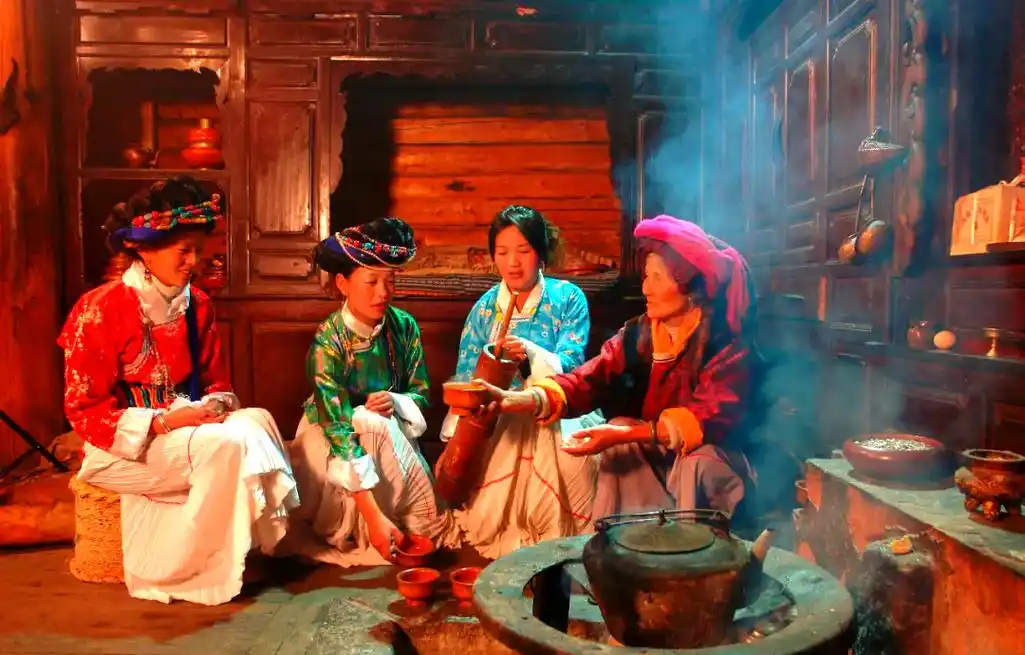
Around Lugu Lake, on the border between Yunnan and Sichuan in southwestern China, the Mosuo are known for distinctive family arrangements, domestic architecture, and cultural traditions. Lakes, mountains, and villages form the setting of everyday life, while enduring kinship ties offer an important starting point for understanding Mosuo culture.
Visitors sometimes describe the region as a “kingdom of women,” but this imaginative label cannot capture the diversity of life in Mosuo communities. A fuller understanding begins with homes, work, relationships, and beliefs: how people sustain traditions across generations, and how those traditions change over time. Field research on kinship and cooperation provides insight into these connections.
Mosuo People at a Glance
| Homeland | The Lugu Lake region on the border of Yunnan and Sichuan, southwestern China |
|---|---|
| Family traditions | Matrilineal kinship and extended households, with important roles for several generations of relatives |
| Visiting relationships | Often called walking marriage; relationship and residence arrangements vary between households |
| Domestic space | The grandmother's house and hearth are important features of traditional family life |
| Traditional dress | Representative elements include elaborate headwear, decorated jackets, patterned waistbands, and pleated skirts |
| Beliefs | Local Daba traditions and Tibetan Buddhist influences |
1. Matrilineal Families: Connecting Generations Through Shared Life
In traditional matrilineal households, family descent and continuity are traced primarily through the maternal line. Grandmothers, mothers, a mother's brothers and sisters, and younger generations may live together in an extended family. Children can receive care from several relatives, rather than depending solely on a couple raising them in a separate household.
“Matrilineal” describes patterns of kinship and family continuity. It does not mean that women control every aspect of society, or that men have no responsibilities. Mothers, maternal aunts, uncles, and other relatives contribute in different ways. Understanding this family structure means looking beyond the question of who rules whom and asking how people organize a shared life. Research on Mosuo kinship documents the importance of maternal relatives in everyday experience.
2. Walking Marriage: A Tradition Within Its Family Context
Often called “walking marriage” in English, the visiting relationship is among the best-known—and most frequently misunderstood—features of Mosuo culture.
In this traditional arrangement, partners may continue living in their respective maternal households and maintain their relationship through visits, rather than establishing a shared residence. This arrangement is closely connected to the extended family's role in work, childcare, and support for older relatives.
Walking marriage should therefore not be understood as an absence of family or responsibility. It represents a way of organizing intimate relationships in which partnership and shared residence do not necessarily coincide. Mosuo relationships and living arrangements also vary across communities and households; no single tradition describes everyone's choices. Research on visiting relationships and social change shows that economic circumstances can influence these arrangements.
Likewise, the claim that Mosuo children know their mothers but not their fathers is misleading. Studies of contemporary Mosuo families document fathers contributing childcare and financial support. The importance of maternal kin does not imply that fathers are necessarily absent. Research on paternal involvement among the Mosuo provides evidence of these contributions.
3. The Grandmother's House: A Center of Domestic Life
Traditional dwellings offer another way to understand Mosuo culture.
The grandmother's house is an important space within the family home. It connects daily activities with the standing of elders, shared memories, and cultural values. The hearth, timber-built interior, and activities of household members give the building meaning beyond its physical structure.

For residents, preserving a traditional home involves more than retaining its appearance. Researchers have found that some spaces change in response to modern needs, while core spaces such as the grandmother's house endure because people continue to use and value them. The life of a building remains closely tied to the lives of its occupants. Field research on the conservation of Mosuo dwellings explores this relationship between continuity and change.
4. Traditional Clothing: Cultural Memory Worn and Shared
Mosuo traditional clothing is distinguished by expressive silhouettes, rich colors, and detailed ornament. Representative elements of women's dress include elaborate headwear, gold-trimmed jackets, patterned waistbands, and pleated skirts.

Full skirts open and sway with movement, while waistbands add color and definition to the outfit. Clothing carries more than visual appeal: it can also sustain practical skills and cultural identity. For those passing on dressmaking traditions, encouraging younger generations to learn, make, and wear these garments matters alongside preserving older examples. An interview with a Mosuo clothing practitioner offers a view of the lives and knowledge behind the garments.
5. Beliefs and Objects: Encounters Between Cultural Traditions
Mosuo spiritual life includes influences from local Daba traditions and Tibetan Buddhism. Rituals, religious objects, and everyday utensils express connections with ancestors, nature, and the spiritual world.
A Mosuo-themed exhibition at Yunnan Provincial Museum presented Daba ritual objects, funerary paintings, and decorated pottery vessels used for butter tea. These objects reflect local traditions as well as cultural exchange across northwestern Yunnan. Their meanings are best understood through specific uses and religious contexts, rather than assigning a single fixed symbolism to every pattern or ornament. The museum exhibition introduction provides examples and background.
6. Mosuo Culture: Continuity Through Change
Mosuo culture is not a picture frozen in the past. Tourism, economic change, and wider social connections influence family life, housing, and everyday choices. Different villages and households respond in different ways. Research on tourism and household change highlights why local life should be understood as dynamic rather than unchanging.

Three Picks from Chinese Showcase
For readers drawn to decorative textiles and accessories, these contemporary Chinese craft-inspired pieces offer a broader styling connection. They are not presented as Mosuo-made items or traditional Mosuo designs.
Song Brocade Ruyi-Lock Earrings
Patterned brocade in a ruyi-lock outline, paired with filigree-style framing and pearl accents.
View product detailsSong Brocade Butterfly Hairpin
A double-sided butterfly design in pale blue and blush brocade, with gold-tone metal and imitation-pearl drops.
View product detailsBamboo-Design Brooch
A bamboo-inspired brooch combining patterned brocade with outlined leaf forms.
View product detailsFrequently Asked Questions
Where do the Mosuo people live?
Mosuo communities are associated with the Lugu Lake region, where Yunnan and Sichuan meet in southwestern China.
Does matrilineal mean that women control every part of society?
No. Matrilineal describes descent and family continuity through the maternal line. It does not, by itself, define authority in every area of life or remove men's family responsibilities.
Do all Mosuo people practice walking marriage?
No single arrangement describes every Mosuo household. Visiting relationships are an important tradition, but partnership and residence patterns vary and change over time.
Are fathers absent from Mosuo children's lives?
No. Studies of contemporary Mosuo families document fathers contributing childcare and financial support. The importance of maternal relatives does not imply that fathers are necessarily absent.
What is the grandmother's house?
It is an important space within the traditional family home, connecting daily activities with elders, household memory, and cultural values.
What are some representative elements of Mosuo women's traditional dress?
Elaborate headwear, decorated or gold-trimmed jackets, patterned waistbands, and pleated skirts are representative elements. A single photograph does not describe everyone's everyday clothing.
Conclusion
Respect for Mosuo culture extends beyond admiring traditional clothing or watching a performance. It also means respecting people's privacy, relationships, and freedom to make their own choices, without turning everyday life into an exotic spectacle.
There is much more to Mosuo culture than walking marriage alone. Care between relatives, the bonds formed through shared work, memories held within the family home, and traditions carried forward through change are all essential parts of its story.
References
- Thomas, M. G., Ji, T., Wu, J., He, Q., Tao, Y., and Mace, R. (2018). Kinship underlies costly cooperation in Mosuo villages. Royal Society Open Science, 5(2), 171535. DOI: 10.1098/rsos.171535. Background on family ties and cooperation.
- Wang, B., Fu, Y., and Zhang, J. (2019). Influence of language and culture on retrieval-induced forgetting under the self-referential condition: Evidence from the Han and the Mosuo. Acta Psychologica Sinica, 51(4), 450–461. DOI: 10.3724/SP.J.1041.2019.00450. Relevant to the importance of mothers and maternal aunts.
- Mattison, S. M. (2010). Economic Impacts of Tourism and Erosion of the Visiting System Among the Mosuo of Lugu Lake. The Asia Pacific Journal of Anthropology, 11(2), 159–176. DOI: 10.1080/14442211003730736.
- Mattison, S. M., Scelza, B., and Blumenfield, T. (2014). Paternal Investment and the Positive Effects of Fathers among the Matrilineal Mosuo of Southwest China. American Anthropologist, 116(3), 591–610. DOI: 10.1111/aman.12125.
- Feng, H., and Xiao, J. Dynamic Authenticity: Understanding and Conserving Mosuo Dwellings in China in Transitions. Sustainability, 13(1), 143, 2021 issue; published online December 25, 2020. DOI: 10.3390/su13010143.
- China News Service, republished by People's Daily Online (September 29, 2019). Mosuo Dress: Mosuo Culture Worn on the Body (Chinese-language interview; title translated). Background on clothing and textile skills.
- Yunnan Provincial Museum exhibition introduction, published by the Chinese Museums Association (June 30, 2020). Exploring Mosuo Matrilineal Culture: The MOSO Exhibition (Chinese-language exhibition introduction; title translated). Background on household objects, Daba ritual objects, and cultural exchange.
Related Reading
Explore More
Stories, symbols and everyday objects
Our journal explores Chinese culture and design. Traditions and interpretations vary by region and source. For a purchase, use the specifications on the individual product page.
About Chinese ShowcaseQuestions or corrections? Contact us ↗