Ox-Head and Horse-Face are among the most recognizable guardians of the Chinese underworld. Usually shown with animal heads and human bodies, the pair escort souls, guard underworld passages, and carry out orders within a moral system of judgment. Their fierce appearance can be unsettling, but they are not simply evil monsters. They represent authority, consequence, and the boundary between life and death.
| Question | Short answer |
|---|---|
| Who are they? | A paired set of animal-headed officers in the Chinese underworld |
| Are they evil? | Not necessarily; they usually enforce an existing moral and legal order |
| Main duties | Escorting souls, guarding gates, restraining escape, and carrying out judgments |
| Who commands them? | Underworld judges, magistrates, and officials in different traditions |
| Related figures | Black and White Impermanence, underworld judges, clerks, and gate guardians |
Who Are Ox-Head and Horse-Face?
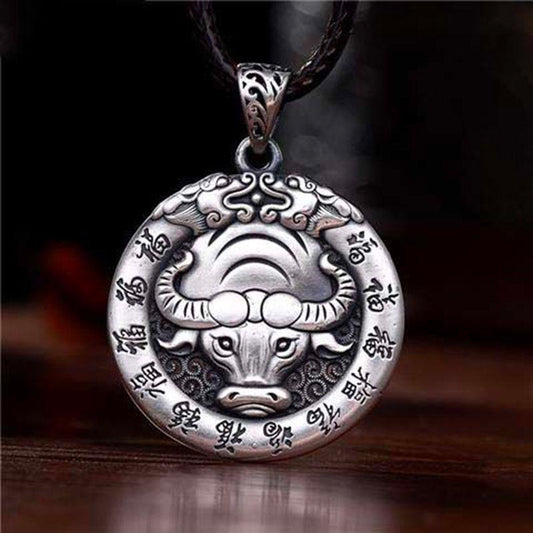
Ox-Head and Horse-Face are supernatural attendants associated with the Chinese realm of the dead. Ox-Head has the head or face of an ox on a humanlike body. Horse-Face has an elongated horse head or face and a similarly human body. They may wear armor, official robes, sashes, or animal skins and carry chains, spears, forks, ropes, or command tablets.
Their English names translate the visual identities by which they are commonly known. They are not one supreme god split into two forms. Nor do all temples, stories, or regional traditions give them an identical biography. Their most stable feature is their function as underworld enforcers.
In the popular imagination, a soul does not simply vanish at death. It enters a managed process: being summoned, escorted, identified, examined, judged, and assigned a destination. Ox-Head and Horse-Face occupy the practical end of this system. Their role resembles that of guards or bailiffs rather than legislators or ultimate judges.

Where Did Ox-Head and Horse-Face Come From?
The familiar pair developed through a long blending of Buddhist images of hell, Daoist underworld administration, local ritual traditions, temple art, storytelling, and popular literature. They should therefore not be assigned to one single origin story.
Ox-headed wardens have strong links to Buddhist descriptions and images of hell. Animal-headed jailers made punishment visible to audiences who might never read a complex religious text. The ox head expressed formidable physical force and an authority that could not easily be resisted.
Horse-Face has a more complicated history. Horse-headed or long-faced attendants appear in different religious and artistic contexts, and the character became increasingly integrated into the Chinese bureaucratic underworld. Over time, the visual contrast between the broad ox and the long-faced horse made the two memorable as a pair.
Chinese religion often developed through accumulation rather than replacement. Buddhist karmic ideas, Daoist registers and officials, local ancestor beliefs, and the structure of an imperial courthouse could coexist in one account of the afterlife. That is why Ox-Head and Horse-Face may look like mythical beasts while behaving like government officers.

What Do Ox-Head and Horse-Face Do?
Escort the dead
Their best-known duty is to bring a deceased person's soul toward the underworld. In stories, they may arrive when a person's allotted lifespan has ended, identify the correct soul, and begin the journey away from the human world.
Guard roads and gates
They may stand near the gates of the underworld, judgment halls, or roads used by the dead. In this role, they prevent unauthorized entry by the living and stop souls from escaping the process of judgment.
Restrain and transport souls
Chains and ropes symbolize lawful restraint. They show that a soul cannot avoid consequences merely by refusing to cooperate. These objects are also visual shorthand: an audience immediately understands that the figures possess official power.
Carry out punishment
Some paintings and stories place the pair among the attendants who enforce a judgment. Yet they normally do not create the moral law or make the final ruling. Underworld kings, judges, and clerks examine records, while Ox-Head and Horse-Face execute orders.
What Do the Ox and Horse Symbolize?
In an agricultural society, the ox suggested strength, endurance, stubborn stability, and labor. An ox-headed enforcer therefore embodied overwhelming force and the certainty that an official order would be completed.
The horse evoked movement, roads, speed, transport, and communication across long distances. Horse-Face could consequently suggest pursuit and rapid passage between worlds. When joined together, the two figures combine force with mobility.
This interpretation is useful but should not be treated as a single ancient doctrine. Symbolic meanings vary by period and source. What can be stated more safely is that the animal heads make the officers visibly nonhuman and immediately identify them as beings of another realm.
Why Do They Always Appear Together?
Chinese visual culture often uses paired guardians: door gods, civil and military protectors, and Black and White Impermanence are familiar examples. Pairing creates balance, reinforces authority, and makes a scene easier to recognize.
Ox-Head and Horse-Face are also effective opposites. One is broad and heavy, the other long and swift. One suggests force, the other movement. Their contrasting silhouettes work especially well in opera, murals, temple sculpture, animation, and games.
They are frequently shown together today, but this does not mean every historical image included both. Individual animal-headed guards also occur, and regional traditions may emphasize one figure more than the other.
Ox-Head, Horse-Face, Black and White Impermanence
Ox-Head and Horse-Face are often confused with Black and White Impermanence because both pairs escort souls and serve the underworld. Black and White Impermanence are usually humanlike figures in contrasting robes and tall hats. Ox-Head and Horse-Face are distinguished by their animal heads and often appear more like guards or jailers.
Popular stories sometimes assign Black and White Impermanence a more direct role in collecting souls from the human world, while Ox-Head and Horse-Face stand closer to gates or judgment halls. This division is not universal. Novels, operas, temples, television dramas, and local traditions freely rearrange their duties.
Underworld judges occupy a higher level. They review records and issue decisions. Clerks keep registers, while attendants escort and enforce. This imagined administration mirrors the courts and offices familiar to people in historical China.
Why Do They Look So Frightening?
Their appearance is designed to warn and command. Horns, glaring eyes, tusks, chains, weapons, dark clouds, and exaggerated muscles communicate that death and judgment cannot be ignored. Before widespread literacy, murals, sculpture, ritual performance, and opera made moral teachings visible and memorable.
Fearsome does not automatically mean evil. Chinese religious art includes many fierce guardians whose threatening faces protect order rather than attack innocent people. Ox-Head and Horse-Face belong to this broader visual language of protective and disciplinary power.
Their bodies also join the familiar and unfamiliar. Oxen and horses were everyday animals, but combining their heads with official clothing and human gestures created beings that belonged unmistakably to a supernatural bureaucracy.
What Moral Idea Do They Represent?
The pair make the concept of moral consequence concrete. A person may conceal wrongdoing from neighbors or avoid a human court, but underworld stories imagine that actions remain recorded. The soul must eventually face an examination that wealth, excuses, and social status cannot permanently prevent.
This idea supported moral education. It encouraged responsibility, restraint, respect for life, and the belief that justice extended beyond immediate human institutions. Modern readers do not have to accept the underworld as a literal map to understand its ethical function.
Ox-Head and Horse-Face can therefore be read as cultural symbols of accountability. They embody the moment when abstract consequences become unavoidable action.
Are There Western Gods Like Ox-Head and Horse-Face?
No Western figure corresponds exactly to the pair, but several have similar duties. In Greek mythology, Hermes can guide souls toward the underworld, Charon carries the dead across the river, and Cerberus guards the entrance. Ancient Egyptian Anubis, shown with a jackal head, protects the dead and is connected with their journey and judgment. The European Grim Reaper personifies death and may appear when life ends.
Ox-Head and Horse-Face combine the roles of escort, enforcer, and gate guardian. Western traditions more often distribute those duties among separate figures. Another important difference is institutional: the Chinese pair commonly serve within a courthouse-like underworld, whereas the Grim Reaper often acts as a solitary personification of death.
Ox-Head and Horse-Face in Art and Popular Culture
The pair appear in temple murals, hell scrolls, sculpture, paper ritual art, opera masks, illustrated books, comics, animation, television, films, and video games. Each medium changes them. Opera favors bold silhouettes and recognizable props; temple art emphasizes judgment; games may turn them into warriors, bosses, or comic companions.

Colors and costumes are not fixed. Ox-Head may be black, blue, brown, gray, or red. Horse-Face may be pale, dark, or vividly colored. Their tools may include a fork, spear, sword, chain, rope, or tablet. Context matters more than one costume detail.
Modern adaptations keep the figures culturally visible, but fictional powers and personalities should not be mistaken for a single traditional canon. A game character inspired by Ox-Head may be excellent design while remaining a contemporary invention.
Are Ox-Head and Horse-Face Demons?
Calling them "Chinese demons" is misleading. In English, demon often suggests a being opposed to sacred order. Ox-Head and Horse-Face usually work for an established system and enforce its judgments. Better descriptions include Chinese underworld guardians, underworld officers, spirit escorts, or ox-headed and horse-faced attendants.
Their exact status moves between guard, ghostly officer, jailer, and minor divine attendant depending on the source. "Underworld officers" is often the clearest general description.
Using Their Images Respectfully
These figures are appropriate subjects for cultural education, temple-art study, opera, illustration, fantasy design, and games. Because they are connected with death and judgment, however, they may feel unsuitable for weddings, birthdays, nurseries, or casual gifts. Reactions depend on family and regional custom.
Commercial descriptions should identify modern artwork as modern, avoid promising supernatural results, and refrain from presenting one game design as an ancient canonical image. Respect begins with accurate context.
Modern Chinese-Style Accessories
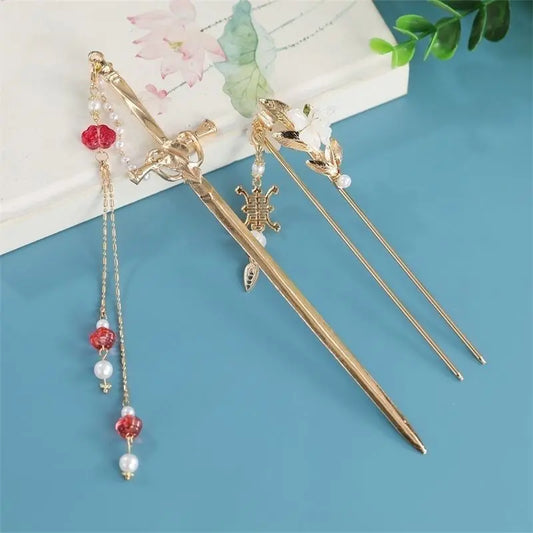
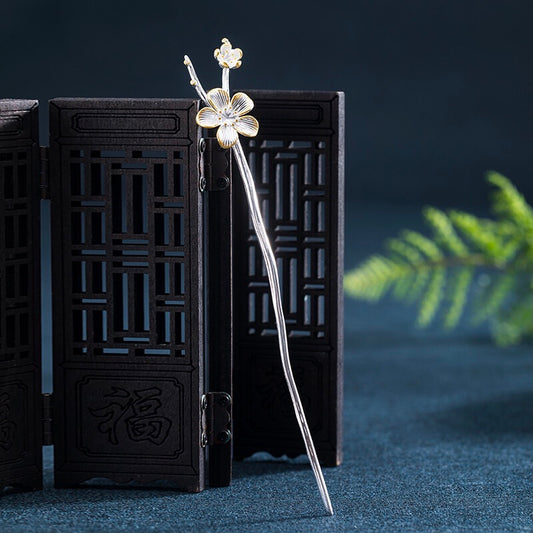
The following are contemporary accessories selected for traditional motifs and dramatic styling. They are not religious objects and are not historical equipment associated with Ox-Head or Horse-Face.

Ruyi Cloud Tassel Hairpin
A cloud-form accessory with moving tassels for a dramatic traditional-inspired updo.
View product
Embroidered Bird and Pearl Brooch
Textile, metal, and pearl details create a layered new-Chinese-style accent.
View product
Sakura Vase Drop Earrings
A sculptural vase and flower design inspired by traditional decorative art.
View productFrequently Asked Questions
What are Ox-Head and Horse-Face called in Chinese mythology?
They are a paired set of animal-headed underworld officers who escort souls, guard passages, and enforce orders.
Are Ox-Head and Horse-Face evil?
Usually not. Their appearance is frightening, but they normally serve the moral and administrative order of the underworld.
Who commands Ox-Head and Horse-Face?
Different traditions place them under underworld kings, judges, magistrates, or clerks.
What weapons do they carry?
Art may show chains, ropes, spears, forks, swords, or command tablets. There is no single required set.
Are they the same as Black and White Impermanence?
No, although their duties overlap. Black and White Impermanence are generally humanlike, while Ox-Head and Horse-Face have animal heads.
Why do they appear together?
The pair combines force and speed while following the Chinese visual tradition of paired guardians.
Is Ox-Head Buddhist or Daoist?
Ox-headed hell wardens have strong Buddhist associations, but the familiar pair developed through Buddhist, Daoist, and folk traditions.
Is Anubis the Western equivalent of Ox-Head and Horse-Face?
Anubis shares an animal-headed appearance and a connection to the dead, but he is a major Egyptian deity, not an exact equivalent.
Can their images ward off evil?
Some people interpret fierce guardians as protective, but beliefs vary and supernatural claims cannot be verified.
What is the best English translation?
"Ox-Head and Horse-Face," "Chinese underworld guardians," or "underworld officers" are clearer than simply calling them demons.
Conclusion
Ox-Head and Horse-Face transform abstract ideas about death, justice, and consequence into unforgettable characters. Their animal heads mark them as supernatural; their chains, weapons, and official clothing identify them as agents of authority. They frighten because the order they represent cannot easily be escaped, not because they are automatically forces of evil.
The pair also reveals how Chinese culture imagined the afterlife through familiar institutions. Judges reviewed records, clerks managed documents, guards controlled gates, and attendants carried out decisions. Across temple art and modern games, Ox-Head and Horse-Face remain powerful symbols of accountability and the guarded boundary between worlds.
References and Further Reading
- Encyclopaedia Britannica: Hermes
- Encyclopaedia Britannica: Charon
- British Museum: Ancient Egyptian Gods and Anubis
- British Museum: What Is a Book of the Dead?