The Chinese Showcase journal Chinese culture
What Is Cicada in Chinese Culture?
What does a cicada symbolize in Chinese culture? Explore rebirth, integrity, Han dynasty jade cicadas, Tang poetry, and the meaning of the golden cicada.
In Chinese culture, the cicada symbolizes renewal, integrity, and talent coming into its own. Its empty shell inspired hopes of rebirth, its song gave Tang poets a way to write about character, and its sudden arrival above ground makes it a fitting emblem for hard work finally being heard.
The golden cicada is easiest to understand by following the insect itself, from the roots of a tree to its branches, and then looking at how poets and artisans gave each stage a different meaning.
Cicada Meaning at a Glance
| Cicada shedding its shell | Renewal, transformation, and the hope of rebirth |
|---|---|
| Cicada singing high in a tree | Integrity and an independent voice in classical poetry |
| Sudden song after a hidden life | Talent recognized after a long period of preparation |
| Jade cicada | A form used for personal ornaments and, in some Han burials, a funerary object |
1. From Earth to Sky: The Origin of Cicada Symbolism
A summer courtyard can be full of cicada song without a single insect in sight. Go close to a tree trunk, though, and you may find the empty shell first. Its legs are still hooked into the bark, and there is a split down its back. The insect itself has already moved on.
A cicada nymph lives underground and feeds on fluid from plant roots. When it is ready for its final molt, it climbs a trunk or a stem. The adult emerges through a break in the old outer shell, and its wings gradually expand. For a little while, the cast-off shell and the new adult can be seen together. [1]

That moment gave Chinese writers an image for leaving an old condition behind. Sima Qian’s account of the poet Qu Yuan in the Records of the Grand Historian compares him to a cicada shedding its shell and rising out of the dirt. The image suggests that a person can pass through troubled circumstances and carry their integrity with them. [2]
2. Cicadas in Tang Poetry: Voices of the Soul
In Yu Shinan’s Tang poem “Cicada,” the insect drinks clear dew and sings from the open branches of a paulownia. [3] The poet says its voice carries because it is high in the tree. Read as a portrait of a person, the height suggests strength of character, and the unhurried song suggests the confidence to speak in one’s own voice. Drinking dew belongs to the poem’s imagery. Cicadas feed on plant fluids.
Luo Binwang heard a very different voice. In “On Hearing a Cicada in Prison,” the song stirs the poet’s longing to be understood. He asks who will speak for him when no one believes in his integrity. Yu’s cicada has a voice that carries across the trees. Luo’s can be heard through prison walls, yet the poet’s own account may never reach the people who need to hear it. The same sound holds confidence in one poem and vulnerability in the other. [4]
3. Rebirth and Immortality: Cicadas in Ancient Beliefs
Jade cicadas appeared in China long before the Han dynasty. The Palace Museum records examples from Neolithic sites associated with the Hongshan, Liangzhu, and Shijiahe cultures. One small Han white-jade cicada in the museum’s collection has protruding eyes and long, smooth wings. Those few details are enough to suggest a cicada at rest. [5]
In some Han burials, a carved jade cicada was placed in the mouth of the deceased. The object was a han, a mouth insert. Its shape drew on the image of the cicada leaving behind its old form and expressed a hope for renewal after death. The National Museum of China also documents jade cicadas used as personal ornaments or attached to headwear. Their perforations and archaeological context can help distinguish those uses. [6]
4. Cicadas in Art, Jewelry, and Daily Life
A cicada can be carved as a small, self-contained figure or abstracted into a repeating border. On a Shang dynasty bronze gui vessel in the National Museum of China, stylized cicada forms sit in a band below pairs of curling dragons. On a jade carving, the body and folded wings can stand on their own. The two objects show how differently artists could use the same insect’s outline. [7]

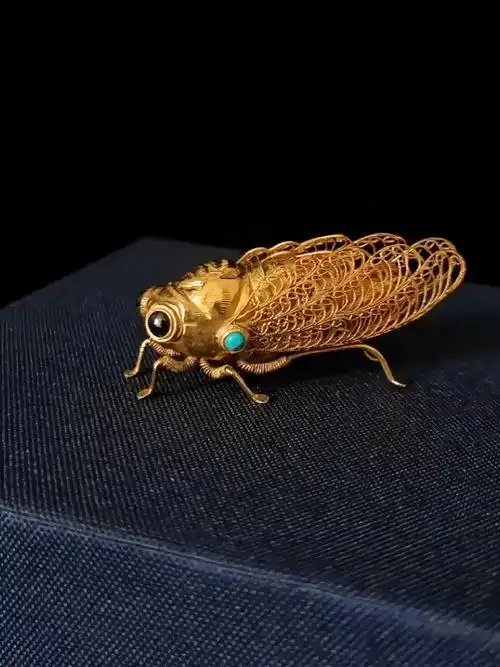
The wings remain a useful starting point when looking at a contemporary cicada design. They can be cut into an open lattice, etched into metal, or suggested with two simple lines. The gold-toned ornament shown here uses fine wire-like curves to suggest the veining of a wing. Even at a small scale, the long silhouette and prominent eyes make the insect recognizable.
5. Auspicious Meanings and Modern Symbolism
A cicada can be a gift for someone about to sit an exam, take the stage, or start a new job. The expression yi ming jing ren, roughly “astonish everyone with a single call,” fits the experience of hearing a sudden cicada song after a long silence. The story in the Records of the Grand Historian originally refers to a bird. The cicada offers a parallel image of the quiet preparation that comes before a striking debut. [8]
The expression jin chan tuo qiao, “the golden cicada sheds its shell,” looks at the molt from another angle. The shell stays in place while the cicada slips away. In a story, the phrase can describe a clever escape in which a decoy or a familiar appearance is left behind. In a gift, the same image can suggest moving through a difficult period and beginning again. [9]

The golden cicada and the golden toad share a pronunciation in Mandarin, jin chan, but have different visual forms and associations. A golden cicada has wings and a slender body. The golden toad in the story of Liu Hai often has three legs and appears with a string of coins. Those coins belong to the toad’s association with wealth, while the cicada draws its meaning chiefly from its song and its molt. [10]
6. Philosophy of Transformation
A cicada ornament can mark different moments in a person’s life. Given to a graduate, it can express the hope that years of work will find their voice. For someone moving to a new city, it can mark the moment an old place becomes a memory and another begins to feel like home. A small cicada worn every day might call to mind Yu Shinan’s clear, independent voice.
The old shell on the tree trunk is part of what makes the motif so enduring. It sheltered the insect until it was ready to leave. By the time the tree is full of song, the long, quiet part of its life is already behind it. A golden cicada honors both parts of that story.
The Chinese Showcase Edit
Three Picks from Chinese Showcase
Three ways to wear the cicada motif, from carved jade to a bamboo-inspired hair stick.


More Cicada Jewelry


Frequently Asked Questions
What does a cicada symbolize in Chinese culture?
A cicada can symbolize renewal through its molt, moral integrity through its place in classical poetry, and the emergence of talent through its song.
What did a jade cicada mean in the Han dynasty?
In some Han burials, a jade cicada placed in the mouth expressed a hope of rebirth. Jade cicadas also appear as wearable or attached ornaments.
Why does the cicada represent a fresh start?
An adult cicada leaves its old outer shell and expands its wings. The visible change gave artists and writers an image for moving into a new phase of life.
What is the difference between a golden cicada and a golden toad?
The golden cicada is a winged insect associated with molting and song. The golden toad, often pictured with three legs and coins, is associated with wealth in the tale of Liu Hai.
Sources and Objects Mentioned
- Smithsonian National Museum of Natural History. Periodical Cicadas. Teaching resource on underground nymphs, emergence, and the final molt.
- Sima Qian. Records of the Grand Historian, chapter 84. “Biographies of Qu Yuan and Jia Yi.” The biography uses cicada molting as an image for Qu Yuan’s integrity.
- Yu Shinan. Cicada. Collected in the Complete Tang Poems, volume 36. The cicada’s song carries from a high perch.
- Luo Binwang. On Hearing a Cicada in Prison. Tang poem with a preface, collected in the Complete Tang Poems. The cicada’s song accompanies the poet’s appeal to be understood.
- Palace Museum, Beijing. Jade Cicada. Han dynasty white-jade carving, collection no. Gu 00103961. The catalogue also records earlier jade cicadas from Neolithic sites.
- National Museum of China. Cicada-Shaped Jade Mouth Insert. Collection entry on the funerary use of jade cicadas and the features of wearable and crown-mounted examples.
- National Museum of China. Bronze Gui with Kui Dragon Decoration. Shang dynasty bronze vessel. The catalogue identifies stylized cicada motifs below the band of kui dragons.
- Sima Qian. Records of the Grand Historian, chapter 126. “Biographies of Witty Advisers.” In the story of Chunyu Kun and King Wei of Qi, a bird’s first call is the image for a startling achievement.
- Ministry of Education, Taiwan. Revised Mandarin Chinese Dictionary, ‘The Golden Cicada Sheds Its Shell’. The entry explains the idiom as slipping away by leaving a decoy and gives examples from literature.
- Palace Museum, Beijing. Liu Hai Playing with a Toad. Decorative miniature with Liu Hai holding a string of coins above a three-legged toad.
Images. The three editorial images were supplied for this article. Product photographs are from the Chinese Showcase listings.
Stories, symbols and everyday objects
Our journal explores Chinese culture and design. Traditions and interpretations vary by region and source. For a purchase, use the specifications on the individual product page.
About Chinese ShowcaseQuestions or corrections? Contact us ↗