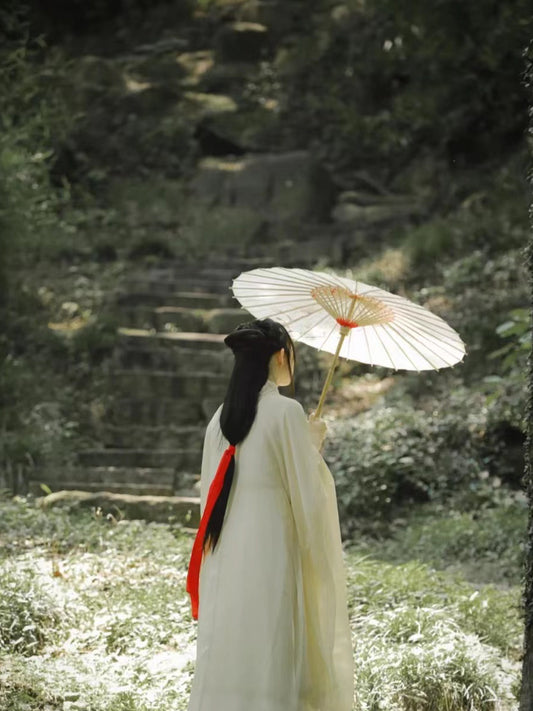
Within the elaborate and nuanced symbolic system of the Chinese Lunar New Year, colors are never merely aesthetic choices; they form a symbolic language carrying deep cultural codes. Red dominates the festival palette, saturating every detail from couplets and lanterns to new clothing. In sharp contrast, white—a color associated with purity and elegance in Western contexts—has historically occupied the core of the “taboo spectrum” in Chinese New Year traditions. The seemingly simple question of “Can one wear white during the New Year?” touches on complex cultural codes related to life and death, temporal philosophy, ethical order, and identity. Its debates and evolution provide a microcosm of how traditional Chinese culture adapts in modern contexts.
I. Origins of the Taboo: White’s “Negative” Symbolism in Chinese Culture
To understand why white is the primary New Year taboo, we must trace its long-standing symbolic associations in Chinese tradition. Unlike Western culture, which links white with purity, sanctity, and new beginnings (wedding dresses, baptism gowns), Chinese traditional color philosophy associates white primarily with mourning and death.
“White Matters” and the Association with Life’s End
In traditional Chinese funerals, white is the dominant color: coarse white hemp for mourning attire, white drapes, candles, and flowers for the altar, white banners in funeral processions, and white floral accessories for family members. These millennia-old practices have embedded in the collective unconscious a near-absolute symbolic link between white and death. Seeing large expanses of pure white clothing evokes, almost reflexively, funeral scenarios. In some dialects, wearing white is directly referred to as “bearing mourning.”
Philosophical Connotations of “Void” and “Emptiness”
In traditional Chinese color philosophy, white is a “non-color,” corresponding to the West, autumn, and the Metal element in the Five Phases, carrying connotations of austerity and contraction. While Daoist aesthetics admire simplicity and quietude, such appreciation is mostly confined to literati and hermits, not the bustling, festive world of public celebrations where prosperity and abundance are emphasized. For ordinary people seeking health, wealth, and success, white’s association with “emptiness” conflicts with New Year aspirations.
Language and Negative Connotations
Chinese homophones and idioms reinforce white’s negative image. Words like baigan (“to do something in vain”), yipeng erbai (“penniless”), or bairizi (“inauspicious day”) tightly link white with failure, poverty, and misfortune. At the start of the year, people consciously avoid white to prevent symbolically setting a “blank” or “fruitless” tone for the year.

II. Temporal, Spatial, and Social Boundaries of the Taboo
The white color taboo during New Year is not an absolute ban; its strictness varies by time, space, and social role.
Time Dimension: Strictest at Year’s Start
The peak of the taboo is New Year’s Day (Zhengyue 1), when clothing choices carry the sacred significance of “setting the tone for the year.” Wearing large amounts of white is almost strictly forbidden. From the second to fifth day (Po Wu), as the festival transitions from sacred to secular, the taboo relaxes. After Po Wu, white clothing is no longer strictly prohibited, though still not the most auspicious choice. After the Lantern Festival, normal clothing conventions resume.
Space Dimension: Family vs. Public
Traditional contexts such as ancestor worship, visiting temples, and paying respects to elders enforce the strictest taboo. White attire in these situations is seen as disrespectful. In informal settings—friend gatherings, shopping, or casual outings—white can be worn with more freedom.
Identity Dimension: Age and Relationship Matter
For elders, particularly those over 60, wearing white during New Year is almost unthinkable. It may evoke associations with aging or illness. For infants and young children, considered “pure yang,” white garments are more acceptable, influenced by Western aesthetics. Newlyweds returning to their families for their first New Year must also avoid white to respect traditional prohibitions.
III. Relaxation of the Taboo: Globalization, Fashion, and White Aesthetic Redefinition
Influence of Western Fashion
In Western fashion, white is associated with elegance, sophistication, and minimalism. From Chanel’s iconic white camellias to white gowns on the Oscars red carpet, to the “little white dress” as a wardrobe staple, global fashion has framed white as a safe, stylish base. Chinese consumers exposed to this system naturally encounter tension between modern aesthetics and traditional norms.
“New Chinese” Aesthetic Integration
“New Chinese” fashion blends tradition and modernity, legitimizing white in New Year attire. Designers embroider traditional auspicious patterns—lotus vines, waves, Five Blessings—onto dark or red fabrics using white thread, or use white as underlayers, accents, or transitional colors. This approach of “partial white” or “patterned white” respects tradition while allowing contemporary minimalism.
Generational Shift
For younger generations (born post-1990s), associations of white with mourning have significantly weakened. White is increasingly viewed as a personal aesthetic choice. A well-designed white wool coat paired with a red scarf and gold accessories signals fashion confidence and creative use of tradition rather than disrespect.
IV. Contemporary Practice Spectrum: From Strict Adherence to Flexible Expression
- Strict adherence in ceremonial contexts: During ancestor worship, visits to elders, or temple ceremonies, white is largely avoided out of respect for tradition and family ethics, not fear of supernatural punishment.
- Symbolic compromise and situational choice: White may appear as inner layers, accessories, or in combination with auspicious colors; timing can be flexible (avoid white on the first day, permissible later); garments may include red or gold embroidery to mediate tradition and personal aesthetics.
- Personalized aesthetic expression: Highly urbanized, internationalized individuals may fully embrace white as a neutral color, prioritizing fabric quality, cut, and styling over hue. A perfectly styled white coat may symbolize a fresh start and purity, aligning with New Year optimism rather than defying tradition.
V. Beyond the Taboo: From “Do Not Wear” to “How to Wear”
The evolution of the white color taboo illustrates that the vitality of traditional festival customs lies not in rigid enforcement but in understanding and creatively expressing their core intent.
Core Meaning: Respect for Beginnings and Desire for Completeness
The essence of the taboo is not fear of white cloth but sensitivity to the New Year as a pivotal temporal marker. People avoid symbols that could evoke negative associations during this critical moment. The emphasis on beginnings reflects a positive, aspirational attitude, signaling that the new year deserves the best reception.
Reframing White: From Taboo to Empowerment
White can be reinterpreted in the New Year context: it is the color of snow, heralding abundance; the color of Xuan paper, awaiting new stories; the color of jade, soft and noble. Shifting its symbolism from death and emptiness to purity, new beginnings, and limitless possibilities transforms white from a forbidden color into an empowering one—an innovative continuation of tradition rather than a contradiction.

Conclusion: Freedom of Color Choice with Cultural Sensitivity
Thus, the question “Can one wear white during the New Year?” has evolved from a clear traditional “no” to an open topic of personal choice and cultural negotiation. This evolution reflects the vitality of culture: tradition is not a museum artifact but a living practice, reinterpreted and enacted by each generation.
Whether wearing a bright red Tang suit on New Year’s Eve, a simple white shirt with a red scarf for family gatherings, or sharing a modern-traditional fusion outfit on social media, the underlying intention remains a wish for a joyful life. Society’s capacity to respect tradition while accommodating diverse expressions reflects cultural confidence and inclusivity.
Therefore, when opening your wardrobe on New Year’s morning and seeing that beloved white coat, consider: What is the occasion? Who will I meet? What message do I want to convey? There is no absolute right or wrong—what matters is conscious awareness. In this dialogue, the warmth of red and the purity of white need not oppose each other; they can coexist, complementing one another to create the rich, diverse, and meaningful cultural landscape through which Chinese people welcome the New Year.