1. The Man Who Changed China Forever
When the Qin Dynasty (221–206 BCE) crumbled under the weight of its own harsh rule, a power vacuum opened that would determine the fate of China for the next two millennia. Among the rebels fighting to claim the empire, one man emerged victorious: Liu Bang, who would become Emperor Gaozu, the founder and first ruler of the Han Dynasty (202 BCE–220 CE)[reference:0]. What made Liu Bang exceptional was not noble birth or military genius, but a combination of political shrewdness, charisma, and an uncanny ability to surround himself with talented advisors. His rise from village policeman to Son of Heaven is one of history's most remarkable stories of upward mobility and strategic brilliance.
2. A Dynasty Born from Chaos: Historical Context
To understand the Han Dynasty's founding, we must look at the Qin Dynasty (221–206 BCE). Although Qin Shi Huang unified China for the first time, his Legalist regime was brutally oppressive: heavy taxes, mass conscription for megaprojects (the Great Wall and his tomb complex), and book burnings that stifled intellectual life. When he died in 210 BCE, widespread rebellions erupted within months[reference:1]. Among the most significant was the uprising led by Chen She and Wu Guang in 209 BCE, which triggered a cascade of revolts across the former Warring States territories[reference:2]. It was into this maelstrom that Liu Bang stepped forward, first as a reluctant rebel and then as a determined leader. The uprising gave rise to two principal successors: Liu Bang and his rival, the noble-born Xiang Yu, who fought a four-year civil war known as the Chu–Han Contention (206–202 BCE) for control of China.
3. From Peasant to Rebel Leader
Liu Bang was born in 256 BCE in Feng County (modern Jiangsu Province)[reference:3]. His family were farmers, but the young Liu showed little interest in tilling fields or commerce. He was described as outspoken, charismatic, and fond of drinking—yet he also possessed generosity and political insight[reference:4]. As a young adult, he managed to secure a minor bureaucratic post as a village chief (亭长), a low-level law enforcement officer[reference:5]. His big break came in 209 BCE when, ordered to escort a group of convicts, he freed them and became an outlaw himself. After the Chen She uprising began, Liu Bang rallied 3,000 followers and joined the rebellion[reference:6]. His early military career was far from glorious, but his talent for forging alliances and winning loyalty soon elevated his standing among the rebels. By 208 BCE, he had allied with Xiang Yu under the nominal leadership of King Huai of Chu—the grandson of a former Chu monarch installed as a figurehead by rebel leaders.
4. Key Turning Points: From Xiang Yu's Rival to Conqueror
After the Qin capital Xianyang fell in 206 BCE, Xiang Yu, as the most powerful rebel leader, divided the empire into 18 kingdoms[reference:7]. Liu Bang was given the remote and undeveloped region of Bashu (modern Sichuan) with the title "King of Han." However, rather than accept this exile, Liu Bang followed his strategist Han Xin's advice, broke out of Bashu, and conquered the Three Qin territories, sparking the Chu–Han Contention[reference:8]. The conflict lasted four brutal years (206–202 BCE). Xiang Yu was a brilliant field commander but a poor politician, while Liu Bang understood the importance of building alliances and winning popular support. In 203 BCE, Xiang Yu challenged Liu Bang to single combat, but Liu Bang wisely refused, instead relying on his generals. The decisive moment came in 202 BCE at the Battle of Gaixia, where Liu Bang's forces surrounded Xiang Yu's army, and through psychological warfare (including having his soldiers sing Chu folk songs to demoralize Xiang's troops), he shattered the enemy[reference:9]. Xiang Yu committed suicide, and Liu Bang proclaimed himself Emperor Gaozu of the Han Dynasty.
5. The First Emperor of the Han Dynasty: Reign and Policies
As emperor, Liu Bang faced a devastated economy, widespread poverty, and the constant threat of rebellion from powerful regional kings. His response was pragmatic and effective:
- Reduced taxes and corvée labor: Liu Bang lowered taxes and agricultural burdens, promoting recovery after the Qin's oppressive policies[reference:10].
- Hewed to the Qin administrative model: Despite overthrowing the Qin, Liu Bang retained its centralized bureaucratic structure, recognizing its efficiency[reference:11].
- "Rule by inaction" (无为而治): Adopting Daoist principles of non-interference in economic life, he allowed local economies to flourish spontaneously[reference:12].
- Suppression of non-Liu kings: One by one, he eliminated potentially disloyal kings such as Han Xin, Peng Yue, and Ying Bu, replacing them with nine kings from his own clan[reference:13].
- Heqin policy with the Xiongnu: In 200 BCE, Liu Bang was defeated by the Xiongnu nomads at the Battle of Baideng. To buy peace, he initiated "heqin"—state-arranged intermarriages between Han royalty and Xiongnu chieftains—that stabilized the northern frontier[reference:14].
6. Key Achievements: A Legacy Forged in a Single Reign
6.1. Institutional Foundations of the Han
Liu Bang retained the Qin central administration but softened its harshness. He recruited officials based on ability rather than birth, bringing former serfs and commoners into government—a revolutionary practice that gradually eroded hereditary privilege[reference:15]. He commissioned his chancellor Xiao He to codify the Han legal code (the "Nine Chapter Laws"), which tempered Qin legalism with greater leniency.
6.2. Economic Recovery
At Liu Bang's accession, the economy was so ruined that the emperor could not find four horses of the same color for his chariot, and high officials rode oxcarts[reference:16]. Through tax reduction, land distribution to veterans, and releasing those sold into slavery during the wars, the economy gradually revived. His "rest and recuperation" policy laid the groundwork for the prosperity later seen during the reigns of Emperors Wen and Jing (the Wen-Jing reign).
6.3. Cultural Impact: The Birth of "Han" Identity
The Han Dynasty's name derived from Liu Bang's title as King of Han. In time, "Han" became the name for the majority ethnic group in China (Han Chinese), and the dynasty's cultural achievements—including the standardization of writing, the promotion of Confucianism (initiated under Emperor Wu, but with roots in Gaozu's respect for scholars), and the expansion of the Silk Road—shaped Chinese identity for two millennia.
7. Comparison: Emperor Gaozu vs. Other Chinese Dynastic Founders
What made Liu Bang unique among China's dynastic founders was his humble background. While emperors like Qin Shi Huang were born to royalty and Li Yuan (Tang founder) came from aristocracy, Liu Bang emerged from the peasant class—one of only two dynasty founders in Chinese history to do so[reference:17].
| Aspect | Emperor Gaozu (Liu Bang) | Qin Shi Huang (Ying Zheng) | Emperor Taizong of Tang (Li Shimin) |
|---|---|---|---|
| Class Origin | Peasant/lower official | Royal nobility (King of Qin) | Aristocratic military family |
| Path to Power | Rebellion, civil war, alliance-building | Inherited throne, conquered rivals | Usurped throne from brothers/father |
| Key Strength | Political acumen, ability to delegate | Ruthless centralization | Military prowess and reform |
| Governing Philosophy | Daoist non-interference (early) | Strict Legalism | Confucian-Legalist synthesis |
| Lasting Legacy | Han identity, meritocracy seeds | Unified script, Great Wall | Tang legal code, historiography |
8. Emperor Gaozu's Death and Succession
In 195 BCE, while suppressing a rebellion led by Ying Bu (King of Huainan), Liu Bang was struck by a flowing arrow[reference:18]. The wound worsened, and despite medical care, he died on June 1, 195 BCE[reference:19]. He was succeeded by his son Liu Ying, who became Emperor Hui of Han. However, real power passed to Liu Bang's formidable widow, Empress Lü Zhi, who became China's first female ruler (though not empress regnant, she dominated the court for nearly 15 years). Liu Bang was given the temple name Taizu (太祖) and the posthumous name Emperor Gao (高皇帝)[reference:20]. His tomb, Changling (长陵), lies near Xi'an, and his legacy as the founder of China's longest imperial dynasty remains secure.
🏮 The Han Dynasty's golden age gave birth to sophisticated jade carving and metalwork. Discover timeless traditional Chinese jewelry inspired by the elegance of imperial China.
9. The Han Dynasty's Legacy and the Birth of Chinese Jewelry Arts
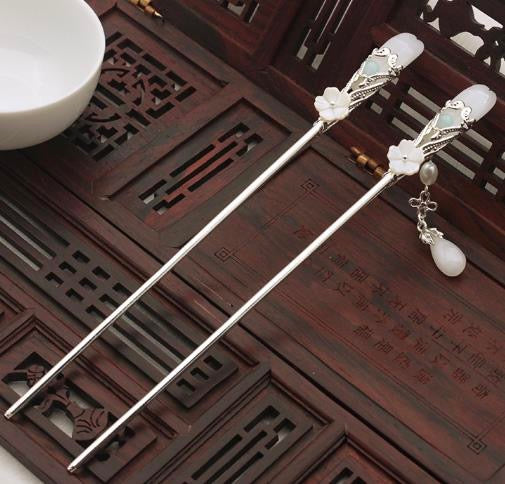
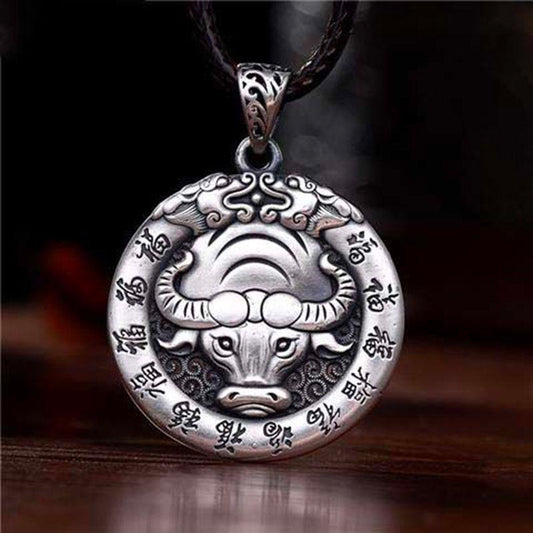
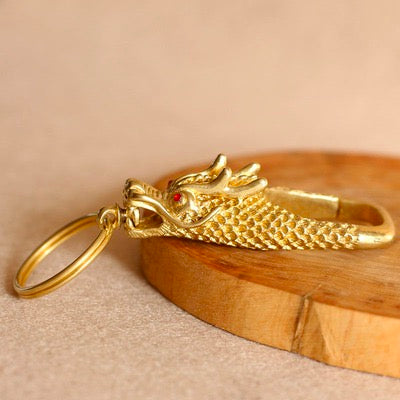
During Liu Bang's reign, the foundations for Han dynasty jade culture were established. Excavations from Western Han tombs—especially near Xuzhou, Liu Bang's home region—have revealed exquisitely carved jade pendants, belt hooks, and ornaments that set new artistic standards[reference:21]. According to the Records of the Grand Historian, at the famous Hongmen Banquet, Liu Bang presented Xiang Yu with a pair of white jade bi discs (玉璧)—demonstrating that even during the civil war, jade was valued as a diplomatic gift among elites[reference:22]. Han dynasty artisans perfected jade carving techniques, developing the distinctive "Han eight knives" style of incision and the use of gold wire inlay. These traditions continue to influence Chinese jewelry craftsmanship today, with pendants, rings, and hairpins echoing the elegant simplicity and symbolic motifs (dragons, phoenixes, and auspicious clouds) that originated in the Han era.
📌 Frequently Asked Questions (FAQ)
• Sima Qian (c. 94 BCE). Records of the Grand Historian (Shiji) – Basic Annals of Emperor Gaozu.
• Ban Gu et al. (82 CE). Book of Han (Hanshu) – Annals of Emperor Gaozu.
• Loewe, Michael (1986). "The Former Han Dynasty" in The Cambridge History of China, Volume 1. Cambridge University Press.
• Watson, Burton (1993). Records of the Grand Historian: Han Dynasty I. Columbia University Press.
• Twitchett, Denis; Loewe, Michael (1986). The Cambridge History of China, Volume 1: The Ch'in and Han Empires. Cambridge University Press.
• de Crespigny, Rafe (2016). Fire over Luoyang: A History of the Later Han Dynasty. Brill.
• ChinaKnowledge.de – "Political History of the Han Period"
• Britannica Online – "Gaozu emperor of Han Dynasty"
🔗 Explore more Chinese cultural heritage at Chinese Showcase
✨ Traditional Chinese Jewelry – Echoes of Imperial Han Elegance
The artistic traditions born during the Han Dynasty—intricate jade carving, gold filigree, and symbolic motifs—live on in these exquisite categories of traditional Chinese jewelry. Each piece reflects a legacy of craftsmanship that has been passed down for over two thousand years.
✨ Each piece celebrates the enduring artistic legacy of the Han Dynasty, where jade was considered more precious than gold and craftsmanship honored imperial tradition.