Exploring symbolism, traditions, and modern significance of white in China
In Chinese culture, colors hold profound symbolic meanings that influence traditions, rituals, art, and daily life. Among them, white is one of the most complex and deeply rooted colors, associated not only with purity and new beginnings but also with mourning, funerals, and ancestral respect. This duality makes white an intriguing subject in the study of Chinese symbolism.

White as a Symbol of Mourning
Unlike in Western cultures, where black is traditionally worn at funerals, in China, white is the primary color of mourning. White funeral garments, paper flowers, and candles are commonly used to honor the deceased. This stems from ancient beliefs where white was seen as the color of metal (in the Five Elements theory), connected to autumn, decline, and the cycle of death.
Wearing white at funerals demonstrates respect for ancestors and acknowledgment of the natural passage of life. Even today, families may dress in white when mourning, and envelopes containing money for the bereaved are often plain white or silver.
White as Purity and Simplicity
Beyond mourning, white embodies purity, honesty, and simplicity. It symbolizes a fresh start, untainted by worldly distractions. White has often been used in literature and poetry to describe snow, jade, or lotus flowers, each representing inner purity and resilience.
In Taoist philosophy, white can be seen as an expression of wuwei (non-action or effortless action), symbolizing simplicity and alignment with the natural flow of life.
White in Festivals and Ceremonies
While white is avoided in celebratory occasions such as weddings or Lunar New Year (where red dominates), it still plays a subtle role in religious ceremonies and ancestral worship. For instance, monks and Taoist priests sometimes wear white robes as a sign of humility and spiritual devotion.
White in Chinese Art and Literature
In classical Chinese art, white often appears in the depiction of snow landscapes, chrysanthemums, and lotus flowers. Poets used white to convey emotions of solitude, melancholy, or transcendence. For example, the imagery of white snow against a dark mountain often reflected the impermanence of life and the beauty of clarity.
Modern Interpretations of White
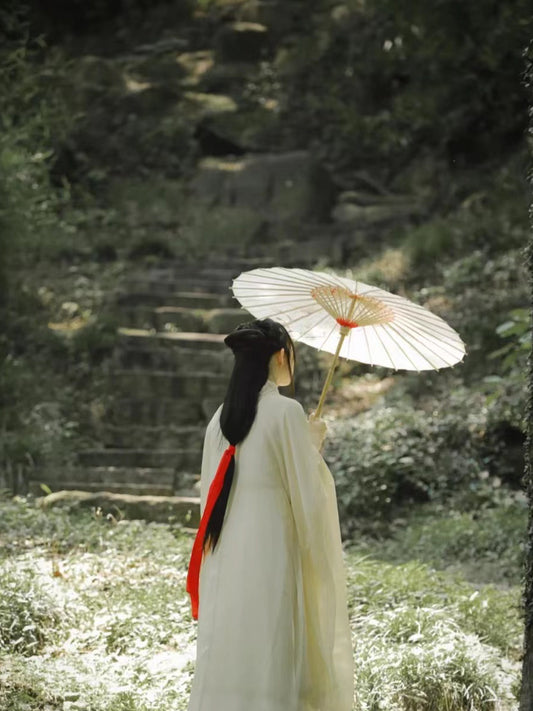
In modern China, the symbolism of white has broadened. While its association with mourning remains strong, younger generations also embrace white for its clean, minimalistic look in fashion and interior design. White jade jewelry, white ceramics, and white flowers are often appreciated for their elegance and contemporary style.
White is also gaining popularity in spiritual practices, as it is linked with clarity, enlightenment, and meditation. In feng shui, white corresponds to the metal element, bringing precision, efficiency, and focus to a space.
Conclusion
White in Chinese culture carries profound dual meanings: it is the color of mourning, decline, and death, yet also of purity, renewal, and clarity. Its place in art, tradition, and modern life reflects the balance of yin and yang—life and death, sadness and purity. Whether through ancestral rituals or minimalist modern design, white remains a color of deep cultural resonance in China.