The Tu people are one of China’s 56 officially recognized ethnic groups. Their largest communities live in the Hehuang region of eastern Qinghai, especially in Huzhu Tu Autonomous County, with other communities in Minhe, Datong, Ledu, and neighboring areas. Tu communities also live in Gansu, notably in Tianzhu. China’s 2020 national census recorded 281,928 Tu people.
The Tu are often introduced through brightly colored sleeves compared to a rainbow. That image is meaningful, but it represents only part of a varied cultural landscape. Tu heritage also includes a Mongolic language, oral epics, village architecture, pan embroidery, regional performance, agricultural festivals, and contemporary rural and urban life.

Tu People at a Glance
| Name | Tu people, or Tu ethnic group |
|---|---|
| Chinese name | Tu zu; the standard English form is “Tu people” |
| Population | 281,928 in China’s 2020 national census |
| Main distribution | Eastern Qinghai, especially Huzhu, Minhe, Datong, and Ledu; additional communities in Tianzhu and other parts of Gansu |
| Community self-names | Forms recorded in different localities include Mongghul, Chaghan Mongghul, Mangghuer, and other regional names |
| Language | Tu language varieties in the Mongolic language family; Mandarin and regional Chinese varieties are widely used, and Tibetan has influenced some communities |
| Traditional livelihoods | Mixed agriculture, animal husbandry, household crafts, and local trade |
| Notable cultural forms | Pan embroidery, Huzhu clothing traditions, Nadun, Anzhao, Yutu, Lunziqiu, local Hua’er traditions, wedding songs, and oral narrative |
Who Are the Tu People?
The name Tu is the standard modern Chinese ethnonym, but communities have historically used different self-names. In parts of Huzhu, Datong, and Tianzhu, forms commonly transcribed as Mongghul or Chaghan Mongghul have been recorded. In Minhe, Mangghuer is often used in linguistic literature. Other names appear in local records. These differences are not minor spelling variations: they point to distinct local histories, speech forms, and relationships with neighboring populations.
Most Tu people live in Qinghai Province, where the Hehuang valleys and the southeastern foothills of the Qilian Mountains form the historical center of Tu community life. Huzhu Tu Autonomous County is the best-known concentration, but significant populations also live in Minhe Hui and Tu Autonomous County, Datong Hui and Tu Autonomous County, and Ledu. In Gansu, Tianzhu Tibetan Autonomous County has long-established Tu communities, while smaller populations are found elsewhere.
Ethnic identity does not depend on wearing a particular costume or speaking one language every day. Many Tu people now live outside traditional villages and primarily use Mandarin, while family memory, place, community networks, and personal identification continue to shape identity.
Tu Language, Writing, and Oral Tradition
Tu language varieties belong to the Mongolic language family. Official overviews have often described Huzhu, Minhe, and Tongren dialect areas, while modern linguistic research sometimes treats the differences between Mongghul in Huzhu and Mangghuer in Minhe as especially substantial. Speakers from distant communities may not understand one another easily. It is therefore safer to describe “Tu language varieties” than to imagine a single uniform speech form used in every settlement.
Centuries of contact are audible in the language. Chinese has supplied many words and is dominant in schooling and public life. Tibetan influence is important in some areas, while individual communities show their own patterns of borrowing and bilingualism. This linguistic layering records the history of the Hehuang region more faithfully than any story of complete isolation could.
Historically, the Tu did not maintain one widely used, standardized writing system of their own. Chinese characters were the principal means of writing, and Tibetan script was also used in some settings. A Latin-alphabet-based Tu writing system was developed in 1979 and has been used in selected teaching, documentation, and publishing projects. It has never replaced Chinese as the everyday written language of all Tu people.
Oral transmission remains central. The long narrative poem Larenbu and Jimensuo, wedding songs, banquet songs, question-and-answer singing, local Hua’er, and family narratives carry vocabulary and community memory. Language preservation therefore requires recorded voices and performance contexts, not only word lists.
Origins and Historical Formation
There is no single, universally accepted account of Tu origins. Scholarly proposals have emphasized Mongol settlement, connections with the Tuyuhun or populations described as Hor, White Tatar or Shatuo Turk elements, local intermarriage, or a combination of several sources. Each theory draws on a different mixture of language, historical records, names, migration traditions, and regional evidence.
Written sources indicate that Mongol soldiers and settlers entered or remained in the Xining and Hehuang areas during the Yuan period. Records from the late Yuan and early Ming use terms translated as “local people” or “native residents,” while more stable communities associated with later Tu populations are visible in the Ming and Qing. These old administrative labels cannot automatically be mapped onto today’s ethnic category.
Huzhu oral tradition includes stories about the commander Geretai and ancestors who settled and intermarried in the region. They express community memory but are not conclusive proof of one ancestry for every Tu person.
The most responsible conclusion is that Tu identity developed over a long period in the Hehuang and Qilian borderlands. Military settlement, pastoral and agricultural movement, marriage, trade, political change, and contact among Mongolic-, Sinitic-, and Tibetan-speaking populations all contributed. The result is a distinct people whose history cannot be reduced to one ancestor or one migration.
The Hehuang Homeland, Villages, and Traditional Houses
The traditional Tu heartland lies on the northeastern edge of the Tibetan Plateau. Mountain slopes, shallow uplands, and river valleys create different possibilities for cultivation and grazing. Barley, wheat, rapeseed, potatoes, and other crops became important in agricultural areas, while livestock remained part of mixed household economies. Climate, altitude, water, and access to market towns produced variation from one valley to another.
Many older villages were built near cultivable land and reliable water while remaining connected to pasture and woodland resources. A traditional courtyard dwelling may be called a rima in local usage. Earth walls, timber beams, flat or gently sloping roofs, enclosed yards, storage areas, kitchens, and animal spaces formed a practical domestic compound.

These compounds are closely related to the zhuangkuo courtyards found across Qinghai. They should not be labeled an exclusively Tu invention. Architecture in the region has always crossed ethnic boundaries, and modern villages now combine older earth-and-timber structures with brick, concrete, improved utilities, roads, schools, and new domestic layouts.
Traditional Clothing, Jewelry, and “Rainbow Sleeves”
Historical descriptions of Tu men’s clothing include felt hats, high-collared or diagonal-front jackets, vests, robes, embroidered belts, and decorated shoes. Women’s clothing could include long garments, vests, embroidered sashes, pouches, needle cases, bells, silver earrings, and elaborate head coverings. The form depended on locality, generation, marital status, wealth, and occasion.
The brightly segmented sleeves popularly called “rainbow sleeves” or “flower sleeves” are most strongly associated with traditional women’s clothing in parts of Huzhu. Descriptions of five-color and later seven-color arrangements coexist, suggesting that the visual system changed over time. The phrase “rainbow” is a useful cultural and visual comparison; it is not proof that every garment always contained an identical sequence of seven colors.
Even within Huzhu, mountain and valley clothing traditions differ, and some outfits do not use multicolored sleeves. Complex historical headdresses are now rarely worn in daily life, while festival outfits may use newer fabrics and standardized decoration.
What Is Tu Pan Embroidery?
Tu pan embroidery is one of the best documented textile traditions of Huzhu. It is recognized as a national-level item of China’s intangible cultural heritage. The technique is usually worked without an embroidery frame. Two threads of the same color perform different roles: one is laid and coiled on the surface, while the other passes through the fabric to secure it. A traditional explanation summarizes the method as “coiling above, stitching below, one needle with two threads.”

Pan embroidery traditionally decorates collars, cuffs, sashes, aprons, pouches, money bags, needle cases, and other textiles. Recorded motifs include five-petal blossoms, cloud forms, diamonds, bird-head shapes, continuous geometric structures, and designs identified with Buddhist or cosmological vocabulary. The technique depends on counting, tension, rhythm, and spatial planning rather than on a printed pattern alone.

It is tempting to assign a precise ancient meaning to every flower, color, or geometric line. The evidence rarely supports such certainty. Some motifs may carry wishes for continuity, prosperity, protection, or harmony in particular contexts; others reflect workshop practice, family preference, or later interpretation. Accurate writing identifies the maker, place, object, and use before claiming symbolism.
Food and Traditional Livelihoods
Tu livelihoods changed over time from a stronger pastoral component toward mixed farming in many settlements. Barley, wheat, potatoes, and oil crops became important, while sheep, cattle, and other livestock continued to support household economies. Local trade connected villages with market towns, monasteries, and neighboring communities.
Ethnographic accounts mention barley foods, wheat noodles and breads, potatoes, milk tea, meat, fried festival foods, sour vegetables, and locally distilled or fermented grain drinks. These dishes belong to particular households and occasions rather than to one rigid national menu. Barley, milk tea, hand-held meat, and preserved vegetables are also widespread among several peoples of Qinghai and Gansu.
Hospitality customs vary, and no single practice describes every modern Tu home. Today, Tu people work in agriculture, animal husbandry, education, public service, manufacturing, tourism, trade, and many other fields. Urban life is as much a part of the contemporary story as traditional farming.
Festivals, Music, Dance, and Community Ritual
Nadun in Minhe’s Sanchuan Area
Nadun is a major village festival tradition of the Sanchuan area in Minhe. Communities traditionally host events in sequence after the agricultural season, with a cycle that may extend from the twelfth day of the seventh lunar month to the fifteenth day of the ninth. The celebration can include Huishou dance, masked dance and ritual drama, village visits, and figures or acts known locally as Fala.
Nadun is sometimes promoted as an exceptionally long carnival, but that label obscures its local organization and ritual meaning. It is not a unified Tu New Year. Its form belongs to Minhe’s agricultural villages, and proposed Yuan or early Ming origins remain scholarly hypotheses rather than established fact.
Anzhao and Lunziqiu in Huzhu
Anzhao is a circle song-and-dance tradition associated especially with Huzhu celebrations and weddings. A lead singer, traditionally called the durijin, begins the song while others answer, move, and turn together. Older performances were commonly unaccompanied by instruments. Stories linking its beginning to the defeat of a demon belong to oral tradition, not documented history.
Lunziqiu is a rotating amusement and physical skill associated with Huzhu harvest and leisure traditions. It later entered organized ethnic sports and stage presentation. Modern safety equipment, competitive rules, and choreographed displays are adaptations; they should not be projected unchanged into every historical village setting.
Yutu in Nianduhu Village
The Yutu ritual is preserved in Nianduhu village in present-day Tongren, Qinghai. Participants paint tiger- or leopard-like markings on their bodies and move through a sequence of village spaces. Several explanations have been proposed for its origins, including connections with Chu culture, ancient Qiang traditions, or Bon-related ritual. None has achieved universal scholarly agreement.
Hua’er, Wedding Songs, and Shared Regional Culture
Hua’er is a broad northwestern song tradition shared by Han, Hui, Tu, Tibetan, Salar, Mongol, Dongxiang, and other communities. Danma Tu Hua’er is a recognized Huzhu local branch, but Hua’er as a whole is not uniquely Tu. This distinction matters because shared forms reveal cultural exchange rather than weak ethnic identity.
Traditional Huzhu weddings used songs, gift exchange, dress, hospitality, and dance to join households. Modern marriages follow contemporary law and individual choice, while families may retain selected heritage elements.
How Does Tu Culture Differ by Region?
Huzhu
Huzhu is closely associated with pan embroidery, famous multicolored-sleeve clothing, Anzhao, Lunziqiu, local wedding traditions, and Danma Tu Hua’er. Clothing and speech still vary inside the county.
Minhe and Sanchuan
Minhe preserves distinct language forms and the Nadun cycle. Agricultural village organization, local ritual, and long interaction with neighboring Chinese-speaking communities shape its cultural profile.
Tongren and Nianduhu
Nianduhu is the home of Yutu. The wider Tongren area belongs to the multiethnic Rebgong cultural region, where Tibetan Buddhist and local artistic traditions have influenced several communities.
Tianzhu and Other Communities
Tu communities in Gansu and scattered Qinghai localities have their own speech patterns, clothing, and local adaptations. Huzhu, Minhe, and Tongren examples should not simply be copied onto them.
Belief, Kinship, and Social Life
Tibetan Buddhism has historically been influential in many Tu communities, especially where monasteries formed part of the regional religious landscape. Local protective deities, ancestor remembrance, agricultural observances, Daoist elements, and rituals interpreted by some scholars as shamanic survivals have also been recorded. The balance differs by village, period, and family.
It is inaccurate to assign every Tu person one religion. Contemporary belief ranges from active practice to occasional family observance or none. Older marriage, birth, funeral, and hospitality customs are valuable records, not compulsory rules for every household today.
Tu Culture and Its Neighbors: Important Distinctions
Tu and Mongol Are Not Synonyms
The Tu language is Mongolic, and Mongol settlement forms part of several historical interpretations. The Tu are nevertheless a distinct ethnic group with their own regional history. Mongolian robes or Naadam should not be inserted into a Tu article without specific evidence.
Tu and Tujia Are Different Peoples
The similar English-looking names cause frequent confusion. Tu communities are centered in Qinghai and Gansu; Tujia communities are concentrated in the Wuling mountain region of south-central China. Their languages and histories are different.
Shared Tibetan Influence Does Not Mean Tibetan Identity
Tibetan Buddhism, plateau foodways, and Rebgong regional culture cross community boundaries. Sharing them does not make the Tu culturally identical to Tibetans or authorize the use of generic Tibetan costume as Tu dress.
Hehuang Culture Is Multiethnic
Hua’er, courtyard architecture, market foods, and some farming customs are shared with Han, Hui, Salar, Tibetan, Mongol, and other neighbors. Shared heritage should be identified rather than claimed as exclusive property.
Cultural Symbols and Responsible Interpretation
Rainbow sleeves, pan-embroidered geometry, Anzhao movement, and Yutu body painting are recognizable public symbols. Each comes from a particular place and context; combining them into one imagined “ancient national costume” erases meaningful differences.
Contemporary designers may respond to pan embroidery through color, line, and repetition. Such work is modern interpretation, not an original ceremonial object. Responsible use identifies the source community and technique, avoids invented symbolism, credits makers, and supports fair benefit.
A festival portrait, stage costume, tourism image, design illustration, and museum object do not provide the same evidence. Clear captions prevent modern presentation from being mistaken for a complete historical record.
Intangible Cultural Heritage and Life Today
National-level intangible cultural heritage entries connected directly with Tu communities include the oral narrative Larenbu and Jimensuo, Danma Tu Hua’er, Yutu, Anzhao, Lunziqiu, Tu pan embroidery, Tu clothing, the Nadun festival, and Huzhu Tu wedding traditions. Each entry names a category and a specific safeguarding community. National recognition does not mean that the practice is performed by every Tu person, nor does it make it a UNESCO world-heritage element.
Current safeguarding includes language classes, recorded songs and narratives, school readers, master-apprentice teaching, embroidery workshops, exhibitions, cultural-ecology programs, and community demonstrations. Pan embroidery has also entered contemporary clothing, accessories, interiors, and online commerce, creating income for some makers and new routes of transmission.
Stage performance, tourism, and e-commerce can give artists wider audiences and income, but can also make one standardized costume or motif stand for all communities. Strong preservation documents vocabulary, makers, techniques, occasions, and differences between villages.
Tu culture is carried by teachers, farmers, students, craftspeople, musicians, migrants, entrepreneurs, and families. Heritage remains living when communities have authority over what is taught, adapted, performed, and remembered.
Three Picks from Chinese Showcase
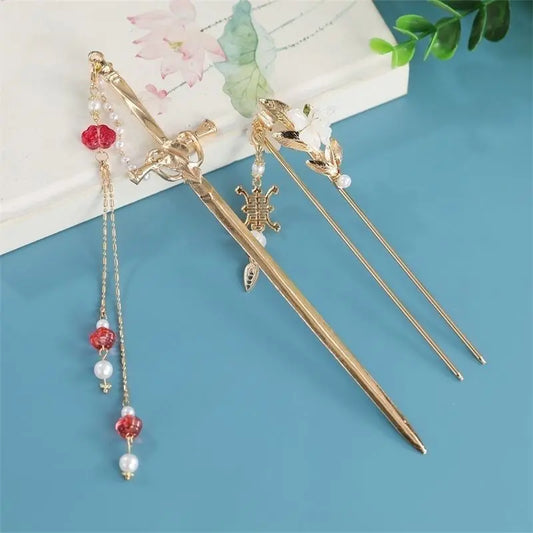
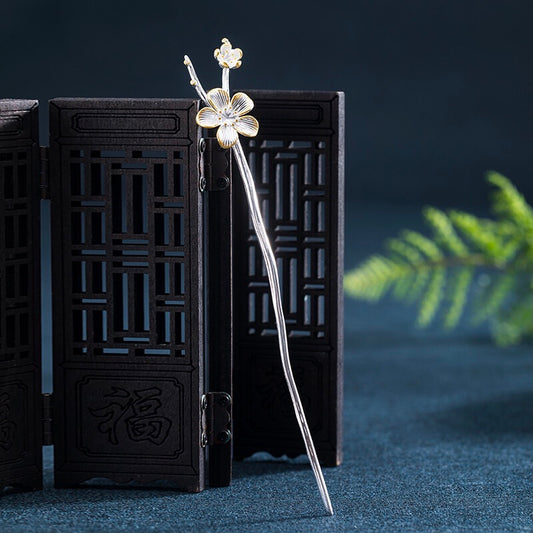
Three contemporary shop selections for readers interested in decorative design. These are not presented as documented heritage objects, community-made crafts, or religious endorsements. Check each product page for current specifications, price, and availability.

White Flower 5 glaze Beads Tassel Hairpin-Wood
View product details
Ancient Gold Enamel Turquoise Earrings – Elegant Hanfu & Qipao Accessories
View product details
Burnt Blue Birdsong Flower Fragrance Ring-Sterling Silver
View product detailsFrequently Asked Questions
Where do the Tu people live?
Most Tu people live in eastern Qinghai, especially Huzhu, Minhe, Datong, and Ledu. Tu communities also live in Tianzhu and other parts of Gansu, with smaller populations elsewhere.
How many Tu people are there?
China’s Seventh National Population Census recorded 281,928 Tu people at the 2020 census reference date.
Do the Tu people have their own language?
Yes. Tu language varieties belong to the Mongolic family. Regional varieties differ, and Mandarin or local Chinese varieties are now widely used. A Latin-alphabet-based writing system was developed in 1979 but is not universally used.
Are the Tu and Tujia the same ethnic group?
No. They are separate peoples with different homelands, languages, and histories. The Tu are centered in Qinghai and Gansu; the Tujia are concentrated in the Wuling mountain region.
Are the Tu people Mongolian?
The Tu language is Mongolic and Mongol settlement is relevant to Tu history, but the Tu are a distinct officially recognized ethnic group formed through a particular history in the Hehuang and Qilian regions.
Do all Tu women wear rainbow sleeves?
No. Multicolored “rainbow” sleeves are especially associated with women’s clothing in parts of Huzhu. Clothing varies within Huzhu and across Minhe, Tongren, Tianzhu, and other communities.
How is Tu pan embroidery made?
Two same-colored threads perform separate roles: one is coiled on the textile surface and the other secures it from below. The work is traditionally done without an embroidery frame.
What is the Tu Nadun festival?
Nadun is a village festival cycle centered in Minhe’s Sanchuan area. It can include communal visits, dance, masked ritual drama, and local performance traditions after the agricultural season. It is not a universal Tu New Year.
What are Anzhao and Yutu?
Anzhao is a Huzhu circle song-and-dance tradition. Yutu is a distinct ritual preserved in Nianduhu village in Tongren, where performers use painted tiger- or leopard-like body markings. They come from different local traditions.
Is Hua’er music unique to the Tu people?
No. Hua’er is shared by several ethnic groups across northwest China. Danma Tu Hua’er is a recognized local Tu branch within that broader regional tradition.
Is traditional Tu clothing still worn every day?
Most people wear contemporary clothing in daily life. Traditional or reconstructed dress is more often seen at weddings, festivals, heritage programs, performances, and other formal cultural occasions.
Conclusion
The Tu people are best understood through regional diversity rather than one costume, festival, or origin story. A Mongolic language connects them to a wider linguistic history, while centuries of life in the Hehuang borderlands produced distinctive communities shaped by farming, herding, intermarriage, religion, trade, and exchange with many neighbors.
Huzhu pan embroidery, Minhe Nadun, and Tongren Yutu are all important, but none represents the entire ethnic group. Accurate writing names the locality, distinguishes scholarship from oral tradition, and recognizes shared regional heritage. Tu culture is living knowledge interpreted by the people who inherit it.
References
- National Bureau of Statistics of China. China Population Census Yearbook 2020. Population data from the Seventh National Population Census.
- National Ethnic Affairs Commission of the People’s Republic of China. “Tu Ethnic Group: Overview.”
- National Ethnic Affairs Commission of the People’s Republic of China. “Tu Ethnic Group: Historical Development.”
- National Ethnic Affairs Commission of the People’s Republic of China. “Tu Ethnic Group: Customs and Social Life.”
- China Intangible Cultural Heritage Network and China Intangible Cultural Heritage Digital Museum. Project records for Tu pan embroidery, Tu clothing, Nadun, Anzhao, Yutu, Lunziqiu, Tu wedding traditions, Danma Tu Hua’er, and Larenbu and Jimensuo.
- Huzhu Tu Autonomous County People’s Government. Materials on Tu language education, intangible cultural heritage safeguarding, pan-embroidery workshops, and the cultural-ecology protection program.
- Academic studies of Mongghul and Mangghuer language varieties, Hehuang regional history, and Tu oral literature.