A Chinese bone hairpin, or gu ji (骨笄), is a slender hair fastener shaped from animal bone. One end was tapered so it could pass through a coil of hair; the other might be plain, capped, or carved into a bird or geometric form. Archaeological examples appear in Neolithic China, while Shang-period finds show a striking expansion in craftsmanship and social meaning. Bone hairpins could secure hair or headgear, decorate the head, and—in particular contexts—help communicate status. They were not exclusively women’s ornaments, and not every excavated hairpin should be interpreted as an object from a coming-of-age ceremony.
Table of Contents

What Is a Chinese Bone Hairpin?
The character ji (笄) names an early single-shaft hair fastener. The dictionary Shuowen Jiezi glosses it as a zan, showing how closely the two terms were related. In its simplest form, a ji is a long pin: the pointed end passes through a bun or gathered hair, while the head prevents the pin from sliding all the way through and may carry decoration.
“Bone” describes the material, not a single fixed style. Bone, antler, horn, ivory, jade, and metal can resemble one another after polishing, but archaeologists classify them separately. An individual object should only be called bone when material observation or scientific analysis supports that identification. The animal species also cannot be determined reliably from appearance alone.
Neolithic Origins: Hair Care Before the Dynasties
Bone hairpins were not invented by the Shang dynasty. Archaeological discussions report examples from the Cishan site dating roughly 7,000–8,000 years ago. These include long, chopstick-like pins with sharpened ends as well as shorter, flatter forms sometimes compared to willow leaves. At Banpo, stone, pottery, and bone hairpin-like ornaments formed a substantial part of the personal-adornment assemblage.
Such finds show that grooming and body ornament were already embedded in settled community life. A pin could perform a practical task—holding hair away from the face—while its polish, outline, or shaped head gave the maker room for visual distinction. Yet a pin’s owner, gender, and exact social role cannot be reconstructed from form alone. Archaeologists also examine burial position, wear, associated objects, figurines, and local chronology.

Why Shang Bone Hairpins Matter
The Shang period, especially the material from Yinxu, is crucial because bone hairpins appear in many forms and settings. Straight utilitarian pins coexist with carefully carved examples. Some have modest disc-like terminals; others use broad heads, openwork, or animal imagery. The shaft still performs the fastening function, but the head turns a household implement into a visible ornament.
The unlooted tomb of Fu Hao is particularly important. Its bone hairpins are numerous and varied, and several were stored together with other valued belongings. That context warns against treating bone as an automatically cheap material. Selection, cutting, fine carving, polishing, and the time of a skilled craftsperson could make a bone ornament socially significant.

How Can You Recognize a Bone Hairpin?
| Feature | What to look for | Why caution is needed |
|---|---|---|
| Shaft | Long, narrow, polished, and tapered toward one end | A broken needle, awl, or pin can look similar |
| Head | Plain disc, cap, flat plaque, openwork, or carved animal form | Not every terminal survives intact |
| Surface | Cutting, scraping, grinding, and polishing traces | Burial conditions may alter color and texture |
| Context | Near the head in a burial, stored with ornaments, or found in a bone workshop | Objects can be displaced before or after burial |
| Material | Dense worked osseous material | Bone, antler, horn, and ivory require expert distinction |

How Were Bone Hairpins Made?
Production likely began with a suitably dense section of animal bone. The joints were removed, the wall was split into blanks, and a blank was cut into a narrow strip. Repeated scraping and grinding formed the shaft; one end was sharpened, while the other was left thick enough for a head. A simple pin could then be polished. An elaborate example required additional drilling, openwork, incision, relief carving, and careful finishing.
Western Zhou bone-working sites at Zhouyuan, Fenghao, and related centers preserve raw material, waste, blanks, unfinished objects, and broken products. These finds reveal organized craft activity rather than occasional household whittling alone. Cattle bone formed an important share of material at some workshops, but that does not mean every hairpin was made from cattle. Species identification belongs to the analysis of each assemblage or object.

Who Wore Bone Hairpins?
It is misleading to describe all ancient Chinese hairpins as women’s jewelry. In societies where long hair was commonly dressed and bound, both women and men could require a fastening device. A hairpin could also help connect a coiffure with a cap or headdress. Shang-period human figures show varied buns, braids, and head coverings; holes in some sculpted headgear have been interpreted as places where pins might have been inserted.
That interpretation still depends on context. A simple pin from a residential deposit, an unfinished blank from a workshop, and a carved set from an elite tomb do not necessarily represent the same wearer or occasion. Gender, occupation, age, and rank should be argued from the complete archaeological setting rather than assumed from the modern marketing category “women’s accessory.”
What Did Bone Hairpins Symbolize?
Order and the dressed body
At the most basic level, a hairpin made hair manageable. A controlled hairstyle turned bodily maintenance into a visible social habit. The object therefore belonged to everyday order before it acquired any more elaborate meaning.
Craft and personal display
A polished shaft or sculpted terminal displayed technical skill at close range. Bird heads are especially associated with Shang bone-hairpin decoration. Birds were prominent in Shang imagery, but it is safer to speak of participation in a wider visual tradition than to label every bird pin a “Xuan Bird totem.”
Status in context—not by material alone
Fine carving, grouped storage, association with prestigious objects, and an elite burial can turn a bone hairpin into an indicator of rank. Conversely, a plain pin may simply be a practical possession. There was no single universal symbolism shared by every bone hairpin over thousands of years.
Western Zhou Continuity and Later Change
Bone hairpins continued into the Western Zhou. Workshop evidence includes large numbers of fragments and semi-finished pieces, demonstrating sustained demand and increasingly organized manufacture. Certain Shang styles also continued among communities carrying earlier craft traditions, although the distribution and social weight of particular forms changed.
Over time, hair ornaments expanded into jade, bronze, silver, gold, wood, and other materials. The term zan became more familiar for later hairpins, while increasingly complex ornaments developed alongside single-shaft fasteners. Bone did not vanish immediately: it remained light, workable, and widely available. Its place within elite display, however, was reshaped by new materials and fashions.
Bone Hairpin, Bone Needle, Ji, Zan, and Chai
| Object | Typical form | Primary use |
|---|---|---|
| Bone ji | One long shaft, tapered end, optional head | Binding hair, securing headgear, ornament |
| Bone needle | Usually finer; many examples have an eye | Sewing, textile work, or other piercing tasks |
| Zan (簪) | Usually a single pin; later forms can be highly decorated | Fastening and ornamenting a hairstyle |
| Chai (钗) | Two or more prongs | Stronger grip and visible hair ornament |
The words ji and zan overlap in historical texts, so they are not a perfect dating system. A damaged artifact also cannot always be separated neatly from a needle or awl by shape alone. Size, head treatment, wear, and archaeological context remain essential.
Bone Hairpins Today: Study, Reconstruction, and Responsible Design
Today, bone hairpins help archaeologists study ancient hairstyles, craft organization, animal-resource use, and social differentiation. Museum interpretation and experimental reconstruction can make their mechanics easier to understand, provided a modern reconstruction is clearly labeled and not presented as an excavated original.
Contemporary designers may echo the long shaft, compact terminal, or animal silhouette without copying an artifact. Modern buyers should also distinguish cultural inspiration from historical reproduction and check that animal-derived materials are legal, traceable, and responsibly sourced. Wood, metal, and plant-based alternatives can preserve the visual principle without imitating ancient bone.
Contemporary Designs in Dialogue with the Ancient Hair Fastener
These live store designs are not replicas of archaeological bone hairpins. They are selected because their structures help a modern reader compare three enduring ideas: the decorated single shaft, the stronger two-prong form, and the curved ornament that frames a bun.

A Floral Head on a Single Shaft
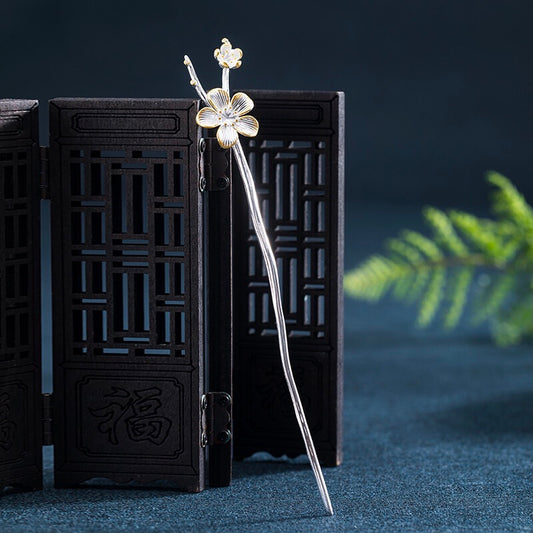
The iris turns a small terminal into the focal point of the hairstyle, recalling the ancient contrast between a functional pin and a visible ornamented head.
From $24.99 USD
Explore the design
Two-Prong Stability and Movement
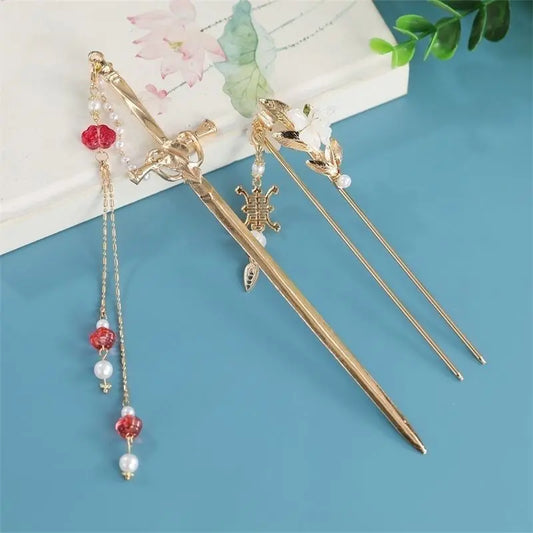
A U-shaped format grips an updo differently from the early single-shaft ji, while fan and pearl details show how structure can carry cultural ornament.
$24.99 USD
Explore the design
A Crescent Framing the Bun
The half-moon curve moves beyond the straight pin while retaining the ancient design problem: how to balance secure fastening with a legible silhouette.
$76.99 USD
Explore the designFrequently Asked Questions
What is a Chinese bone hairpin called?
It is commonly called gu ji (骨笄), literally “bone ji.” In English, “bone hairpin” or “bone hair fastener” is usually clearest.
How old are Chinese bone hairpins?
Archaeological discussions report examples from Neolithic sites such as Cishan, roughly 7,000–8,000 years ago. New discoveries may refine the earliest date.
Were bone hairpins only worn by women?
No. Both women and men could bind long hair, and pins could also help secure headgear. The wearer must be assessed from context, not modern gender assumptions.
Were all bone hairpins status symbols?
No. Plain examples were practical tools. Fine carving, an elite burial, grouped storage, and association with prestigious objects can support a status interpretation for particular pieces.
What animals supplied the bone?
Ancient workshops used several animal species, with cattle important in some assemblages. The species of a specific hairpin requires scientific identification rather than visual guesswork.
Is every bone hairpin connected with the “hairpin ceremony”?
No. The coming-of-age meaning of ji ji belongs to later ritual texts. It should not automatically be applied to Neolithic or Shang archaeological finds.
How is a bone hairpin different from a bone needle?
A hairpin is usually longer or thicker and may have a distinct head. A sewing needle is often finer and may have an eye, but broken objects require contextual study.
What is the difference between a ji, zan, and chai?
Ji and zan are overlapping terms for single-shaft hair fasteners. A chai normally has two or more prongs.
References
- Institute of Archaeology, Chinese Academy of Social Sciences. Tomb of Fu Hao at Yinxu. Cultural Relics Publishing House, 1980.
- Palace Museum. “Bone-Carved Bird-Head Hairpin (Phoenix-Bird Head).” Accessed August 13, 2026.
- Institute of Archaeology, Chinese Academy of Social Sciences / Chinese Archaeology. “Neolithic Ornaments—Clouds Think of Her Clothes Series.” 2015.
- Institute of Archaeology, Chinese Academy of Social Sciences / Chinese Archaeology. “Shang Head Ornaments and Hairstyles—Clouds Think of Her Clothes Series.” 2015.
- Chinese Archaeology. “Western Zhou Bone-Working Workshop Sites.” 2012.
- Sanya Museum. “Types, Origins, and Functions of Bone Hairpins from Yinxu.” 2022.
- Xu Shen. Shuowen Jiezi, “Bamboo” section.
- Book of Rites, “Patterns of the Family” (Neize).
Related Reading
- What Is Liangzhu Jade Culture? Ritual, Power, and Craft 5,000 Years Ago
- What Is Chinese Seal Engraving? History, Techniques, and Cultural Meaning
- What Is Chinese Calligraphy? History, Styles, Meaning and Art