Ancient Chinese jewelry was more than decoration. Jade pendants, hairpins, ear ornaments, bracelets, belt fittings, and gold or silver headdresses could interact with dress, movement, ceremony, social position, and beliefs about the body. The Shang dynasty jade huang shown here offers an especially useful starting point: its simple arc and suspension holes reveal how material, form, and wearability could meet in a single object.

Information Snapshot
| Object in the image | Jade huang (玉璜) |
|---|---|
| Date on the label | Shang dynasty |
| Basic form | Flat, open arc with a suspension hole near each end |
| Likely functions | Wearable ornament, pendant component, or ceremonial object, depending on archaeological context |
| Material | Identified by the label as jade; exact mineral cannot be determined from the photograph |
| Key distinction | A huang is an open arc rather than a complete jade disc or ring |
Reading the Shang Dynasty Jade Huang in the Photograph
A huang is an arc-shaped jade object. The form appeared in Neolithic China and continued through later periods, changing in width, curvature, decoration, and use. The photographed example is broad and plain, with a small hole near each end. Those holes are technologically and functionally important: a cord could pass through them so the arc hung in a controlled orientation.
The museum label compares Shang dynasty huang to roughly one-third of a jade bi, the flat circular disc with a central opening. This is a helpful visual analogy, but it should not be turned into a universal manufacturing rule. Not every huang was literally cut from a finished bi. Archaeological examples show different blanks, proportions, and working methods.
The clean silhouette is also a reminder that ancient jewelry does not need dense ornament to be sophisticated. Its maker had to select a workable stone, cut and grind a balanced arc, thin and smooth the surface, and drill holes without breaking the piece. Because jade cannot be shaped like soft metal, the object was produced through patient abrasion rather than rapid carving.
Evidence boundary: the photograph supports the label’s identification and lets us discuss visible form. It does not allow a secure claim about dimensions, excavation site, owner, exact jade mineral, or original pendant arrangement.
How Could a Jade Huang Be Worn?
Two terminal holes make suspension plausible. A cord passing through both holes would help the curved object hang across the chest or abdomen. It could also be combined with beads, tubes, animal-shaped jades, and other pendants. Excavated huang found near the body provide stronger evidence for wear than appearance alone.
Yet “jewelry” and “ritual object” are not mutually exclusive modern boxes. An ornament could be worn on the body during life, used in a ceremony, express rank, and later enter a burial. The interpretation of any particular object must therefore begin with archaeological context: where it lay, what accompanied it, and whether its holes show wear.
By the Western Zhou period, elaborate assembled jade pendants became more systematic. Multiple huang could appear with other named components in vertically organized sets. Later examples moved, sounded, and interacted with the wearer’s pace. That mature Western Zhou system helps explain the long history of pendant design, but it should not be projected unchanged onto every Shang object.
What Counted as Jewelry in Ancient China?
Hair ornaments
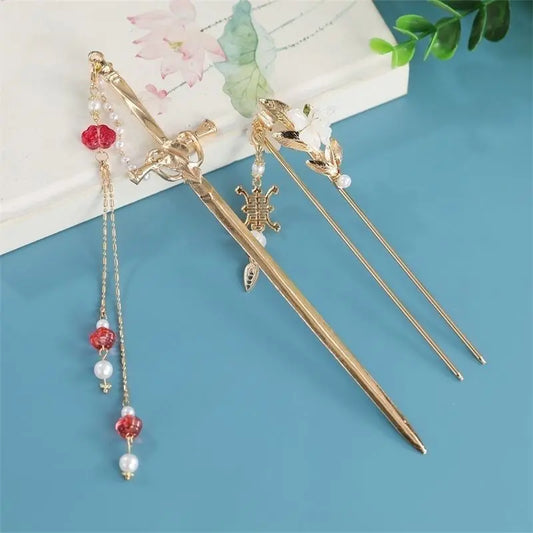
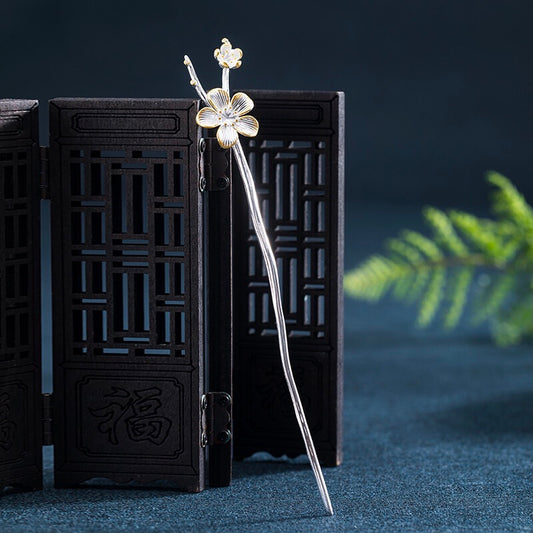
The ji (笄) and zan (簪) secured arranged hair and could also carry decoration. A chai (钗) generally had two prongs. The term buyao (步摇) became associated with ornaments whose light leaves, flowers, beads, or pendants moved as the wearer walked. Historical forms varied greatly; the oversized, mixed-period headdresses familiar from costume drama should not be treated as a single timeless style.
Ear ornaments
Ancient ear ornaments included slit rings, ear pendants, and later earrings in many materials. Some Neolithic jue-shaped objects have been interpreted as ear ornaments because of their position beside the skull, but wear and function still require contextual study. Regional customs were never uniform across all of China.
Neck, chest, and body pendants
Bead strings, animal-shaped jades, huang, rings, and assembled jade sets decorated the neck and torso. The body completed the design: cords held elements together, clothing created a background, and movement changed the visual arrangement.
Wrist, finger, and belt ornaments
Bracelets and armlets encircled the limbs. Rings and archer’s thumb protectors could move between practical and ornamental roles over time. Belt hooks, buckles, and plaques secured dress while signaling workmanship, material value, or affiliation.
A Short History of Ancient Chinese Jewelry
Neolithic foundations
Jade huang, slit rings, beads, shell ornaments, bone hairpins, and bracelets occur in Neolithic sites. Their distribution shows that body ornament was already connected to craft specialization and exchange. Some pieces were everyday adornment; others may have marked status or ritual participation. “Jewelry” should not erase those differences.
Shang and Zhou: jade, dress, and ceremonial order
Shang jade includes discs, huang, handle-shaped pieces, and birds, fish, dragons, and other animals. Some were wearable, while others had ceremonial or funerary roles. The pictured huang belongs to this wider world of shaped and perforated jade.
During the Western Zhou, assembled jade pendants became increasingly important in elite dress and ritual. Later philosophical texts compared the qualities of jade with moral virtues. Those texts are essential evidence for evolving ideas, but their mature ethical vocabulary should not automatically be assigned to every earlier Neolithic or Shang wearer.
Spring and Autumn and Warring States: complex silhouettes
Jade huang became more varied. Examples could end in dragon or animal heads and carry cloud, grain, or raised spiral patterns. Openwork and projecting outlines made some pendants visually intricate. In assembled sets, the arrangement of several pieces created a vertical composition across the body.
Qin, Han, and the age of mixed materials
Gold, silver, jade, glass, bronze, and organic materials appeared together in increasingly diverse ornaments. Hairpins, earrings, belt hooks, beads, pendants, and thumb protectors show how practical objects could acquire decorative or symbolic roles.
Wei, Jin, and the Northern and Southern Dynasties
Gold flowers and trembling leaf ornaments became prominent in some regions. Certain steppe and Central Asian crown traditions also influenced the movement of forms and techniques across Eurasia. Ancient Chinese jewelry developed through contact as well as local continuity.
Sui and Tang splendor
Gold and silver working, gemstone setting, floral hair ornaments, comb backs, and bird or plant motifs flourished in elite contexts. Lavish tomb finds are visually memorable but socially exceptional; they should not be presented as the daily jewelry of every Tang woman.
Song to Qing: refinement and specialization
Song ornaments often favored delicate floral, bird, child, and openwork imagery. Yuan jewelry reflects connections across a wide territory. Ming and Qing hairpins, earrings, bracelets, pendants, and dress accessories employed filigree, kingfisher-feather inlay, enameling, gem setting, and chasing. Historical kingfisher-feather work involved wildlife materials; modern reproductions should use lawful, ethical substitutes.
Materials and Techniques
| Material | Typical possibilities | Editorial caution |
|---|---|---|
| Jade and other hardstones | Pendants, huang, discs, slit rings, bracelets, hair ornaments, belt plaques | “Jade” in historical usage is not always one modern mineral; color in a photograph cannot establish source. |
| Gold and silver | Hair ornaments, earrings, crowns, beads, plaques, chains | Elite precious-metal finds are not representative of everyone. |
| Bronze and copper alloys | Belt fittings, pins, rings, plaques, functional ornaments | Corrosion can obscure original color and surface finish. |
| Bone, antler, shell, glass, and organic materials | Hairpins, beads, ear ornaments, pendants | Less costly material does not mean less historical value. |
Hardstone working relied on sawing, drilling, abrasion, grinding, and polishing. Metalwork allowed hammering, casting, chasing, soldering, filigree, and the attachment of moving elements. Jewelry design therefore grew from the possibilities and limits of its material: jade favored durable silhouettes and polished surfaces, while thin metal could become branches, petals, and trembling leaves.
Identity, Ritual, and the Limits of Symbolism
Ancient jewelry could communicate age, gender, marital position, political status, ceremonial role, regional identity, wealth, or group affiliation. It could be exchanged as a gift, worn during important events, or placed in a burial. One object might occupy several of these roles during its history.
Symbolic interpretation nevertheless requires discipline. Excavation position, inscriptions, ancient texts, and traces of use offer different kinds of evidence. A later literary explanation may illuminate a long-lived tradition without proving the original meaning of a much earlier object. Likewise, modern sales phrases—“prosperity,” “protection,” or “eternal love”—should not be presented as automatic ancient meanings for every cloud, animal, or geometric line.
| Evidence | What it can reasonably support |
|---|---|
| Excavation record | Position on the body, association with other objects, chronology, and burial context |
| Wear and manufacturing traces | How an object was suspended, repaired, handled, or reworked |
| Contemporary or near-contemporary texts | Names, ritual rules, social ideas, and literary associations—within their historical setting |
| Modern design interpretation | A new creative meaning, which should be labeled as modern rather than ancient fact |
Jade Huang, Bi, Ring, and Jue Compared
| Term | Basic form | Quick recognition |
|---|---|---|
| Huang 璜 | Arc or semi-circular segment | Open form; often perforated for suspension |
| Bi 璧 | Flat disc with a central opening | Complete circular body; traditionally the body is wider than the aperture |
| Ring 环 | Complete circular ring | Relatively large central opening |
| Jue 玦 | Nearly circular ring with a break | Narrow gap interrupts the circle |
| Yuan 瑗 | Disc or ring with a large opening | Ancient terminology and modern classification can be debated |
The photographed piece is most readily recognized as a huang because its ends are widely separated and the body forms a deliberate open arc. A jue, by comparison, normally preserves almost the entire circle and is interrupted by a much narrower break.
How to Look at Ancient Chinese Jewelry
Begin with construction rather than symbolism. Observe the silhouette, thickness, holes, edges, joins, abrasion, polish, and any asymmetry. Ask how cords, hair, cloth, or a belt completed the object. Consider whether it moved, sounded, caught light, or rested against the body.
Then separate what is visible from what is known through context. In the pictured huang, the two holes are visible; a complete necklace is not. The label supplies a Shang date; the photograph does not supply the excavation record. That distinction keeps an accessible museum story accurate.
Finally, resist treating “ancient Chinese jewelry” as one fixed style. Eight millennia of ornaments across many regions, communities, and social settings cannot be reduced to jade bracelets, phoenix hairpins, or imperial gold. The most rewarding view is historical: every ornament belongs to a material tradition, a body, and a specific moment.
Three Picks from Chinese Showcase
Three contemporary shop selections inspired by this article’s materials, motifs, or wider decorative themes. These products are not historical artifacts. Check each product page for current specifications, price, and availability.

Handcrafted Magnolia Blossom Ring in 925 Sterling Silver Hetian Jade – Vintage Chinese Cloisonné Enamel Adjustable Ring
View product details
Lotus Pearl and Hetian Jade Tassel Earrings-Sterling silver
View product details
Hetian Jade Mermaid Pearl Clavicle Chain Pendant - Sterling Silver
View product detailsFrequently Asked Questions
What is a jade huang?
A jade huang is an arc-shaped or semi-circular jade object found in China from the Neolithic period onward. Depending on its archaeological context, it could serve as a personal ornament, a component of an assembled jade pendant, or an object with ceremonial significance.
Was every Shang dynasty jade huang worn as jewelry?
No. Suspension holes can support an interpretation as a wearable ornament, but the precise function of an individual huang depends on its findspot, associated objects, and archaeological documentation.
Is a jade huang made by cutting a jade bi into pieces?
Not necessarily. Describing a huang as one-third or one-half of a jade bi is a useful comparison of shape. Some examples may have been made from ring-shaped blanks, while others were designed directly as arcs.
How is a jade huang different from a jade bi, ring, or jue?
A huang is an open arc; a bi and a ring form complete circles; and a jue is nearly circular but has a narrow break. Ancient terminology and modern archaeological classification can overlap, so context remains important.
Can the jade type or origin of the pictured object be identified from the photograph?
No. The photograph shows the form and a museum label identifying it as a Shang dynasty jade huang, but mineral type, source, dimensions, findspot, and collection cannot be confirmed from the image alone.
What were the main types of ancient Chinese jewelry?
Major categories included hair ornaments such as ji, zan, chai, and buyao; ear ornaments; necklaces and assembled pendants; bracelets and armlets; rings and archer’s thumb protectors; and belt ornaments such as hooks and plaques.
References
- Palace Museum, Beijing. “Jade Huang.”
- Palace Museum, Beijing. “Jade Huang with Dragon Design.”
- Palace Museum, Beijing. “Jade Heng with Dragon Design.”
- National Museum of China. “Cloud-and-Animal Patterned Green Jade Huang.”
- National Museum of China. “Jade Huang with Silkworm Pattern.”
- National Museum of China. “The Art of Ancient Chinese Jade.”
Related Reading
- 7 Types of Ancient Chinese Jewelry and Meanings
- 21 Classifications of Traditional Chinese Jewelry
- Why Do the Chinese Wear Jade Bracelets?