The Qiankun Circle (乾坤圈, Qián kūn quān) is a legendary ring most closely associated with Nezha, the youthful hero of Chinese mythology. It is best known from the Ming-dynasty novel Fengshen Yanyi (The Investiture of the Gods), where it appears as a supernatural weapon. Its circular form and the name “Qiankun”—heaven and earth—later inspired ideas of completeness, cosmic order, courage, and disciplined power.

At a Glance
Table of Contents
- What is the Qiankun Circle?
- Literary origins and Nezha’s story
- How to recognize the motif
- Symbolism and cultural meaning
- From temple art to animation
- How it differs from other rings and treasures
- Modern design and everyday interpretation
- FAQ
What Is the Qiankun Circle?
The Qiankun Circle is a supernatural ring in Chinese mythological storytelling. It is not a documented historical weapon with one surviving ancient prototype. Instead, it belongs to the world of literary imagination, temple imagery, opera, popular prints, animation, and games.
Its most recognizable owner is Nezha. In modern English, Qiankun Circle is usually the safest transliteration. Universe Ring or Cosmic Ring can help readers understand the name, but they are explanatory translations rather than universally standardized titles.
Literary Origins and Nezha’s Story
Nezha’s image developed over a long period through religious transmission, local worship, oral storytelling, and literary adaptation. The familiar combination of a child hero, a red silk ribbon, fiery wheels, and a circular ring was gradually stabilized by later storytelling.
The clearest source for the Qiankun Circle is the Ming-dynasty novel Fengshen Yanyi. In the early chapters devoted to Nezha’s birth and youth, the Qiankun Circle appears together with the Huntian Ling, or Cosmic Silk, as one of his extraordinary treasures. The ring helps establish that Nezha is not an ordinary child and gives physical form to his unusual power.
In episodes connected with the Dragon Palace and later conflicts, the ring functions as a dramatic weapon. It allows the narrative to show speed, force, and supernatural authority while also revealing Nezha’s impulsive character. Possessing a powerful treasure does not automatically mean that its owner understands responsibility; that tension is central to Nezha’s growth.
How to Recognize the Qiankun Circle
The simplest identifying feature is a closed, hollow circle. In paintings, sculptures, stage props, and screen adaptations, it may be held in the hand, worn around the arm, or shown flying through the air. A metallic gold or bronze surface is common because it makes the object read immediately as a powerful treasure.
Cloud scrolls, flame edges, thunder marks, lotus details, and engraved characters are later decorative choices. The novel does not prescribe one universal color, diameter, material, or surface pattern. When examining an image, it is therefore useful to separate the stable core—a circular supernatural ring associated with Nezha—from the style added by a particular artist or production.

Symbolism and Cultural Meaning
Heaven, earth, and wholeness
In the Yijing tradition, qian (乾) and kun (坤) are the names of the first two trigrams and hexagrams. Later explanations commonly associate qian with heaven and kun with earth. The name gives the ring an expansive literary atmosphere, suggesting the relationship between the whole world and the individual who acts within it.
This is a cultural interpretation of the name, not evidence that the Yijing itself describes Nezha’s weapon.
Power in a small form
A ring is compact, yet the mythic Qiankun Circle can defeat much larger opponents. The contrast between a small child and a mighty treasure creates one of Nezha’s most memorable visual tensions. The object can therefore suggest courage, initiative, and the idea that appearance does not measure ability.
A circle of discipline
A circle can strike, surround, restrain, and protect. Modern adaptations often develop this last quality by presenting the ring as a device that helps contain dangerous energy or teaches Nezha to control his impulses. That “seal” or “restraint” meaning is especially influential in contemporary film, but it should be described as an adaptation choice rather than a feature shared by every classical version.

From Temple Art to Animation
When Nezha stories entered temple sculpture, wall painting, New Year prints, and opera, artists needed instantly readable attributes. The ring became one of the objects that helped viewers identify Nezha, alongside the Huntian Ling, the Fire-tipped Spear, and the Wind-Fire Wheels. Regional works vary: one figure may hold the ring prominently, while another may emphasize a spear or a wheel.
The 1979 animated feature Nezha Conquers the Dragon King (Nezha Nao Hai), produced by Shanghai Animation Film Studio, played an important role in spreading a vivid modern image of Nezha and his treasures. Later films, television series, comics, and games have redesigned the ring as a glowing weapon, an energy device, or a symbol of inner control. These versions share a recognizable cultural memory while telling different stories.
How Does It Differ from Other Rings and Treasures?
Modern Design and Everyday Interpretation
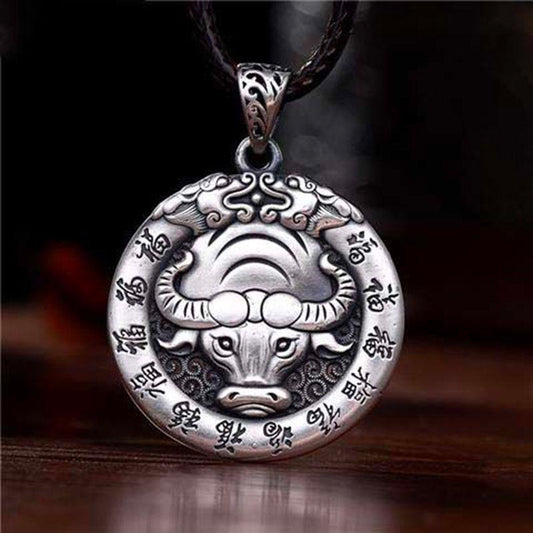
Today the Qiankun Circle appears in character art, jewelry-like accessories, theatrical props, home décor, and digital media. Designers often keep the open circular silhouette and combine it with cloud scrolls, flames, dragons, lotus petals, or calligraphy. A wooden ring can feel warm and handcrafted; metal can emphasize the object’s martial and supernatural character; engraved text can make the design more explicitly literary.
For a historically careful presentation, describe these objects as contemporary interpretations inspired by Nezha’s mythic ring. Avoid presenting a modern decorative ring as an excavated relic, and avoid claiming that the motif guarantees wealth, healing, or a fixed supernatural result. Its strongest cultural meanings are symbolic: wholeness, courage, power, self-control, and the responsibility that comes with ability.

FAQ
Is the Qiankun Circle a real ancient weapon?
No confirmed archaeological object matches the literary treasure. The Qiankun Circle belongs primarily to mythological literature, religious art, performance, and modern media.
Who is most closely associated with the Qiankun Circle?
Nezha is its best-known bearer, especially in Fengshen Yanyi and the many visual adaptations that followed.
What does the name Qiankun mean?
Qiankun combines qian and kun, terms traditionally associated with heaven and earth. The name suggests a broad cosmic setting, but it does not make the ring a literal object from the Yijing.
Is the Qiankun Circle the same as Nezha’s Wind-Fire Wheels?
No. The Qiankun Circle is a ring used as a treasure or weapon; the Wind-Fire Wheels are associated with movement and flight.
Why do modern versions show different colors and powers?
Artists and filmmakers adapt the core circular form for their own visual language. Gold, glowing effects, engraved symbols, and power-sealing functions are common later design choices rather than one fixed classical standard.
References
- Xu Zhonglin (attributed), Fengshen Yanyi (The Investiture of the Gods), Nezha chapters.
- The Book of Changes (Yijing), Qian and Kun hexagrams.
- Zhu Xi, Zhouyi Benyi and Zhuzi Yulei, discussions of qian and kun.
- “The Evolution of Nezha’s Image,” Peking University academic resource.
- “Drama as a Divine Image: Nezha Murals in the General’s Temple Theatre Building in An’an Township, Luding County,” Journal of Sichuan University (Social Science Edition), 2023.
- Shanghai Animation Film Studio, Nezha Conquers the Dragon King, 1979.
Related Reading
- Sun Wukong: Monkey King Story in Chinese Mythology
- What Does Butterfly Mean in Chinese Culture?
- What Is Listening to the Qin?