The Chinese Showcase journal Chinesische Kultur
What Is Chunfen? China’s Spring Equinox Solar Term
Chunfen is the Spring Equinox and the midpoint of traditional Chinese spring. Its astronomy and the equinox gathering in Anren reveal different ways of marking the same season.
Chunfen (春分, Chūnfēn), the Spring Equinox, is the fourth of China’s 24 solar terms. It begins around March 20 when the Sun reaches 0° of apparent ecliptic longitude and crosses the celestial equator northward. Within the traditional Chinese seasons, Chunfen marks the midpoint of spring.
What Does Chunfen Divide?
The word joins chūn, “spring,” with fēn, “to divide.” Beginning of Spring opens the traditional season in early February. Three terms have begun by the time Chunfen arrives, and two more, Qingming and Grain Rain, follow it before the Beginning of Summer. Chunfen therefore lies at the halfway boundary of the spring arc.
“Spring Equinox” and “Vernal Equinox” name the same March astronomical event. English calendars sometimes call it the beginning of astronomical spring in the Northern Hemisphere. The Chinese solar-term calendar counts spring from an earlier point, so both labels can apply to the same moment under different seasonal conventions.
Are Day and Night Exactly Equal?
At the equinox, the Sun is directly over the equator at the instant of crossing. Daylight and darkness are close to equal across much of the globe. Sunrise is counted from the first appearance of the upper edge of the Sun, and sunset ends when that edge disappears. Refraction in the atmosphere also bends light and makes the Sun visible a little earlier at sunrise and later at sunset. The exact day of equal daylight and darkness can therefore fall on a nearby date.
The equinox describes geometry between Earth and the Sun. One hemisphere is moving toward its longer days while the other is moving toward shorter ones. The daytime conditions people notice locally depend on latitude, elevation, weather, and the horizon.
What the Equinox Meant for Spring Work
Increasing daylight gives farmers another way to think about the working season. In early spring, they may be monitoring how an overwintered crop resumes growth, deciding whether a seedbed is warm enough, or preparing irrigation and tools for later planting. Chunfen gives those spring decisions a shared date in the calendar.
In a wet southern field, drainage may be the immediate task. In a frost-prone place, the safer time to plant a tender crop depends on local conditions. The solar term is precise as an astronomical marker, while farm observations tell a grower what is possible that week.
The Equinox Gathering in Anren, Hunan
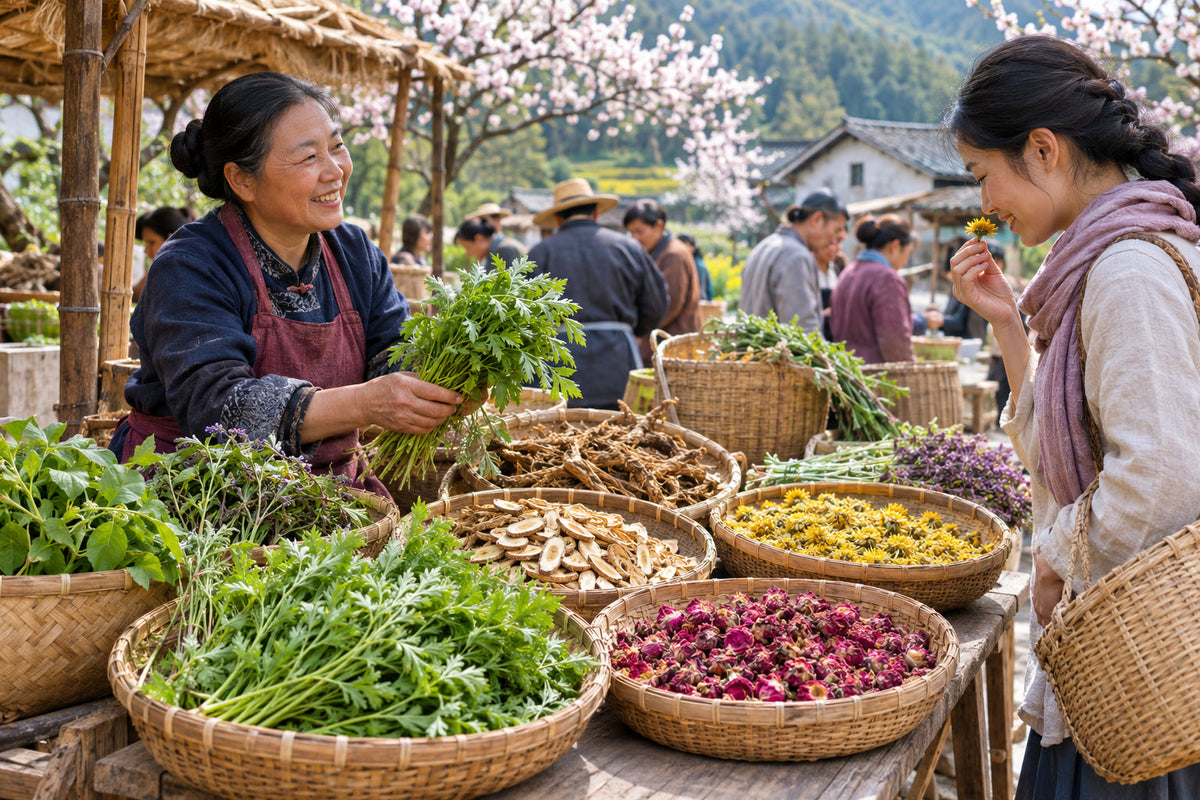
In Anren County, the spring equinox season is associated with Gan Fen She (赶分社), recognized in China’s national intangible cultural heritage inventory. The local tradition combines an observance honoring Shennong with spring farming and a market for medicinal herbs. Shennong is a legendary figure associated with teaching agriculture and testing plants.
The heritage record cites a Qing-era county gazetteer that describes a ritual asking for a good grain harvest. The modern gathering brings ceremonies and trade into the same public setting. In Anren, a date that can be calculated astronomically is also carried forward by vendors, farmers, and families meeting at a particular season.
Frequently Asked Questions
When does Chunfen occur?
It falls around March 20 or 21 in China. The precise moment depends on when the Sun crosses the celestial equator northward.
Is Chunfen the first day of Chinese spring?
In the 24 solar terms, Lichun begins spring in early February. Chunfen marks the spring midpoint. In a common Western astronomical convention, the same March equinox starts spring.
Why can daylight exceed 12 hours at the equinox?
The finite size of the Sun’s disk and atmospheric refraction extend the time between observed sunrise and sunset.
Where is Gan Fen She celebrated?
The best-known example in China’s heritage inventory is in Anren County, Hunan, where an equinox gathering includes ritual, trade, and farming traditions.
Continue Through the Solar Terms
- Previous term: Awakening of Insects (Jīngzhé)
- Next term: Qingming (Qīngmíng)
- All 24 Chinese solar terms by season
References
- Hong Kong Observatory. The 24 Solar Terms.
- U.S. National Weather Service. The Seasons, the Equinox, and the Solstices.
- China Intangible Cultural Heritage Network. The Lunar Calendar’s Twenty-Four Solar Terms, Anren Gan Fen She (农历二十四节气〈安仁赶分社〉), national project entry.
- UNESCO. The Twenty-Four Solar Terms, knowledge in China of time and practices developed through observation of the sun’s annual motion. Representative List of the Intangible Cultural Heritage of Humanity, 2016.
Woven baskets of herbs and roots at a spring market. AI-generated cover illustration.
The 24 Solar Terms
Choose a solar term below or browse the full seasonal guide.
| Season | Solar term guides |
|---|---|
| Spring | |
| Summer | |
| Autumn | |
| Winter |
Stories, symbols and everyday objects
Our journal explores Chinese culture and design. Traditions and interpretations vary by region and source. For a purchase, use the specifications on the individual product page.
About Chinese ShowcaseQuestions or corrections? Contact us ↗