Puwen is a refined geometric pattern found on ancient Chinese jade, especially jade bi discs from the late Warring States period through the Han dynasty. It is formed by intersecting lines and low geometric units arranged across the surface. Because the structure resembles a mat woven from cattail leaves, later scholars called it Puwen, or the "cattail-mat pattern."
| Feature | Puwen at a glance |
|---|---|
| Chinese name | Puwen |
| Literal idea | A pattern resembling a woven cattail mat |
| Main objects | Jade bi discs, jade rings, and later archaistic jade |
| Peak use | Late Warring States through the Han dynasty |
| Visual structure | Intersecting lines, grids, and shallow geometric relief |
| Common confusion | Grain pattern and nipple pattern |
What Is the Chinese Puwen Pattern?
Puwen is a geometric ornament used on ancient Chinese jade. The Palace Museum describes it as a pattern commonly seen on jade objects, particularly jade bi discs, whose interwoven lines resemble the surface of a cattail mat. It is especially associated with the Warring States and Han periods, while later archaistic jade also reused it.
The basic design is created from two or more sets of parallel lines. These lines cross at controlled angles and divide the surface into repeating diamonds, polygons, or woven-looking units. On some objects, the spaces between the lines rise slightly above the background. The result combines engraving, low relief, and the quiet luster of polished jade.

Why Is It Called a Cattail-Mat Pattern?
Cattails grow in wet ground and shallow water. Their long, strong leaves can be processed and woven into mats and other household objects. A finished mat displays a regular network of crossing strips. The surface organization of Puwen was thought to resemble that familiar texture.
The name does not mean that the jade shows flowers, leaves, or a naturalistic cattail plant. It describes a structural resemblance. This is important because modern pattern names are often based on appearance and may not reproduce the exact vocabulary or intention of the original jade worker.

When Did Puwen Become Popular?
Puwen is most strongly associated with the late Warring States period and the Han dynasty. Earlier jade bi were often plain or only lightly decorated. By the Eastern Zhou period, jade workshops produced increasingly complex grain patterns, cloud forms, dragons, intertwined creatures, and geometric textures.
During the Han dynasty, jade bi design became highly organized. A disc could be divided into zones: Puwen or grain pattern might fill the inner field, while dragons, chi creatures, rope borders, or openwork designs occupied the outer area. The National Museum of China documents a dragon-pattern jade bi whose inner zone carries Puwen and whose outer zone contains groups of stylized dragons separated by a rope border.
After the Han, Puwen became less central to mainstream jade decoration, but it never disappeared. Song, Ming, and Qing artisans returned to ancient jade forms as part of a wider archaistic tradition.
Why Does Puwen Often Appear on Jade Bi Discs?
A jade bi is a flat circular object with a central opening and is one of the most important forms in the history of Chinese ritual jade. Its broad, continuous surface is ideal for repeated geometry. Puwen can cover a large area without interrupting the clarity of the circle.
The contrast is subtle but effective: the bi is round, while the internal pattern is angular and ordered. Light moves across the engraved lines and shallow raised units, creating a changing texture without overwhelming the object's solemn outline.

Puwen could also function as a background. Fine geometric texture filled the main field while an outer dragon or chi design provided a stronger focal point. This division gave the jade both richness and visual discipline.
How Was Puwen Carved?
The apparent simplicity of Puwen hides a demanding production process. The jade worker first shaped the disc, established the central opening, and planned the decorated zones. The surface then had to be divided into lines of nearly equal spacing and consistent direction.
One set of grooves was cut before another crossed it. A line that was too deep could weaken or visually damage the jade; a line that was too shallow could disappear after polishing. When the design included low raised units, the surrounding field had to be reduced and carefully smoothed.
Finally, the object was polished without erasing the geometry. The success of the pattern depended on consistency across a curved circular field. This makes a well-organized Puwen bi evidence of planning as much as hand skill.

Puwen, Grain Pattern, and Nipple Pattern
Puwen is often confused with grain pattern because both occur on Warring States and Han jade bi and both may include low raised units. The easiest starting point is to ask whether the eye reads a continuous woven grid or a field of separate grains.
| Pattern | Main visual feature | How to recognize it |
|---|---|---|
| Puwen | Interwoven lines and a continuous grid | The surface resembles a woven mat |
| Grain pattern | Seed-like raised curls or sprouting grains | Individual units dominate over the connecting grid |
| Nipple pattern | Independent rounded bosses | Raised dots are clearer and usually lack the woven line system |
| Generic mat or lattice pattern | Any repeated woven geometry | Context may not support the specific archaeological term Puwen |
Wear, burial alteration, later polishing, and modern restoration can blur these distinctions. A reliable identification should consider the entire object: shape, layout, carving method, material, provenance, and archaeological context.

What Did Puwen Symbolize?
The most defensible meaning of Puwen comes from its relationship with jade bi, ritual practice, rank, display, and burial. A decorated bi could participate in ceremonies, elite exchange, personal adornment, or funerary contexts depending on its size, period, and archaeological setting.
Classical ritual texts include the phrase often translated as "a noble of the rank zi holds a grain-pattern bi; a noble of the rank nan holds a cattail-pattern bi." This passage influenced later discussions of grain and Puwen jade. Yet texts, surviving objects, and archaeological chronology do not always correspond neatly. Not every Puwen bi can be assigned to a specific rank.
Modern viewers may see order, connection, stability, continuity, and craft in its interwoven structure. These are reasonable contemporary interpretations, but they should not be presented as one universal ancient lucky meaning. There is insufficient evidence that Puwen always represented wealth, love, or longevity.
Was Puwen an Agricultural Symbol?
The name links the pattern to cattail mats and therefore to wetland plants, household work, and woven material. Its visual source belongs to the practical world of making. Nevertheless, Puwen is not a naturalistic agricultural picture.
It is better understood as a transformation of woven structure into jade ornament. Ancient makers converted the logic of flexible plant strips into a precise design on hard stone. That translation from everyday material to elite jade is one of the pattern's most interesting cultural features.
Puwen in Later Archaistic Jade
Later collectors and artisans admired early Chinese ritual objects. From the Song period onward, old bronze and jade forms became sources for new designs. Puwen was reused because it immediately suggested the visual language of Warring States and Han jade.
Qing court jade could combine ancient-looking grids with contemporary materials, inscriptions, animal borders, or imperial taste. Such works were not always intended as deceptive copies. Many were creative reinterpretations of antiquity.
For this reason, Puwen alone cannot date an object. A jade piece with the pattern may be ancient, later archaistic, or modern. Tool marks, drilling, polishing, weathering, material, provenance, and secure excavation records all matter.
How Can Puwen Be Used in Modern Design?
Puwen works well in jewelry, textiles, packaging, screens, lighting, furniture, and digital graphics because it is modular and repeatable. Designers can preserve three essentials: intersection, continuity, and disciplined rhythm.
A literal copy may become too dense on a small screen or pendant. Modern designers can enlarge the grid, reduce the number of lines, or use alternating relief and open space. The result can remain recognizable without pretending to be an archaeological reproduction.
Puwen should not be marketed with unverified promises of supernatural protection. Its strongest value lies in jade history, ritual culture, geometric design, and the ingenuity of ancient craft.
Ping An Kou Recommendations
These are modern store products selected from the verified Ping An Kou jewelry collection. They are contemporary accessories, not reproductions of excavated Puwen jade bi.

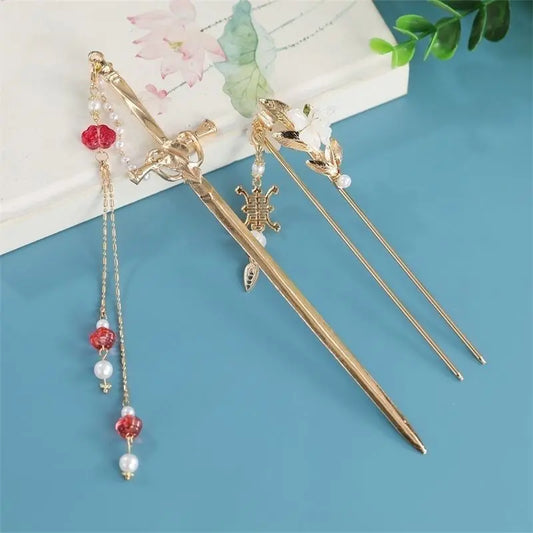
Ping An Kou Bamboo and Gourd Hairpin
A circular peace-buckle element is paired with bamboo leaves and gourd tassels in a traditional-inspired hair accessory.
View product
Jade Pi Disc and Red Cinnabar Bracelet
A modern bracelet centered on a circular jade disc, visually connecting the ancient bi form with wearable design.
View product
Jade Fish Pattern Bracelet
A jade-centered bracelet from the store's Ping An Kou jewelry collection, finished with garnet and silver details.
View productFrequently Asked Questions
What is Puwen in Chinese art?
Puwen is a geometric jade pattern formed by intersecting lines that resemble a woven cattail mat.
How do you pronounce Puwen?
In English it can be approximated as "poo-wen," with both syllables spoken clearly.
When was Puwen most popular?
It is especially associated with the late Warring States period and the Han dynasty.
Where is Puwen usually found?
It is most famous on jade bi discs, though it also appears on jade rings and later archaistic objects.
Is Puwen a flower pattern?
No. The name refers to the woven structure of a cattail mat, not a realistic cattail flower or leaf.
Is Puwen the same as grain pattern?
No. Puwen emphasizes a continuous woven grid, while grain pattern emphasizes separate seed-like or sprouting units.
Is Puwen a lucky symbol?
It has important ritual-jade associations, but there is no evidence that it carried one universal lucky meaning in every period.
Does Puwen prove that a jade is ancient?
No. Song, Ming, Qing, and modern artisans also made archaistic Puwen jade.
What does a jade bi symbolize?
Its meanings vary by period and context, including ritual status, elite identity, display, burial, and later ideas of completeness.
How is Puwen used today?
Designers adapt its intersecting geometry for jewelry, textiles, interiors, packaging, and digital patterns.
Conclusion
Puwen is one of the most disciplined geometric patterns in ancient Chinese jade. Its crossing lines turn the flexible logic of a woven mat into a carefully polished surface on hard stone. Most closely associated with jade bi of the late Warring States and Han periods, it demonstrates both technical control and the ordered visual language of ritual jade.
To understand Puwen accurately, viewers should distinguish it from grain and nipple patterns, avoid assigning it one fixed lucky meaning, and remember that later artisans repeatedly revived it. Its lasting appeal comes from structure: quiet repetition, interconnected lines, and a balance between the circular jade form and the angular woven field.
References and Further Reading
- The Palace Museum: Puwen
- The Palace Museum: Grain-Pattern Jade Bi
- National Museum of China: Dragon-Pattern Jade Bi with Puwen
- National Museum of China: Jade Bi
Related Reading
- Ping An Kou: The Popular Amulet of Protection in China
- Explore the Chinese Symbols Blog
- Explore the Chinese Culture Blog