The Chinese Showcase journal Chinesische Symbole
Dragon-Pattern Jade Jue: A Spring and Autumn Jade Ornament
Explore the dragon-pattern jade jue, an ancient Chinese open-ring ornament, through two Spring and Autumn examples, their incised curves and evidence of wear.
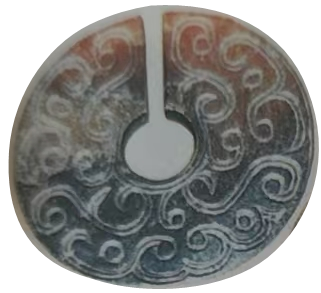
At first glance, the two ornaments in the photograph look like small jade rings filled with spirals. Each has a central hole and a narrow slit running out to the edge. That opening gives the form its name, jue, pronounced roughly jweh. The book identifies both examples as dragon-pattern jade jue from China’s Spring and Autumn period.
A dragon-pattern jade jue is an open-ring jade ornament decorated with a dragon motif. In these two pieces, long curves follow the rim while smaller curls turn back toward the centre. Trace the lines around the ring and a dragon begins to emerge through the motion of its body.
Dragon-Pattern Jade Jue at a Glance
| Period | Spring and Autumn period, conventionally 770–476 BCE |
|---|---|
| Form | A flat jade ring with a central hole and a narrow opening to the outer edge |
| Decoration | Incised arcs, hooked curves and interlocking curls used to suggest a coiling dragon |
| Evidence of use | Many excavated jade jue were found near the ears, supporting their identification as ornaments worn there |
| In early texts | The open ring could express a break in relations or serve as a signal to act |
The Opening That Makes a Jue

The slit on each piece is a regular part of the outline. Imagine closing it and the eye could travel around the ring without interruption. With it open, the composition has two distinct ends. The carver can use those edges to begin a pattern, turn it inward or bring it to a stop.
The shape is much older than these two ornaments. A Neolithic Xinglongwa jade jue in the National Palace Museum collection is only about 2.5 centimetres across and has the proportions of a short cylinder. The flat Spring and Autumn pieces pictured here offer a wider surface for ornament. Across those very different proportions, the defining feature is the same small opening.
Reading the Dragon in the Curves
Start with the long arc along the outer edge, then look inward to the shorter arcs around the central hole. Between those two paths, smaller curls hook into one another or pause across a narrow space. The motif seems to travel around the outside before folding back toward the centre.

Seen alone, a curl might look like a cloud tip or an eddy. Read together, the curves suggest the dragon’s body turning through a confined space. The lower half of the ornament gives the longer lines room to open out. Near the slit, the same lines gather into tighter turns.
An early Spring and Autumn jade jue in the Shanghai Museum makes a different use of the same shape. A dragon head appears at each end of the slit, and the two heads share one body. That object lets the viewer recognise the heads first. The examples in the photograph draw the eye along the bends and turns of the body.
How Incised Lines Bring the Pattern to Life
An incised line sits below the surface of the jade. Under angled light, the edge of a groove may catch the light while the groove itself darkens. Viewed from another angle, the same mark can become harder to see. Part of the movement comes from this interplay between carved line and shifting light.
Jade working depended on abrasion. The Palace Museum in Beijing describes how carvers used hard mineral grains to grind and shape jade. On a piece this small, the spacing between grooves matters as much as their depth. A tight turn can crowd the next curl, and an overly wide gap can interrupt the rhythm. Near the central hole, where the arc is shortest, every curve has to fit into less space.
From Ear Ornament to Literary Symbol
Many jade jue recovered from tombs lie near the ears. When matching pieces appear on opposite sides of the head, their position makes the case for paired ear ornaments especially persuasive. The photograph shows the two pieces side by side. Their original arrangement and use would depend on the archaeological record for each object.
Early texts give the open ring another role. The Xunzi associates a jue with breaking off relations and a closed ring with restoring them. In the Records of the Grand Historian, Fan Zeng repeatedly lifts his jade jue at the Hongmen Banquet to signal to Xiang Yu. The shape becomes a way to express a decision without speaking. The excavated ornaments and the literary examples show how the same kind of object could belong to both dress and gesture.
Looking from the Outline to the Surface
A Shang dragon-shaped jade jue from Fu Hao’s tomb, now in the National Museum of China, has a recognisable head, a turned tail and a serrated spine. The silhouette itself helps describe the dragon. On the nearly round Spring and Autumn examples shown here, the carving on the face carries more of that work.
The Chinese Showcase Edit
Dragon Motifs in Jewelry
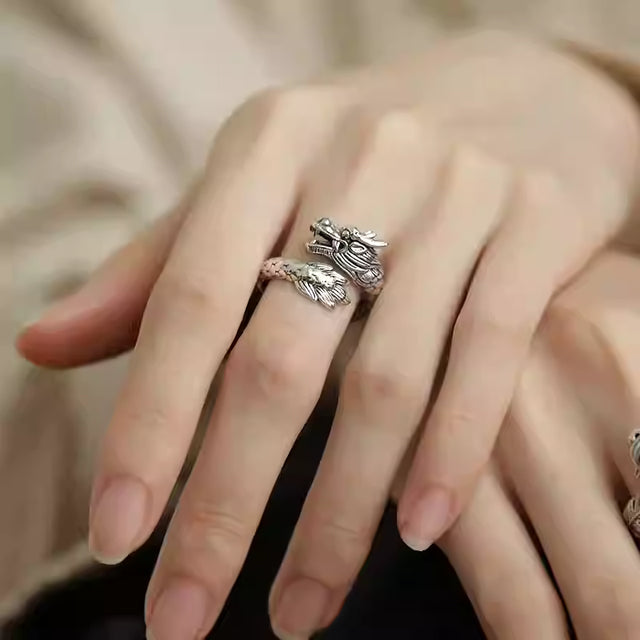
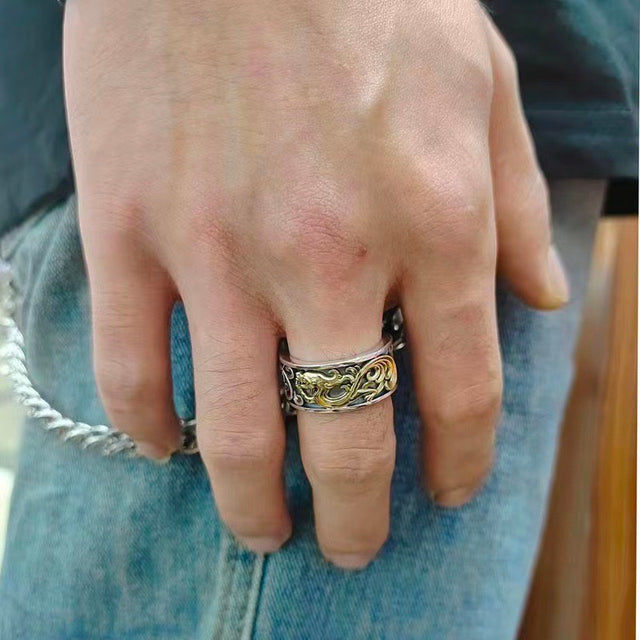
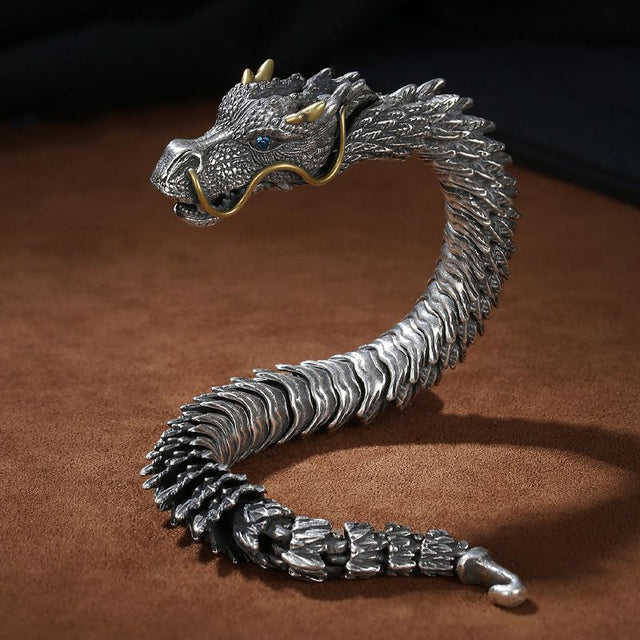
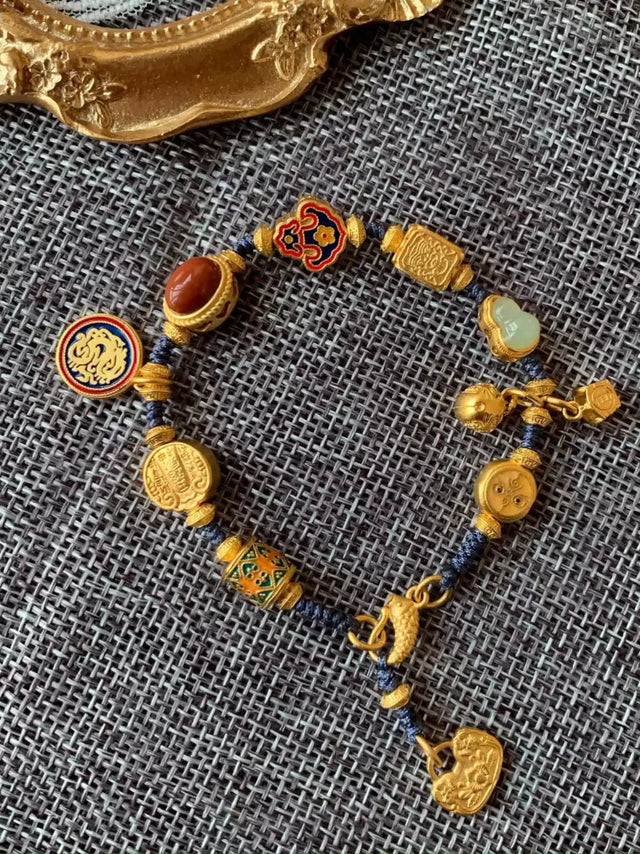
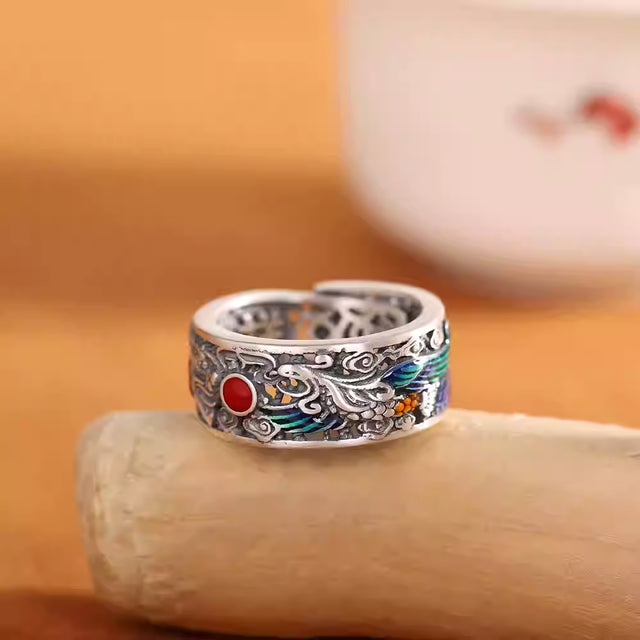
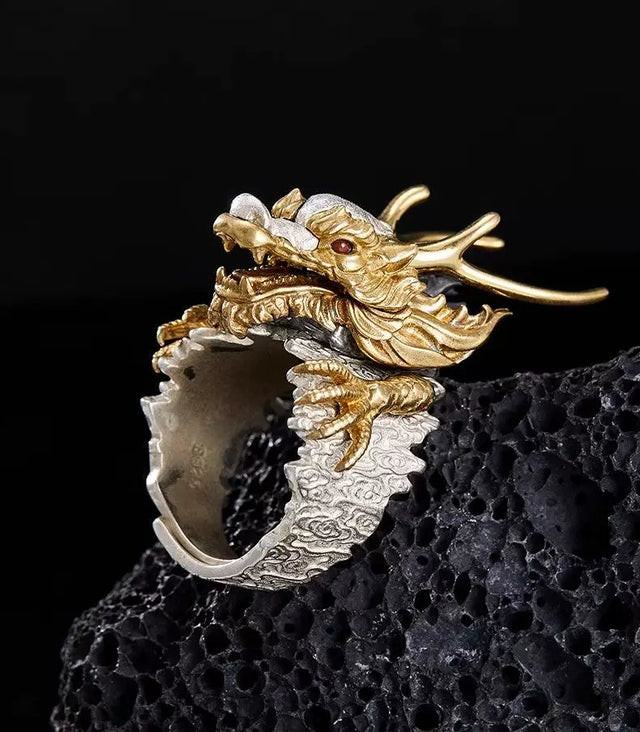
These contemporary pieces pick up details from the article, from a dragon within a round frame to the open space around a motif and a dragon worn at the ear.


Frequently Asked Questions
What is a dragon-pattern jade jue?
It is an open-ring jade ornament with a central hole, a narrow slit to the outer edge, and a carved dragon motif. The pieces shown here are identified in the reference photograph as Spring and Autumn period examples.
How can you tell a jade jue from a closed jade ring?
Look for a deliberate opening that connects the central hole to the outside edge. On the illustrated pieces, that slit interrupts the outline at the top.
Were jade jue worn as earrings?
Many excavated examples were found near the ears, which supports their identification as ear ornaments. The exact use of an individual piece depends on its archaeological context.
Why does the dragon look like a series of spirals?
A jade carver could simplify the body into long arcs and join them to shorter curls. The curves follow the outer edge and central hole, allowing the dragon to fit around the ring.
What did the jade jue mean in ancient Chinese texts?
The Xunzi associates a jue with breaking off relations and a closed ring with restoring them. In the Records of the Grand Historian, Fan Zeng uses a jade jue as a signal during the Hongmen Banquet.
A Dragon in an Open Ring
Return to the opening and follow the longest curve down one side, across the lower arc and back toward the central hole. Along the way the short curls change direction and the two ornaments begin to look less alike. The ring stops at the slit, but the carved lines keep the eye moving.
References
- Shanghai Museum. Dragon-Pattern Jade Jue, early Spring and Autumn period.
- The Palace Museum, Beijing. Collection entry for Jade Jue and glossary entry for jade-working abrasive.
- National Palace Museum, Taipei. Jade Jue Earring, Xinglongwa culture.
- National Museum of China. Dragon-Shaped Jade Jue, from the tomb of Fu Hao.
- Xunzi, “Da Lue,” and Records of the Grand Historian, “Basic Annals of Xiang Yu.”
Stories, symbols and everyday objects
Our journal explores Chinese culture and design. Traditions and interpretations vary by region and source. For a purchase, use the specifications on the individual product page.
About Chinese ShowcaseQuestions or corrections? Contact us ↗