The Chinese cloud-and-guaizi interlocking pattern—套云拐子纹, tào yún guǎi zi wén—is a composite ornament that joins rounded cloud heads with the hard, repeated turns of a guaizi meander. It is best understood as a design description rather than a single, universally standardized historical category. Its visual identity comes from the meeting of flowing curves and disciplined geometry, especially in furniture, woodcarving, screens, railings, lacquerwork, and architectural latticework associated with the Ming and Qing periods.

What Is the Cloud-and-Guaizi Interlocking Pattern?
The name can be understood in three parts. Yun means cloud. In decorative art, it can refer to rounded cloud heads, inward curls, ruyi-like lobes, or elongated cloud tails. Guaizi refers to a line that repeatedly turns at firm angles. On traditional furniture it often travels along a border, arm, apron, corner bracket, or openwork panel. Tao, meaning to enclose or fit one form around another, describes the nesting relationship between the two.
The result is not simply a cloud placed beside a geometric border. The cloud and the angular framework share space: one may surround the other, interrupt it, emerge from it, or complete its turn. This interdependence is what gives the motif its characteristic tension between softness and structure.
How to Recognize the Pattern
Look first for a visible angular skeleton. A guaizi line usually changes direction through right angles, stepped bends, or squared spirals. It may form a closed frame or continue in a horizontal or vertical band. Then look for rounded cloud units within, around, or at the ends of that skeleton.

- Hard turns: repeated right-angle or stepped changes of direction establish the guaizi framework.
- Cloud heads: rounded lobes, inward curls, or trailing hooks soften the geometry.
- Nesting: the cloud is enclosed, crossed, or linked by the angular structure rather than merely placed nearby.
- Repetition: the unit may repeat as a border, mirror across a centerline, or expand into a four-way lattice.
- Designed negative space: in openwork, the empty areas are as important as the carved lines.
A motif with only squared turns is more likely to be a hui or guaizi border. A motif made entirely from flowing curls is more likely to be a cloud or ruyi-cloud pattern. The combination of both systems is the identifying clue.
Origins and Historical Development
Cloud imagery and angular meanders both have long histories in Chinese art, but their antiquity should not be used to claim that the exact compound term 套云拐子纹 existed from the earliest periods. Early bronze cloud-and-thunder designs, painted cloud scrolls, and later furniture meanders belong to related but historically distinct design systems.
Earlier visual foundations
Curled clouds provided Chinese artisans with a flexible vocabulary for depicting movement, air, and an idealized celestial environment. Geometric meanders supplied a contrasting vocabulary of repetition and boundary. Over time these systems could be combined, but the date of an ancient cloud or meander alone does not establish the origin of this exact named pattern.
Ming-period integration
In Ming furniture and architecture, decoration often follows the logic of the structure. Cloud terminals can soften the meeting of straight members, while angular turns fit naturally into rails, aprons, corner spandrels, and framed panels. The strongest examples treat ornament as part of the construction rather than as a separate surface layer.
Qing-period elaboration
Qing furniture and lacquerwork frequently employ denser combinations of cloud heads, guaizi turns, hui borders, scrolling plants, lotus forms, and stylized dragons. Museum records of Qing chairs, beds, incense stands, and tables show cloud and guaizi structures appearing on the same object or within a single decorative zone. This period provides especially clear surviving evidence for the composite design language.
Regional workshops and different crafts did not always use identical names. A carpenter might describe a structural openwork unit differently from a textile designer or lacquer craftsman, even if the finished forms appear visually related.
Composition, Line, Repetition, and Pairing
The pattern’s visual power comes from contrast. Straight sections establish direction; turns create rhythm; cloud curls provide release. The eye moves through a sequence of restraint and expansion, making the design feel active without becoming chaotic.
Common compositions
- Two-directional borders: one unit repeats along a horizontal or vertical edge.
- Mirrored corner units: a cloud-and-turn form is reflected to fill a ninety-degree junction.
- Four-way lattices: repeated units surround a center and create balanced open space.
- Nested medallions: a cloud unit is enclosed by squared spirals or stepped frames.
- Mixed ornament: the framework is combined with ruyi, lotus scrolls, bats, longevity characters, or stylized dragons.
Material changes the appearance. Wood openwork needs connections thick enough to remain strong. Lacquer can support finer lines and layered color. Textile versions can repeat more densely because they are not structural. Architectural versions are often simplified so that the pattern remains legible from a distance.
Meaning and Cultural Associations
Cloud forms in later Chinese decorative culture are often associated with auspicious clouds, favorable circumstances, and elevated or celestial settings. Their use around dragons, phoenixes, immortals, sacred mountains, and auspicious characters strengthened this positive visual association.
The guaizi framework creates an impression of continuity. Because the line keeps turning and reconnecting, modern and popular explanations may interpret it as enduring fortune, continuity, or an unbroken flow of blessings. These readings are plausible symbolic associations, but they should not be presented as a single fixed meaning shared by every maker and every period.
At a more abstract level, the meeting of rounded clouds and squared turns suggests a balance between movement and order. This is a useful modern design interpretation, although it should be identified as interpretation rather than quoted as an ancient doctrine.
Variations by Object, Region, and Setting
On chairs, the motif may be compressed into a corner bracket or assembled from stepped arm supports. On tables and beds, it often forms a longer band along aprons, rails, or surrounding panels. In screens and window lattices, the negative space becomes more prominent, creating changing patterns of light and shadow.

In painted lacquer, cloud curls may be highlighted in gold while the angular frame remains dark. In carving, changes in depth can make one line appear to pass over another. In weaving or embroidery, makers may replace strict right angles with softer stepped lines so the motif suits the movement of thread.
Names may also vary across workshops. For that reason, identification should rely on visible structure, material, construction, date, and provenance rather than a modern label alone.
How It Differs from Similar Chinese Patterns
| Pattern | Main visual feature | How it differs |
|---|---|---|
| Hui pattern 回纹 | Uniform right-angle meander, often based on a squared spiral | Usually more regular and geometric, without a necessary cloud-head component. |
| Guaizi pattern 拐子纹 | Continuous hard-angle turns used especially in furniture decoration | It can exist without clouds; it is the angular framework within the compound design. |
| Cloud or ruyi-cloud pattern 云纹/如意云纹 | Rounded lobes, curls, and flowing tails | It may contain no angular lattice or meander at all. |
| Cloud-and-thunder pattern 云雷纹 | Early curvilinear and squared spiral vocabulary, especially associated with ancient bronze decoration | It belongs to a different historical classification and should not be renamed simply because both curves and angles appear. |
| Guaizi-dragon pattern 拐子龙纹 | Angular body with a recognizable dragon or kui-dragon head | Eyes, horns, jaws, or animal anatomy distinguish it from a cloud-only interlocking design. |
Modern Use and Cultural Preservation
Contemporary designers can translate the pattern into room dividers, furniture details, textile borders, jewelry silhouettes, packaging frames, and digital repeat patterns. The most successful adaptations preserve three relationships: curve against angle, solid against empty space, and individual unit against continuous repetition.
Digitization makes it easy to create seamless vectors, but accuracy still matters. Keeping at least one recognizable cloud head prevents the design from becoming an ordinary geometric border. Avoiding eyes, horns, and animal jaws prevents it from being confused with a guaizi-dragon pattern.
Modern marketing may use gentle phrases such as “continuity,” “harmonious movement,” or “auspicious cloud imagery.” Claims that a pattern guarantees wealth, protection, or a change of fate go beyond what historical evidence can establish.
Related Motif Expressions to Explore
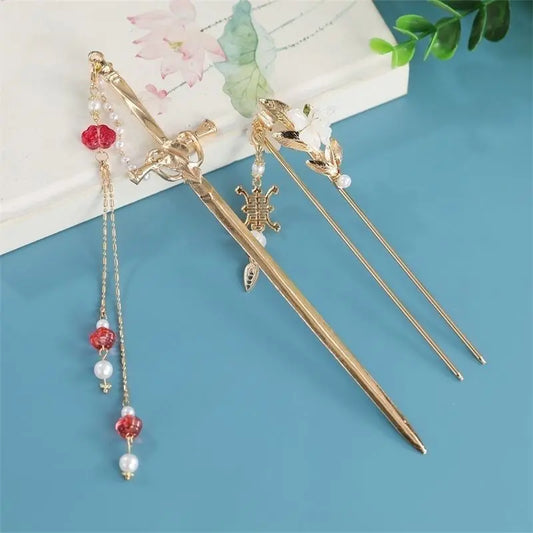
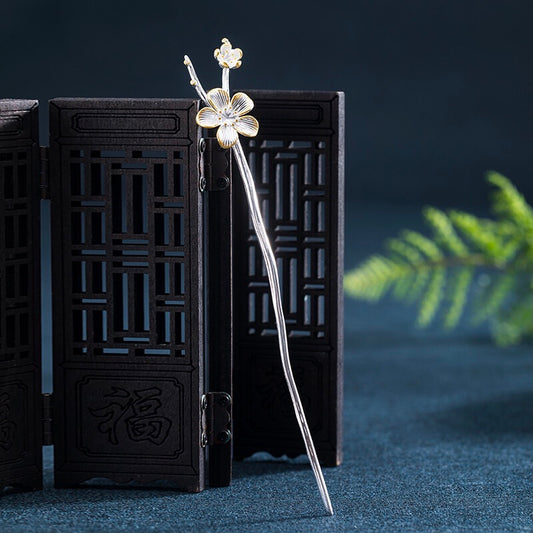
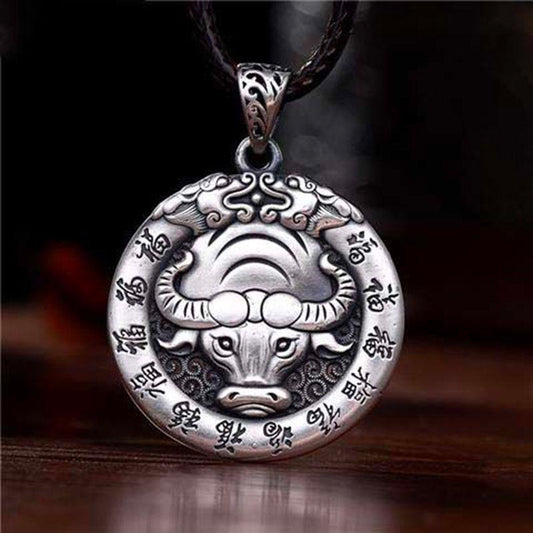
These contemporary pieces show how cloud curls, ruyi contours, tassels, red agate, and balanced repetition can move from architectural ornament into wearable design. The connection is visual and thematic; none is presented as an exact reproduction of a historical 套云拐子纹 object.

Ruyi Cloud + Tassel
A soft cloud contour and suspended tassel translate flowing movement into a hair ornament.
$24.99 USD
View the design
Cloud Scroll + Red Agate
A compact ruyi-cloud curve surrounds a vivid red accent, emphasizing enclosure and contrast.
$36.99 USD
View the design
Ruyi Curve + Double Pearl
Symmetry and paired drops echo the ordered repetition found in continuous ornamental borders.
$56.99 USD
View the designFrequently Asked Questions
Is the cloud-and-guaizi interlocking pattern simply a cloud pattern?
No. Cloud forms are only one component. The design also requires a visible framework of repeated angular guaizi turns and a nesting or linking relationship between the two.
Is 套云拐子纹 the same as the hui pattern?
No. A hui pattern is usually a regular right-angle meander. The cloud-and-guaizi composition adds rounded cloud heads, curled tails, or ruyi-like units to the angular structure.
When did this pattern first appear?
Its component ideas are old, but current evidence does not support naming one early object as the first 套云拐子纹. The composite design is easier to identify in surviving Ming- and Qing-period furniture and architectural decoration.
Does the pattern always symbolize good luck?
No single meaning applies to every object. Cloud forms can carry auspicious associations, while continuous turns may suggest continuity. On many objects, however, the primary role is structural and decorative.
How can I distinguish it from a guaizi-dragon pattern?
Look for animal anatomy. Eyes, horns, jaws, or a recognizable dragon head indicate a guaizi-dragon. Cloud heads and angular turns without those features are closer to the cloud-and-guaizi interlocking type.
Where is the pattern most commonly found?
It is especially suited to furniture rails, aprons, corner spandrels, screens, window lattices, lacquer borders, and architectural openwork because its angular framework follows constructed edges well.
References
- Palace Museum, Beijing. Zitan Armchair with Carved Cloud Motifs and Cane Seat. Collection record. Accessed August 3, 2026.
- Palace Museum, Beijing. Black-Lacquer Bed with Gold-Painted Scroll and Guaizi Patterns. Collection record. Accessed August 3, 2026.
- Palace Museum, Beijing. Zitan Incense Stand Inlaid with Boxwood. Collection record. Accessed August 3, 2026.
- Shanghai Museum. Zitan Armchair with Lotus Carving and Cloud-Head Crest Rail. Collection record. Accessed August 3, 2026.
- Qu Feng. “Dragon-Motif Carving on Ming and Qing Furniture.” Palace Museum Journal, no. 7, 2020.
- National Museum of China. Black-Lacquer Offering Table with Painted Gold, Color Decoration, Drawers, and Carved Dragon Motifs. Collection record. Accessed August 3, 2026.