The Chinese ring pattern is a broad family of designs built from circles, ovals, nested rings, or linked circular units. In museum terminology, however, “ring pattern” is not one universal ancient motif. More precise names include chonghuan wen (重环纹, nested-ring pattern), circle pattern, pearl-roundel pattern, linked-roundel pattern, and huandai wen (环带纹, circular band pattern). Their forms, dates, materials, and meanings should not be merged into a single timeless symbol.
Information Snapshot
What Is a Chinese Ring Pattern?
At its simplest, a ring pattern uses a circular or oval outline as its basic unit. One ring may stand alone; several may be nested, linked, overlapped, repeated in a band, or organized around a center. This broad visual description is useful for modern design, but historical catalogues usually employ narrower terms.
The most important distinction is between a general ring-shaped design and chonghuan wen. According to the Palace Museum, chonghuan decoration appears as one ring set inside another, sometimes reaching three layers. It occurs on ancient jade and bronze objects and can serve either as a main motif or as a supporting border. On bronze vessels it emerged in the late Western Zhou period.

Historical Development
Early circular decoration
Dots, circles, spirals, and concentric forms appear in many early decorative traditions. Their presence does not prove that every circular motif belonged to one continuous system or carried the same meaning. A simple circle may result from tool use, vessel construction, counting, surface division, or visual preference.
Late Western Zhou bronzes
Chonghuan wen became a representative geometric motif during the transformation of Zhou bronze design. Earlier Shang and early Western Zhou bronzes often emphasized powerful animal imagery. From the middle Western Zhou onward, many designs became more abstract, rhythmic, and band-like. Nested rings, tile patterns, curved bands, and reconstructed geometric motifs worked especially well around vessel rims, bodies, lids, and feet.
The Palace Museum’s bronze pan numbered “0070,” for example, has chonghuan decoration on its wall and a huandai band on its foot. Their coexistence on one object proves that the two terms describe different structures, even though both contain the character huan.
Spring and Autumn and Warring States periods
Nested rings continued to appear in combination with tile, curved, dragon, scale, and cloud motifs. On vessels and mirrors they could separate decorative zones, stabilize a lower border, or form an independent band. Variation is normal: rings may be oval, angular on one side, compressed by the vessel surface, or transformed into unusual composite forms.
Tang to Ming-Qing linked roundels
Later decorative arts developed other circular systems. The Palace Museum notes that linked roundel structures appeared in Tang crafts, while repeated pearl or ball patterns became more common in Song decorative arts and continued into the Ming and Qing periods. These designs relate visually to rings, but they should not automatically be called Western Zhou chonghuan wen.
How Nested-Ring Structure Works
The defining idea is layering. A larger ring encloses one or more smaller rings, creating movement inward and outward at the same time. Yet ancient units are not necessarily perfect compass-drawn circles. On jade, a form may be oval on one side and angular on another. On bronze, curvature and casting can stretch or compress the unit.
Ring units may be arranged in several ways:
- Single ring: one enclosed outline, sometimes holding another motif.
- Concentric rings: several circles sharing a center.
- Nested rings: inner and outer rings combined, not always perfectly concentric.
- Repeated band: similar units arranged horizontally around an object.
- Linked roundels: circles visually interlock or touch in a chain.
- Roundel frame: a ring encloses an animal, flower, figure, or character.

Ring Pattern, Chonghuan, Huandai, and Related Motifs
| Term | Basic structure | How to distinguish it |
|---|---|---|
| Ring pattern 环纹 | Any design broadly based on rings | A convenient umbrella description, not one fixed archaeological type |
| Chonghuan wen 重环纹 | Ring inside ring, sometimes two or three layers | Emphasizes nesting and layered enclosure |
| Circle pattern 圆圈纹 | Repeated single circles | Simpler, without necessary internal nesting |
| Pearl-roundel pattern 连珠纹 | Rows of small circular beads | Looks like a string or border of pearls |
| Linked-roundel pattern 连球纹 | Round units joined or interlaced | Common in later crafts and textiles |
| Huandai wen 环带纹 | A broad undulating band running around a vessel | “Huan” describes encircling the object; it is not a row of circular rings |
| Spiral pattern 涡纹 | Center with rotating arms | Rotation, rather than ring-within-ring, defines the motif |
Do not confuse this article with our guide to Huandai Wen. Huandai is an undulating band that circles a bronze vessel; chonghuan is built from nested ring units.
How Ring Structures Appear in Different Materials
Bronze ritual vessels
On late Western Zhou and later bronzes, chonghuan bands can appear below the rim, on the neck, body, lid edge, handle, or foot. Their function changes with position. A band below the rim establishes a boundary; one on the body can become a primary field; one near the foot visually stabilizes the vessel.
Jade
Jade examples depend on cutting, abrasion, and polishing rather than casting. Their nested units can be elongated or angular. Bronze terminology should therefore not be applied mechanically without considering the object and technique.
Mirrors and lacquer
A circular mirror naturally encourages concentric zoning. Nested-ring borders can separate an inner dragon field from outer ornament. Lacquerware, meanwhile, may use painted, incised, or needle-engraved circles among many other geometric borders.
Textiles
Tang and later textiles developed linked or framed roundels that could enclose animals, flowers, or figures. Weaving turns curves into stepped, repeated structures governed by warp and weft. These designs demonstrate the adaptability of circular organization, but their historical category is not necessarily chonghuan.

What Does the Ring Pattern Mean?
A circle readily suggests completeness, enclosure, continuity, or return. Linked rings can suggest connection, while repeated units create order and rhythm. These associations are valuable for modern design, but they should not be presented as one proven ancient meaning.
On Zhou ritual bronzes, the safest interpretation begins with visual and structural function. A ring band organizes the vessel surface, marks divisions, balances other patterns, and contributes to a dignified rhythm. Whether a particular example carried a ritual, lineage, cosmological, or protective meaning requires evidence from the whole object, its inscription, find context, and comparison with related vessels.
Claims that every ring motif automatically means “eternal love,” “wealth,” or “protection” go beyond the evidence. Those may be contemporary brand meanings, but they are not universal archaeological conclusions.
Ring Patterns in Contemporary Design
Designers can adapt ring structures through modular repetition, concentric layers, linked chains, radial rosettes, and circular frames. The strongest adaptations identify what is historical and what is newly invented.


Responsible use means naming the source period when known, avoiding invented magical functions, and not claiming an exact artifact reproduction when the design has been substantially altered.
Cultural Symbols and Craft Inspiration
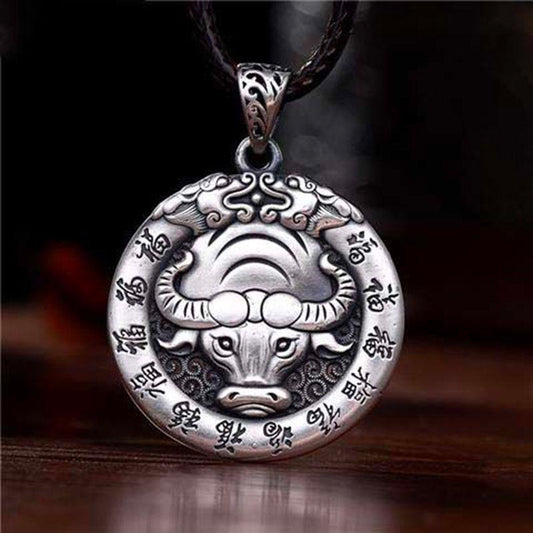
These active store pieces explore roundness, enclosure, and circular framing in contemporary jewelry. They are not ancient ring-pattern artifacts, Western Zhou bronzes, or replicas of chonghuan decoration.
Three Picks from Chinese Showcase
Three contemporary shop selections inspired by this article’s materials, motifs, or wider decorative themes. These products are not historical artifacts. Check each product page for current specifications, price, and availability.

Vintage Chinese Style Rotating Jade Ring – Six-Character Mantra Peace Amulet Spinner Ring | 925 Sterling Silver
View product details
Vintage Bamboo Segment Adjustable Ring – Minimalist Polished Silver Band
View product details
lotus seed tassel lotus ring-925 sterling silver
View product detailsFrequently Asked Questions
What is a Chinese ring pattern?
It is a broad description for decoration based on circles, ovals, nested rings, or linked round units. Historical objects usually require a more specific name.
What is chonghuan wen?
Chonghuan wen is a nested-ring motif in which one ring is set inside another, sometimes in as many as three layers.
When did chonghuan decoration appear on bronze vessels?
The Palace Museum identifies it as appearing in the late Western Zhou period.
Are ring pattern and huandai wen the same?
No. Huandai wen is an undulating band that circles a vessel; a ring pattern is based on circular units.
Does every ring motif mean eternity?
No. Eternity and continuity are common modern interpretations of circular form, not proven meanings for every ancient example.
Where is chonghuan decoration found?
It is known on ancient bronzes and jade, and related circular organizations appear on mirrors, lacquer, textiles, ceramics, and later crafts.
Is every concentric circle a chonghuan motif?
No. The catalogue term depends on structure, period, object type, and scholarly classification.
How can I identify an authentic ancient example?
Pattern alone is insufficient. Examine material, form, manufacture, inscription, provenance, excavation record, and authoritative catalogue information.
Can modern designers use ring structures?
Yes, but they should distinguish documented historical patterns from creative contemporary recompositions.
Why were ring bands useful on bronze vessels?
They could divide decorative zones, follow the vessel’s circumference, balance other motifs, and create a measured visual rhythm.