The Chinese chrysanthemum pattern, often called juhua wen, combines the beauty of an autumn flower with ideas of integrity, quiet refinement and wishes for a long life. Slender petals can create a light, flowing design, while densely layered blossoms offer a fuller decorative rhythm. From a flowering sprig on porcelain to a textile roundel or sculptural hair ornament, the chrysanthemum moves between natural form and artistic reinvention.

Chrysanthemum Pattern at a Glance
| Name | Juhua wen; Chinese chrysanthemum pattern or chrysanthemum motif |
|---|---|
| Main elements | Flower heads, layered or curling petals, buds, stems and leaves |
| Frequent associations | Autumn, integrity, a cultivated life, longevity and well-being |
| Common arrangements | Single blooms, flowering sprigs, floral scrolls, roundels, petal bands and repeating patterns |
| Decorative settings | Ceramics, woven textiles, embroidery, painting and contemporary accessories |
| Identification caution | A radial or many-petaled flower is not automatically a chrysanthemum; foliage and reliable records also matter |
What Is the Chinese Chrysanthemum Pattern?
The term describes decorative designs based on chrysanthemum flowers, buds, stems and leaves. These elements may be selected, rearranged or transformed to suit a particular surface.
It is not one unchanging emblem. Some designs preserve the irregular movement of a flowering branch, balancing open blossoms with buds. Others organize petals into a radial structure or connect flowers through a repeating framework of curling stems.
Three relationships are especially useful to notice. The flower head establishes a focal point, the petals create changes in density and direction, and the stems and leaves connect the composition.
These relationships allow the same floral subject to appear delicate and spacious in one work, yet full and richly ornamented in another.
History: From Chrysanthemum Appreciation to Everyday Objects
The motif developed within a broader culture of growing, admiring, painting and writing about chrysanthemums. The flower's appearance in an early text, however, does not establish the origin date of a particular decorative pattern.
Tao Yuanming's poetry gave the chrysanthemum a lasting connection with rural retreat and contentment away from public ambition. His image of gathering chrysanthemums beside an eastern fence helped make the flower more than a garden subject: it became a way to express a chosen manner of living.
The Palace Museum's exhibition on chrysanthemum-themed works explains the flower's close connections with autumn, the Double Ninth Festival and longevity wishes. Its selection spans painting, textiles and objects, showing the breadth of the subject across artistic media.
Surviving objects provide firmer evidence for the development of individual forms. The Palace Museum's Northern Song Ding-ware bowl with carved chrysanthemum petals has thirty petals inside its conical body. The museum notes that their varying widths evoke natural forms instead of pursuing absolute uniformity.
A different approach appears in the National Museum of China's Hongwu-period underglaze-red bottle with a scrolling chrysanthemum design. Here, connected stems carry flowers around a curved vessel rather than reducing the subject to a band of petals.
These examples show why the history is not a simple sequence of one pattern replacing another. Petals, sprigs and complete flower heads offer different starting points, and several approaches can coexist.
What Does the Chrysanthemum Pattern Mean?
Integrity and Steadfastness
The chrysanthemum's cultural image is often associated with autumn flowering and a poetic ability to face the frost. This becomes a metaphor for maintaining one's character as circumstances change.
In a design, the idea may be suggested by an upright stem or a blossom that remains composed amid a lively arrangement of leaves. The impression can be quiet rather than dramatic.
Such symbolism is a literary and artistic interpretation. It does not mean that all chrysanthemum varieties have identical flowering seasons or tolerance of cold.
Retreat, Refinement and a Self-Directed Life
The association with Tao Yuanming makes the flower an important reference in Chinese literati aesthetics. Retreat need not be read only as a literal departure into the mountains. It can also suggest finding a personal rhythm, appreciating nature and valuing something beyond outward reputation.
A single sprig against an open background can express that atmosphere with very little ornament. Its appeal lies in the balance of the parts rather than an accumulation of detail.
Yet refinement does not require a pale or sparse design. A dense embroidered chrysanthemum can interpret the same subject through color, texture and carefully controlled abundance.
Longevity and Well-Being
The chrysanthemum also belongs to the traditional language of birthday and longevity wishes. Palace Museum research on Qing court clothing describes chrysanthemum decoration combined with round longevity characters, making the intended blessing more explicit.
In such work, natural forms and written wishes reinforce each other. Flowers bring movement and variation, while the characters provide a stable visual structure.
Longevity is a cultural wish expressed through the motif, not a claim that owning, wearing or using a chrysanthemum-decorated object produces health benefits.
Autumn and the Beauty of Maturity
The flower also brings a strong seasonal atmosphere. Instead of suggesting only the freshness of spring, it can evoke autumn light, fullness and a more reflective mood.
Warm yellow, ochre and red can emphasize that feeling, but color is not the only means. An ink outline, a blue-painted branch or a restrained carved surface can also convey a sense of autumn.
Common Forms of the Chrysanthemum Pattern
The following categories are practical ways to look at designs, not a fixed classification used uniformly across all historical periods.
| Form | Arrangement | Visual effect |
|---|---|---|
| Single blossom | One flower head with little or no supporting foliage | Attention to the center and petal structure |
| Flowering sprig | A selected stem with flowers, buds and leaves | Natural movement and flexible use of open space |
| Scrolling chrysanthemum | Flowers joined by continuously turning stems | A connected rhythm suited to a curved or extended surface |
| Chrysanthemum roundel | A circular or nearly circular decorative unit | A balanced focal point or repeatable ornament |
| Petal pattern | Selected petal forms arranged in a sequence | A radial rhythm, boundary or structured band |
| All-over pattern or border | Floral units repeated across a field or along an edge | A rich background or a clearly defined decorative margin |

Why Does a Scrolling Chrysanthemum Resemble a Vine?
A floral scroll is a method of organizing ornament, not a requirement to reproduce a plant's growth exactly. A designer can connect flowers and leaves with continuous curves so the pattern follows a bottle, a length of fabric or a narrow border.
The important question is how the stems carry the eye through the design. Repetition can establish a rhythm while changes in flower direction prevent the result from becoming mechanical.

How Other Motifs Change the Meaning
Chrysanthemum, Plum Blossom, Orchid and Bamboo: The Four Gentlemen
The chrysanthemum is one of the Four Gentlemen, alongside plum blossom, orchid and bamboo. Together, these subjects provide different plant forms and cultural associations through which cultivated character can be explored.
They may appear in separate paintings, panels or groups of ornament, or share a single object. The grouping does not require identical scale or perfectly symmetrical placement.
The chrysanthemum contributes an autumn association, but the full meaning of a particular work still depends on its arrangement, inscriptions and context.
Chrysanthemums and Longevity Characters
When chrysanthemums accompany the shou character for longevity, the wish becomes easier to recognize. Curving flowers can alternate with round character medallions, creating both a decorative rhythm and a readable blessing.
A chrysanthemum by itself, however, is not proof that an object was made specifically as a birthday gift.
Chrysanthemums and Quails: A Wish for a Peaceful Home
Traditional auspicious combinations can also work through sound associations. The National Palace Museum in Taipei interprets its famille-rose covered jar with autumn chrysanthemums and quails as expressing anju, a wish for peaceful or settled living.
This documented example shows why the relationship between subjects matters. The meaning arises from the combined image rather than from the flower alone.
Chrysanthemums with Rocks, Birds or Butterflies
A rock can provide a solid counterpoint to a flexible branch, while birds and butterflies introduce direction and movement. These are useful compositional relationships even before a symbolic reading is proposed.
Not every combination corresponds to one fixed auspicious title. Where an inscription or reliable collection description is absent, it is better to describe what is visible than to assign an elaborate blessing without evidence.
The Chrysanthemum in Traditional Crafts
Ceramics: Carved Petals and Painted Branches
On ceramics, the subject can be carved into the surface or expressed through painted decoration. Incised and carved work emphasize line and depth; painted color can separate petals, leaves and buds.
The vessel's shape also matters. A central flower may anchor a dish, while a continuous stem can guide the eye around a rounded body. Borders near the mouth and foot help divide the decorative zones.

Look beyond the flower head. The distance between blossoms, the angle of a stem and the contrast between painted areas and bare glaze all help determine the design's effect.

Repeated radial flowers offer another approach. Instead of one freely growing branch, a plate can distribute flower heads through concentric zones, using smaller curling elements to connect and fill the spaces.

Textiles and Embroidery: Petals Built with Thread
Textiles can carry anything from a single flowering sprig to a dense field of blossoms. Changes in stitch direction, color and density provide different ways to distinguish petals from leaves.
A Guangxu-period chrysanthemum-decorated satin garment in the Palace Museum uses several embroidery techniques and color shading to describe curled petals and leaf details. It is a documented reminder that the motif can be naturalistic as well as geometric.

Vessel Form: When the Object Becomes Flower-Like
Sometimes the flower influences more than surface decoration. A radial petal structure can inform a vessel's outline or relief, giving the whole object a flower-like rhythm.
Three descriptions should therefore be kept distinct. A chrysanthemum motif identifies the decorative subject; a chrysanthemum-petal pattern emphasizes selected petal elements; a chrysanthemum-shaped object may involve the overall form. They can overlap, but they are not interchangeable.
Jewelry and Accessories
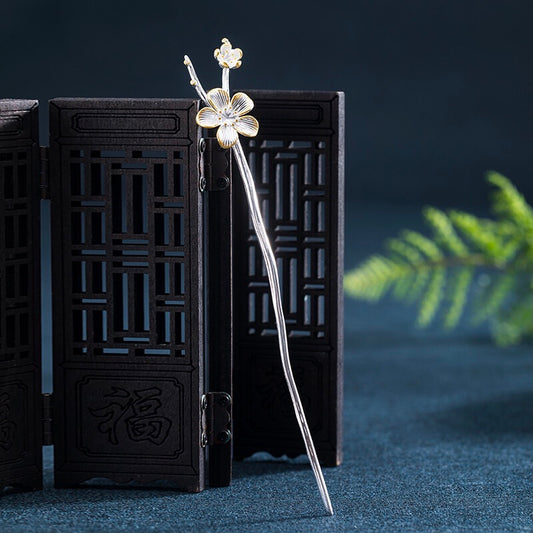
Brooches, pendants and hair ornaments can translate the flower into a small sculptural form. Long petals establish a recognizable outline, while overlapping layers create volume.
Even a simplified design can retain an expressive floral rhythm. Its materials, construction and intended use should nevertheless be checked against the individual product, not inferred from the motif's cultural meaning.
How to Recognize a Chrysanthemum Motif
Consider the flower head, foliage and overall arrangement together. Many chrysanthemum-inspired designs emphasize numerous narrow, curling or radiating petals, but no single feature is conclusive.
- Many petals do not prove the flower is a chrysanthemum. Peonies, lotuses and composite decorative flowers can also be richly layered.
- A radial ornament may not represent one specific plant. Some roundels emphasize decorative order rather than botanical detail.
- Petal count is not a universal symbolic code. It cannot independently establish a blessing, an owner's status or an object's purpose.
- Recognizing the motif does not date the object. Form, materials, technique, marks and documented history must also be considered.
When a design is highly simplified, “chrysanthemum-inspired flower” or “radial floral pattern” may be a more accurate description than a confident botanical identification.
The Chrysanthemum in Contemporary Design
Modern interpretations need not be yellow or elaborate. A single-color outline highlights direction, blue and white bring attention to line and empty space, metal can emphasize sculptural layers, and soft fibers lend themselves to fuller petals.
What is worth carrying forward is not only one flower shape, but the way a design manages relationships: blossom and leaf, density and openness, small details and the overall silhouette.
Handled thoughtfully, these relationships allow a familiar subject to retain its cultural resonance while finding a natural place in contemporary life.
Three Chrysanthemum-Inspired Picks from Chinese Showcase
Explore the flower as a contemporary hair accessory. Each selection interprets the chrysanthemum theme in a different way; its product page provides current specifications, price and availability.

Chrysanthemum & Shell-Flower Hairpin
A small radial flower and blue decorative accents add a colorful focal point to a classic bun.
View product details
Blue Chrysanthemum Hairpin
Soft blue petals and dangling details translate the chrysanthemum into a sculptural hair ornament.
View product details
Chrysanthemum & Persimmon Hair Stick
A dark wooden shaft pairs a floral accent with orange persimmon-shaped hanging charms.
View product detailsFrequently Asked Questions
Does the chrysanthemum pattern symbolize only longevity?
No. Longevity is important, but autumn, refinement, integrity and a life of quiet contentment are also relevant associations. Read the complete composition.
How does a chrysanthemum motif differ from a peony motif?
Many chrysanthemum designs emphasize narrow, radiating or curling petals, while peony designs often feature broader overlapping petals. Highly stylized flowers require supporting foliage and reliable records for a firmer identification.
Must a chrysanthemum pattern be yellow?
No. Carved monochrome surfaces, blue-and-white painting and multicolored embroidery can all express the subject. Color is not the only basis for recognition.
Are traditional chrysanthemum designs always realistic?
No. Makers can adjust proportions, connect stems and organize flowers into symmetrical or repeating units. Decorative rhythm may matter more than botanical precision.
Can a chrysanthemum pattern establish a ceramic object's date?
Not by itself. Dating requires evidence from the whole object and its recorded history, rather than the floral subject alone.
An Autumn Flower with Many Ways to Speak
The chrysanthemum brings together qualities that need not exclude one another: seasonal calm and the fullness of a bloom, personal integrity and wishes for a long, settled life.
From a carved petal to an embroidered sprig or a scroll around a vessel, its forms have been repeatedly reorganized and reinterpreted. Looking closely reveals more than the image of a flower: it reveals different ways of giving character, rhythm and meaning to everyday objects.
References
- The Palace Museum: chrysanthemum-themed exhibition materials, including autumn, Double Ninth Festival and longevity associations.
- The Palace Museum: collection record for a Northern Song Ding-ware bowl with carved chrysanthemum petals.
- The National Museum of China: collection record for a Hongwu-period underglaze-red bottle with scrolling chrysanthemums.
- The Palace Museum: research on Qing court garments combining chrysanthemum decoration with longevity characters, and a collection record for chrysanthemum embroidery on a Guangxu-period satin garment.
- The National Palace Museum, Taipei: collection record for a famille-rose covered jar decorated with autumn chrysanthemums and quails.