The Chinese Showcase journal Chinesische Symbole
What Does the Big Dipper Symbolize in Chinese Culture?
Discover what Běidǒu, the Seven Stars of the Northern Dipper, symbolizes in Chinese culture, from finding north and marking the seasons to Daoist ritual and wishes for long life.
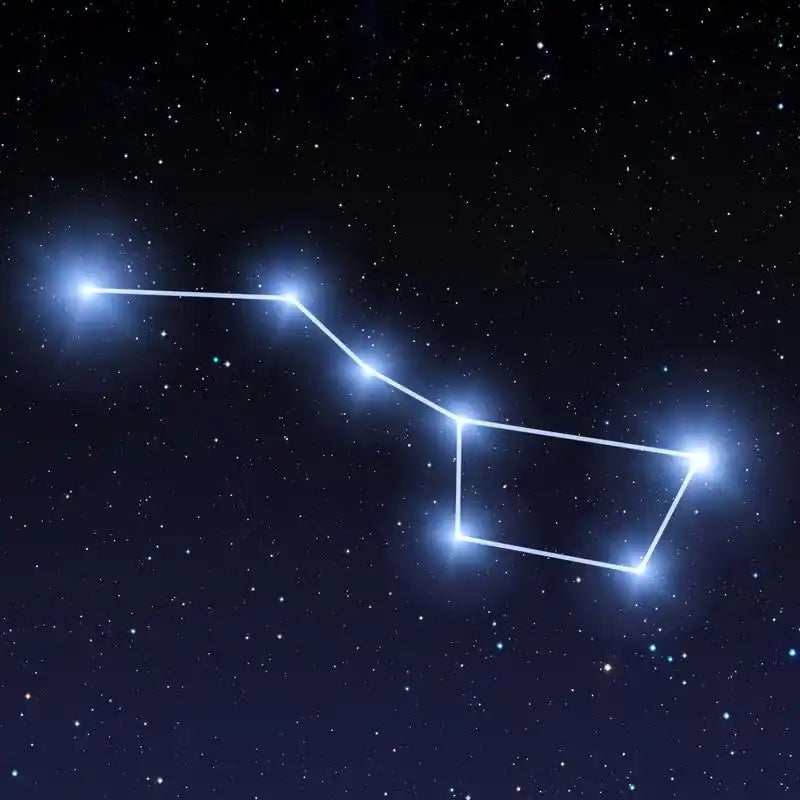
Běidǒu, the Seven Stars of the Northern Dipper, symbolizes direction, seasonal change, and celestial order in Chinese culture. This star pattern is commonly called the Big Dipper in English. In Daoist and folk traditions it also expresses wishes for safety, relief from hardship, and long life. [1] [2] [3] [4] [6]
Four stars outline a bowl and three curve away from it like a handle. Look past the outer edge of the bowl and it points the way toward Polaris. Return at a similar hour in another season and the same familiar pattern can be tilted in a different direction. Both observations help explain what this group of stars came to mean.
What Are the Seven Stars of the Northern Dipper?
Běidǒu means Northern Dipper. Its seven stars form a recognizable pattern in the larger constellation Ursa Major. In Chinese star lore, the four stars of the bowl are called the dǒukuí, and the three stars of the handle are called the dǒubiāo. [1] [2] [11]
| Chinese name | English name | Position |
|---|---|---|
| Tiānshū | Dubhe | Bowl · outer pointer |
| Tiānxuán | Merak | Bowl · outer pointer |
| Tiānjī | Phecda | Bowl |
| Tiānquán | Megrez | Bowl · joins the handle |
| Yùhéng | Alioth | Handle |
| Kāiyáng | Mizar | Handle |
| Yáoguāng | Alkaid | Tip of the handle |
How Does the Big Dipper Point North?
Find the side of the bowl farthest from the handle. Its two stars are Tiānxuán, or Merak, and Tiānshū, or Dubhe. Trace an imaginary line from Merak through Dubhe and extend it roughly five times the distance between them. It leads toward Polaris, the North Star. Polaris lies near the north celestial pole, so its direction is close to true north. [2]

The Dipper gives the eye a pattern to find first. Polaris supplies the steady point of reference. That is why an image of the seven stars can suggest finding one’s way, even when the person looking at it is far from a night sky.
What Did the Dipper’s Handle Tell People About the Seasons?
The Chinese classic Heguanzi, in the chapter often called “Circulation,” relates the handle’s direction to the season. It pairs east with spring, south with summer, west with autumn, and north with winter. The sequence turns the movement of a familiar star pattern into a way to remember the cycle of the year. [3]
To picture the observation, imagine standing in the same place at a similar hour after dusk over several months. The Dipper appears at a different angle as the seasons pass. It also turns over the course of a single night, so the hour matters when comparing what you see. The old passage captures a recurring pattern in the sky and connects it with the seasonal rhythms people also saw in their fields and gardens. [2] [3]
Why Did the Big Dipper Represent Celestial Order?
In the “Treatise on the Celestial Offices,” Sima Qian’s Records of the Grand Historian compares the Dipper to the celestial ruler’s carriage. The text places it at the center and links it with the four directions and the setting of the seasons. The carriage gives the reader a way to imagine the order of the sky through the movement of one recognizable figure. [4]
A Warring States-period lacquered clothes chest from the tomb of Marquis Yi of Zeng offers a visual counterpart. Its lid carries a large character for “Dipper” in the center, with the names of the twenty-eight lunar mansions around it. A dragon and a tiger flank the design. The size and position of the central character tell you where to begin reading the sky on the lid. [5]
Why Is Běidǒu Associated With Safety and Long Life?
Daoist texts give the seven stars personal names and roles. The Scripture of the Northern Dipper for the Extension of Life connects the Star Lords with individual destiny and lifespan. Its prayers express wishes to pass through difficulties safely and to live a long life. [6]
A story in the third volume of In Search of the Supernatural gives the idea a human scale. Guan Lu tells a young man named Yan Chao to bring wine and dried venison to two people playing a board game under a mulberry tree. The players turn out to be the Northern and Southern Dippers. They consult the record of his lifespan, and the young man is granted more years. The story puts hopes about fate into a scene a reader can picture, with a tree, a game, and a record that can be amended. [7]
How Are the Seven Stars of the Northern Dipper Used in Daoism?
Reciting the Northern Dipper Scripture
The scripture honors the stars as the Seven Star Lords. Their titles are Tanlang, Jumen, Lucun, Wenqu, Lianzhen, Wuqu, and Pojun. The astronomical names in the table help identify the stars in the sky. These titles identify the Star Lords in recitation and worship. The text describes recitation on occasions connected with a person’s birth and destiny, with prayers for peace and long life. [6]
Paying Homage in a Dipper Rite
A Dipper rite can be called lidou or baidou. In some Taiwanese temple traditions, a vessel filled with rice is placed on the altar with a lamp and a ritual slip. The slip may bear the names of those for whom prayers are said and depict the northern seven-star Dipper alongside the southern six-star Dipper. The celestial image becomes part of a ceremony in which people pray for their families. [8]
Lighting Northern Dipper Star Lamps
The Daoist canon includes the Rite of the Star Lamps of the Seven Lords of the Northern Dipper. It describes lighting lamps while honoring the Star Lords. Some regional Dipper lamps also give meaning to everyday materials. Grains of rice can stand for the stars, and the flame can represent the spiritual vitality of the person for whom the rite is held. [9]
Pacing the Dipper
In some ceremonies, a Daoist officiant uses a sequence of ritual steps known as bugang tadou, or pacing the Dipper. A patterned mat can mark positions associated with stars on the ritual ground. In this setting, the pattern people see overhead becomes a path the officiant traces on the altar floor. [10]
How Can You Recognize the Northern Dipper in Chinese Art?
A cluster of four marks and a curved line of three can be enough to suggest the Dipper. Dots, engraving, or inlay can all carry the pattern. Religious art sometimes gives the stars human form. A print called Images of the Seven Stars in the National Museum of Taiwan History shows seven figures in two rows under a pavilion. Their number and grouping help the viewer recognize the idea even when the stars themselves have become people. [11]
Frequently Asked Questions About Běidǒu and the Big Dipper
What does Běidǒu mean?
Běidǒu is Mandarin for the Northern Dipper. In Chinese astronomy, it refers to the seven stars that form the Big Dipper in Ursa Major.
What do the Seven Stars of the Northern Dipper symbolize?
In Chinese culture, the seven stars symbolize orientation, the cycle of the seasons, and celestial order. In Daoist and folk traditions they also carry wishes for safety, relief from hardship, and long life.
What are the seven stars of Běidǒu called?
From the bowl toward the end of the handle they are Tiānshū, Tiānxuán, Tiānjī, Tiānquán, Yùhéng, Kāiyáng, and Yáoguāng. Their commonly used English names are Dubhe, Merak, Phecda, Megrez, Alioth, Mizar, and Alkaid. [1] [2]
How does the Big Dipper point to the North Star?
Look at the two outer stars of the bowl, Merak and Dubhe. Follow the line from Merak through Dubhe for roughly five times the distance between them. It leads toward Polaris, which lies close to the north celestial pole. [2]
Big Dipper and Daoist-Inspired Jewelry
The open ring carries a Big Dipper engraving inside the band. The necklace and bracelet feature the Bagua, a separate motif found in Daoist-inspired design.

999 Fine Silver Big Dipper Open Ring
The Big Dipper is engraved inside the 999 fine silver band. One open end bears the red yin-yang and Eight Trigrams detail shown here.
View product details
Rotating Yin-Yang Bagua Necklace
This sterling silver pendant frames a copper-toned yin-yang center with the Eight Trigrams, or Bagua.
View product details
Bagua Leather Bracelet
A circular yin-yang and Eight Trigrams motif sits at the center of this leather bracelet, with turquoise and red agate accents.
View product detailsRelated Reading
References
- Beijing Planetarium. Educational guide to the Big Dipper and its seven traditional Chinese star names.
- NASA Science. “What Is the North Star and How Do You Find It?” NASA Goddard. “Finding the Pole Star” and Stargazers notes on the names of the Big Dipper’s stars.
- Heguanzi, chapter five, “Circulation.”
- Sima Qian. Records of the Grand Historian, chapter 27, “Treatise on the Celestial Offices.”
- Hubei Provincial Museum. Catalogue description of the lacquered clothes chest with the Twenty-Eight Mansions from the tomb of Marquis Yi of Zeng.
- Scripture of the Northern Dipper for the Extension of Life, in the Daoist Canon. See also the Daoist Culture Centre’s catalogue entry.
- Gan Bao. In Search of the Supernatural, volume three, the story of Guan Lu and Yan Chao.
- Dictionary of Taiwanese Folk Objects, entry on the Dipper vessel and the Dipper rite.
- Rite of the Star Lamps of the Seven Lords of the Northern Dipper, in the Daoist Canon. Taiwan Cultural Memory Bank, catalogue entry on the Dipper lamp.
- Daoist Culture Centre. Entries on ritual pacing and the ritual mat used in Dipper pacing.
- National Museum of Taiwan History, Images of the Seven Stars, catalogue entry via the Taiwan Cultural Memory Bank.
Stories, symbols and everyday objects
Our journal explores Chinese culture and design. Traditions and interpretations vary by region and source. For a purchase, use the specifications on the individual product page.
About Chinese ShowcaseQuestions or corrections? Contact us ↗