The Chinese Showcase journal Chinesische Symbole
What Does the Heart Sutra Mean? A Guide to Emptiness and Wisdom
What does the Heart Sutra teach? Explore the five aggregates, the meaning of form is emptiness, the closing mantra, and the text’s place in Buddhist practice and Chinese calligraphy.
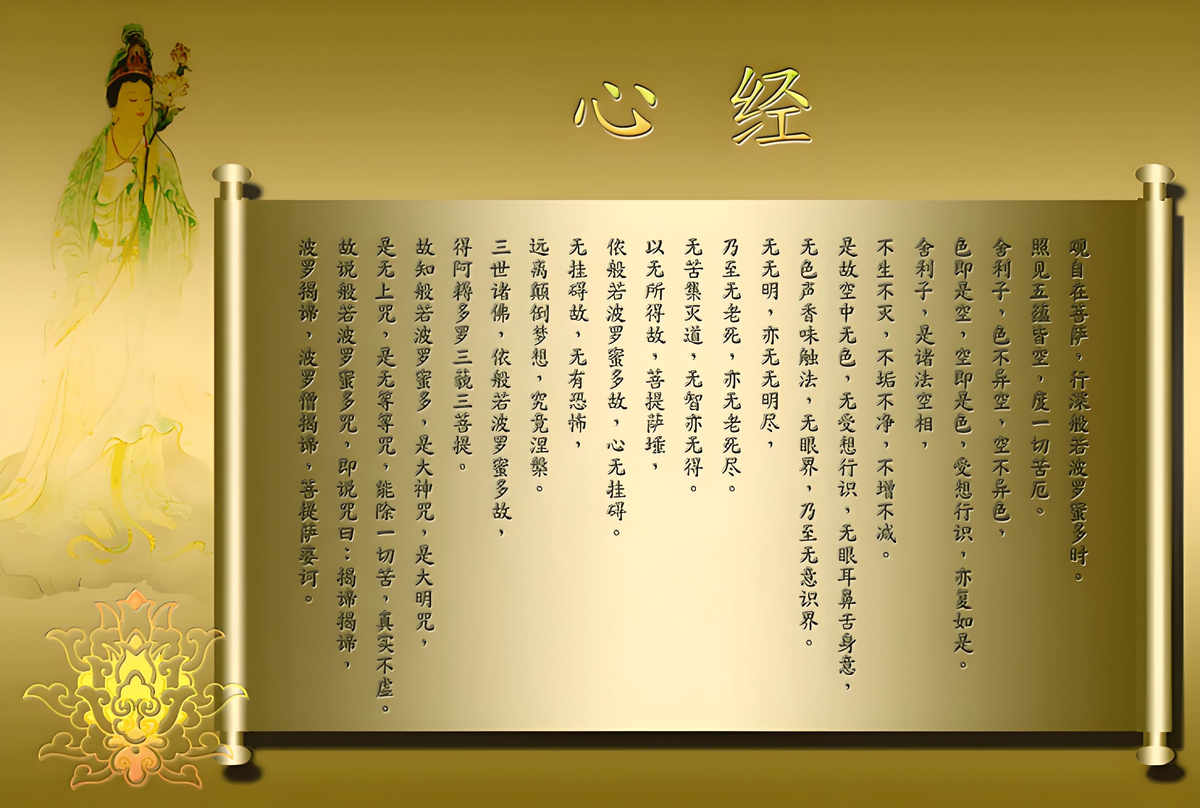
The Heart Sutra teaches that everything we experience, including the body, feelings, and thoughts, arises through conditions and has no fixed, independent nature. In Mahayana Buddhism, seeing this clearly is part of the perfection of wisdom. The sutra connects that insight with loosening our grip on things we cannot hold still, and with freedom from fear. [1] [2]
Think of a cup of tea. The same tea can smell like home to one person and taste too bitter to another. Even your own response can change from one day to the next. The Heart Sutra begins with ordinary experience like this and asks what we find when we look closely at how it comes together.
What Is the Heart Sutra?
The Heart Sutra is a short scripture of the Perfection of Wisdom tradition, known in Sanskrit as Prajñāpāramitā. Its title points to the heart, or essence, of that teaching. The common short Chinese version is traditionally attributed to the Tang-dynasty translator Xuanzang. It opens with Avalokiteshvara, known as Guanyin in Chinese Buddhism, perceiving the emptiness of the five aggregates. Avalokiteshvara then addresses Shariputra, a disciple of the Buddha. In the longer Tibetan version, Shariputra asks how to practice the perfection of wisdom, and Avalokiteshvara answers. [1] [2]
The perfection of wisdom is the capacity to see experience clearly. The sutra starts with the five aggregates, continues through the senses and other Buddhist categories, and ends with a mantra. This movement gives the short text the shape of a practice.
What Does It Mean That the Five Aggregates Are Empty?
The five aggregates, or skandhas, describe the physical and mental processes at work in an experience. Here is how they come together when you drink a cup of tea. [1] [2]
- Form
- The physical side of the experience, including the cup, the tea, and the hand holding it.
- Feeling
- The pleasant, unpleasant, or neutral quality of the experience as it happens.
- Perception
- Recognizing the fragrance as jasmine or identifying the cup as a familiar one.
- Mental formations
- Intentions, habits, and responses, such as deciding to take another sip.
- Consciousness
- The awareness that accompanies seeing, smelling, tasting, and other kinds of contact.
The tea might have grown cold. A cold could dull your sense of smell. The scent might bring back a memory that changes the whole experience. Seeing the aggregates as empty means noticing how each of them depends on conditions. Their interaction accounts for why a moment can feel so vivid and still change so quickly.
What Does “Form Is Emptiness” Mean?
“Form is emptiness” means that material things arise and function through conditions. A porcelain cup takes its shape from clay, glaze, firing, and the potter’s work. It holds water while it is intact. A crack can change what it can do, and someone may use the same cup to hold a flower. Emptiness is the absence of an independent nature in the cup we actually handle. [1] [2]
“Emptiness is form” brings the same insight back to what we can see and touch. The cup itself is where we can observe its dependence on conditions. The sutra applies this insight to the other four aggregates as well. It then extends it to hearing and the other senses, and even to the Buddhist teachings we use to make sense of suffering.
Consider a conversation heard through a door. Hearing depends on the voice, the listener’s ears, the distance, and the position of the door. Move closer, and a faint sound may become a recognizable sentence. The sutra’s repeated negations invite us to look for this dependence even in experiences that seem immediate and self-evident.
What Does the Heart Sutra Teach About Nonattainment?
The sutra connects nonattainment with an unobstructed mind. Applying insight also means noticing the urge to own the fruits of practice. A peaceful sitting can turn into a source of frustration if we spend the next sitting trying to reproduce it. The same habit appears when a single mistake becomes the standard by which we judge ourselves. [1] [2]
Seeing a feeling as conditioned lets us ask what gave rise to it. A remark may have been sharp, and tiredness or an old memory may have made it sting more. Those details help explain why the feeling takes the form it does. They also give us more room to decide how to respond.
What Does the Heart Sutra Mantra Mean?
The closing mantra is commonly written in Sanskrit transliteration as gate gate pāragate pārasaṃgate bodhi svāhā. The repeated sounds evoke going beyond and reaching the farther shore. Bodhi means awakening. The exact English phrasing varies because the Sanskrit formula is transmitted and recited as a mantra. Xuanzang’s Chinese version likewise represents the sounds of the mantra in Chinese characters. [1] [2]

The Heart Sutra in Chanting and Chinese Calligraphy
People read, chant, study, and copy the Heart Sutra. The short Chinese version can be recited from memory, while a written copy preserves the shape and pacing of the words on the page. In Chinese calligraphy, the size of the characters, the handling of the brush, and the intervals between lines can change how the reader moves through the text. [1] [2]
A Ming-dynasty handscroll in the National Palace Museum in Taipei pairs Wen Zhengming’s calligraphy of the Heart Sutra with a painting by Qiu Ying. As the viewer unrolls the work, scripture and painting become part of one viewing experience. The handscroll shows how a text recited in Buddhist practice also became a subject for Chinese painters, calligraphers, and collectors. [3]
Frequently Asked Questions About the Heart Sutra
What is the Heart Sutra in simple terms?
The Heart Sutra is a short Mahayana Buddhist scripture about the perfection of wisdom. Its main teaching is that the things we experience, including the parts of our own body and mind, depend on conditions and lack an independent, fixed nature.
Why is the Heart Sutra important?
It gives a compact account of Buddhist emptiness and links that teaching to freedom from clinging and fear. Its brevity also makes it well suited to chanting, memorization, commentary, and copying by hand.
What does “sutra” mean in Buddhism?
A sutra is a Buddhist scripture or discourse that preserves a teaching. The Heart Sutra presents the bodhisattva Avalokiteshvara’s teaching on the perfection of wisdom.
What is the difference between the Heart Sutra and the Diamond Sutra?
Both are Mahayana scriptures of the Perfection of Wisdom tradition. The Heart Sutra gives a compact teaching on the emptiness of the five aggregates and ends with a mantra. The longer Diamond Sutra presents a dialogue between the Buddha and Subhuti about the bodhisattva path and letting go of fixed views. [1] [4]
What does the Heart Sutra mantra mean?
The usual Sanskrit formula begins with the repeated word gate, often read as “gone.” It evokes crossing to the farther shore and awakening. Buddhist communities chant the sounds in forms handed down within their traditions. [2]
How do Buddhists practice the Heart Sutra?
Practices include chanting it aloud, studying it with a commentary, and copying the text. A simple way to begin is to read a short passage and then notice how the conditions behind an ordinary sensation or feeling change over time.
Why do people chant the Heart Sutra?
In Buddhist practice, people chant it as a way to remember the teaching of emptiness and return their attention to it. Chanting can be performed alone or as part of a group service, with pronunciation and melodies that vary by tradition. [2]
Heart Sutra Jewelry
These pieces carry Heart Sutra inscriptions in different forms, from an adjustable lotus ring to an enamel bangle with the text engraved on the inside.

Fine Silver Heart Sutra Lotus Ring
A lotus motif and Heart Sutra engraving meet on this adjustable 999 fine silver band.
View product details
Enamel Phoenix Feather Heart Sutra Bangle
Colored enamel brings out the phoenix feathers on the outside. The Heart Sutra is engraved on the inner band.
View product details
Lotus Buddha Heart Sutra Necklace
The 999 fine silver pendant pairs a lotus design with the Heart Sutra and has a rotating center.
View product detailsRelated Reading
References
- The Heart Sutra, short Chinese version attributed to Xuanzang, Taishō Tripiṭaka, no. 251, vol. 8, p. 848c. Electronic edition hosted by National Taiwan University.
- 84000: Translating the Words of the Buddha. The Heart of the Perfection of Wisdom, the Blessed Mother, Toh 531. Tibetan long version in English translation.
- National Palace Museum, Taipei. Ming-dynasty handscroll with Qiu Ying’s Exchanging Tea and Wen Zhengming’s calligraphy of the Heart Sutra.
- British Library, International Dunhuang Programme. Diamond Sutra (Or.8210/P.2), with text and English translation.
Stories, symbols and everyday objects
Our journal explores Chinese culture and design. Traditions and interpretations vary by region and source. For a purchase, use the specifications on the individual product page.
About Chinese ShowcaseQuestions or corrections? Contact us ↗