The Wa people are one of the ethnic groups native to the highlands of southwestern Yunnan, China. Their culture is often introduced through striking images of wooden drums, black-and-red clothing and energetic dance. These are meaningful traditions, but they are only part of a much larger story shaped by language, oral literature, farming, regional exchange and modern life.
This guide explores who the Wa people are, where they live, what the Sigangli tradition means, why the wooden drum matters, and how clothing, festivals, food and architecture vary across Wa communities.
Who Are the Wa People?
In China, the Wa are one of the country’s officially recognized ethnic groups. Their principal communities are in southwestern Yunnan, especially in Cangyuan and Ximeng Wa autonomous counties, as well as Menglian, Gengma, Lancang, Shuangjiang, Zhenkang and Yongde.
Much of this region lies between the Lancang River and the Nu River. Parts of the mountainous area are commonly known as the Awa Mountains. Wa-related communities also live across the border in Myanmar, making the Wa a cross-border people. Shared linguistic and cultural connections do not erase differences in citizenship, local history or contemporary experience.
Regional names have also varied. Communities have historically used self-designations including Wa, Barao, Burao and Awa. An older Chinese exonym sometimes found in historical records is now considered derogatory and should not be used as an ordinary name.
Wa Culture at a Glance
- Main region in China: Southwestern Yunnan
- Language: Wa, usually classified within the Austroasiatic language family
- Important oral tradition: Sigangli
- Well-known cultural symbol: The wooden drum
- Major seasonal celebration: The New Rice Festival
- Traditional arts: Oral literature, music, dance and patterned weaving
Sigangli: Stories About the Beginning of the World
Sigangli is one of the best-known bodies of Wa oral literature. Its stories address the formation of the world, the origin of humans and animals, village histories, work, relationships and customary life. For this reason, it is sometimes described as an encyclopedia of traditional Wa culture.
There is no single universal version. In some Cangyuan traditions, “Sigang” is associated with a gourd, and people are said to have emerged from it. In versions from Ximeng, the word is interpreted as a stone cave or cavern from which humanity entered the world.
These accounts should be understood as oral heritage and collective memory rather than literal substitutes for archaeological or documentary history. Their regional differences show how stories change as they are told by different communities and generations.
The Ximeng Wa Sigangli tradition is included in China’s national representative list of intangible cultural heritage. The documented version described by the national heritage project contains thousands of lines, while living oral versions continue to vary.
The Wa Language and Writing System

Wa is generally classified in the Mon-Khmer branch of the Austroasiatic language family and is related to languages including Blang and De’ang. It includes regional varieties commonly grouped as Wa, Barao and Awa, with further local differences in pronunciation and vocabulary.
For centuries, knowledge was preserved through speech, song, storytelling, material signs and forms of wood notation. A Latin-based Wa writing system was developed and promoted after the founding of the People’s Republic of China. Today, patterns of language use differ by place: Wa, written Wa, Standard Chinese and Chinese characters may all be used in education, work, media and family life.
Why Is the Wooden Drum Important?
The wooden drum is among the most recognizable Wa cultural symbols, but it is more than a musical instrument. Traditionally carved from a large section of timber, it has been connected in some communities with ritual life, collective gatherings, communication and village memory.
Cangyuan Wa wooden-drum dance traditionally incorporates several stages, including pulling the drum, bringing it into the wooden-drum house, beating it and conducting ceremonies associated with it. Dancers may bend their knees, bow, swing their arms, step and stamp in time with drumming and song.
In 2006, Cangyuan Wa wooden-drum dance was included in the first national list of representative intangible cultural heritage projects. Today it appears in community events as well as choreographed stage and tourism performances. A modern performance should not automatically be treated as an unchanged reconstruction of an older ritual.
Is Hair-Swinging Dance the Only Wa Dance?
No. Hair-swinging dance has become a highly visible stage image, often featuring women moving their long hair to a strong drum rhythm. Its visual power has made it popular at festivals and in tourism promotion.
Wa dance traditions are much broader. They include wooden-drum dances, circle dances, house-building dances, grain-pounding dances, elephant-foot-drum dances and bamboo dances. Not every Wa woman performs hair-swinging dance, and long hair or stage clothing should never be used as a test of ethnic identity.
Traditional Wa Clothing Varies by Region

There is no single costume worn by every Wa community. In parts of Ximeng, traditional women’s clothing may include a dark short jacket, tubular skirt, silver or bamboo headband, necklaces, beads, bracelets and large earrings. Some Cangyuan garments feature narrow-sleeved jackets, long skirts, rows of metal ornaments and woven patterning.
Traditional men’s clothing in some areas includes a short jacket, loose short trousers and a black or red head wrap. In Zhenkang and Yongde, long-term cultural exchange has produced clothing traditions with much in common with neighboring communities.
Most Wa people today wear modern everyday clothing. Elaborate matching outfits are more likely to appear at festivals, weddings, cultural events and performances. Images that present one costume as “the Wa costume” therefore need to be read with care.
Weaving, Color and Geometric Patterns

Wa textiles often use repeated bands, diamonds, stepped shapes and contrasting colors. Black, red and white are especially visible in many ceremonial garments, while contemporary textiles may use a much wider palette.
Patterns and color combinations can indicate local style, the maker’s choices and the purpose of a garment. They should not be treated as a fixed code shared identically by every Wa community. Weaving is both a practical craft and a changing design tradition, now appearing in clothing, bags, accessories and contemporary cultural products.
The New Rice Festival and the Agricultural Calendar
The New Rice Festival celebrates the ripening of grain and the first taste of a new harvest. Traditional activities may include selecting an auspicious date, gathering rice ears, preparing new rice, making rice liquor, sharing a meal and performing songs and dances.
The timing and details vary according to locality, village practice and the ripening of the crop. Other traditional observances include festivals associated with new fire and sowing. Wa communities also celebrate widely shared holidays such as Lunar New Year, the Dragon Boat Festival and the Mid-Autumn Festival.
It is useful to distinguish inherited seasonal customs from modern cultural festivals. The Ximeng Wooden Drum Festival was created in 2003, and Cangyuan’s Sigangli Carnival followed in 2004. These contemporary events promote cultural transmission and tourism, but their present-day format should not be described as unchanged since ancient times.
What Does Wa Food Taste Like?

Rice, red rice, maize, beans, vegetables, bamboo shoots and chilies are common ingredients in many Wa areas. Some communities are known for rice liquor, soft rice dishes or chicken porridge, along with tea, preserved foods and locally gathered greens.
Food changes with altitude, available crops, family preference and modern lifestyles. A dish served in a tourism restaurant may draw on Wa flavors without representing what every Wa family eats at home. During the New Rice Festival, rice and rice liquor carry particular meaning because they connect the harvest with household labor and communal sharing.
Traditional Villages and Houses
Traditional Wa settlements often follow the contours of hillsides rather than a rigid street plan. In parts of Cangyuan, Ximeng, Menglian and Lancang, older homes were commonly built with bamboo and timber. Some used a raised-floor structure, with living space above and room below for tools, storage or livestock.
Other areas, including Zhenkang and Yongde, also developed earth, brick and tile houses. There has never been only one Wa architectural form. Today, modern homes, roads and public services are widespread, while certain preserved or reconstructed villages combine residence, heritage education and tourism.
The Ban Hong Resistance in Modern Wa History
In the 1930s, British forces entered the Ban Hong and Ban Lao area amid disputes connected with mineral interests. Wa leaders and members of neighboring communities organized resistance to defend their land. The conflict became known as the Ban Hong Incident or Ban Hong Resistance.
In 1936, seventeen local Wa leaders jointly issued an appeal to their compatriots in China. The episode remains an important part of modern Wa history because it expresses attachment to land, community and national belonging.
Wa Culture Today
Contemporary Wa life cannot be reduced to old photographs or festival stages. Wa people live in villages, county towns and cities and work in agriculture, education, commerce, tourism, the arts, digital media and many other fields.
Traditional songs now meet contemporary music. Weaving motifs appear in new designs. Oral literature is recorded in print, audio and video. Wooden-drum dance is taught, adapted and performed in new settings. Cultural continuity does not mean freezing a community in the past; it means allowing people to interpret and carry their heritage forward on their own terms.
Frequently Asked Questions
Where do the Wa people live?
In China, the largest Wa communities are in southwestern Yunnan, particularly Cangyuan and Ximeng, with significant populations in Menglian, Gengma, Lancang, Shuangjiang, Zhenkang and Yongde. Wa-related communities also live in Myanmar.
Is the Awa Mountain a single mountain?
Usually not. “Awa Mountains” is a regional name for parts of the mountainous Wa-inhabited area of southwestern Yunnan rather than the name of one individual peak.
Is Sigangli a historical record?
Sigangli is oral literature that preserves cultural memory and traditional knowledge. It is historically valuable, but its origin narratives should not be treated as literal archaeological evidence.
Is the wooden drum only a musical instrument?
No. In certain traditional settings it has also been connected with ceremony, communication, collective gathering and village identity. Meanings and practices differ by region.
Do all Wa women perform hair-swinging dance?
No. It is one prominent dance and stage form, not a universal activity or a complete representation of Wa culture.
Does all Wa clothing use black and red?
No. Those colors are prominent in some regional and ceremonial styles, but garments, patterns and accessories vary. Modern everyday clothing is also widely worn.
Is the Wooden Drum Festival an ancient festival?
The wooden-drum tradition is older, but the organized Ximeng Wooden Drum Festival was created in 2003. Its current festival format is a contemporary cultural development.
Sources and Further Reading
- National Ethnic Affairs Commission of China: Overview of the Wa Ethnic Group
- National Ethnic Affairs Commission of China: Historical Development of the Wa
- National Ethnic Affairs Commission of China: Wa Customs and Cultural Traditions
- China Intangible Cultural Heritage: Sigangli
- China Intangible Cultural Heritage: Cangyuan Wa Wooden-Drum Dance
To understand the Wa people, it is necessary to look beyond a few vivid symbols. The regional differences within Wa language, dress, storytelling and everyday life reveal a culture that is not static, but living, adaptive and diverse.
Three Picks from Chinese Showcase
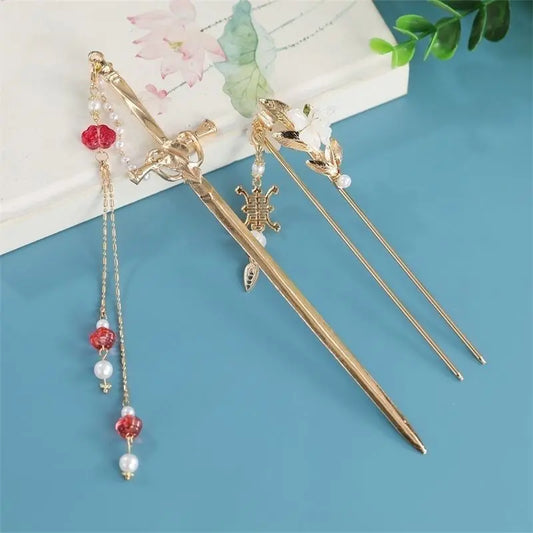
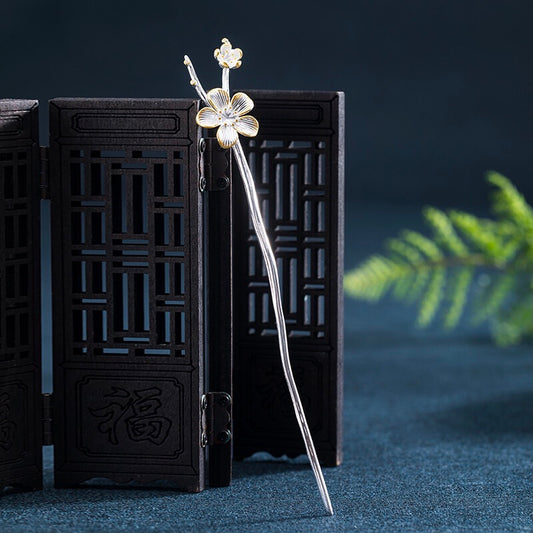
Three contemporary shop selections for readers interested in decorative design. These are not presented as documented heritage objects, community-made crafts, or religious endorsements. Check each product page for current specifications, price, and availability.

Cat pearl flower tassel antique wooden hairpin
View product details
Dark Wood Hair Stick with Green Bead Tassels
View product details