The Chinese Showcase journal Chinese culture
Xiaohan (Minor Cold) in China's 24 Solar Terms
Xiaohan, or Minor Cold, starts around January 5 and often brings some of China's lowest average temperatures. Learn why the cold can deepen after the solstice and how Nanjing's vegetable rice reflects local winter cooking.
Xiaohan (小寒, Xiǎohán), or Minor Cold, is the 23rd of China's 24 solar terms. It usually begins around January 5 in the Gregorian calendar, when the Sun reaches 285° ecliptic longitude. It follows Dongzhi (Winter Solstice) and comes before Dahan (Major Cold). Despite the modest name, Xiaohan falls in the heart of winter and can be colder than Dahan.
The first solar term of a typical Gregorian year poses a good question about seasonal names. How can the days be getting longer while the weather is still getting colder? The answer starts with the winter solstice and continues with the local climates, farming routines and meals that give Xiaohan its character.
The First Solar Term of January
Xiaohan begins about two weeks after the winter solstice. Observatories determine the moment of the term from the Sun's apparent position along the ecliptic. They use the March equinox as the starting point for measuring longitude. Winter Solstice falls at 270°, Xiaohan at 285°, and Dahan at 300°. Some English calendars call Xiaohan Lesser Cold or Moderate Cold. All three translations refer to the same crossing and the following stretch of roughly 15 days.
By early January, daylight is lengthening again in the Northern Hemisphere. Land and air can continue cooling when the heat they lose still exceeds what the Sun supplies. That seasonal delay helps explain why the shortest day and the period of strongest cold are separated. Temperature also responds to cold air outbreaks, cloud cover and moisture, so two places at the same calendar point can feel quite different.
Can Minor Cold Be Colder Than Major Cold?
Yes. China Meteorological News reported that across China, the average temperatures for the solar-term periods in 1991–2020 were about −5.1 °C during Minor Cold and −4.5 °C during Major Cold. The comparison uses a long-term national average. The order can differ in an individual city, at higher elevation or in any one winter.
Folk calendars offer another way to describe this time. The winter practice called shǔjiǔ (数九) counts nine groups of nine days from the winter solstice. Xiaohan usually begins late in the second group of nine and includes the third group, sānjiǔ (三九). The saying lěng zài sānjiǔ (冷在三九), meaning that the cold comes in the third nine, captures an early-January experience familiar in many places.
Keeping Food and Livestock Through the Cold
An account from the Beijing Municipal Forestry and Parks Bureau emphasizes the protection of vegetable stores and animal shelters during Xiaohan. In a cold spell, a cellar can buffer temperature swings for food stored below ground. Sheltered space also helps households keep supplies close at hand through weeks of low temperatures.
A cellar’s role in the winter kitchen is different from that of cured meat. The cellar holds produce gathered earlier in the year, while curing changes how meat can be kept and used. Both help explain how a winter meal could combine stored ingredients with the greens available locally.
Nanjing's Vegetable Rice for Minor Cold
The Nanjing Local Gazetteers Office describes an old local custom of cooking càifàn (菜饭) at Xiaohan. One version cooks short-stem greens called ǎijiǎohuáng together with glutinous rice, chopped ginger and cured pork, sausage or diced salted duck. The ingredients vary. Cooking the greens and rice with preserved meat makes the dish a useful record of what could be brought together in a winter kitchen.
The same gazetteer feature presents a poem by the Ming writer Wang Wei (王韦) about friends gathering by a stove after fresh snow, with plum blossoms about to open. The rice and the poem preserve two different ways to observe the cold season in and around Nanjing.
Frequently Asked Questions
When is Xiaohan?
It starts around January 5 in the Gregorian calendar. The exact local date and time depend on when the Sun crosses 285° ecliptic longitude.
What does Xiaohan mean?
The name means Minor Cold. It is also translated as Lesser Cold or Moderate Cold.
Which term follows Minor Cold?
Dahan, or Major Cold, follows around January 20. It closes the traditional solar-term cycle.
What is a documented Xiaohan food custom?
Nanjing's local gazetteer records vegetable rice, sometimes made with local greens, ginger and preserved meat.
Continue Through the Solar Terms
- Previous term: Winter Solstice (Dōngzhì)
- Next term: Major Cold (Dàhán)
- All 24 Chinese solar terms by season
References
- Hong Kong Observatory. The 24 Solar Terms. Table of solar longitudes.
- China Meteorological News. Minor Cold feature in the Traveling Through the 24 Solar Terms series, January 5, 2024. Includes the 1991–2020 temperature comparison.
- Beijing Municipal Forestry and Parks Bureau. Minor Cold and Major Cold in the 24 Solar Terms (二十四节气之小寒 大寒), February 2023.
- Nanjing Local Gazetteers Office. Ye Jun, Jinling's Solar-Term Poetry: Minor Cold (金陵节气诗词:小寒), January 5, 2024.
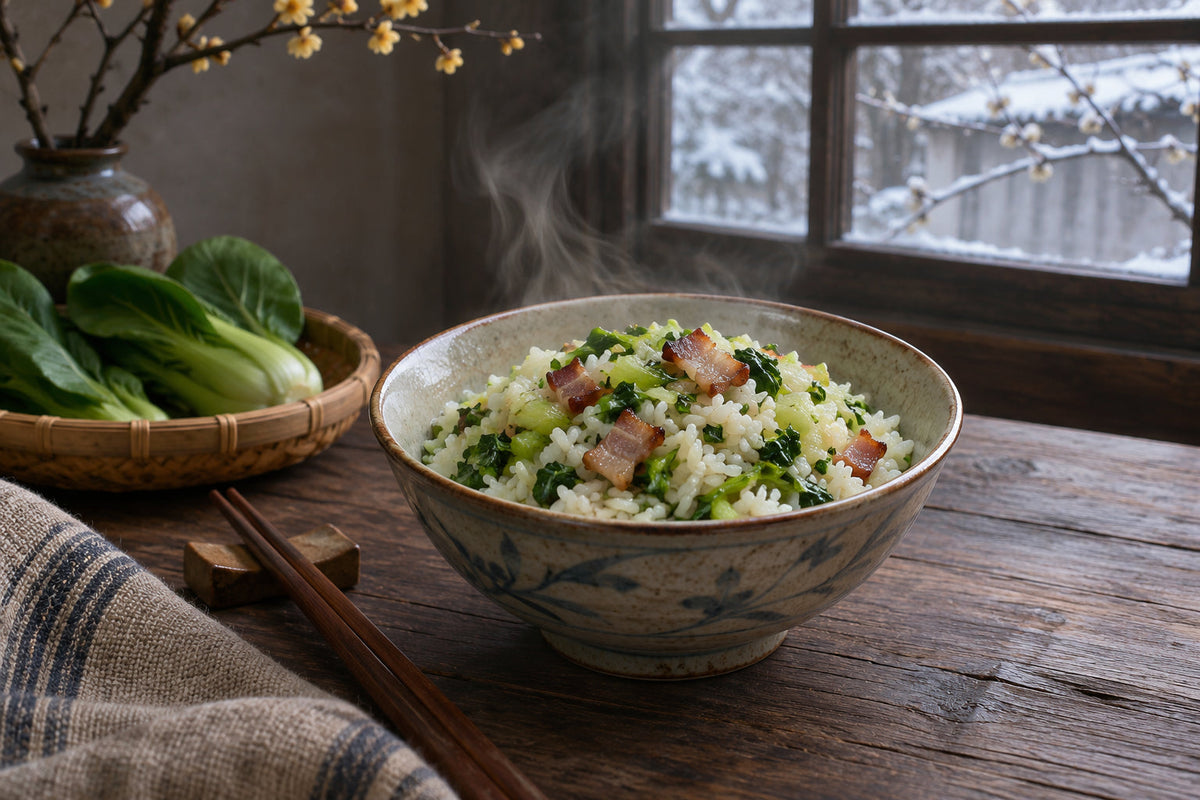
Nanjing-style vegetable rice with greens and cured meat. AI-generated cover illustration.
The 24 Solar Terms
Choose a solar term below or browse the full seasonal guide.
| Season | Solar term guides |
|---|---|
| Spring | |
| Summer | |
| Autumn | |
| Winter |
Stories, symbols and everyday objects
Our journal explores Chinese culture and design. Traditions and interpretations vary by region and source. For a purchase, use the specifications on the individual product page.
About Chinese ShowcaseQuestions or corrections? Contact us ↗