The Chinese Showcase journal Chinese culture
What Is Taoism? Beliefs, History and Practices of Daoism
A guide to Taoism in China and beyond, from the ideas of Laozi and Zhuangzi to ritual, sacred mountains, deities and the dynasties that shaped religious Daoism.
Taoism, also spelled Daoism, is a Chinese religious and philosophical tradition centered on the Dao, or Way. The Daodejing and Zhuangzi express ideas about naturalness and how to act without forcing things. Organized Daoist communities are documented from the second century CE. Their traditions include scripture, temple worship, priestly lineages, rituals for the living and dead, and practices of self-cultivation.
A reader may encounter the Dao in a book of early Chinese philosophy, a priest’s petition at a temple festival, or a discussion of inner alchemy. All three belong in the history of Taoism, though they developed in different settings. This guide traces these connections from the late Han movements through the courts of the Tang and Ming, and explains how to recognize the people, sacred places and objects associated with the tradition.
Taoism and Daoism Mean the Same Thing
Daoism follows modern Hanyu Pinyin, where 道 is written dào. Taoism preserves the familiar spelling from the older Wade–Giles system, where the same word was written tao. A common English pronunciation is DOW-iz-um, with “dow” rhyming with “now.” You may also hear TOW-iz-um for the spelling Taoism. Both forms appear in English books and museum catalogs.
In Chinese, dàojiā (道家) commonly refers to the intellectual currents associated with Laozi and Zhuangzi. Han scholars grouped earlier writings under this name, so it also reflects how later readers organized the past. Dàojiào (道教) commonly refers to the religious traditions that developed their own scriptures, ritual roles, communities and lineages. “Taoism” and “Daoism” can each refer to either usage. The Chinese terms describe different emphases in a shared history.
The early books supplied concepts and authoritative voices for later religious Daoists. Laozi came to be revered as Lord Lao, also known as Taishang Laojun, and some Daoist communities understood him to have delivered revelations. Zhuangzi’s stories and accounts of self-cultivation influenced religious readers, including the Shangqing tradition. In the Tang, the book associated with Zhuangzi received the title Classic of Southern Florescence. These developments help explain why the same text can be read in a philosophy class and commented on by a Daoist priest. Fabrizio Pregadio discusses this overlap in Religious Daoism.

What Are the Main Beliefs of Taoism?
The Dao is commonly translated as “the Way.” In the Daodejing, it gives rise to and sustains the world, even though names and descriptions can only convey part of it. De (德), variously translated as virtue, power or potency, describes the way the Dao is expressed in particular beings and in conduct. Religious traditions give these ideas practical form through moral discipline, communal ceremonies, meditation and the pursuit of spiritual transformation.
- Wuwei (无为)
- Often translated as “nonaction,” it can mean acting without coercion or unnecessary interference. The Daodejing applies this idea to government as well as personal conduct.
- Ziran (自然)
- Literally “so of itself,” it describes naturalness or spontaneity. The term can include the way human relationships and the wider world unfold when they are allowed to follow their own conditions.
- Qi (气)
- Breath or vital energy in traditional Chinese thought. Daoist texts use qi in discussions of the body, the cosmos and cultivation. Its use varies across texts and practices.
- Compassion, frugality and humility
- Chapter 67 of the Daodejing names three treasures often understood as compassion, moderation in expenditure, and a reluctance to put oneself first. Religious lineages also transmit precepts and rules appropriate to a practitioner’s role.
The Taoist Symbol, Yin and Yang, and the Eight Trigrams
The familiar black-and-white circle is a form of the taijitu, or diagram of the Supreme Ultimate. Its curved halves portray yin and yang as complementary and changing. The small spot of the other color in each half can suggest that each condition contains the possibility of its counterpart. Yin and yang are used throughout Chinese cosmology, including in Confucian thought, medicine and calendrical systems. The familiar design became strongly associated with Daoism in modern visual culture. Earlier diagrams could take other forms.
The bagua, or Eight Trigrams, use sets of three broken or unbroken lines. They are associated with the Yijing and appear in some Daoist cosmological and ritual objects. A bagua surrounds the yin-yang design in some modern depictions. Read more about yin and yang in Chinese symbolism.
Taoist Sacred Texts and Books
The best-known Taoist books are the Daodejing (also Tao Te Ching), the Zhuangzi and the Liezi. The Daodejing circulated in differing early forms, as the Guodian and Mawangdui manuscripts show. The Zhuangzi is a composite text traditionally associated with the philosopher Zhuang Zhou. The Liezi, attributed to Master Lie, survives in an edition of debated date and was also honored as a classic in the Tang.
The Daozang, or Daoist Canon, is a collection with many kinds of works. It includes liturgies, revelations, precepts, commentaries and treatises on cultivation. The Ming Zhengtong Daozang and its Wanli supplement preserve a large part of this religious literature. The Scripture of Great Peace gives a sense of early religious cosmology, while the Scripture of Salvation illustrates Lingbao teachings about ritual deliverance. Readers looking for a first book can begin with a complete translation of the Daodejing or the Zhuangzi. For the ritual tradition, the canon and its different textual lineages provide more context.
Where Did Taoism Originate, and When Was It Founded?
Taoism took shape in China. Its foundational writings reach back to the Warring States period, while the earliest enduring organized Daoist lineage emerged in southwestern China in the second century CE. That difference accounts for two common answers to the question of its age. Classical Daoist ideas have a history of roughly 2,300 years or more. The conventional founding date of the Celestial Masters tradition is 142 CE, nearly 1,900 years ago.
Several older currents fed into the religion. Early Han writers associated the Yellow Emperor and Laozi with Huang-Lao teachings on government and self-cultivation. Specialists known as fangshi practiced arts that could include divination, medicine and the search for long life. Local communities kept their own customs for honoring the dead and addressing spirits. The first Daoist movements drew selectively on this wider world and organized religious life around new teachings, scriptures and forms of authority.
The Five Pecks of Rice and the Celestial Masters
In the Celestial Masters' founding story, the deified Laozi appeared to Zhang Daoling in 142 CE and appointed him Celestial Master. Tradition places the revelation at Mount Heming in present-day Sichuan. The date belongs to the lineage's sacred history. Early records give firmer evidence for Zhang Lu's government in Hanzhong, in present-day southern Shaanxi. The lineage remembers him as Zhang Daoling's grandson and third Celestial Master.
The name Wudoumi Dao, or Way of the Five Pecks of Rice, refers to a rice contribution described in early histories. Accounts connect the label with the southwest movement, and the Dianlüe passage preserved in Pei Songzhi's notes to the Records of the Three Kingdoms also names the religious leader Zhang Xiu. The rice label and the title Way of the Celestial Masters come from different ways of describing this early community. The Celestial Masters ran local districts, enrolled households and authorized religious officers. Confession and written petitions addressed to celestial officials were central to its religious life.
Cao Cao conquered Hanzhong in 215 CE and accepted Zhang Lu's surrender. The resettlement of followers carried Celestial Masters communities into northern China. Their registers, ordinations and petition rituals continued to develop after the loss of their territorial base and became part of the heritage of later Zhengyi Daoism.
The Way of Great Peace and the Yellow Turban Rebellion
In 184 CE, Zhang Jue, also written Zhang Jiao, and his brothers Zhang Bao and Zhang Liang led followers in the Yellow Turban Rebellion against the Eastern Han. Zhang Jue's Way of Great Peace, or Taiping Dao, had grown through preaching and healing. The proclamation that a new Yellow Heaven would succeed the old order gave the uprising a religious explanation for political change. The Han suppressed the main revolt that year, and armed groups associated with the movement continued to operate afterward.
Both the Great Peace movement and the Celestial Masters appeared in the late Han and linked healing with religious discipline. They had separate leaders, regions of influence and political trajectories. Zhang Jue's followers rose against the Han in the east and across parts of the central plains. Zhang Lu governed a southwestern community and later submitted to Cao Cao. The relationship between Zhang Jue's movement and the precise text of the surviving Scripture of Great Peace, or Taiping Jing, remains uncertain.
How Chinese Dynasties Treated Taoism
Imperial support took different forms. A court could approve ordinations, print scriptures, confer titles on gods or call on priests to perform ceremonies for the ruler. The same state could regulate clergy and temple property, and a successor could reverse a predecessor's patronage.
| Period | What changed |
|---|---|
| Han | Huang-Lao ideas had currency among early Han elites. In the Eastern Han, Laozi acquired a public cult, organized religious movements emerged and the Han state suppressed the Yellow Turban rebellion. |
| Three Kingdoms and Jin | Celestial Masters followers spread in the north after the Hanzhong surrender. Later migration and contact with southern traditions helped reshape Jiangnan Daoism. The Shangqing and Lingbao scriptures emerged in that southern setting between the fourth and early fifth centuries. |
| Northern and Southern Dynasties | Kou Qianzhi's reforms gained court support under Northern Wei Emperor Taiwu. In the south, Lu Xiujing organized scriptures and rites, and Tao Hongjing edited and transmitted Shangqing revelations at Mount Mao. Northern courts could also curtail the religion. The Northern Zhou court proscribed both Buddhist and Daoist institutions in 574. |
| Sui | After reunification, Sui rulers patronized Daoists alongside Buddhist institutions. The movement of texts and clergy between north and south helped prepare the religious landscape of the Tang. |
| Tang | The Li ruling house claimed Laozi as an ancestor. Prominence at court varied across reigns, with especially close ties between the imperial house and Daoist institutions under Xuanzong. |
| Five Dynasties and Ten Kingdoms | Patronage became regional after the Tang collapse. The Daoist priest Du Guangting served the Former Shu court in Sichuan, where ritual and literature framed Shu as heir to the Tang. |
| Song and Jin | Song emperors such as Zhenzong and Huizong patronized Daoist rites and institutions. Huizong supported the Divine Empyrean network and rituals associated with Lin Lingsu. In the north under Jin rule, Wang Chongyang and his disciples established Quanzhen communities. |
| Mongol rule and Yuan | Qiu Chuji's audience with Chinggis Khan in 1222 helped his Quanzhen order expand. Later restrictions culminated in Kublai Khan's orders to destroy many Daoist texts and printing blocks. The court continued to recognize Daoist institutions, including the Celestial Masters' authority over ordination traditions. |
| Ming | The Yongle emperor developed the Wudang temple complex. The court-sponsored Daoist Canon was completed in 1445, with a supplement in 1607. Later, Jiajing brought Zhengyi priests, court ceremonies and the pursuit of longevity into his own imperial religious life. |
| Qing | Court support was selective. Wang Changyue renewed Quanzhen ordination in early Qing Beijing, helping make his Longmen lineage prominent. In some state-sponsored temples, Daoist officiants lost earlier roles. Local priests and communities continued to conduct festivals, funerals and rites for renewal. |
Daoism After the End of Imperial Rule
During the Republican period, reform campaigns challenged many temple institutions. In some places, temple property was reassigned to schools or other public uses, while some clergy and local communities found new ways to sustain religious life. A national Daoist association was established in 1957. The Cultural Revolution interrupted public worship and damaged many sites. From the late twentieth century, some temples reopened and communities rebuilt ritual and training networks. Rebuilding followed local paths, including in communities whose institutions developed on a different timeline, such as those in Taiwan and Hong Kong.
Why Did the Tang Dynasty Favor Taoism?
The Tang emperors belonged to the Li house. Claiming descent from Laozi, traditionally known as Li Er, gave the dynasty a sacred ancestor whose honor could be expressed in titles, temples and state rites. Taizong's 637 edict gave Daoist clergy precedence over Buddhist clergy in official settings. Buddhism still received patronage from members of the ruling family, including Taizong's support for Xuanzang's translation work. During Wu Zetian's own Zhou dynasty, she drew heavily on Buddhist sources of legitimacy.
Emperor Xuanzong made the ancestral connection especially visible. He expanded Laozi's imperial titles, building on the title Emperor of Mysterious Origin granted by Gaozong in 666. He sponsored shrines and wrote a commentary on the Daodejing. He placed Daoist institutions under the oversight of the Court of the Imperial Clan, the office that managed the ruling family's genealogies. The Palace of Great Purity ritually brought Lord Lao and Tang ancestors together. Such arrangements made the genealogy part of court administration and worship.
Tang Daoism also had a scholarly life. Cheng Xuanying and Li Rong wrote sophisticated commentaries on the Daodejing. Their arguments belonged to a world in which Buddhist and Daoist scholars read, debated and adapted one another's ideas. In the 840s, Emperor Wuzong's persecution devastated Buddhist monasteries. Successive Tang reigns show how quickly a court could shift religious priorities.
Why Did the Jiajing Emperor Believe in Taoism?
The Ming emperor Jiajing, Zhu Houcong, came to the throne in 1521 from a collateral branch of the imperial family. Daoism mattered to him as personal faith and as a means of securing the dynasty's future. He sought longevity, commissioned rites for an heir and used religious texts and ceremonies to give his rule a sacred foundation.
The Great Rites Controversy showed what was at stake. Court officials and the new emperor disputed how his biological father should be honored within the imperial ancestral order. Jiajing fought for his own father's recognition. That struggle concerned state ritual and dynastic legitimacy. His patronage of Daoist specialists unfolded alongside it, offering other ways to protect the royal family and articulate what made a ruler worthy of Heaven's support.
In 1524, Jiajing summoned the Zhengyi priest Shao Yuanjie, who performed rites that included prayers for an heir. After his first son was born in 1533, the emperor gave Shao credit and bestowed honors on him. Later Tao Zhongwen rose to prominence at court. The emperor built ritual halls and supported worship associated with thunder deities and the protection of the realm. He made the West Park in Beijing a place of residence and cultivation, reshaping part of the imperial capital to embody ideas about lands of immortals.
Jiajing’s patronage also reached Mount Qiyun in Anhui. The court sent a priest there to perform rites for an heir and later gave its main Zhenwu temple the name Xuantian Taisu Palace. Richard G. Wang traces how this support helped make the mountain a center of state ritual.
Art historian Maggie C. K. Wan traces these commitments through the buildings Jiajing commissioned. Bony Schachter's study of Jiajing's preface to the Scripture of the Three Offices also shows an emperor engaging with Daoist texts and ideas of rulership. The religious story of his reign includes his interest in immortality, the urgency of an imperial succession and the uses of ritual within government.
The Major Schools of Taoism
Zhengyi, or Orthodox Unity, and Quanzhen, or Complete Perfection, are two major lineages of institutional Daoism. Earlier movements, including Shangqing and Lingbao, left scriptures and ritual practices that later schools continued to use.
Zhengyi and the Celestial Masters
Zhengyi traces its lineage to Zhang Daoling. Mount Longhu in Jiangxi became associated with the Celestial Masters' ordination authority. Zhengyi priests may marry and serve local communities while living with their families. They transmit registers, prepare formal petitions and conduct ceremonies for the living and the dead. Their commissions may include a temple's renewal offering or a family's funeral. Practice varies by lineage and locality.
Quanzhen and the Dragon Gate Lineage
Wang Chongyang founded Quanzhen in the twelfth century. Its early community included Sun Bu'er, Ma Yu and Qiu Chuji. Quanzhen became known for celibate monastic life, meditation, precepts and internal alchemy. Lay supporters and non-monastic lineages also helped circulate its teachings. Longmen, or Dragon Gate, traces its transmission to Qiu Chuji and became especially prominent after Wang Changyue's Qing-era revival.
Shangqing, Lingbao and Later Ritual Lineages
Shangqing, or Highest Clarity, drew on fourth-century revelations, with attention to inner visualization, recitation and encounters with the Perfected. Lingbao, or Numinous Treasure, developed scriptures and ceremonies for communal salvation and rites for the dead. Under the Song and Yuan, ritual traditions such as Shenxiao and Qingwei developed methods associated with thunder officials. Their histories show how a Daoist priest could combine transmitted ritual, scriptural knowledge and personal cultivation.
How Are Taoism and Buddhism Related?
Taoism formed in China. Buddhism originated in South Asia and developed distinctive schools in China after its transmission there. Both traditions formed monasteries, trained specialists and provided services for the dead. Each developed its own scriptures and lineages, and centuries of interaction changed the way both looked in China.
Early Lingbao writers adapted Buddhist conceptions of karmic consequences, rebirth and the deliverance of living beings. Buddhist texts and rites in China also took up local stellar cults, talismanic forms and techniques adapted to new religious settings. Christine Mollier traces parallels between Buddhist Guanyin and the Daoist Heavenly Worthy Who Rescues from Suffering, showing how Buddhist models informed the Daoist deity's iconography and role. Each retained its place in a distinct pantheon and liturgy.
Their encounters included competition over whose clergy should rank first at court and over which scriptural traditions were authoritative. The legend that Laozi traveled west and converted foreign peoples was one disputed claim, and later Mongol court debates led to measures against some of the Daoist literature associated with it. In everyday life, families could call on specialists from either tradition, visit different temples and honor local gods shared across the two. For more on the other side of this exchange, see the guide to Chinese Buddhist history, beliefs and traditions.
Famous Taoist Figures and What They Contributed
Taoism draws on classical thinkers, founders of religious communities, physicians, and figures whose lives are told in legends. Their roles differ. Laozi and Zhuangzi gave later readers a language for thinking about the Dao. Zhang Daoling stands at the beginning of an organized religious lineage. Ge Hong and Sun Simiao show how the search for long life intersected with medicine, while Lü Dongbin became an immortal honored in temples and art.
Laozi and the Daodejing
Laozi, the “Old Master,” is the traditional author of the Daodejing, also written Tao Te Ching. Sima Qian’s Records of the Grand Historian tells of a Zhou archivist who sets off toward the west and leaves a short book with the keeper of a frontier pass. It also preserves competing accounts of who Laozi might have been. Manuscripts from Guodian and Mawangdui show that versions of the text circulated long before its received form stabilized. The identity of a single author remains uncertain.
In religious Taoism Laozi is also honored as the Most High Lord Lao, or Taishang Laojun, and as Daode Tianzun, one of the Three Pure Ones. The Celestial Masters tell of the deified Laozi revealing a covenant to Zhang Daoling. The same name thus connects classical writing, a deity who appears in ritual, and a founding narrative of organized Taoism.

Zhuangzi and the Classic of Nanhua
Zhuangzi, or Zhuang Zhou, was a thinker of the Warring States period. The book bearing his name developed through several hands. Its seven Inner Chapters form the oldest core traditionally associated with him. The butterfly dream, which asks whether a man dreamed he was a butterfly or a butterfly dreamed it was a man, makes transformation a question about the standpoint from which we judge experience. Later religious readers also found models of self-cultivation in the book’s descriptions of the perfected person and the practice called “sitting in forgetfulness.” In 742, Tang imperial recognition conferred the scriptural title Nanhua Zhenjing, the True Classic of Nanhua, on the work.
Guiguzi and the Art of Persuasion
Guiguzi means “Master of Ghost Valley.” Later tradition remembers him as a secluded teacher of strategists and associates him with figures such as Su Qin and Zhang Yi. The surviving Guiguzi explores how a speaker listens, assesses motives, and adapts an argument to a particular person and situation. Its authorship and the details of the master’s life are disputed. The hermit’s later reputation brings him into the wider cultural world of Taoism, while the book itself is usually studied for rhetoric, strategy, and political persuasion.
Zhang Daoling and the Celestial Masters
Zhang Daoling, also called Zhang Ling, is traditionally counted as the first Celestial Master. The lineage dates his encounter with Lord Lao to 142 CE in Sichuan. Its origin story explains the religious authority of the Celestial Masters, who organized households, taught rules of conduct, and presented petitions in rites. The movement is historically visible in the late Han, especially under Zhang Lu, whom the lineage remembers as Zhang Daoling’s grandson. Mount Qingcheng preserves the Sichuan founding memory, while Mount Longhu became the leading home of the Celestial Masters in later centuries.
Ge Hong and the Baopuzi
Ge Hong was a scholar of the early fourth century who brought ethical discipline, medicines, and alchemical methods into the same account of self-cultivation. The Inner Chapters of his Baopuzi, or Master Who Embraces Simplicity, preserve information about early elixir traditions. Works on emergency remedies circulated under his name, and the Biographies of Divine Immortals is traditionally attributed to him. The surviving materials have layered histories. His own writings give a particularly valuable account of what an educated writer of his period thought a seeker could learn and practice.
Tao Hongjing and the Shangqing Scriptures
Tao Hongjing (456–536) gathered and annotated manuscripts associated with the fourth-century medium Yang Xi and the Xu family. His Zhengao, the Declarations of the Perfected, preserves their revelations alongside notes that situate them in particular households and places. From Mount Mao in Jiangsu, Tao helped establish the transmission of Shangqing, or Highest Clarity, with its practices of visualization and its accounts of celestial realms. He also worked on materia medica, the study of medicinal substances. His career shows how textual scholarship and the study of the body could belong to the same religious life.
Sun Simiao and the Ethics of Healing
Sun Simiao was a seventh-century physician who read the Daodejing and wrote about nourishing life. His Essential Prescriptions Worth a Thousand in Gold and its supplement brought together remedies, diet, and medical practice. The chapter often translated as “The Absolute Sincerity of Great Physicians” asks physicians to care for patients with compassion and without discrimination by wealth or rank. Later devotees venerated him as the Medicine King, or Yaowang. His medical writing and his later worship are two ways his reputation was transmitted.
Lü Dongbin and the Eight Immortals
Lü Dongbin, also called Lü Chunyang, is one of the Eight Immortals and a patriarch in Quanzhen lineage accounts. In the Yellow Millet Dream story, he experiences a whole career of ambition and loss while a meal is cooking. He wakes with a changed sense of what is worth pursuing. Paintings and sculptures often give him a sword, making him recognizable even in a group of immortals. Such stories and objects show how his cult developed. The dates and details given for his earthly life belong largely to religious biography.
Wang Chongyang and the Founding of Quanzhen
Wang Chongyang (1113–1170), also known as Wang Zhe, began his movement in northern China under the Jin dynasty and taught in Shandong in the late 1160s. His followers understood cultivation as a discipline involving ethical conduct, meditation, and work on the self. Later tradition remembered seven leading disciples as the Seven Perfected, among them Sun Bu’er, Ma Yu, and Qiu Chuji. Claims that Wang received teachings from immortals such as Lü Dongbin became part of the lineage’s account of its religious inheritance.
Qiu Chuji and His Journey to Chinggis Khan
Qiu Chuji (1148–1227), also called Master Changchun, took his disciples across Central Asia and met Chinggis Khan in 1222. The journey and conversations are recorded by his disciple Li Zhichang. An audience sought for advice on long life helped establish a relationship between the Mongol ruler and the Quanzhen leadership. In Beijing, Qiu’s memorial at White Cloud Temple anchors this wider story in a place of worship. The Dragon Gate tradition remembers him as a founding patriarch and took its later institutional form through subsequent generations.
Zhang Sanfeng, Wudang, and Taijiquan
Zhang Sanfeng appears in the official History of the Ming as a wandering adept associated with the Wudang Mountains. The text itself gives conflicting accounts of his life span. Later Wudang and martial arts traditions remember him as a founder of internal boxing or taijiquan, also known as tai chi. Those founder stories help explain the association of Wudang with martial arts and self-cultivation. The historical development of taijiquan includes later, documented lines of transmission. UNESCO’s inscription describes its emergence in seventeenth-century Henan and acknowledges the influence of Taoist thought.
Taoist Temples, Sacred Mountains, and Places of Worship
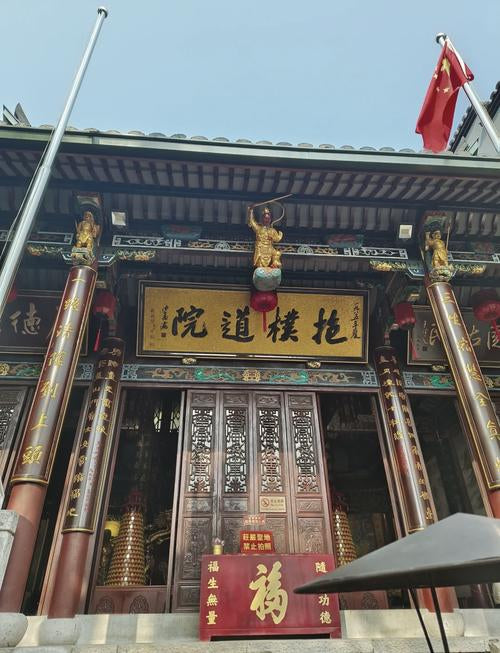
A Taoist place of worship may be called a guan (abbey or temple) or a gong (palace or temple complex). At a major complex the gate leads to several halls, each of which may honor a deity, an immortal, or a lineage master. An altar for a communal ceremony can be set apart from the spaces used for individual offerings. A sacred mountain is a wider religious landscape with routes, caves, cliffs, shrines, and several temple precincts. The climb between sites can form part of a pilgrimage, alongside prayers, incense offerings, and attendance at a festival.
The Four Sacred Mountains of Taoism
The customary group includes Wudang in Hubei, Qingcheng in Sichuan, Longhu in Jiangxi, and Qiyun in Anhui. Other important centers include Mount Mao in Jiangsu, associated with Shangqing, and Mount Lao in Shandong. The list of four is a useful introduction to a wider sacred geography that includes the Five Great Peaks and regional pilgrimage sites.
- Wudang Mountains, Hubei. The mountain complex is closely associated with Zhenwu, the Perfected Warrior. Its summit shrine and Zixiao Gong (Purple Heaven Palace) sit within a network of temples and routes expanded under the Yongle emperor. A pilgrimage can take in several altars before reaching the summit.
- Mount Qingcheng, Sichuan. Jianfu Palace and Changdao Temple belong to a group of Taoist temples adapted to the mountain landscape. Tradition identifies the site of Changdao Temple with Zhang Daoling’s teaching. The Qingcheng temples share a UNESCO World Heritage listing with the nearby Dujiangyan irrigation system.
- Mount Longhu, Jiangxi. The Celestial Masters’ Mansion (Tianshi Fu) and the Great Shangqing Palace in Shangqing connect this area with the later history of Celestial Master ordination and ritual transmission. The mansion and palace are distinct sites within the wider landscape.
- Mount Qiyun, Anhui. Paths through cliff gateways and along Yuehua Tianjie lead to the Xuantian Taisu Palace, dedicated to the northern deity also known as Zhenwu. Inscriptions on the cliffs and stelae record temple construction and testimony from visitors. They preserve a history of the mountain alongside its buildings.
White Cloud Temple, Louguan, and Qingyang Palace
White Cloud Temple (Baiyun Guan) in Beijing is a major Quanzhen abbey. Its sequence of courtyards includes a hall dedicated to Qiu Chuji and shrines to the Jade Emperor and the Three Pure Ones. Louguan, near Zhouzhi in Shaanxi, is tied to the story that Laozi passed on his teaching to Yin Xi. That association made the site a center for reading and transmitting the Daodejing. Qingyang Palace (Qingyang Gong) in Chengdu illustrates a prominent urban temple, in a province with long connections to the Celestial Masters. Taiqing Palace on Mount Lao gives the complementary example of a temple set within a coastal mountain pilgrimage landscape.
Baopu Taoist Temple near West Lake in Hangzhou is dedicated to Ge Hong. It shows how a temple can preserve the memory of a historical Daoist author through local worship.
Taoist Gods and Immortals
Taoist temples and scriptures recognize many divine beings, including the Three Pure Ones, the Jade Emperor, the Three Officials, star deities, and protectors with local followings. In some rites they are pictured as a celestial court, with ranks, offices, petitions, and messengers. Taoists may pray to different beings according to a temple’s dedication or the purpose of an observance. The Dao remains the underlying Way through which this cosmos unfolds.
The Three Pure Ones and the Jade Emperor
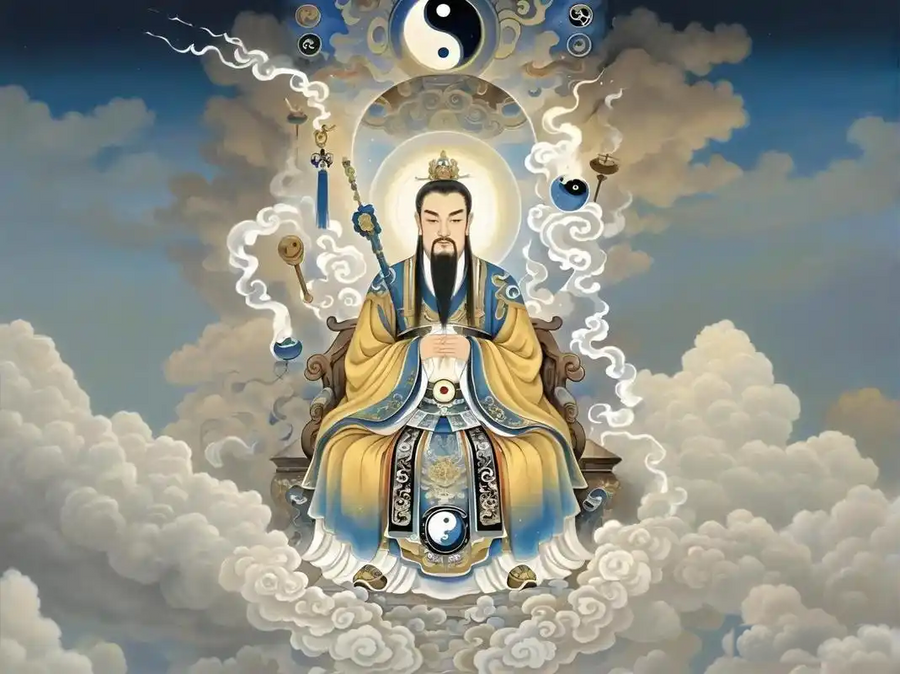
The Three Pure Ones (Sanqing, 三清) are the highest triad in many Taoist pantheons. They are Yuanshi Tianzun, the Celestial Worthy of the Primordial Beginning, Lingbao Tianzun, the Celestial Worthy of the Numinous Treasure, and Daode Tianzun, the Celestial Worthy of the Way and Its Virtue, commonly identified with Lord Lao, the deified Laozi. Tianzun means “Celestial Worthy” and is an honorific borne by several deities. Texts and images associate the Three Pure Ones with the unfolding of the cosmos and major bodies of scripture.
The Jade Emperor (Yuhuang Dadi) presides over the heavenly administration in many accounts and is widely honored in popular worship. Art can clarify the difference in roles. An embroidered priest’s robe documented by the Art Institute of Chicago sets the Three Pure Ones above a celestial assembly and gives the Jade Emperor a prominent position within the court. The placement distinguishes the triad’s cosmological status from the emperor’s role as a sovereign who receives petitions and oversees divine officials.
Several traditions also group high-ranking celestial rulers as the Siyu, often translated as the Four Sovereigns. Lists and ranks vary across periods and liturgies. Beiji Ziwei, associated with the celestial north, and Houtu, associated with the earth, illustrate how ideas about rulership extended across the cosmos.
The Three Officials, the Dipper, and Local Deities
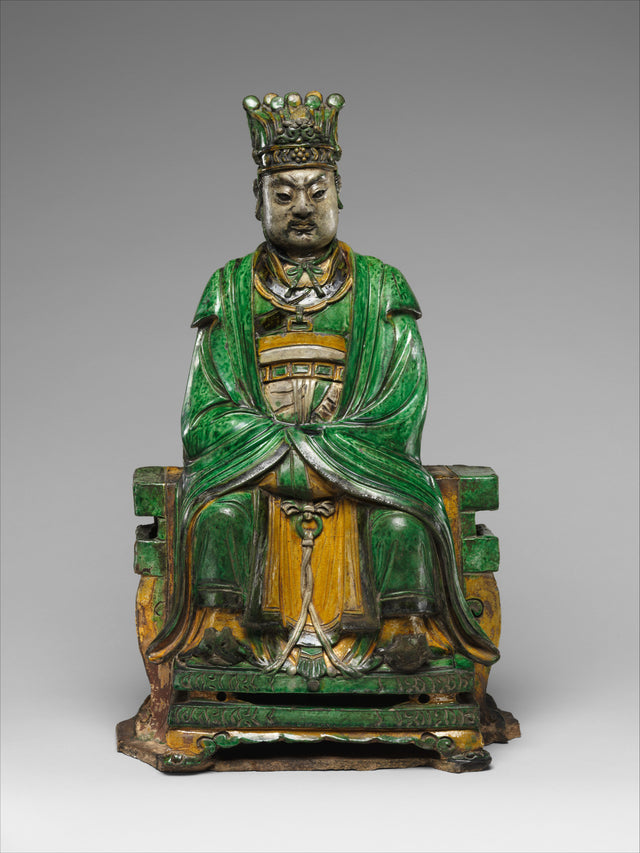
The Three Officials (Sanguan) govern Heaven, Earth, and Water. Early Celestial Master communities petitioned them in healing rites that involved confession and requests for aid. In later worship the Official of Heaven bestows blessings, the Official of Earth pardons offenses, and the Official of Water relieves adversity. A Southern Song painting preserved at the Museum of Fine Arts, Boston, shows the Official of Heaven seated at a desk surrounded by attendants as a priest kneels before him. The image gives a concrete sense of what a celestial audience meant.
Doumu, the Mother of the Dipper, belongs to a different part of this divine world. One legend describes nine stars emerging from lotus buds, including the Seven Stars of the Northern Dipper (Beidou). Star worship in Taoism gives the Dipper a role in rites concerned with destiny, well-being, and the passage of time. Zhenwu and the northern symbol Xuanwu share an enduring connection to the north. Zhenwu became especially important under Ming imperial patronage and at Mount Wudang.
Regional worship also shapes temple pantheons. Mazu, for example, is revered as a protector of seafarers and has her own temple networks. Taoist liturgies may honor her, and devotees can maintain a relationship with her through community practices. The identity of a temple’s principal deity, the lineage of the officiating priest, and the practices of the people who come to worship can each tell a different part of its history.

The Eight Immortals
An immortal or transcendent (xian, 仙) is a figure who surpasses the ordinary human condition in religious literature and legend. Accounts describe bodily longevity, ascent to the heavens, transformation, and exceptional spiritual attainments. The Eight Immortals (Baxian) are typically named as Zhongli Quan, Lü Dongbin, Zhang Guolao, Li Tieguai, Han Xiangzi, Lan Caihe, He Xiangu, and Cao Guojiu. They are especially recognizable through the emblems they carry. Look for Lü Dongbin’s sword, Han Xiangzi’s flute, or Li Tieguai’s gourd. On porcelain, lacquer, and textiles, the emblems can stand for their bearers even when the figures themselves are absent.
Taoist Rituals, Festivals, and Talismans
A jiao (醮) is an offering rite. A community may sponsor one to renew its relationship with its deities. The occasion can combine formal liturgy inside the temple with processions, music, and theater in the streets. A zhai (齋) is a ritual retreat or purification observance with a long history in Taoism. Historical forms include rites on behalf of the dead. The expression zhaijiao often groups together related liturgical traditions. Certain passages of a major rite are open to worshippers, while others belong to the officiants and the community representatives.
Priests may chant scriptures, present offerings, and deliver written petitions proclaiming the purpose and sponsors of a rite. Talismans (fu, 符) contain graphs understood within a lineage as forms of communication and authority. Registers (lu, 籙) have other functions, including recording rank and ritual powers in some traditions.

Daoist Protective Talismans and Exorcism
In religious Daoism, quxie (驱邪) means warding off harmful influences, while zhenyao (镇妖) refers to subduing troublesome spirits in ritual and folklore. Purifying an altar, safeguarding a household, and expelling a disruptive presence could each call for a different rite. The officiant’s lineage, the purpose of the ceremony, and the deities addressed all shaped what was done. Historian Mark Meulenbeld documents the use of protective talismanic writing in Daoist ritual manuscripts from Hunan, including writing used to establish a purified ritual space.
A Daoist protective talisman is a fu (符), a written or drawn sign understood in its tradition to carry a request or command. A zhou (咒) is a spoken incantation. Written talismans and oral formulas can work together in a ritual, and a seal may mark the document with the authority of a deity or an office. These practices belong to the ritual traditions of daojiao (道教). Protective imagery also circulated more widely through popular customs, including the winged bixie guardian beast.
What Is a Shan Gui Charm Coin?
A Shan Gui charm coin (山鬼花钱) is a coin-shaped amulet associated with wishes for protection in Chinese popular tradition. Such pieces belong to the wider category of huaqian, or charm coins, made for purposes other than payment. The National Museum of History’s example has a round hole. Its front bears the names Shan Gui and Lei Ling and a thunder invocation that names Lord Lao. The reverse displays the Eight Trigrams. Hole shapes and inscriptions can vary across surviving examples.
The thunder language gives the coin a connection to Daoist religious imagery. The coin brings that imagery into a portable object. A priest’s command tablet, described below, serves a particular role within a ceremony. Explore the inscriptions and designs in our guide to Shan Gui charm coins.


The Daoist Nine-Character Formula in the Baopuzi
The words commonly called the Nine-Character Mantra (九字真言) appear in “Dengshe,” chapter 17 of Ge Hong’s Baopuzi Inner Chapters. The received text in the Ming Daoist Canon calls it the liujia mizhu (六甲祕祝), or secret invocation of the Six Jia. It gives the wording 臨兵鬥者,皆陣列前行 (临兵斗者,皆阵列前行). The passage concerns protection when entering mountains. Its imagery is military, with fighters advancing in formation.
Other textual witnesses give different wording. The Chinese Buddhist commentator Tanluan quotes a form written 臨兵鬥者皆陳列在前 in a discussion of sacred words. The Japanese encyclopedia Wakan Sansai Zue also records a form ending in 在前 and comments on the Baopuzi wording. In Japan the term kuji means “nine characters.” Scholar Hitoshi Miyake describes versions in Shugendō that combine formulas with hand seals. Ge Hong’s mountain invocation and the Japanese ritual therefore have different settings in the sources that describe them.

Taoist Festivals and the Lunar Calendar
Taoist festivals include the Three Yuan observances, birthdays of deities and lineage founders, and festivals tied to a particular temple or region. The calendar below uses dates in the traditional Chinese lunisolar calendar. Their Gregorian dates change from year to year, and a temple may hold its rites or public procession over several days around the feast.
| Lunar date | Observance | Meaning and customs |
|---|---|---|
| Month 1, day 9 | Jade Emperor’s Birthday (玉皇诞) | Temple and household rites honor the Jade Emperor. In Fujian and Taiwan the observance is commonly called Tiangong sheng, the birthday of the Lord of Heaven. |
| Month 1, day 15 | Shangyuan (上元节) | The Official of Heaven grants blessings in the traditional Three Officials cycle. It shares its date with the Lantern Festival. |
| Month 1, day 19 | Yanjiu Festival (燕九节) | A Beijing observance associated with the birthday of the Quanzhen patriarch Qiu Chuji and the historic temple fair at White Cloud Temple. |
| Month 2, day 15 | Lord Lao’s Birthday (太上老君圣诞) | Temples honor Taishang Laojun, the divinized Laozi. Hong Kong’s Ching Chung Taoist Association also calls this observance Taoist Festival. |
| Month 3, day 3 | Zhenwu’s Birthday (真武诞) | Devotees honor the Perfected Warrior. At Mount Wudang, prayers and pilgrimages can extend over several days around the date. |
| Month 3, day 23 | Mazu’s Birthday (妈祖诞) | Coastal communities honor Mazu, also called Tianhou. Local temple celebrations can include processions and pilgrimages. Her worship is shared across Daoist and popular religious settings. |
| Month 4, day 14 | Lü Dongbin’s Birthday (吕祖诞) | Calendars such as Ching Chung’s commemorate the immortal Lü Dongbin, also called Lü Chunyang and revered as a Quanzhen patriarch. |
| Month 7, day 15 | Zhongyuan (中元节) | The Official of Earth grants pardon in the Three Officials cycle. Services for the dead and offerings for unprovided-for spirits are part of many local observances. |
| Month 9, days 1–9 | Nine Emperor Gods Festival (九皇胜会) | Some temples in Southeast Asia celebrate for nine days. At Singapore’s Tou Mu Kung, the main closing observance is on day nine. |
| Month 9, day 9 | Doumu’s Birthday (斗母诞) | Some temple calendars honor the Mother of the Dipper on this date. Other traditions record the twentieth day of the sixth month. |
| Month 10, day 15 | Xiayuan (下元节) | The Official of Water relieves adversity in the Three Officials cycle. Some communities hold purification rites or offer prayers for relief. |
The Three Yuan Festivals
The Three Yuan (Sanyuan, 三元) fall on the fifteenth days of the first, seventh, and tenth lunar months. They honor the Three Officials of Heaven, Earth, and Water. Their customary associations are blessings, pardon, and relief from adversity, respectively.
- Shangyuan. Daoists honor the Official of Heaven. On the same date, the Lantern Festival, or Yuanxiao, brings lantern displays and other New Year customs into public and family life.
- Zhongyuan. Daoist rites may seek pardon from the Official of Earth and make offerings for the dead. Buddhist Ullambana observances and local Ghost Festival customs also fall in this season. The mix of ceremonies varies by community. Read more about Zhongyuan and the Hungry Ghost Festival.
- Xiayuan. On the fifteenth day of the tenth lunar month, worship centers on the Official of Water. Temple or household observances may include incense, offerings, and prayers for relief from hardship.
Temple Birthdays and Dipper Festivals
A deity’s birthday may bring worshippers to a temple through incense offerings, chanting, processions, or performances. A local calendar helps explain which customs go with which observance. The traditional Yanjiu fair at Beijing’s White Cloud Temple commemorates Qiu Chuji, while the festivities at Mount Wudang on the third day of the third month honor Zhenwu. Mazu’s birthday belongs to the maritime traditions of coastal temple communities.
The ninth lunar month illustrates how observances can share dates. The Nine Emperor Gods Festival, observed at Tou Mu Kung in Singapore, culminates on the ninth day. Hong Kong’s Ching Chung calendar honors Doumu, the Mother of the Dipper, on the ninth as well, while other sources record a different date for her birthday. The Double Ninth Festival, or Chongyang, also falls that day and has its own seasonal and family customs.
The Five La Days in Daoist Texts
Another ritual cycle, the Five La Days (五腊日), is associated with fasting and honoring ancestors. The Song anthology Yunji Qiqian records the first day of the first month, the fifth day of the fifth, the seventh day of the seventh, the first day of the tenth, and a festival day in the twelfth month. The Taoist Culture Centre lists that last observance on the eighth day of the twelfth month. These historical prescriptions help explain how Daoists organized ritual time alongside temple feasts.
Taoist Robes and Ritual Implements
What Do Taoist Priests Wear?
Two forms found in museum collections are the sleeved daopao (道袍) and the broad ceremonial jiangyi (絳衣), often translated as “robe of descent.” Ornate examples can carry stars, trigrams, dragons, cranes, or entire celestial courts. A late eighteenth-century robe in the Metropolitan Museum of Art (30.75.3) has a celestial palace motif worked in silk and metal thread on silk satin. The sun and moon flank the palace above a field of flying cranes. Such imagery gives visual form to the realm a priest addresses in a ceremony. Garment, headwear, embroidery, and color vary with ritual occasion, region, and lineage.

What Are Taoist Ritual Tools Used For?
Taoist ritual implements (faqi, 法器) have different roles. Their use depends on the service and tradition. Many forms recall objects once seen in courts or military administration, alongside instruments used to organize sound, time, and movement at the altar.
- Ritual seal (fayin, 法印)
- Impresses a mark of ritual authority on a petition, document, or talisman.
- Command tablet or banner (lingpai, 令牌, or lingqi, 令旗)
- Signals authority to summon or command divine attendants in particular rites. Some Taiwanese Five Thunder tablets carry characters and astral designs.
- Court tablet (hu, 笏)
- Recalls the tablets once held by officials at court. In ritual it expresses a priest’s formal attendance before the gods.
- Ritual sword (fajian, 法劍) and ruler (fachi, 法尺)
- May be used to ritually clear or protect sacred space. Some swords carry a seven-star design associated with the Northern Dipper.
- Handbell, chime, drum, cymbals, and wooden fish
- Signal transitions and accompany chanting or invocation. The three-pronged handle on some Daoist handbells is associated with the Three Pure Ones. The wooden fish is also found in Buddhist liturgy.
Other altar objects described in Chinese reference works include the ruyi scepter, a bowl for ritual water, the wooden altar block, and a handheld chime that can guide a procession inside the ritual space. A ruler inscribed for Marshal Tianpeng belongs to a distinct family of talismanic implements. Incense burners and lamps form part of the altar setting. Rings and pendants with related imagery belong to another material setting, explored in our guide to jewelry with Taoist motifs.
The Daoist Command Tablet and the Five Thunders
A Daoist command tablet, or lingpai (令牌), is an implement that signifies an officiant’s authority to summon or direct divine agents during a rite. The Five Thunders command tablet (wulei lingpai, 五雷令牌) is one type. The National Taiwan Museum describes it in connection with summoning the marshals of the Thunder Department. Its wooden example AH000413-011 has an arched top and a flat base. One face bears 五雷號令, or “Command of the Five Thunders,” and the other depicts a thunder deity.
In the language of the celestial court, a court tablet (hu) marks formal attendance, a seal authenticates a written communication, and a lingpai conveys a command. Museum records document different uses of the Five Thunders tablet, including purifying a ritual precinct and summoning divine officials. The inscription and setting help explain what this object does within Daoist liturgy.
Lightning-Struck Wood in Taoist Tradition
Leijimu (雷擊木) literally means wood from a tree struck by lightning. Some historical Taoist instructions prefer lightning-struck jujube wood for particular seals. Scholar Shih-shan Susan Huang relates this preference to the symbolism of thunder and the spread of Thunder Rites (leifa) during the Song and Yuan. The Daofa huiyuan, a major compendium of ritual methods, also preserves a rule against using such wood for one particular seal. The belief attached to the material therefore has to be read in the context of a specific text, object, and lineage. The appearance of a wood carving alone cannot verify the tree’s history.
Taoist Alchemy and the Search for an Elixir
Chinese Taoist alchemy developed traditions of external alchemy (waidan, 外丹) and internal alchemy (neidan, 內丹). External alchemy sought to create an elixir from substances such as minerals and metals, often in a carefully ordered ritual setting. Some practitioners hoped that the durability they associated with these substances would translate into longevity or transcendence. Their writings preserve observations on material changes and show how religious aims shaped what they considered worth investigating.
External elixirs containing substances such as mercury compounds or arsenic could cause severe poisoning. Medieval records preserve debates over how to interpret these dangers. Daoist cultivation and the medical arts shared interests in longevity and the body, while their writers pursued different goals. Ge Hong distinguished remedies that treated illness from elixirs he thought might make transcendence possible. Sun Simiao’s medical writings offer another perspective, with detailed attention to diagnosis, care, and the ethical responsibilities of the physician.
In internal alchemy, the work of refinement takes place within the practitioner. Texts can use the language of furnaces and ingredients to describe the transformation of jing (essence), qi (breath or vital energy), and shen (spirit). Other teachings describe the preparation of the elixir through clearing attachments and returning to one’s original nature. The imagery of a laboratory thus appears alongside a discipline of meditation and self-cultivation.

Daoist Alchemy and the Origins of Gunpowder
One of the earliest written clues to gunpowder in China comes from Daoist external alchemy. Alchemists working in the waidan tradition sought elixirs and long life. The Zhenyuan miaodao yaolüe (真元妙道要略), generally dated to the late Tang or Five Dynasties period, warns of an alchemical fire that burned people and spread to a dwelling. Historians read the passage as evidence of an early gunpowder-like reaction. The text preserves a connection with alchemy, while its authorship and the identity of any inventor remain uncertain.
By 1044, the Northern Song court’s Wujing zongyao (武经总要), a military compendium, recorded gunpowder explicitly. The two sources document different stages in its history, from a hazard noted in an alchemical text to a material studied by military specialists.
How Taoism Spread Outside China
Taoist ideas, texts, objects, and rituals traveled by different routes. Migrants carried temple worship and festivals abroad. Books and artistic motifs circulated through routes that also carried Buddhism and classical Chinese learning. English translations of the Daodejing broadened a different part of Taoism’s readership. These routes produced communities with different forms of religious practice and cultural interest.
Taoism in Southeast Asia
Chinese diaspora temples in Singapore and Malaysia maintain religious ties across neighborhoods, dialect groups, and countries. The Nine Emperor Gods Festival, held during the first nine days of the ninth lunar month, brings together offerings, processions, vegetarian abstinence, and worship of astral deities. Its celebrations in Singapore, Malaysia, and Thailand show how related traditions take local forms. Research on Singapore’s temples documents a continuing interplay of Taoist liturgy, Buddhist observances, and local traditions.
Vietnam shows another route. Daoist ritual manuals copied in the Sino-Vietnamese borderlands preserve talismans and diagrams of stars and trigrams. Some early twentieth-century copies were used in rural communities for ceremonies concerning both the living and the dead.
Taoist Influence in Japan
In Japan, some Taoist imagery, rites, and cosmological ideas entered through exchanges among East Asian courts, Buddhist networks, and readers of Chinese texts. Onmyōdō, Japan’s Way of Yin and Yang, grew around its own institutions and drew on Chinese yin-yang and Five Phases theory, as well as Taoist, esoteric Buddhist, and folk practices. The Met’s Edo-period painting of Daoist immortals greeting Jurōjin, the god of longevity, shows religious imagery traveling through art. A comparison of temples, priestly lineages, and rites helps distinguish Japanese reception of these ideas from the institutions that developed in China.
Taoism in North America and Beyond
The Weaverville Joss House in California, rebuilt in 1874, records the religious life of an immigrant community formed in the mining era. Its story illustrates one channel of Taoist diffusion. Modern groups in North America and Europe also encounter Taoism through translations, classes, and relationships with teachers and lineages. Reading a philosophical text, taking part in a temple feast, and receiving formal training represent different kinds of involvement with the Taoist tradition.
Jewelry with Taoist Motifs
These contemporary pieces use three designs discussed in the guide.
-
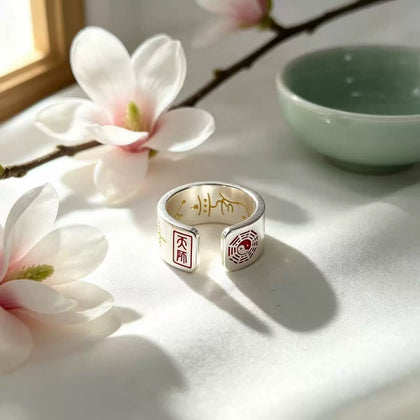
Fine Silver Big Dipper Ring
The band takes its motif from the seven stars of the Northern Dipper.
-
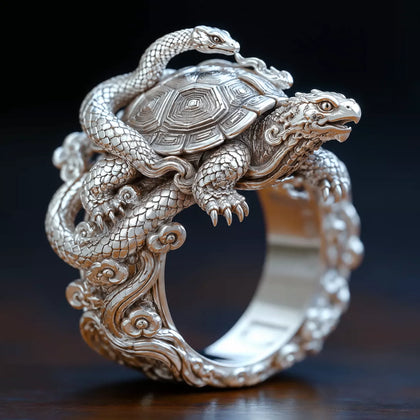
Xuanwu Tortoise and Snake Ring
The linked tortoise and snake refer to the northern emblem discussed above.
-
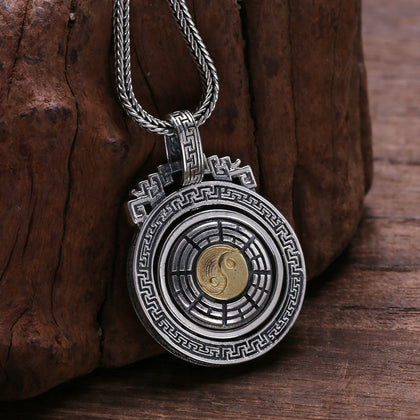
Rotating Yin-Yang and Bagua Necklace
A rotating pendant pairs the yin-yang diagram with the Eight Trigrams.
Related Reading
Frequently Asked Questions
What is the main belief of Taoism?
Taoism centers on the Dao, or Way. Its philosophical texts explore how people can live in accordance with the Way, while religious traditions put this into practice through ethical conduct, worship, ritual and cultivation.
Is there a difference between Taoism and Daoism?
The two spellings refer to the same Chinese tradition. Daoism follows Pinyin and Taoism reflects Wade–Giles. The Chinese terms daojia and daojiao are more useful for discussing the relationship between philosophical texts and organized religion.
How do you pronounce Taoism?
In English, Taoism and Daoism are commonly pronounced DOW-iz-um, with DOW rhyming with now. TOW-iz-um is also used for Taoism. The Chinese character 道 is written dào in Pinyin.
Where did Taoism originate, and how old is it?
Taoism originated in China. Its early philosophical texts took shape in the late Zhou and early imperial eras. Organized Daoist communities emerged in the late Eastern Han, around 1,900 years ago, with the Celestial Masters associated with Sichuan and the Hanzhong region.
Who founded Taoism?
Laozi is traditionally revered as the sage associated with the Daodejing and as the divine Lord Lao in religious Daoism. Zhang Daoling is traditionally credited with founding the Way of the Celestial Masters. The answer depends on whether the question is about the early classics or an organized lineage.
Do Taoists believe in a god?
Religious Daoism recognizes many deities, including the Three Pure Ones, the Jade Emperor and local protective gods. The Dao is the Way and the source of cosmic order. Describing Daoist worship simply as a belief in a single creator would miss these distinctions.
Who do Taoists pray to?
It depends on the temple, the occasion and the lineage. A rite may address the Three Pure Ones, an astral deity such as Doumu, or a protector such as Zhenwu. Temples may also honor local or regional deities shared with Chinese popular religion.
What is the Taoist symbol?
The best-known symbol associated with Taoism is the black-and-white yin-yang diagram, a form of the taijitu. The Eight Trigrams also appear in some Daoist settings. Both belong to wider Chinese cosmological traditions.
Where do Taoists worship?
Daoist places of worship include temples, palace-temples, mountain shrines and household altars. The terms guan and gong appear in many temple names. Community ceremonies may also take place at temporary altars.
Is Taoism a form of Buddhism?
Taoism and Buddhism are distinct traditions with a long history of contact in China. Daoist lineages developed their own canon and priesthood, while Buddhist communities preserve teachings and ordinations associated with the Buddha. Their rituals, images and vocabularies have influenced one another.
How does Taoism compare with Christianity, and does it believe in Jesus?
Christianity centers on God and Jesus Christ. Taoism centers on the Dao, and religious Daoism has its own deities, rituals and lineages. Jesus is outside the customary Daoist canon and pantheon, although people may personally draw on more than one tradition.
Is Taoism against LGBTQ people?
Daoism has no single worldwide authority that speaks for all communities on LGBTQ identities. Older texts and precepts were written in different social settings. A temple or lineage’s contemporary position is best understood from its own practice and statements.
Can a Taoist drink alcohol?
Rules depend on the lineage, vows and ritual occasion. Some clergy take abstinence vows, and ritual fasting may prohibit alcohol for a period. Chinese stories about wine-drinking immortals, including figures among the Eight Immortals, belong to folklore and do not establish rules for practitioners.
What is a person who follows Taoism called?
Taoist or Daoist is the broad English term. A formally trained Daoist priest is often called a daoshi (道士). Lay donors, worshippers and readers of Daoist philosophy may have very different relationships to the tradition.
Is Taoism still practiced today?
Yes. Daoist priests and temple communities continue to practice in Chinese-speaking regions and in diaspora communities. Some people also study Daoist philosophy or practice cultivation through teachers outside temple institutions.
How did Taoism spread outside China?
Daoist texts and cosmological ideas traveled to Korea and Japan through scholarship and religious exchange. Migration and temple networks carried Chinese ritual lineages overseas, especially to Southeast Asia. Translations and teachers later brought other forms of Daoist study to Europe and North America.
Is Taoism an ethnic or universalizing religion?
It grew in Chinese cultural settings and many ritual communities remain closely linked to local histories and languages. Its texts and some lineages also attract followers of varied backgrounds. These patterns are more informative than assigning it a single textbook category.
What are some common criticisms of Taoism?
The tradition has faced different criticisms over time. Some court officials questioned the cost of temple patronage and imperial alchemy, and some reformers objected to aspects of popular religious practice. Modern readers sometimes ask whether wuwei encourages passivity. Daoist texts often use the term for disciplined action with less coercion.
What is the main Taoist holy book?
The Daodejing is the best-known Taoist classic, alongside the Zhuangzi. Religious communities also use liturgies, precepts and revealed scriptures collected in the Daozang, the Daoist Canon.
What is lightning-struck wood in Taoism?
Some Daoist ritual texts specify wood from a tree struck by lightning for particular implements, especially seals in some Thunder Rite traditions. The material’s meaning comes from its ritual association with thunder. A wooden object’s appearance alone cannot establish its origin or use.
What is a Daoist protective talisman?
A Daoist protective talisman is a written or drawn fu used in a tradition of warding off harm or addressing divine officials. It may accompany a spoken formula, a seal or a purification rite.
What is a Shan Gui charm coin?
A Shan Gui charm coin is a coin-shaped Chinese amulet associated with protection. Some historical examples combine a thunder invocation on one face with the Eight Trigrams on the other.
What is a Five Thunders command tablet used for?
It is a type of Daoist lingpai used in ceremonies to summon or direct divine Thunder Department officials. Its use depends on the officiant’s lineage and the rite.
What are the nine characters in the Daoist mantra?
Ge Hong’s Baopuzi records 臨兵鬥者,皆陣列前行 as an invocation for entering the mountains. Some Chinese and Japanese sources preserve a form ending in 在前.
What are the main Taoist festivals?
The Three Yuan festivals honor the Officials of Heaven, Earth, and Water. Other important observances include the birthdays of Lord Lao, the Jade Emperor and Zhenwu, plus festivals celebrated by particular temples, such as the Nine Emperor Gods Festival.
When is the birthday of Laozi in Taoism?
The fifteenth day of the second lunar month is a traditional feast for Taishang Laojun, the divinized Laozi. Some Taoist associations call it Taoist Festival. It is a religious observance whose Gregorian date changes each year.
How are the Lantern Festival and Hungry Ghost Festival related to Taoism?
The Lantern Festival shares the first lunar month’s fifteenth day with Shangyuan, which honors the Official of Heaven. On the seventh lunar month’s fifteenth day, Daoist Zhongyuan rites honor the Official of Earth and overlap with Buddhist and local observances for the dead.
Did Taoist alchemists invent gunpowder?
Early Chinese alchemical writing connects the search for elixirs with a gunpowder-like reaction. The Northern Song military compendium Wujing zongyao records gunpowder in 1044. Surviving texts establish a link with Daoist external alchemy and leave the identity of a single inventor uncertain.
Why did the Jiajing emperor support Taoism?
His patronage combined personal interests in health and longevity, rites for imperial and family concerns, and efforts to secure his authority as ruler. Court Daoists performed ceremonies and some became influential. The sources describe his policies more securely than his private motives.
References and Further Reading
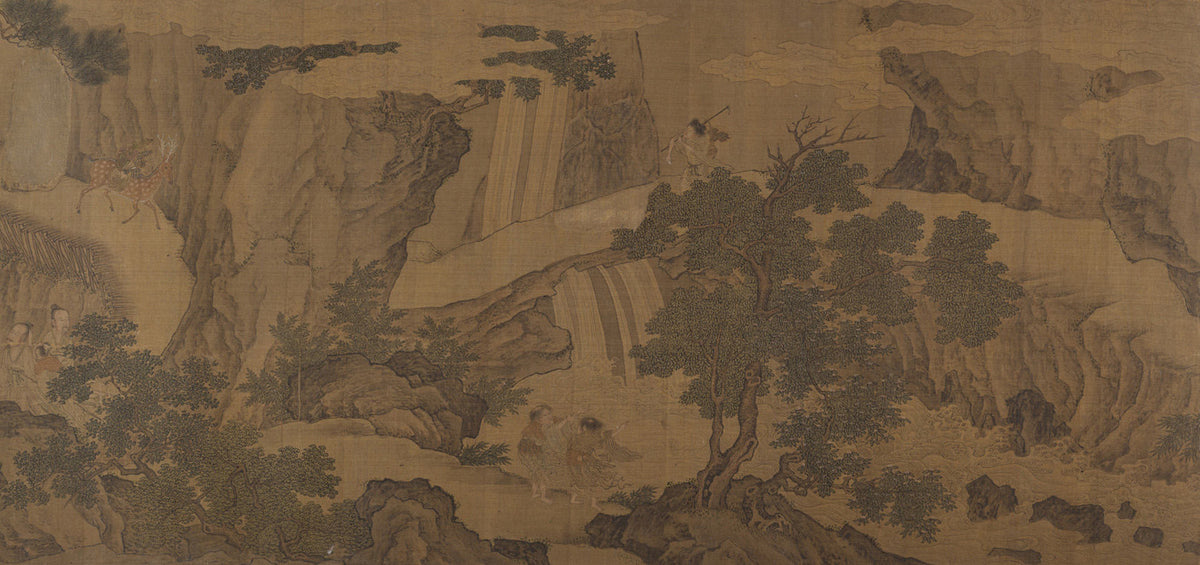
The cover is a detail from Daoist Immortals in a Landscape, a Ming dynasty handscroll in The Metropolitan Museum of Art (1983.357). The other collection images are identified in their captions. Eight supplied images also appear in the article, five with digitally retouched corners.
Encyclopedia outlines and Daoist classics
- Baidu Baike. Daoism (道教).
- Baidu Baike. History of Daoism (道教历史).
- Baidu Baike. Daoist Priests’ Ritual Implements (道士法器). Entry 13871322, sections 道教 and 道教法器. Used to identify the implements discussed, with ritual contexts cross-checked against academic and museum sources.
- Fabrizio Pregadio. Religious Daoism. Stanford Encyclopedia of Philosophy.
- Alan Chan. Laozi. Stanford Encyclopedia of Philosophy.
- Zhuangzi. Chinese Text Project.
- Kristofer Schipper and Franciscus Verellen, editors. The Taoist Canon. A Historical Companion to the Daozang. University of Chicago Press.
- Joseph A. Adler. Zhou Dunyi (Chou Tun-i). Kenyon College.
- Merriam-Webster. Taoism. Merriam-Webster Dictionary.
Celestial Masters, dynasties and the imperial court
- Chen Shou, with commentary by Pei Songzhi. Records of the Three Kingdoms. Biography of Zhang Lu.
- Fan Ye. Book of the Later Han. Biographies of Huangfu Song and others.
- Terry F. Kleeman. Celestial Masters. History and Ritual in Early Daoist Communities. Harvard University Asia Center.
- Geoffrey C. Goble. The Commissioner of Merit and Virtue: Buddhism and the Tang Central Government. Brill, Buddhist Statecraft in East Asia.
- Friederike Assandri. Conceptualizing the Interaction of Buddhism and Daoism in the Tang Dynasty. Religions.
- Maggie C. K. Wan. Building an Immortal Land. The Ming Jiajing Emperor's West Park. Asia Major.
- Bony Schachter. Daoism and Ming Rulership. On the Authenticity of Jiajing's Preface to the Scripture of the Three Offices. Bulletin of the School of Oriental and African Studies.
- Jinping Wang. Reburials of Eminent Masters. The Construction of Quanzhen Daoist Lineages in North China under Mongol Rule. Journal of Chinese History.
- Vincent Goossaert and David A. Palmer. The Religious Question in Modern China. University of Chicago Press.
- Richard G. Wang. Lineages Embedded in Temple Networks. Daoism and Local Society in Ming China. Harvard University Asia Center.
Famous figures and sacred places
- Michael Robert Broschat. Guiguzi: A Textual Study and Translation. University of Washington.
- Stephen R. Bokenkamp. A Fourth-Century Daoist Family: The Declarations of the Perfected, Volume 1. University of California Press.
- Sun Simiao. Sunzhenren bei ji qian jin yao fang. Library of Congress.
- Lü Dongbin and the Yellow Millet Dream. Art Institute of Chicago, Taoism and the Arts of China.
- Li Zhichang. Record of the Perfected Master Changchun’s Journey to the West. Chinese Text Project.
- History of the Ming, Biographies 187. Chinese Text Project.
- Taijiquan. UNESCO Intangible Cultural Heritage.
- UNESCO World Heritage Centre. Ancient Building Complex in the Wudang Mountains.
- Mount Qingcheng and the Dujiangyan Irrigation System. UNESCO World Heritage Centre.
Taoist festivals and temple calendars
- The Palace Museum. Shangyuan and Yanjiu Court Performance (上元, 燕九承应).
- Taiwan Historica. The Three Great Emperor-Officials and Birthday of the Lord of Heaven. Taiwan Folk Cultural Objects Dictionary.
- Executive Yuan. Traditional Festivals, entries on the Lantern Festival and Zhongyuan.
- Ching Chung Taoist Association of Hong Kong. Religious Activities and Temple Calendar.
- Wudang Mountain Taoist Association. Zhenwu’s Birthday at Mount Wudang.
- Chinese Temples Committee, Hong Kong. Deity Festival Dates. UNESCO. Mazu Belief and Customs.
- National Heritage Board, Singapore. Tou Mu Kung.
- Taoist Culture Centre. Doumu.
- Zhang Junfang. Yunji Qiqian, juan 37, “On Diverse Fasting Rites.” Taoist Culture Centre. Five La Days.
Protective talismans, command tablets and the Nine Characters
- Baidu Baike. Daoist Protective Talismans (驱邪道家符).
- Mark Meulenbeld. Vernacular “Fiction” and Celestial Script. A Daoist Manual for the Use of Water Margin. Religions 10 (2019), 518.
- National Museum of History. Shan Gui Thunder Command Charm Coin. Collection object 05807.
- National Taiwan Museum. Five Thunders Command Tablet. Collection object AH000413-011.
- Ge Hong. Baopuzi, Inner Chapters, chapter 17, “Dengshe.” Ming Daoist Canon edition.
- Tanluan. Commentary on the Treatise on Rebirth, lower fascicle. Roger Corless translation, revised by Takusui Patrick Kameyama, Pacific World 17 (2015), p. 162.
- Terajima Ryōan. Wakan Sansai Zue, discussion of the nine-character invocation.
- Hitoshi Miyake. Religious Rituals in Shugendo. A Summary. Japanese Journal of Religious Studies 16 (1989), p. 107.
External alchemy, gunpowder and Baopu Taoist Temple
- Zhenyuan miaodao yaolüe (真元妙道要略), received Daoist Canon edition, DZ 924.
- Joseph Needham. The Guns of Kaifêng-Fu. University of London Press.
- Chung Hin Wong. Revisiting the Transformation of Daoist Alchemy. Studies in Chinese Religions.
- Columbia University, Asia for Educators. Gunpowder, with the date of the Wujing zongyao.
- Hangzhou municipal portal. Baopu Taoist Temple.
Ritual objects, alchemy and Daoist art
- Birgitta Augustin. Daoism and Daoist Art. The Metropolitan Museum of Art.
- Art Institute of Chicago. Taoist Priest’s Robe. Taoism and the Arts of China.
- Shih-shan Susan Huang. Daoist Seals, Part 1. Activation and Fashioning. Journal of Daoist Studies 10 (2017), 70–103.
- Hsieh Tsung-jung. Daoist Ritual Implements and Their Use in Taiwan. Taiwan e-Learning and Digital Archives Program (in Chinese).
- Zehong Zhang and Yang Luo. An Overview of the Weiyi (Dignified Liturgies) of Taoism. Religions 14, no. 6 (2023), 779.
- Yan Liu. Poisons in the Premodern World. ETHOS, Carnegie Mellon University Libraries.
- The Metropolitan Museum of Art. Daoist immortals in a landscape. Collection object 1983.357.
- The Metropolitan Museum of Art. Daoist Immortal, probably Laozi (老子). Collection object 42.25.19.
- The Metropolitan Museum of Art. Daoist divine official. Collection object 1971.163.
- The Metropolitan Museum of Art. Daoist deity Zhenwu. Collection object 2019.446.2.
- The Metropolitan Museum of Art. Daoist priest’s ritual robe with celestial palace. Collection object 30.75.3.
Buddhist exchange and Taoism outside China
- Christine Mollier. Buddhism and Taoism Face to Face. Scripture, Ritual, and Iconographic Exchange in Medieval China. University of Hawai‘i Press.
- Henrik H. Sørensen. On the Presence and Influence of Daoism in the Buddhist Culture of Dunhuang. Brill.
- Koh Keng We et al.. The Nine Emperor Gods Festival in Singapore. Heritage, Culture and Community. Singapore Chinese Cultural Centre, ch. 1.
- Masuo Shin’ichirō. Chinese Religion and the Formation of Onmyōdō. Japanese Journal of Religious Studies 40, no. 1 (2013), 19–43.
- California State Parks. Weaverville Joss House State Historic Park. Public historic site record.
- Ekaterina Zavidovskaia. Daoist Ritual Manuals in Vietnam. Activating Stars and Trigrams. Journal of Daoist Studies 10 (2017).
- Harvard University Pluralism Project. Folk Daoism Comes to the West. Religious literacy essay.
Stories, symbols and everyday objects
Our journal explores Chinese culture and design. Traditions and interpretations vary by region and source. For a purchase, use the specifications on the individual product page.
About Chinese ShowcaseQuestions or corrections? Contact us ↗