The Chinese Showcase journal Chinesische Symbole
Da Afu Meaning in Chinese Culture and the Art of Huishan Clay Figurines
Da Afu is the smiling child of Wuxi’s Huishan clay figurine tradition. Learn why the child holds a blue-green lion, what the pair Da Afu and A Xi represents, and how artisans bring each face to life.
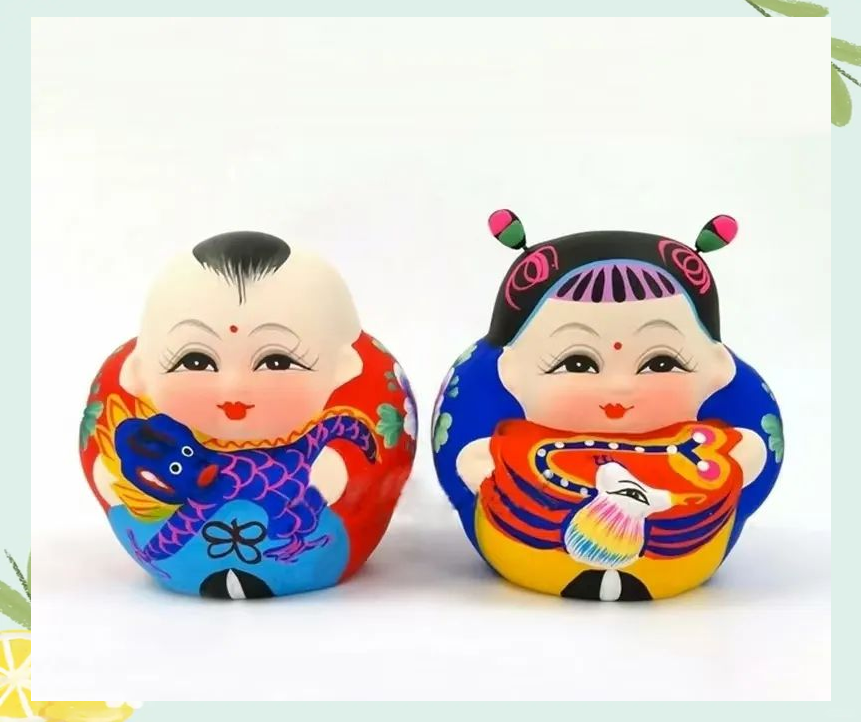
Da Afu is a smiling child figure from the Huishan clay figurine tradition of Wuxi, in China’s Jiangsu province. The child often sits cross-legged with a blue-green lion in its arms. That pairing recalls a local story about a child who tamed wild beasts and expresses a wish for a safe household and good fortune. [1] [2]
A round face catches the eye first. Then there is the animal, twisting in the child’s lap with its mouth open. The child sits calmly enough to make the creature seem manageable. Some modern versions give the child a gold ingot or a different animal to hold. The compact pose and painted smile make these figures easy to recognize.
Da Afu at a Glance
| Place of origin | Huishan, Wuxi, Jiangsu, China |
|---|---|
| Traditional form | A round-faced seated child, often holding a blue-green lion |
| Meaning | Good fortune and protection for the household |
| Common pairing | Da Afu and A Xi, a boy and a girl |
| Intangible cultural heritage | Huishan clay sculpture entered China’s first national list in 2006 |
Where Did Da Afu Come From?
The name Huishan clay figurines comes from the neighborhood in Wuxi where artisans historically made and sold the figures. China’s national intangible cultural heritage register dates the craft’s beginnings to the late Ming dynasty. Dedicated workshops flourished during the Qing, and shops selling clay figurines became a feature of local streets. Da Afu established itself as one of the best-known subjects within that larger tradition. [1]
These figures were small enough to carry home from a market or give to friends. A pair arranged on a chest or shelf brought the same bold colors and rounded forms into an ordinary room. The name helps explain the appeal. Fu means blessing or good fortune. It suits a figure that could serve as a toy, a tabletop ornament, or a gift carrying a wish for the recipient. [2] [6]

Why Does Da Afu Hold a Blue-Green Lion?
In a story recorded by Wuxi’s archives, wild animals once made it dangerous for villagers to go into the hills. A child called Sha Hai’er could stop the beasts with a smile. In remembrance of the child, villagers made a clay figure and put a creature resembling both a lion and a tiger in its arms. The story gives the animal a role that is easy to see in the finished sculpture. Its jaws may still be open, yet it is already held securely. [2]
Another local telling gives the child four adversaries that harm people and livestock and trample crops. He defeats them and dies of his injuries. Villagers remember him by making two clay children, a boy and a girl. The details vary across the tellings. In each, the clay figure makes a local wish for safety visible and gives the villagers a way to remember who helped them. [2] [3]
On some surviving figures, the lion turns sharply to one side while the child looks straight ahead. The turn supplies what little movement there is. A sculptor can tell the whole story with that curve and the placement of two small hands. [4]

What Do the Details on a Qing-Dynasty Da Afu Mean?
A Qing-dynasty example at Wuxi Museum stands about 22 centimeters tall. The seated child wears a peony in its hair, a coat associated with the Five Blessings, a longevity lock at the chest, and boots with red soles. The museum reads the peony as a wish for prosperity, the coat as an invitation to good fortune, and the lock as a hope for a long life. The boots express a wish for success in the imperial examinations. The lion adds the protective meaning drawn from local folklore. [4]
The whole design reads from the outside in. A large head and a rounded seated body make the figure recognizable at a glance. The sleeves, crossed legs and animal fit closely together, giving the sculpture a full, compact outline. The small ornaments then carry the individual wishes. Some versions show the child barefoot, and contemporary examples may dress the pair in different colors or give each figure a distinct auspicious object. [2] [4] [6]

How Are Huishan Clay Figurines Made?
The craft is closely associated with Huishan’s fine, pliable dark clay. Many traditional Da Afu figures belong to the mold-made category known locally as cu huo. Artisans press prepared clay into a mold, remove and refine the shape, and paint it after it has dried. The same regional tradition includes hand-modeled figures called xi huo. The opera figures in this category often preserve details of a stage pose, a sleeve in motion, or the folds of a costume. [1] [5]
The painted expression deserves as much attention as the modeled form. A curve above the eyelid can shift the face from animated to serene. A soft patch of pink at the cheeks and a short brushstroke at the mouth turn a round clay surface into a face. Broad areas of red, green or blue carry the design from a distance. Fine lines at the cuffs and collar give the eye places to stop up close. [1] [6]
Why Are Da Afu and A Xi Often Shown Together?
Da Afu can stand alone or appear alongside A Xi. Wuxi Museum holds a pair modeled by Yu Xianglian and painted by Wang Nanxian. Both children sit in the same compact pose. Both wear decorative flowers and hold blue-green lions. Their shared outline makes the two figures read as a pair, and details of dress and painting give each child a separate expression. The museum describes the pair as a wish for peace and happiness. [7]
The pairs pictured here show how much room that format gives the painter. The figures can face forward and sit at the same height, while the colors, hairstyles and ornaments differ from one to the next. A household might remember the pair for its cheerful faces. A visitor familiar with the old stories might notice the child’s hands, the animal held close, and the calm that follows the encounter.

Frequently Asked Questions About Da Afu
What is Da Afu in Chinese culture?
Da Afu is a seated child figure from the Huishan clay figurine tradition of Wuxi, Jiangsu. It is associated with good fortune, protection and wishes for a peaceful household.
What does Da Afu mean?
The name includes fu, the Chinese word for blessing or good fortune. The figure traditionally expresses wishes for safety and well-being, which also explains its use as a gift.
Why does Da Afu hold a lion?
The blue-green lion recalls local stories about a child who subdued dangerous animals. In a traditional figure, the tamed creature in the child’s arms represents protection.
Who are Da Afu and A Xi?
Da Afu and A Xi are the boy and girl often shown together in Huishan clay sculpture. Their matching seated forms and cheerful expressions are associated with peace and happiness.
What are Huishan clay figurines made from?
Traditional makers use fine local dark clay. A Da Afu figure is commonly shaped in a mold, then refined and painted. Other Huishan works, including opera figures, can be modeled by hand.
Are Huishan clay figurines recognized as intangible cultural heritage?
Yes. Huishan clay sculpture was included in China’s first national intangible cultural heritage list in 2006 as a traditional art from Wuxi, Jiangsu.
Jewelry with Motifs from the Da Afu Story

Fine Silver Enamel Guardian Lion Bracelet
The blue enamel lion echoes the guardian animal held by Da Afu and the wish for protection it represents.
View product details
Hetian Jade Longevity Lock Stud Earrings
The ruyi-shaped jade studs carry the same wish for long life as the lock on the Qing-dynasty Da Afu’s chest.
View product details
Peony Ceramic Hairpin
A pale pink ceramic peony recalls the flower in the Qing figurine’s hair, a traditional wish for prosperity.
View product detailsRelated Reading
References
- China Intangible Cultural Heritage Network, national register entry for Huishan clay sculpture, project VII-47, listed in 2006.
- Wuxi Municipal Archives and Local History Office, “The Legend of Afu,” October 2012.
- Wuxi Municipal Archives and Local History Office, “Afu Fights the Four Monsters,” December 2012.
- Wuxi Museum, article on its Huishan clay sculpture collection and the Qing-dynasty Da Afu, June 2025.
- China Intangible Cultural Heritage Network, essay on clay figurines depicting scenes from Kunqu opera.
- Liu Jiakui, essay on the history, modeling and painting of Huishan clay figurines, Chinese Social Sciences Net, 2022.
- Wuxi Museum, “Yu Xianglian and Wuxi Museum,” museum account of the paired Afu and A Xi figurines, September 2023.
Stories, symbols and everyday objects
Our journal explores Chinese culture and design. Traditions and interpretations vary by region and source. For a purchase, use the specifications on the individual product page.
About Chinese ShowcaseQuestions or corrections? Contact us ↗